

Table of Contents
- Why Do Standard Parcel Bags Fail So Fast in Busy Warehouses?
- What Makes Heavy-Duty Parcel Sorting Bags More Reliable?
- How Does Floor Dragging Damage Ordinary Parcel Delivery Bags?
- Why Is Abrasion Resistance Critical for Parcel Sorting Sacks?
- What Features Help Workers Sort Faster and Smarter?
- How Can Foldable Courier Sorting Totes Save Warehouse Space?
- Why Does OEM Customization Matter for Logistics Operations?
- How Do Bulk Orders Support Growing Delivery Networks?
- Why Are Global Logistics Companies Switching to ACTSORTING?
- How Can the Right Parcel Delivery Bag Lower Total Operating Costs?
Introduction
If you’ve ever walked through a busy parcel hub at 7:30 in the morning, you know the chaos. Bags everywhere. Parcels stacked too high. Workers dragging overloaded sacks across rough concrete like they’re pulling dead weight. It’s fast, loud, messy… and honestly, no one has time to stop because a bag ripped open.
That’s where the real problem starts.
A lot of logistics companies still buy cheap Parcel Delivery Bags thinking they’re saving money. On paper, maybe yes. In reality? Not really. Those bags often fail in weeks, sometimes days, especially in high-friction environments where bags are constantly dragged, kicked, overloaded, or thrown into vans.
And every damaged bag creates friction. Not just physical friction. Operational friction too.
Workers slow down. Parcels get mixed up. Routes get delayed. Replacement costs stack up. Sorting accuracy drops. Customers complain. Managers panic.
This is exactly why heavy-duty Parcel Sorting Sacks have become a standard tool for high-volume warehouses, courier companies, and large e-commerce distribution centers.
At ACTSORTING, we’ve been manufacturing industrial-grade Parcel Delivery Bags since 2013. From our 12,000+ square meter factory in Yangchun, Guangdong, with over 400 workers and full BSCI and ISO9001 certification, we supply durable logistics solutions for customers across Europe and North America.
Our products are built for real-world abuse. Not showroom samples. Real abuse.
From Last-Mile Delivery Totes to Courier Sorting Totes, Van Loading Totes, and DSP Delivery Supplies, our heavy-duty woven bag systems help logistics companies sort faster, carry more, drag harder, and replace less.
And honestly, that’s what matters.
Because in logistics, speed matters. But durability matters even more.
1. Why Do Standard Parcel Bags Fail So Fast in Busy Warehouses?
It’s actually pretty simple.
Most standard parcel bags were never designed for industrial-level logistics in the first place.
They look okay when new. The stitching seems fine. The material feels “strong enough.” But once they enter a live warehouse environment, the weaknesses show almost immediately.
Picture this.
A worker drags a full Parcel Delivery Bag across a rough concrete floor for maybe 15 meters. Then another 20. Then again. Maybe 200 times in a day. Multiply that by five days a week. Then multiply that by 52 weeks.
That’s a brutal amount of abrasion.
Cheap bags start breaking down at the bottom first. The fabric thins. Edges fray. Corners split. Once the bottom weakens, the whole structure loses stability.
Then the handles start taking stress.
Many low-cost Parcel Sorting Sacks use light-duty webbing or weak sewing. Under repeated heavy loads, these stress points stretch, deform, or tear completely. Once that happens, workers either stop using the bag—or worse, keep using it until parcels spill.
That’s expensive.
Not because of the bag itself. But because of what the bag interrupts.
Sorting speed slows. Workers have to stop. Damaged parcels may need rescanning. Delivery routes get delayed. Some bags become unusable mid-shift, forcing manual reloading.
For large fulfillment centers handling 20,000 to 100,000 parcels daily, these “small failures” add up fast.
This is why professional logistics buyers now prioritize Heavy-Duty Parcel Sorting Bags instead of generic transport sacks.
At ACTSORTING, we build bags specifically for this environment. Reinforced bottoms. Abrasion-resistant woven fabrics. Stronger seam density. Load-bearing handles. Foldable but stable construction.
Our Parcel Delivery Bags are designed not for occasional use, but repeated abuse.
That’s the difference.
Not how it looks on Day 1.
How it survives on Day 180.
2. What Makes Heavy-Duty Parcel Sorting Bags More Reliable?
Reliability in logistics isn’t about fancy design.
Nobody in a warehouse cares if a bag looks premium.
They care if it survives.
That’s it.
A heavy-duty Parcel Delivery Bag becomes reliable because every part of its construction is built around operational stress.
Material is the first thing.
ACTSORTING mainly uses industrial-grade PP woven fabrics, laminated woven materials, and optional high-density polyester blends depending on customer requirements. These fabrics offer significantly better tear resistance compared to standard textile bags. More importantly, they perform well under repeated floor friction.
That matters a lot.
A warehouse floor is basically sandpaper over time.
Our material selection is based on this exact problem.
Then comes structure.
A strong bag isn’t just thick fabric. The stitching pattern, reinforcement placement, and load distribution all matter. We use reinforced cross stitching at lifting points, double-layer bottom structures, and edge reinforcement where friction is highest.
This extends product lifespan dramatically.
Some of our customers report using the same Parcel Sorting Sacks for over 12 months in daily high-frequency sorting environments. That’s huge compared to low-grade alternatives that may fail in under 8 weeks.
The closure system also affects reliability.
Loose openings create sorting confusion. Parcels shift. Labels disappear. Items may even fall out during van loading.
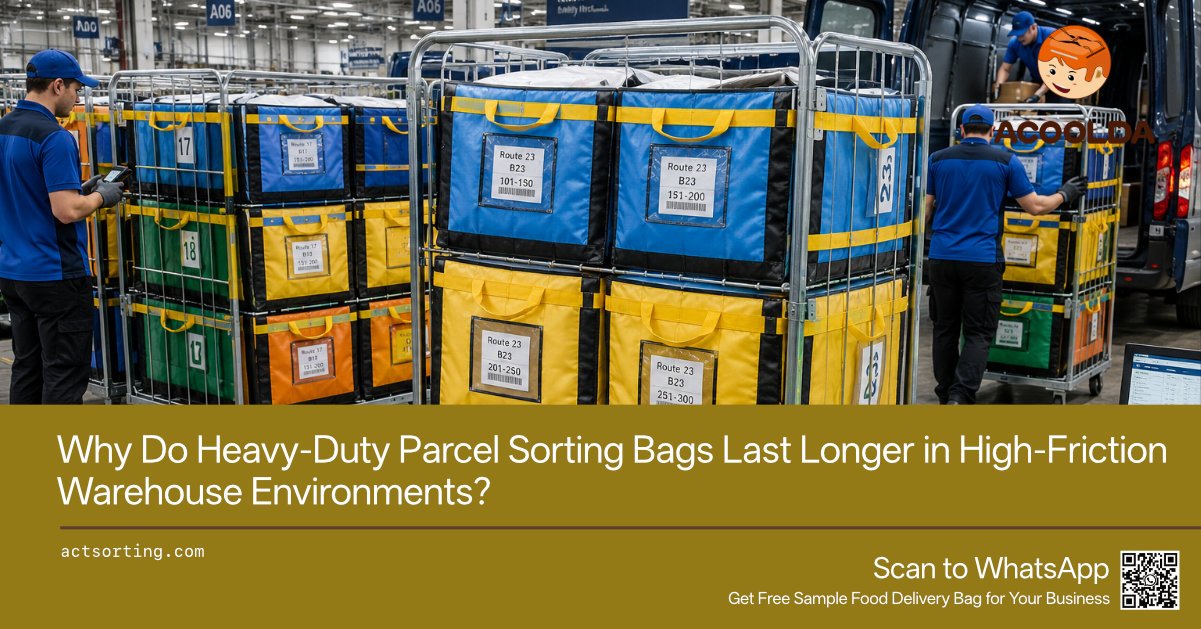
That’s why ACTSORTING offers Velcro closures, zipper systems, open-top designs, adjustable strap closures, and custom flap systems depending on workflow.
Transparent label holders are another practical detail.
It sounds small. But when workers can instantly identify routes, zones, or delivery priorities without opening the bag, sorting becomes much faster.
That’s less time searching.
Less time means lower labor cost.
And that’s the real value.
Reliability isn’t only about product life.
It’s about making everything around the product smoother.
That’s why our Last-Mile Delivery Totes, Courier Sorting Totes, and Van Loading Totes are increasingly used by parcel companies, Amazon DSP teams, and e-commerce warehouses across North America and Europe.
Not because they’re “bags.”
Because they remove friction.
Literally and operationally.
3. How Does Floor Dragging Damage Ordinary Parcel Delivery Bags?
This is probably the most underestimated problem in warehouse logistics.
Dragging.
It sounds harmless, but it destroys ordinary bags faster than almost anything else.
In real warehouses, workers rarely lift fully loaded Parcel Delivery Bags all day. It’s inefficient and physically exhausting. So naturally, they drag them.
Across concrete.
Across metal ramps.
Across loading bays.
Across warehouse corners.
And every surface creates wear.
The bottom layer takes the full punishment.
With standard bags, the friction heat and repeated scraping gradually break down the outer fibers. Once the protective layer is gone, the inner weave becomes exposed. That’s when tearing accelerates fast.
It usually starts small.
A tiny weak spot. A loose thread.
Then suddenly one heavy parcel pushes through.
Game over.
At ACTSORTING, this exact issue pushed us to redesign the bottom structure of our heavy-duty Parcel Sorting Sacks years ago.
We realized that bottom durability wasn’t optional. It was the battlefield.
So we introduced thicker abrasion zones, stronger woven densities, and optional double-layer reinforcement for high-friction customers.
Some customers even request PVC-coated bottoms for extra drag resistance.
That’s common for Amazon DSP routes and urban courier systems where bags constantly move between vans, sidewalks, staircases, and sorting depots.
Another hidden issue with floor dragging is shape collapse.
Ordinary bags lose structure over time. Once the base deforms, stacking becomes unstable. Parcels shift. Sorting gets messy.
Our heavy-duty Courier Sorting Totes are designed to maintain shape even after extended use. This improves stacking, loading, and route organization.
It sounds like a small detail.
But in logistics, small details scale into big costs.
That’s why smart buyers now ask different questions.
Not “How cheap is the bag?”
But:
“How long will it survive our floor?”
4. Why Is Abrasion Resistance Critical for Parcel Sorting Sacks?
Abrasion resistance sounds like one of those technical words buyers skim over in a spec sheet. But in parcel logistics, it’s actually one of the most expensive things to ignore.
A warehouse doesn’t destroy bags in dramatic ways. It wears them down little by little. Every drag, every push, every rough floor contact slowly strips away material strength. That’s the real killer.
And it happens fast.
In high-volume fulfillment centers, a single Parcel Delivery Bag can touch the ground hundreds of times in one shift. Not gently either. Workers are moving fast. They’re under pressure. Parcels need to be sorted, loaded, dispatched. Nobody’s carefully placing bags down like luxury luggage.
They slide them.
Pull them.
Kick them into position.
That repeated abrasion creates weak spots, especially at the bottom corners and edge seams. Once those weak points appear, the bag’s lifespan drops sharply.
For procurement teams, this creates a chain reaction.
More bag replacements. More emergency stock. More downtime. More cost.
And it’s not only the bag.
A damaged Parcel Sorting Sack can cause package spills, sorting mistakes, route confusion, and even customer complaints if parcels are delayed or damaged.
This is why ACTSORTING treats abrasion resistance as one of the first priorities in product development.
We use industrial woven fabrics selected specifically for drag-heavy environments. Depending on customer needs, we can adjust fabric density, coating type, thickness, and reinforcement layers. For warehouses dealing with particularly aggressive floor conditions, we often recommend double-bottom reinforcement or PVC-coated wear zones.
This adds durability where it matters most.
It’s not about making the whole bag heavier. That would slow workers down.
It’s about strengthening the impact zones while keeping the structure practical.
That balance matters.
Our heavy-duty Parcel Delivery Bags are used in high-friction parcel hubs, Amazon DSP systems, courier depots, and cross-border logistics centers where daily abuse is normal. Many customers come to us after trying cheaper alternatives and realizing that frequent replacements cost far more than a better bag upfront.
The math usually becomes obvious pretty quickly.
If one ACTSORTING bag lasts 6–12 times longer than a low-grade alternative, the cost per cycle drops dramatically.
That’s where the real savings are.
Not in the purchase price.
In how long the product stays alive.
5. What Features Help Workers Sort Faster and Smarter?
When buyers first ask about a Parcel Delivery Bag, they usually start with size or material.
Makes sense.
But after enough years in this business, we’ve noticed something: the features that actually improve warehouse efficiency are often the small ones.
Not flashy.
Just practical.
And practical wins.
Take transparent label holders.
A lot of people overlook them. But in a fast-moving warehouse, they’re one of the most useful features on a Parcel Sorting Sack. Workers can instantly see route numbers, delivery zones, customer groups, or dispatch codes without opening the bag.
That saves seconds.
Seconds become hours.
Hours become money.
Color coding is another huge one.
Large logistics operations often separate routes, regions, or delivery priorities using bag colors. Blue for urban. Red for express. Yellow for returns. Green for oversized parcels.
Simple visual systems reduce sorting errors fast.
Especially when temporary workers are brought in during peak seasons.
Closure systems matter too.
Some customers need open-top Parcel Delivery Bags for speed. Others prefer Velcro because drivers repeatedly open and close bags during delivery. Some want zippers for secure transit between hubs.
There’s no universal “best” choice.
The right system depends on the workflow.
That’s why ACTSORTING offers full customization.
Handle positions are another underrated feature.
Badly placed handles slow loading. Workers struggle to lift or drag efficiently. In van loading scenarios, the right strap placement can save serious effort over hundreds of loading cycles.
That’s why our Van Loading Totes and Courier Sorting Totes are often designed around customer vehicle dimensions and loading habits.
Foldability also matters.
Empty bags need to disappear quickly, not waste floor space.
A foldable Parcel Delivery Bag makes warehouse storage cleaner and more efficient, especially for multi-shift operations.
At ACTSORTING, these details aren’t afterthoughts. They’re built into the design process from the beginning.
Since 2013, we’ve worked with logistics companies across Europe and North America, helping them customize practical bag systems based on actual daily use—not guesswork.
That’s the difference between making bags…
and understanding logistics.
6. How Can Foldable Courier Sorting Totes Save Warehouse Space?
Warehouse space is expensive.
Everybody knows that.
But what’s funny is, many companies still waste huge amounts of it on empty containers.
Rigid bins, plastic totes, metal cages—they all work, sure. But when they’re empty, they still take up the same amount of room. That becomes a serious problem in high-volume logistics environments.
Especially during off-peak cycles.
This is where foldable Courier Sorting Totes offer a practical advantage.
It’s not exciting. But it’s very useful.
Once empty, a foldable Parcel Delivery Bag can be collapsed into a flat form and stacked compactly. Instead of dozens of bulky empty containers eating up floor space, hundreds of folded bags can be stored in a fraction of the area.
That changes warehouse flexibility.
Space that was previously blocked by empty bags can now be used for active sorting, temporary storage, or faster route staging.
It also helps during return logistics.
Delivery drivers finishing their routes don’t need to bring back bulky rigid containers. Folded Last-Mile Delivery Totes take up less room in the van, allowing more space for return parcels, failed deliveries, or reverse logistics pickups.
That’s operational efficiency most companies don’t think about until they start measuring vehicle utilization.
And it adds up.
Another advantage is mobility.
Foldable Parcel Sorting Sacks are easier to redistribute between facilities during seasonal peaks. For example, during Black Friday or Christmas, one warehouse may need extra sorting capacity while another has spare equipment.
Foldable bags are easier and cheaper to move.
This makes temporary scaling much easier.
At ACTSORTING, our foldable systems are designed to balance flexibility and strength. The bag must fold easily, yes—but it still needs to survive rough warehouse conditions.
That’s where engineering matters.
We reinforce key stress points while maintaining lightweight construction. Customers can choose Velcro, zipper, or open-top systems depending on how quickly the bag needs to collapse and reopen.
Custom dimensions are also available to fit specific shelving systems, van layouts, or conveyor setups.
For large logistics companies, these operational details can improve not just storage efficiency—but overall workflow speed.
And that’s the point.
A better bag shouldn’t only carry parcels.
It should make the whole system cleaner, faster, and easier to manage.
That’s what ACTSORTING builds every day from our 12,000-square-meter production facility, supported by over 400 skilled workers and backed by BSCI and ISO9001 standards.
Because in logistics, efficiency isn’t always about moving more.
Sometimes it’s about wasting less space.
7. Why Does OEM Customization Matter for Logistics Operations?
A lot of buyers start by asking, “Do you have stock?”
That’s normal.
But after a few rounds of discussion, especially with serious logistics companies, the real question usually changes to:
“Can you make it fit our system?”
That’s where OEM and ODM become important.
Because the truth is, logistics operations are never exactly the same.
An Amazon DSP station doesn’t work like a regional courier depot. A cross-border warehouse doesn’t sort the same way as a domestic e-commerce center. Even two fulfillment hubs from the same company can have different shelving systems, vehicle sizes, route structures, and package volumes.
So why should they all use the same Parcel Delivery Bag?
They shouldn’t.
At ACTSORTING, customization isn’t a side service. It’s one of the core reasons customers work with us.
Some clients need oversized Parcel Sorting Sacks for bulky parcels. Others need narrow Courier Sorting Totes designed specifically to fit van aisle layouts. Some want stronger webbing because their workers drag bags instead of lifting. Others need larger transparent card slots because their sorting labels contain more route data.
These things sound small.
But they affect real efficiency.
Wrong dimensions waste vehicle space. Wrong opening styles slow workers down. Weak reinforcement creates early product failure. Poor handle placement causes awkward lifting.
Over time, those small mismatches create daily inefficiencies.
That’s expensive.
Our OEM capabilities cover nearly every part of the product.
Fabric customization is one of the most common requests. Customers can choose PP woven, laminated woven, polyester blends, coated fabrics, or reinforced abrasion materials depending on how aggressive their warehouse environment is.
Size customization is equally important.
Length, width, height—all can be adjusted based on shelving, van loading, pallet systems, or sorting lanes.
Closure systems can be customized too.
Velcro for speed.
Zipper for security.
Open-top for high-frequency loading.
Flap systems for weather protection.
Even strap placement matters.
Some customers need side handles. Others need top lifting straps. Some want bottom reinforcement loops for easier dragging.
ACTSORTING handles all of it.
And because everything is managed inside our 12,000-square-meter factory with 400+ employees, sample development and mass production remain stable and fast.
That’s the real OEM advantage.
Not just changing colors.
Building products around real operations.
8. How Do Bulk Orders Support Growing Delivery Networks?
Growth sounds good.
Until operations can’t keep up.
That’s where a lot of delivery companies hit problems.
A courier network expands from one city to five. Then ten. Suddenly, the original bag supplier can’t keep up. Lead times stretch. Product quality changes between batches. Different warehouses end up using different bag systems.
That creates operational inconsistency.
And inconsistency is a headache in logistics.
Bulk ordering solves a lot of that—but only if the supplier has the capacity to support it.
At ACTSORTING, large-volume production is one of our strengths.
Since 2013, we’ve focused on B2B logistics bag manufacturing. Our factory in Yangchun, Guangdong operates with more than 400 workers across a 12,000+ square meter production space, equipped for high-output industrial sewing, inspection, and packaging.
That scale matters.
For growing delivery networks, standardization becomes critical.
If one distribution center uses a different Parcel Delivery Bag size than another, sorting systems become harder to align. Drivers need retraining. Storage layouts become inconsistent. Replacement stock becomes more complicated.
Bulk production creates uniformity.
Same size.
Same material.
Same labels.
Same handling experience.
That consistency improves operations across multiple locations.
It also improves purchasing efficiency.
Instead of placing small emergency orders every few months, buyers can secure larger production runs with more stable pricing, faster replenishment, and better planning.
Many of our customers in Europe and North America run recurring bulk orders for Parcel Sorting Sacks, Last-Mile Delivery Totes, and Van Loading Totes as part of their annual procurement cycle.
That gives them stability.
Especially during peak seasons like Q4, holiday sales, Prime Day, or major promotional campaigns.
And let’s be honest—peak season is where weak suppliers get exposed.
A bag shortage during a major delivery spike is a disaster.
That’s why ACTSORTING works with long-term production planning, helping customers forecast usage, reserve capacity, and maintain smoother inventory flow.
It’s not just about making bags.
It’s about supporting logistics growth without interruption.
That’s a different level of manufacturing partnership.
9. Why Are Global Logistics Companies Switching to ACTSORTING?
The logistics world is changing fast.
Parcel volumes are rising every year. Customer expectations are higher than ever. Delivery windows are getting tighter. Warehouse labor costs keep climbing.
And under all that pressure, equipment quality matters more than before.
That’s one reason many logistics companies are moving away from general bag suppliers and choosing specialized manufacturers like ACTSORTING.
Because specialization shows.
Since 2013, ACTSORTING has focused specifically on logistics transport bags—not fashion bags, not promotional bags, not random textile categories.
Just logistics.
That focus allowed us to improve one thing over and over:
how a Parcel Delivery Bag survives real warehouse abuse.
Our customers come from different sectors.
Parcel delivery networks.
Amazon DSP contractors.
Third-party logistics providers.
Postal organizations.
Large e-commerce warehouses.
Retail fulfillment centers.
Cross-border delivery hubs.
What they all have in common is simple.
They need products that work.
Not products that look good in a catalog.
ACTSORTING’s heavy-duty Parcel Sorting Sacks are built around practical warehouse pain points: floor friction, overloading, fast route sorting, vehicle space optimization, repeated opening and closing, rough handling, and constant movement.
That’s why our products continue gaining traction across Europe and North America.
It’s not because we’re the cheapest.
We’re usually not.
It’s because the total cost over time is better.
Longer lifespan.
Fewer replacements.
Less downtime.
Better sorting speed.
More consistent operations.
Our factory strength also matters.
With over 400 skilled workers, a 12,000-square-meter production facility, BSCI and ISO9001 certification, and years of export experience, we’re able to support both stable repeat orders and complex OEM development.
That combination—specialization, capacity, and flexibility—is hard to find.
And global buyers know it.
Especially the experienced ones.
Because after enough failed suppliers, they stop asking who is cheapest.
They start asking who is dependable.
That’s where ACTSORTING keeps winning.
10. How Can the Right Parcel Delivery Bag Lower Total Operating Costs?
A lot of purchasing teams still focus too much on unit price.
It’s understandable.
A cheaper Parcel Delivery Bag looks better in a quotation sheet. Lower upfront cost feels like savings. But once those bags enter real warehouse conditions, the numbers often tell a very different story.
And honestly… that’s where many companies realize they calculated the wrong thing.
Because the real cost of a Parcel Delivery Bag isn’t the purchase price.
It’s the operational cost across its full lifespan.
Let’s break it down.
If a low-grade Parcel Sorting Sack costs 30% less but fails after 6 weeks, while a heavy-duty ACTSORTING bag lasts 8 to 12 months under the same conditions, the math becomes obvious. You’re not saving money—you’re increasing replacement frequency.
That means:
more purchase orders,
more shipping costs,
more stock management,
more downtime,
more worker interruptions.
And there’s another hidden cost.
Labor.
When bags fail, workers slow down. They have to switch bags, re-sort parcels, pick up dropped items, and reorganize routes. In a warehouse processing 30,000 parcels a day, even a few extra seconds per bag can add up into serious labor costs over time.
This is why experienced logistics operators now think differently.
They look at cost-per-cycle.
Not cost-per-piece.
That’s a smarter metric.
A durable Parcel Delivery Bag reduces replacement rates. It maintains shape longer. It protects parcel integrity. It improves sorting speed. It helps workers move faster and more consistently.
That lowers total operating cost.
Not theoretically.
Practically.
ACTSORTING designs every product around this exact principle.
Our heavy-duty Parcel Delivery Bags, Last-Mile Delivery Totes, Parcel Sorting Sacks, Courier Sorting Totes, Van Loading Totes, and DSP Delivery Supplies are engineered for commercial logistics environments where wear, friction, overloading, and repetitive handling are normal.
From reinforced woven fabrics to customized bottom protection, stronger stitching, flexible closure systems, transparent label holders, and foldable space-saving structures, every detail is built to improve workflow while extending product life.
And because we support full OEM and ODM manufacturing, customers can adapt the product to their operation instead of forcing operations to adapt to the product.
That creates even more efficiency.
Since 2013, ACTSORTING has supplied industrial logistics bags to customers across Europe and North America from our 12,000-square-meter factory in Guangdong, China. With over 400 skilled employees, advanced production lines, and internationally recognized BSCI and ISO9001 certifications, we continue supporting parcel companies, e-commerce warehouses, courier fleets, and distribution centers with scalable production and long-term supply stability.
If your team is currently facing high bag replacement rates, sorting inefficiencies, or warehouse friction problems, it may not be a labor issue.
It might simply be a bag issue.
And fixing that can be much easier than most people think.
Contact ACTSORTING today to request samples, discuss custom specifications, or receive a bulk quotation for your next logistics project.
Because in parcel delivery, durable equipment doesn’t just survive longer.
It makes the whole system stronger.
FAQ
Q: What materials are best for heavy-duty Parcel Sorting Bags?
A: For high-friction warehouse environments, PP woven fabric remains one of the most practical choices because of its excellent tear resistance, abrasion performance, and cost efficiency. Depending on the workload, ACTSORTING can also offer laminated woven fabrics, polyester blends, or PVC-coated reinforcement for stronger drag resistance.
Q: Can Parcel Delivery Bags be customized for specific warehouse systems?
A: Yes. ACTSORTING provides full OEM and ODM support including fabric material, bag size, color coding, transparent label holders, closure systems, handle placement, bottom reinforcement, logo printing, and packaging requirements. This helps customers align the bags directly with their workflow.
Q: Are foldable Courier Sorting Totes strong enough for industrial use?
A: Absolutely. Foldable design does not mean weak. Our foldable Courier Sorting Totes are reinforced at critical stress points and built for repeated loading, dragging, and unloading while still saving warehouse space when empty.
Q: What industries commonly use heavy-duty Parcel Delivery Bags?
A: These bags are widely used by parcel delivery companies, Amazon DSP contractors, e-commerce fulfillment centers, courier services, postal networks, 3PL providers, retail distribution hubs, and warehouse sorting facilities handling high daily parcel volumes.
Q: Why choose ACTSORTING as your Parcel Delivery Bag manufacturer?
A: ACTSORTING specializes exclusively in industrial logistics bags. Since 2013, we have focused on solving practical parcel sorting and delivery challenges. With a 12,000+ square meter factory, 400+ workers, BSCI and ISO9001 certifications, and strong OEM & ODM capability, we provide durable, scalable, and reliable logistics bag solutions for global B2B buyers.