

Table of Contents
- Why Do Cross-Docking Operations Lose Time Between Sorting and Dispatch?
- How Can Parcel Delivery Bags Reduce Rehandling Between Logistics Hubs?
- Why Are Parcel Sorting Sacks Useful for Fast Transfer Operations?
- How Do Transparent Label Holders Improve Hub-to-Hub Identification?
- Why Do Courier Sorting Totes Help Reduce Misrouting?
- How Can Foldable Bags Improve Empty-Return Logistics?
- Why Are Van Loading Totes Important for Regional Transfer Fleets?
- How Does OEM & ODM Customization Support Different Hub Networks?
- What Should Procurement Teams Check Before Ordering Transfer Bags?
- How Can ACTSORTING Support Large-Scale Parcel Transfer Programs?
Introduction
In a well-run cross-docking operation, parcels should barely stop moving.
They arrive at one side of the facility, get identified, grouped, transferred, and leave again. There may be no long-term storage at all. The whole system depends on speed, clear route separation, accurate labels, and equipment that can survive repeated handling.
On paper, it sounds beautifully efficient.
In a real warehouse at 5:40 in the morning, things are usually less poetic.
A truck arrives late. One route is overloaded. Workers are dragging full sacks across concrete. Two bags have similar labels. A transfer van is already waiting outside. Someone is trying to find one missing parcel before the entire load can leave. And naturally, this is the exact moment when a weak bag decides to split at the bottom.
For parcel delivery companies, courier networks, e-commerce fulfillment centers, regional sorting hubs, and large distribution systems, these small failures create real operational costs.
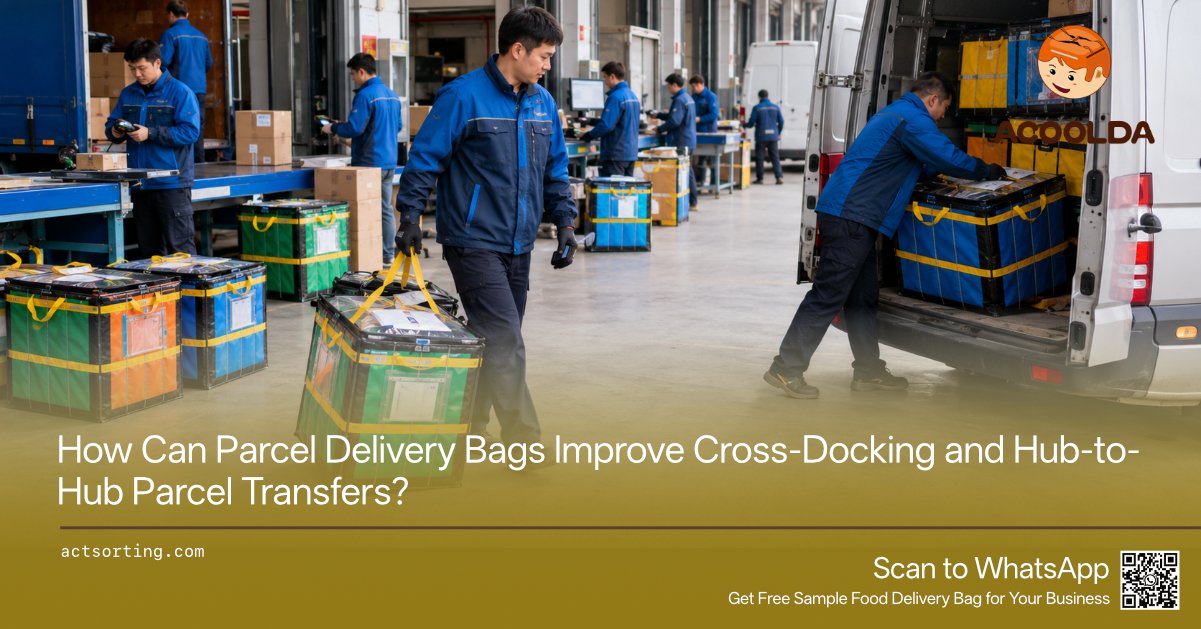
A properly designed Parcel Delivery Bag can reduce unnecessary rehandling, improve route identification, simplify hub-to-hub transfers, and help parcels move from one stage of the network to the next without being repeatedly unloaded and reorganized.
ACTSORTING has specialized in industrial logistics bags since 2013. From a 12,000+ square meter manufacturing facility in Yangchun, Guangdong, China, supported by more than 400 experienced workers, ACTSORTING manufactures Parcel Delivery Bags, Parcel Sorting Sacks, Courier Sorting Totes, Last-Mile Delivery Totes, Van Loading Totes, and DSP Delivery Supplies for business customers across Europe and North America.
With BSCI and ISO9001 certification, ACTSORTING provides comprehensive OEM & ODM services, including fabric customization, size development, color matching, transparent label holders, logo printing, closure systems, handle placement, reinforcement structures, and large-volume manufacturing.
For fast-moving logistics networks, the goal is not simply to carry parcels.
The goal is to move them once, move them clearly, and avoid touching the same parcel five unnecessary times.
1. Why Do Cross-Docking Operations Lose Time Between Sorting and Dispatch?
Cross-docking is supposed to reduce storage time.
A shipment enters the facility, gets sorted, and moves quickly toward the next truck, van, route, or distribution point. In theory, this removes unnecessary warehousing and speeds up the entire supply chain.
The problem is that every transfer creates another chance for confusion.
Parcels may need to be separated by destination hub, delivery region, route, vehicle, customer account, service level, or departure time. If this separation is not physically clear, workers spend more time checking labels, reopening containers, moving parcels between staging zones, and correcting mistakes.
A few seconds do not seem important.
But consider a regional sorting center processing 40,000 parcels in one shift. If workers spend only five unnecessary seconds rechecking or repositioning each parcel, that becomes more than 55 additional labor hours.
That is the annoying thing about logistics inefficiency. It rarely arrives wearing a giant sign saying, “Here is your lost profit.” It hides inside thousands of tiny movements.
A Parcel Delivery Bag helps reduce this rehandling by grouping parcels into controlled transfer units.
Instead of handling each parcel individually between sorting, staging, and vehicle loading, workers can place multiple packages into one clearly identified Parcel Sorting Sack. The entire bag can then move as one unit through the facility.
For example, one bag might be assigned to Hub A, another to Hub B, another to a specific postcode zone, and another to a late-night regional departure.
Transparent label holders allow workers to identify these groups quickly. Customized colors can separate different hub networks or dispatch waves. Reinforced handles make it easier to drag or lift loaded bags. Strong woven materials help withstand repeated contact with warehouse floors, ramps, loading docks, and vehicle interiors.
ACTSORTING designs Parcel Delivery Bags for this real operating environment, where speed matters but durability cannot be sacrificed.
A faster cross-docking operation is not simply about moving workers faster.
It is about reducing how many unnecessary decisions and movements they need to make.
2. How Can Parcel Delivery Bags Reduce Rehandling Between Logistics Hubs?
Every time a parcel is handled, something can go wrong.
It can be misplaced.
It can be scanned into the wrong route.
It can fall from a cart.
It can be loaded into the wrong vehicle.
It can simply disappear into that mysterious warehouse dimension where one missing package somehow survives unnoticed until a customer starts asking questions.
Reducing rehandling is therefore one of the most practical ways to improve logistics efficiency.
A Parcel Delivery Bag allows parcels to remain grouped through multiple stages of transportation. Once packages are sorted into a specific destination group, the bag can move from warehouse lane to staging area, then to truck, regional hub, van, or last-mile delivery station without opening and reorganizing every parcel at each step.
This is particularly valuable for hub-to-hub transfer networks.
Imagine a large e-commerce distribution center sending parcels to ten regional delivery stations. Instead of loading loose parcels individually, workers can prepare separate Parcel Sorting Sacks for each destination. Each sack carries a visible route or hub label and remains closed during transfer.
At the receiving hub, workers already know where the bag belongs.
Less opening.
Less checking.
Less resorting.
Less chance of mixing destinations.
ACTSORTING can customize the structure based on how many transfer cycles the bag is expected to complete. For heavy-duty operations, stronger PP woven fabrics, laminated materials, reinforced corners, double-layer bottoms, or additional webbing can be used.
Customers can also choose between open-top, hook-and-loop, zipper, flap, or strap closure systems.
A fast-loading cross-dock may prefer open-top Parcel Delivery Bags for speed. A hub-to-hub operation involving longer transportation may prefer zipper closures for better containment. A delivery station may choose hook-and-loop systems because workers need repeated access.
The best design depends on the workflow.
That is why ACTSORTING supports OEM & ODM development rather than forcing every customer into one standard product.
The real advantage is simple: once a group of parcels is sorted correctly, the equipment should help keep it that way.
3. Why Are Parcel Sorting Sacks Useful for Fast Transfer Operations?
Parcel Sorting Sacks are especially useful in fast transfer operations because they combine three things logistics teams desperately need: capacity, mobility, and flexibility.
A rigid container can hold parcels, but it takes up the same space when empty.
A metal cage can carry heavy loads, but it may be difficult to move between different types of vehicles.
Loose parcels require constant handling.
A foldable Parcel Sorting Sack provides a different balance.
It can hold a large group of packages, move through the warehouse as one unit, fit inside trucks or vans, and fold down when empty.
For cross-docking operations, this flexibility matters.
One transfer lane may need 30 bags in the morning and 80 bags at night. Another destination may suddenly receive higher volume after a promotion. A regional hub may need temporary capacity because bad weather delayed several previous departures.
Parcel Sorting Sacks can be deployed quickly without changing the physical warehouse infrastructure.
Workers can create new sorting groups simply by adding labeled bags.
ACTSORTING manufactures Parcel Sorting Sacks in custom sizes according to parcel type, expected load, vehicle space, shelving dimensions, and operational workflow.
A fashion e-commerce network handling mostly poly mailers may prefer tall lightweight sacks.
A courier company dealing with mixed cartons may need wider bags with stronger bottom reinforcement.
A regional delivery center may require medium-size Courier Sorting Totes that fit directly into delivery vans.
The material can also be customized according to use intensity.
Heavy-duty woven fabrics provide tear resistance. Laminated surfaces may improve protection against dirt and moisture. Reinforced bottoms support operations where workers regularly drag bags across concrete.
Transparent label pockets help workers identify the destination without opening the sack.
These features work together to create a simple but powerful transfer tool.
A Parcel Sorting Sack does not need Wi-Fi, artificial intelligence, or a monthly software subscription. Miraculously, sometimes a durable bag with the right label still solves a real problem.
4. How Do Transparent Label Holders Improve Hub-to-Hub Identification?
In cross-docking, speed depends on identification.
Workers need to know where a bag came from, where it is going, which route it belongs to, whether it is priority cargo, and sometimes when it must leave.
If that information is unclear, the transfer process slows down immediately.
Transparent label holders solve this in a very direct way.
A clear document pocket can carry route numbers, hub codes, barcode sheets, vehicle assignments, driver IDs, departure waves, destination cards, or handling instructions.
The information remains attached to the Parcel Delivery Bag as it moves through the warehouse and transport network.
This is much more reliable than placing loose paper labels on top of parcels or depending only on memory.
Imagine a night shift handling bags for ten regional hubs.
The workers are tired. The loading area is busy. Several destinations use similar route codes. A visible label pocket allows staff to confirm the correct destination immediately.
ACTSORTING can customize transparent label holders in different sizes and positions.
Some customers need small card windows for basic route numbers.
Others require larger document pockets for A4-style transfer sheets.
Barcode-focused operations may prefer narrow horizontal pockets placed near the top of the bag for easy scanning.
The pocket can be positioned on the front, side, top flap, or multiple surfaces depending on how the bags are stacked and handled.
Color coding can also work together with label holders.
For example, blue Parcel Sorting Sacks might belong to northern regional hubs. Green bags may represent southern routes. Red Courier Sorting Totes may indicate urgent transfers. The label then provides detailed destination information.
This reduces the mental workload on workers.
Color gives the broad category.
The label gives the exact destination.
For large parcel networks, that combination can reduce misrouting and speed up loading.
A transparent pocket is a small feature.
But when thousands of bags move through a facility every day, small features become operational systems.
5. Why Do Courier Sorting Totes Help Reduce Misrouting?
Misrouting is one of the most frustrating logistics errors because the parcel often continues moving efficiently.
Just in the completely wrong direction.
A parcel intended for one regional hub gets loaded into another transfer vehicle. By the time the mistake is discovered, the package may already be hundreds of kilometers away from where it should be.
Now the company has to move it again.
Extra transport.
Extra scanning.
Extra handling.
Extra customer complaints.
All because one item entered the wrong flow.
Courier Sorting Totes help create stronger physical separation between routes.
Instead of relying only on digital scans, parcels are placed into clearly identified containers according to destination, hub, dispatch wave, service type, or vehicle.
Once inside the correct tote, the entire group moves together.
This is especially valuable in busy transfer hubs where several departures may happen within a short period.
A worker can see the color, label, printed route number, or transparent document pocket and immediately understand where the tote belongs.
ACTSORTING can customize Courier Sorting Totes with large printed destination codes, different body colors, reflective markings, transparent pockets, barcoded labels, or numbered identification systems.
The bag dimensions can also be developed around the sorting process.
For example, smaller totes may be assigned to low-volume routes.
Larger Parcel Delivery Bags may serve high-volume regional hubs.
Specific shapes can be designed to fit staging racks, transfer carts, or vehicle shelves.
Closure design also matters.
A secure zipper can reduce the chance of parcels spilling during vehicle movement.
A hook-and-loop flap provides faster access during repeated transfer operations.
An open-top design may work best where speed is more important than full closure.
There is no universal answer.
There is only the right answer for the operation.
That is the logic behind ACTSORTING’s OEM & ODM service.
The tote should support the route system already in place, not force workers to invent awkward workarounds.
6. How Can Foldable Bags Improve Empty-Return Logistics?
Every logistics network eventually has to deal with empties.
A full Parcel Delivery Bag moves parcels forward.
An empty Parcel Delivery Bag still has to go somewhere.
If the container is rigid, the return trip can become surprisingly inefficient. Empty bins occupy vehicle space. Metal cages need collection and redistribution. Plastic containers stack only to a certain extent.
Foldable logistics bags solve this problem.
Once empty, the bags can be collapsed into compact shapes, stacked together, bundled, and returned to the originating hub using far less vehicle space.
This is especially valuable in hub-to-hub networks where transfer bags circulate repeatedly between facilities.
Imagine 500 full bags leaving a national sorting center for regional hubs.
After unloading, those 500 bags eventually need to come back.
If they are rigid, the return transport requires significant capacity.
If they are foldable, hundreds of empty bags can be compressed and returned in a much smaller footprint.
This improves reverse movement efficiency and reduces storage pressure at receiving hubs.
ACTSORTING designs foldable Parcel Sorting Sacks, Courier Sorting Totes, and Last-Mile Delivery Totes that combine flexibility with commercial durability.
The bag can fold when empty but still use reinforced woven materials, strong seams, durable webbing, and optional bottom protection.
Customers can also request bundling straps or specific folded dimensions for easier warehouse storage.
For multi-hub networks, bag identification can remain visible even when empty. Printed hub codes, colors, or permanent logos help facilities return the equipment to the correct owner or region.
Empty-return logistics is not the most exciting part of parcel delivery.
Nobody writes heroic stories about successfully returning 300 empty bags to a distribution center.
But inefficient empty equipment movement wastes truck space, warehouse space, and labor.
Foldable bags help reduce that waste quietly and repeatedly.
Which, frankly, is exactly what good logistics equipment should do.
7. Why Are Van Loading Totes Important for Regional Transfer Fleets?
Regional transfer vehicles operate differently from last-mile vans.
They may carry larger route groups, travel between hubs, serve several distribution points, or complete multiple collection and delivery cycles in one shift.
Without organized loading, a vehicle can quickly become a mixed pile of bags and parcels.
The driver arrives at the next hub, opens the door, and discovers that the correct route group is behind everything else.
Now workers have to unload half the vehicle just to access one destination.
Humanity has invented satellites and quantum computers, yet this kind of thing still happens daily.
Van Loading Totes help maintain vehicle organization.
Each tote can be assigned to a specific hub, stop sequence, route, service type, or customer account.
The totes can then be loaded in planned order.
The first destination stays accessible.
Later destinations are positioned deeper inside.
Returns or exception parcels can have separate bags.
ACTSORTING can customize Van Loading Totes according to vehicle dimensions, interior shelf layouts, door openings, stacking requirements, and expected parcel volume.
A rectangular tote may fit better against van walls.
A lower-profile bag may work under shelving.
A taller Parcel Delivery Bag may be more suitable for bulky mixed parcels.
Handle placement can be developed for how workers actually move the bags.
Side handles help pull totes from shelves.
Top straps support lifting.
Lower loops may help workers move heavily loaded bags together.
Transparent label holders make the destination visible without opening the bag.
Custom colors and printed numbers improve stop sequence recognition.
Reinforced bottom materials help when bags are repeatedly dragged across loading bays.
The vehicle becomes more organized because the equipment supports the route logic.
And when the correct bag is exactly where the driver expects it to be, the whole transfer process becomes faster.
8. How Does OEM & ODM Customization Support Different Hub Networks?
No two logistics networks are exactly alike.
A national courier company may operate large central hubs connected to dozens of regional stations.
An e-commerce platform may use fulfillment centers, sortation centers, delivery stations, and last-mile contractors.
A 3PL provider may handle different customer accounts within the same warehouse.
A postal operator may separate routes by region, service level, and delivery schedule.
One standard Parcel Delivery Bag cannot fit every situation perfectly.
OEM & ODM customization allows the product to match the actual network.
ACTSORTING supports customized fabrics, dimensions, colors, closures, transparent label pockets, handle positions, webbing structures, bottom reinforcement, logo printing, route markings, packaging, and other structural details.
For example, a large hub may need extra-large Parcel Sorting Sacks for high-volume transfer lanes.
A smaller regional station may prefer compact Courier Sorting Totes.
A delivery fleet may require Van Loading Totes designed around specific vehicle shelves.
A multi-country logistics network may need different colors for different regions.
A high-security transfer operation may prefer zipper closures.
A fast cross-docking center may use open-top bags for speed.
Some customers already have complete drawings and technical specifications.
Others only have a problem.
“Our workers are mixing two destination hubs.”
“Our bags tear at the bottom.”
“Our drivers cannot identify route bags quickly.”
“Our empty containers take up too much return space.”
These are the situations where ODM development becomes valuable.
ACTSORTING can work from operational requirements to create a practical sample, adjust dimensions or materials, test the design, and move into mass production after approval.
Customization should not exist merely to make a bag look different.
It should remove a real source of friction.
That is the difference between decorative customization and operational customization.
9. What Should Procurement Teams Check Before Ordering Transfer Bags?
A large transfer bag order may look simple from the purchasing side.
Choose size.
Choose material.
Compare price.
Place order.
Then reality arrives.
The bags are too small for route volume.
The handles sit in the wrong position.
The label pocket is difficult to scan.
The bottom wears out too quickly.
The closure slows workers down.
Or the supplier produces a good sample and an inconsistent mass order, one of manufacturing’s less charming traditions.
Procurement teams should therefore evaluate several things before placing a large order.
First, understand the actual use cycle.
How often will the bags move between hubs?
Will workers drag them across concrete?
What is the average and maximum load?
Will the bags be stacked?
Do they need to fit inside specific vans or cages?
How will empty bags return?
Second, evaluate material and construction.
The fabric should match the expected friction, load, weather exposure, and lifespan.
Stress points such as handles, bottom corners, seams, and closures may require reinforcement.
Third, check identification requirements.
Does the operation need transparent label holders?
Barcode pockets?
Printed hub numbers?
Color-coded routes?
Large destination codes?
These details should be decided before production.
Fourth, verify factory capacity and quality management.
ACTSORTING has operated since 2013, with a 12,000+ square meter production facility and more than 400 workers. BSCI and ISO9001 certification support manufacturing management and quality control.
Finally, evaluate whether the supplier actually understands logistics.
A bag manufacturer may know fabrics and sewing.
A logistics bag manufacturer should also understand cross-docking, route separation, hub transfer, floor dragging, van loading, folding, and repeated circulation.
The difference tends to become painfully clear after 10,000 units arrive.
10. How Can ACTSORTING Support Large-Scale Parcel Transfer Programs?
ACTSORTING manufactures industrial logistics bags for parcel sorting, cross-docking, hub-to-hub transfer, regional distribution, last-mile delivery, van loading, and warehouse operations.
Since 2013, the company has focused on Parcel Delivery Bags, Parcel Sorting Sacks, Courier Sorting Totes, Last-Mile Delivery Totes, Van Loading Totes, and DSP Delivery Supplies for business customers.
The manufacturing facility in Yangchun, Guangdong covers more than 12,000 square meters and employs over 400 workers.
BSCI and ISO9001 certification support responsible manufacturing and consistent quality management.
For cross-docking and hub-transfer projects, ACTSORTING can customize:
Fabric material and weight.
Bag dimensions.
Body colors.
Transparent label holders.
Barcode pockets.
Logo printing.
Hub identification numbers.
Route markings.
Closure systems.
Handle placement.
Bottom reinforcement.
Webbing structure.
Reflective elements.
Folding methods.
Export packaging.
Customers can provide technical drawings, existing samples, photos, target dimensions, expected loading weight, material requirements, or simply describe the operational problem.
ACTSORTING’s OEM & ODM team can then develop a solution around the actual workflow.
The company supports parcel delivery companies, e-commerce platforms, courier networks, 3PL providers, postal operators, regional distribution centers, warehouse groups, Amazon DSP-style operations, and other organizations requiring large-volume logistics bags.
For large-scale programs, consistency matters.
The tenth order should perform like the first.
A hub in Germany should receive the same dimensions as a hub in France.
A replacement batch should fit the same van shelves and route systems as the original batch.
This is where stable manufacturing capacity becomes as important as product design.
If your current operation is struggling with repeated rehandling, unclear hub identification, misrouted bags, high abrasion, inefficient empty returns, or inconsistent equipment across multiple facilities, ACTSORTING can develop a customized Parcel Delivery Bag system around your transfer network.
Send the expected bag dimensions, parcel type, target load, material preference, closure method, label requirements, logo artwork, estimated quantity, and usage scenario to receive a customized proposal.
Because in a fast logistics network, the best parcel is the one that keeps moving in the right direction.
And the best bag is the one that helps it do exactly that.
FAQ
Q: Can Parcel Delivery Bags be used for cross-docking operations?
A: Yes. Parcel Delivery Bags are suitable for cross-docking because they allow parcels to be grouped by hub, route, vehicle, departure wave, or service category. This reduces repeated handling and makes transfers between sorting and dispatch areas faster.
Q: Can ACTSORTING customize bags for different logistics hubs?
A: Yes. ACTSORTING supports custom dimensions, colors, hub numbers, route markings, transparent label holders, barcode pockets, closures, handles, reinforcement, fabric materials, and logo printing for multi-hub logistics networks.
Q: Are foldable Parcel Sorting Sacks useful for empty-return logistics?
A: Yes. Foldable Parcel Sorting Sacks can be collapsed after unloading, allowing large quantities of empty bags to be returned using less vehicle and warehouse space than rigid containers.
Q: What closure options are available for hub-to-hub transfer bags?
A: ACTSORTING can provide open-top, zipper, hook-and-loop, flap, strap closure, and other customized structures depending on whether the operation prioritizes speed, containment, security, or repeated access.
Q: Why choose ACTSORTING for large-volume Parcel Delivery Bag orders?
A: ACTSORTING has specialized in logistics bags since 2013 and operates a 12,000+ square meter factory with over 400 workers. With BSCI and ISO9001 certification, OEM & ODM capability, and bulk manufacturing experience, the company supports long-term logistics projects for global business customers.