

Table of Contents
- Why Do Multi-Site Logistics Networks Struggle With Inconsistent Equipment?
- How Can Standardized Parcel Delivery Bags Reduce Daily Confusion?
- Why Do Common Bag Sizes Make Training Easier Across Warehouses?
- How Can Color Coding and Label Holders Improve Route Identification?
- Why Are Courier Sorting Totes Important for New Warehouse Launches?
- How Do Standardized Van Loading Totes Support Delivery Fleets?
- Why Does Foldable Design Matter Across Multiple Distribution Centers?
- How Can OEM & ODM Customization Create a Unified Logistics System?
- What Should Procurement Teams Check Before Standardizing Parcel Bags?
- How Can ACTSORTING Support Large Multi-Warehouse Programs?
Introduction
One warehouse can usually develop its own habits. Experienced workers know where each Parcel Delivery Bag belongs, supervisors recognize routes without checking every label, and drivers understand which tote goes into which vehicle. Informal routines fill the gaps because the same people use the same equipment every day. The real problem begins when a logistics company expands from one warehouse to five, ten, or even dozens of distribution centers. One site uses blue Parcel Delivery Bags, another buys black bags from a local supplier, one warehouse uses small route cards, another tapes A4 sheets directly onto the bag, and different facilities gradually develop different sizes, closures, handles, and identification systems.
This kind of inconsistency may seem harmless at first, but it quickly creates operational friction. Workers transferred between facilities need retraining. Drivers have to relearn van loading methods. Procurement teams manage too many specifications. Replacement bags from one site may not fit the shelves or vehicles at another. New warehouses waste time rebuilding systems that already exist elsewhere. For parcel delivery companies, e-commerce fulfillment networks, courier operators, regional sorting hubs, and large delivery station groups, standardized Parcel Delivery Bags can create a much more predictable working environment across multiple locations.
ACTSORTING has specialized in industrial logistics bags since 2013. From a 12,000+ square meter manufacturing facility in Yangchun, Guangdong, China, supported by more than 400 experienced workers, ACTSORTING produces Parcel Delivery Bags, Parcel Sorting Sacks, Courier Sorting Totes, Last-Mile Delivery Totes, Van Loading Totes, and DSP Delivery Supplies for parcel delivery companies, warehouse operators, e-commerce distribution centers, courier networks, and other large commercial logistics operations across Europe and North America. With BSCI and ISO9001 certification, the company supports complete OEM & ODM customization covering fabrics, dimensions, colors, logo printing, transparent label holders, closure systems, handle positions, webbing structures, reinforced bottoms, folding methods, and large-volume repeat production.
For a company operating one warehouse, customization improves a product. For a company operating twenty warehouses, standardization can improve the entire network.
1. Why Do Multi-Site Logistics Networks Struggle With Inconsistent Equipment?
Inconsistency rarely appears overnight. It usually grows slowly through hundreds of reasonable local decisions. One warehouse buys a slightly different bag because the regular model is temporarily unavailable. Another facility chooses a cheaper alternative. A regional manager requests a new color. A delivery station changes the label size. Six months later, the company may be managing five different bag dimensions, four closure systems, three label pocket positions, and several materials that were never intended to work together.
This often happens because logistics networks grow faster than their equipment standards. New warehouses open, new service regions are added, temporary suppliers are introduced during peak seasons, and local managers solve urgent problems in whatever way is fastest. The result is operational fragmentation. A driver transferred from Warehouse A to Warehouse B may find completely different Van Loading Totes. A worker trained to recognize routes through color coding may arrive at another facility where every Parcel Sorting Sack looks identical. Replacement stock from one depot may not fit another depot’s shelving system, van layout, or staging rack.
Procurement also becomes more complicated. Instead of managing one or two approved Parcel Delivery Bag specifications, purchasing teams may have to maintain a long list of slightly different models. Forecasting becomes harder, minimum order quantities are divided across too many variations, and emergency replenishment becomes less flexible. A warehouse with excess stock cannot easily support another site if the bag sizes, labels, handles, or closures are incompatible.
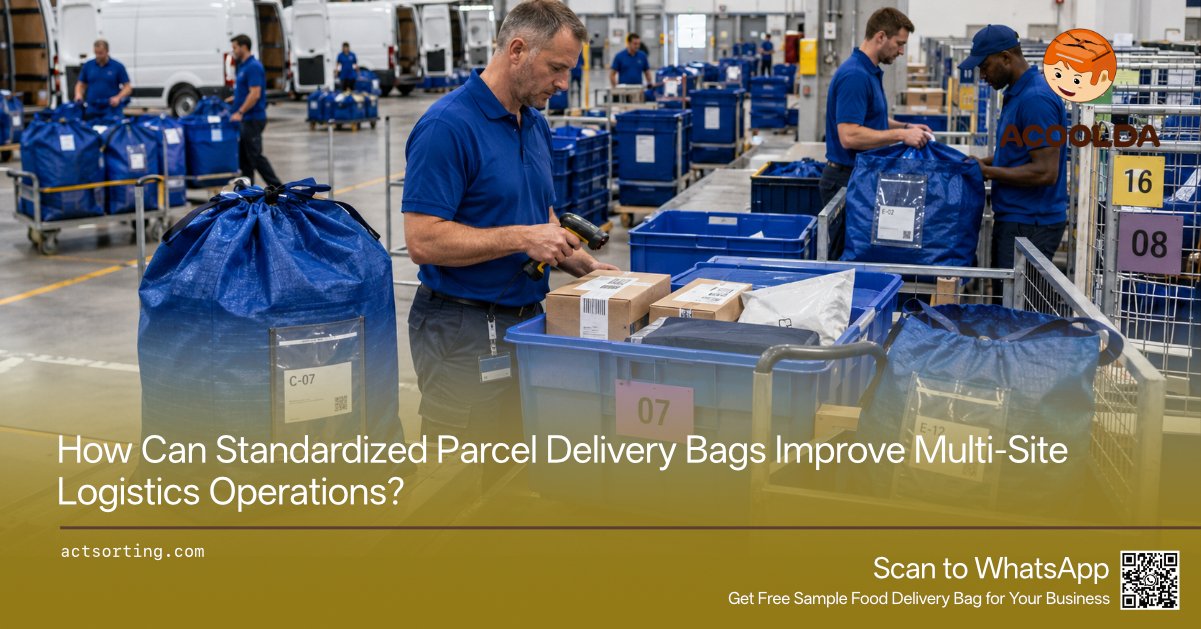
A standardized system reduces this complexity. A logistics company may define three core models: a medium Courier Sorting Tote for city routes, a larger Parcel Sorting Sack for high-volume regional deliveries, and a rectangular Van Loading Tote designed around fleet shelving dimensions. The same transparent label holder can appear in the same position on every bag. The same colors can represent the same parcel status across every facility. Blue always means standard delivery, green always means returns, red always means priority shipments, and gray always means failed deliveries. Workers do not need to guess, supervisors can understand a staging area at a glance, and procurement teams can manage fewer specifications.
ACTSORTING can support this type of standardization through controlled OEM production. Once an approved specification is confirmed, the same material, dimensions, webbing, label pocket, printing, closure method, and reinforcement structure can be reproduced across repeat orders. One bag standard may look like a minor purchasing decision, but across fifty warehouses it becomes part of the operating system.
2. How Can Standardized Parcel Delivery Bags Reduce Daily Confusion?
Warehouse confusion often begins with very small uncertainties. Is this bag for Route 12 or Route 21? Does the red tote contain priority parcels or returns? Can this replacement bag fit the same shelf as the original one? Should this Courier Sorting Tote go into the city van or the regional transfer vehicle? None of these questions should require much thought, yet inconsistent equipment forces workers to make these decisions repeatedly throughout the day.
Standardized Parcel Delivery Bags reduce this uncertainty by making the physical system predictable. The same bag type performs the same function across different facilities. A worker transferred from one warehouse to another immediately recognizes the equipment. A supervisor can look at a staging area and understand route categories through consistent colors and visible labels. A procurement manager knows exactly which replacement model to reorder.
This becomes particularly important during peak seasons, when temporary employees join busy distribution centers and need to learn quickly. A complex bag system with different colors, sizes, label locations, and closures at every site increases training pressure. A standardized system is easier to explain and easier to remember. Blue Parcel Sorting Sacks may represent standard routes, yellow Last-Mile Delivery Totes may indicate same-day delivery, red Courier Sorting Totes may carry priority shipments, and green bags may be reserved for returns. The worker does not need years of warehouse experience to understand a clear visual system.
Transparent label holders add another layer of information. The bag color gives the general category, while the card pocket provides the exact route number, driver ID, vehicle number, departure wave, destination, or barcode sheet. ACTSORTING can customize the size and position of these pockets according to each customer’s route cards, scanning process, and warehouse layout. Some customers prefer small horizontal label holders. Others require large document windows. The position can also be standardized across the entire product range so workers always know where to look.
A few seconds saved per bag may not sound impressive. But imagine a worker handling 300 bags in one shift, then multiply that across hundreds of employees and several warehouses. Consistency scales. Unfortunately, confusion scales too. Standardized Parcel Delivery Bags help make sure the company scales the first one.
3. Why Do Common Bag Sizes Make Training Easier Across Warehouses?
Bag size affects much more than capacity. It influences how many parcels fit inside, how much weight workers can handle comfortably, whether the tote fits inside a van shelf, how bags are arranged in staging lanes, how many empty bags fit on a pallet, and how quickly warehouse teams can move equipment between facilities.
If every warehouse uses different dimensions, the answers to these operational questions change from one location to another. A worker familiar with a large Parcel Sorting Sack at one site may arrive at another warehouse and find smaller totes with different carrying methods. A driver accustomed to loading four bags across a shelf may discover that the replacement model is too wide. Supervisors then create local workarounds, and the system becomes even less consistent.
Common bag sizes simplify this. A logistics company may standardize two or three main Parcel Delivery Bag dimensions for most daily operations. A smaller Courier Sorting Tote can serve low-volume urban routes. A medium Last-Mile Delivery Tote can handle standard residential delivery. A large Parcel Sorting Sack can support higher-volume routes, hub transfers, or bulky mixed parcels. Once these dimensions are approved, workers know what each model is intended for, supervisors can plan staging areas more easily, and fleet managers can calculate how many Van Loading Totes fit into each vehicle type.
New warehouse launches also become easier. Shelving, storage areas, staging lanes, and vehicle loading zones can be designed around the same bag specifications already used elsewhere. Instead of testing several different tote sizes during opening week, the new facility starts with an established system. Training materials can also be reused because the same models, colors, labels, and handling methods are already familiar across the network.
ACTSORTING can develop customized dimensions based on parcel mix, expected load, shelf height, pallet size, vehicle measurements, existing samples, or route volume. The purpose is not to force every operation into one identical bag. A dense urban delivery route clearly does not need the same tote as a large regional transfer hub. The real goal is to eliminate unnecessary variation. Instead of managing fifteen slightly different sizes, a company may only need three carefully designed models.
Common dimensions also improve emergency stock flexibility. If one distribution center faces a sudden parcel surge, spare bags from another site are more likely to be compatible. During Black Friday, Christmas, Prime Day, weather disruptions, or unexpected delivery spikes, this ability to redistribute equipment can be extremely valuable.
4. How Can Color Coding and Label Holders Improve Route Identification?
A large distribution center may have hundreds or thousands of Parcel Delivery Bags in circulation at the same time. Without clear identification, they quickly begin to look alike. One bag sits in the wrong lane, another loses its paper tag, two totes with similar shapes are mistaken for the same route, and suddenly one parcel begins an unnecessary tour of the logistics network.
Color coding provides a simple first layer of identification. Different colors can represent routes, regions, service levels, parcel statuses, warehouse zones, or delivery waves. Blue may indicate standard delivery, red may identify priority parcels, yellow may represent same-day routes, green may be used for returns, gray may separate failed deliveries, and orange may identify special handling. The exact color system depends on the customer, but consistency is essential. If green means returns in London, it should not suddenly mean express delivery in Manchester.
Transparent label holders provide the detailed information that colors cannot. A Parcel Delivery Bag can carry a route number, barcode, warehouse code, vehicle number, driver ID, hub destination, departure wave, or stop range. ACTSORTING can customize these pockets in different sizes, materials, and positions. Some operations need a small card slot. Others need a large transparent window for A4 documents. Barcode-focused warehouses may prefer a pocket near the upper front panel so workers can scan labels without bending or moving the bag.
For multi-site networks, permanent printed warehouse codes can also improve equipment control. A logistics group may use codes such as LON-01 for London Warehouse 1, MAN-02 for Manchester Warehouse 2, or BER-03 for Berlin Warehouse 3. These markings help prevent bags from gradually migrating between facilities and disappearing into another site’s inventory.
When color coding and label holders work together, workers receive information in two steps. The color gives the broad category. The label gives the exact route or destination. This reduces mental workload, speeds identification, and helps temporary staff learn the system faster. In a warehouse processing thousands of parcels every day, simple visual rules can be surprisingly powerful.
5. Why Are Courier Sorting Totes Important for New Warehouse Launches?
Opening a new warehouse already involves enough moving parts. Staff need to be hired and trained. Shelving must be installed. Scanners need to work. Vehicles need routes. Sorting areas must be organized. Safety rules need to be communicated. Meanwhile, parcels are expected to start moving as if the entire operation has existed for years.
Standardized Courier Sorting Totes can make new site launches easier because the facility starts with an equipment system that has already been tested elsewhere. The bag dimensions are approved, colors already have defined meanings, transparent label holders match existing route cards, closures suit the workflow, handles are positioned for the usual loading method, and replacement stock has a clear specification.
A growing courier company may decide to use the same three models across every new facility: a medium Courier Sorting Tote for normal city routes, a large Parcel Sorting Sack for high-volume areas, and a rectangular Van Loading Tote designed around fleet shelving. When the eighth warehouse opens, the team does not need to reinvent the equipment system from scratch. Workers receive the same tools already used at the previous seven locations.
This also helps with staff transfers and training. Experienced supervisors can move between warehouses without adapting to completely different equipment. Workers from established sites can support the launch of new facilities because the same tote system is already familiar. Training materials, route identification rules, storage methods, and handling procedures become easier to reuse.
Regional adjustments may still be necessary. A Scandinavian warehouse may need stronger weather protection. A dense urban delivery station in Paris may prefer smaller Last-Mile Delivery Totes. A suburban operation in the United States may use larger vans and higher-capacity bags. Standardization should allow controlled variation rather than blind uniformity.
ACTSORTING’s OEM & ODM capability supports this model. Customers can establish a core global specification and then develop regional versions where practical differences require them. The result is one recognizable system with carefully managed adaptations, rather than every local warehouse independently inventing its own collection of bags.
6. How Do Standardized Van Loading Totes Support Delivery Fleets?
Delivery vehicles create another strong reason to standardize logistics bags. Fleet managers usually know their internal van dimensions, shelf heights, door widths, aisle space, and average route volume. Problems arise when Parcel Delivery Bags vary too much in size or structure. One model fits perfectly, another is too tall, another collapses inside the shelf, and another has handles placed in a position that makes it awkward to pull out.
Standardized Van Loading Totes create a more predictable vehicle layout. The tote dimensions are designed around the actual van interior, the same models fit the same shelves, drivers know how many bags usually fit per route, and warehouse workers can load vehicles using familiar patterns. Early-route totes can be positioned near the doors, later-route bags can be placed deeper inside, returns can use a dedicated color, and priority shipments can have their own label system.
ACTSORTING can customize Van Loading Totes according to vehicle models, shelf dimensions, aisle width, door openings, expected parcel volume, and loading methods. Rectangular bags may use space more efficiently. Lower-profile bags may fit beneath shelves. Taller Parcel Delivery Bags can support bulky parcels. Side handles can help workers pull totes from shelves, top straps can support lifting, and lower webbing loops can improve two-person handling for heavier loads.
Standardization is especially valuable for drivers who move between depots. A driver familiar with one facility can understand another more quickly if the same bag sizes, labels, colors, and closures are used. The physical logic travels with the employee. Less adaptation means less wasted time and fewer loading mistakes.
One bag may only save a few seconds of searching or handling. Across thousands of delivery routes, those seconds become labor hours. This is why equipment consistency matters far beyond the purchasing department.
7. Why Does Foldable Design Matter Across Multiple Distribution Centers?
Empty equipment still requires storage, counting, transportation, and warehouse space. Rigid containers occupy nearly the same volume whether full or empty. Across one warehouse, this may be manageable. Across twenty or thirty distribution centers, it becomes a significant footprint problem.
Foldable Parcel Delivery Bags provide much more flexibility. When empty, they collapse into compact forms that can be stacked, bundled, palletized, stored, or transferred between facilities. This helps logistics companies manage seasonal demand and temporary capacity changes. If one warehouse experiences a sudden parcel surge while another has extra equipment, foldable Courier Sorting Totes can be moved more efficiently because empty bags consume less transport space than rigid containers.
ACTSORTING can customize folded dimensions, bundling methods, permanent warehouse codes, and packing quantities. Customers may request integrated straps that keep folded bags together, specific pallet configurations, or printed identification that helps facilities track where each batch belongs. This is particularly useful in large networks where equipment moves between hubs and delivery stations.
Foldability also supports new site launches and peak-season planning. A large quantity of Parcel Sorting Sacks can be shipped compactly before opening day, then deployed according to actual route demand. When volume drops, unused bags return to storage without occupying excessive floor space.
Durability remains essential. A foldable design is useless if repeated folding weakens the seams or damages the structure. ACTSORTING uses reinforced stitching, abrasion-resistant woven materials, durable webbing, and optional bottom reinforcement according to expected use cycles. The goal is to combine compact storage with dependable commercial performance.
Good logistics equipment should occupy space when it is doing useful work, not when it is sitting empty in a warehouse corner like an expensive piece of furniture.
8. How Can OEM & ODM Customization Create a Unified Logistics System?
Standardization does not mean choosing a random generic bag and forcing every warehouse to use it. That approach usually creates new problems instead of solving old ones. A proper standardized system should be designed around the actual network, including parcel types, route volumes, vehicles, shelves, handling methods, identification systems, and warehouse layouts.
ACTSORTING supports customization across fabric material, fabric weight, bag dimensions, body colors, transparent label holders, barcode pockets, logo printing, warehouse codes, route markings, closure systems, handle positions, bottom reinforcement, webbing structures, reflective elements, internal dividers, folding methods, and export packaging.
For example, a courier network may decide that every standard Parcel Delivery Bag should use blue PP woven fabric, one large front label holder, two reinforced side handles, a top lifting strap, and a hook-and-loop closure. That model can then be used across twenty warehouses. A second red version may handle returns, while a gray version is reserved for failed delivery parcels. The result is a unified physical system that workers can recognize instantly.
ODM development becomes valuable when the customer does not yet have a final design. A logistics company may simply describe a problem: workers cannot identify route bags quickly, current totes do not fit van shelves, transparent labels are too small, bags tear at the bottom, or replacement stock is incompatible between sites. ACTSORTING can turn these problems into product requirements, develop samples, adjust dimensions or materials, resize label pockets, change handle positions, and refine the structure before mass production.
This is what meaningful customization should do. It should not merely make a bag look different. It should remove a real source of operational friction and create a specification that can be reproduced reliably across the network.
9. What Should Procurement Teams Check Before Standardizing Parcel Bags?
Standardizing Parcel Delivery Bags is a bigger decision than placing one ordinary purchase order. Once a specification is adopted across multiple warehouses, changing it later can be expensive. Procurement teams should therefore evaluate real use conditions carefully before approving a model.
The first step is to understand the actual workflow. What types of parcels are handled? What is the normal and maximum load? Are bags lifted or dragged? Do they need to fit van shelves, carts, cages, or racks? Will they move between hubs? How often are they folded? What information needs to remain visible? These questions should be answered before choosing material, size, closure, handles, or reinforcement.
The second step is to reduce unnecessary variation. A company may discover that fifteen slightly different bag sizes do not serve fifteen genuinely different needs. They may simply have accumulated through years of local purchasing. Consolidating them into two, three, or four well-designed core models can simplify procurement, stock management, training, and redistribution.
The third step is real-world testing. A sample should not spend its entire evaluation period sitting neatly on a conference table. Workers should load it, drag it, lift it, fold it, place it inside vans, scan the label, and use it through multiple handling cycles. Tables are extremely gentle working environments and therefore poor judges of logistics equipment.
The fourth step is supplier capacity and consistency. Multi-site programs may require thousands or tens of thousands of units, followed by repeat orders over several years. ACTSORTING has operated since 2013, with a 12,000+ square meter factory and more than 400 experienced workers. BSCI and ISO9001 certification support responsible manufacturing and quality management.
Finally, procurement teams should consider repeatability. The tenth shipment should match the first in dimensions, fabric, color, label holder position, closure, webbing, and reinforcement. The entire purpose of standardization is consistency. If every production batch changes slightly, the system gradually breaks apart again.
10. How Can ACTSORTING Support Large Multi-Warehouse Programs?
ACTSORTING specializes in industrial logistics bags for parcel sorting, warehouse staging, van loading, regional transfer, last-mile delivery, returns, and courier operations. Since 2013, the company has manufactured Parcel Delivery Bags, Parcel Sorting Sacks, Courier Sorting Totes, Last-Mile Delivery Totes, Van Loading Totes, and DSP Delivery Supplies for commercial customers across Europe and North America.
The manufacturing facility in Yangchun, Guangdong covers more than 12,000 square meters and employs over 400 experienced workers. BSCI and ISO9001 certification support responsible production and consistent quality management. For large multi-site programs, ACTSORTING can help customers develop standardized bag systems around actual operational requirements rather than forcing them to accept a generic product.
Customers may provide existing samples, technical drawings, current specifications, van dimensions, shelf measurements, expected load, parcel types, route structures, color systems, label formats, logo artwork, and estimated annual quantities. The OEM & ODM team can then develop samples, adjust materials and dimensions, refine structural details, and prepare the final specification for mass production.
A large delivery network may decide to standardize four core products: one small Courier Sorting Tote, one medium Last-Mile Delivery Tote, one large Parcel Sorting Sack, and one rectangular Van Loading Tote. Different colors may represent different parcel statuses or services. Permanent warehouse codes can improve equipment tracking. Transparent pockets can follow one common route card format. Reinforcement can be adjusted according to load and floor friction.
ACTSORTING supports parcel delivery companies, e-commerce platforms, fulfillment centers, courier networks, 3PL operators, postal systems, regional distribution groups, Amazon DSP-style delivery operations, and other organizations requiring reliable logistics bags in large quantities.
The value of standardization is straightforward. Workers learn faster, equipment is easier to recognize, replacement stock is easier to manage, new sites launch more smoothly, vehicles use space more consistently, and procurement teams manage fewer specifications. Most importantly, different warehouses stop behaving as if each one independently invented its own version of logistics.
If your company operates multiple warehouses, distribution centers, parcel hubs, or delivery stations and currently struggles with inconsistent bag sizes, colors, labels, closures, or materials, ACTSORTING can develop a unified Parcel Delivery Bag system around your actual network. Provide current specifications, usage scenarios, target quantity, preferred material, dimensions, color requirements, logo design, label format, and key operational problems to receive a customized manufacturing proposal.
Because a growing logistics network does not simply need more bags. It needs bags that follow the same rules.
FAQ
Q: Why should multiple warehouses use standardized Parcel Delivery Bags?
A: Standardized Parcel Delivery Bags help different warehouses use consistent sizes, colors, labels, closures, and handling methods. This can reduce training complexity, simplify replacement stock, improve route recognition, and make new warehouse launches easier.
Q: Can ACTSORTING create different bag models within one standardized system?
A: Yes. A customer may standardize several core models, such as a small Courier Sorting Tote, medium Last-Mile Delivery Tote, large Parcel Sorting Sack, and rectangular Van Loading Tote. Each model can follow the same branding, labeling, color, and identification system.
Q: Can colors and transparent label holders be standardized across different distribution centers?
A: Yes. ACTSORTING can customize body colors, transparent label holders, barcode pockets, route markings, warehouse codes, logo printing, and identification systems so different facilities follow the same visual standards.
Q: Are foldable Parcel Delivery Bags suitable for multi-site logistics networks?
A: Yes. Foldable Parcel Delivery Bags save storage and return transportation space when empty. They are particularly useful for networks that need to move equipment between warehouses, launch new sites, or manage seasonal changes in parcel volume.
Q: Why choose ACTSORTING for a multi-warehouse logistics bag program?
A: ACTSORTING has specialized in logistics bags since 2013 and operates a 12,000+ square meter factory with more than 400 workers. With BSCI and ISO9001 certification, OEM & ODM support, and large-volume manufacturing capability, the company can support standardized repeat production for global logistics networks.