

Table of Contents
- The Real Cost of a Disorganized Delivery Van
- Parcel Delivery Bags Turn Loose Packages Into Route Units
- Better Loading Order Means Less Searching at Every Stop
- Van Loading Totes Use Vehicle Space More Predictably
- Clear Labels Prevent the Wrong Bag From Joining the Wrong Route
- Practical Handles and Openings Keep Drivers Moving
- Durable Materials Survive Repeated Van and Warehouse Handling
- Foldable Totes Make Empty Returns Easier to Manage
- OEM & ODM Customization Connects the Bag to the Delivery Workflow
- ACTSORTING Supports Large Delivery Networks With Stable Bulk Production
Introduction
A delivery van can leave the warehouse completely full and still be poorly loaded. Parcels are stacked wherever space is available, route groups become mixed, small packages disappear behind large cartons, and drivers begin the day with a vehicle that looks organized only while the rear doors remain closed. At the first ten stops, the weakness of the loading plan becomes obvious. Drivers move boxes, check labels repeatedly, open several bags, and sometimes unload part of the van just to reach one package.
This is not only an inconvenience for drivers. It is a recurring operating cost. If a driver spends an extra 20 seconds searching at 80 delivery stops, more than 26 minutes disappear from one route. Multiply that across 50 vehicles and the network loses over 21 labor hours in a single day. The parcels are technically moving, but a surprising amount of paid time is spent looking for them.
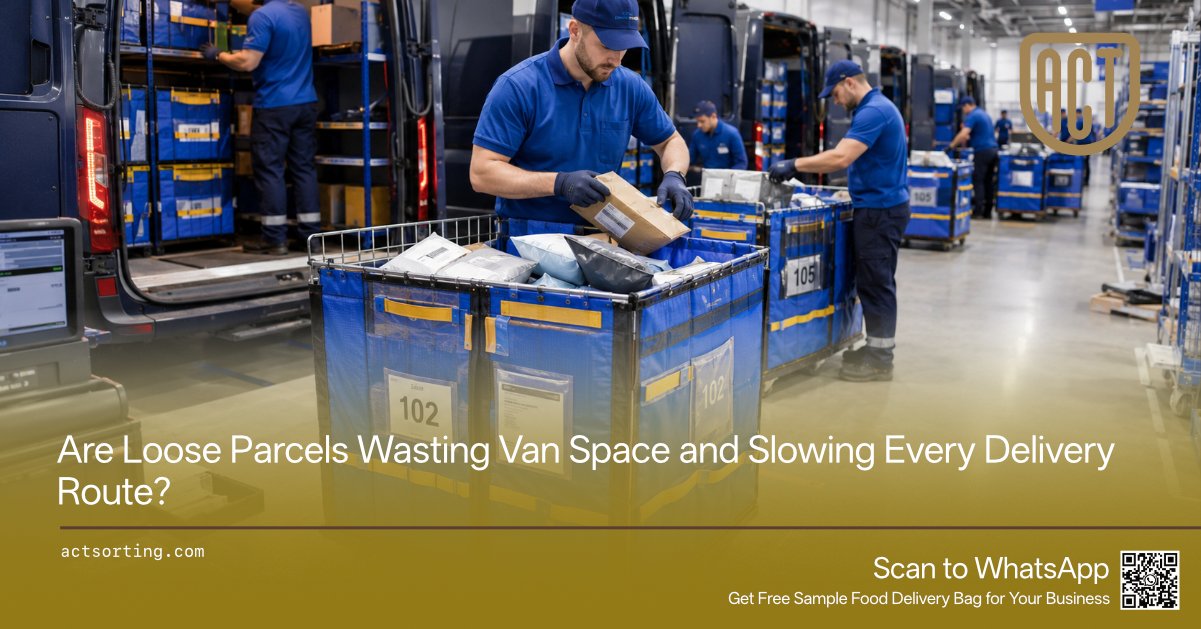
A properly designed Parcel Delivery Bag helps divide loose packages into controlled route units before the van leaves the delivery station. Last-Mile Delivery Totes can group parcels by neighborhood, stop sequence, postcode, building cluster, delivery window, or route section. Van Loading Totes create more predictable vehicle layouts, while Courier Sorting Totes help warehouse workers keep each driver’s packages separate during staging.
ACTSORTING has manufactured industrial logistics bags since 2013. The company operates a production facility covering more than 12,000 square meters in Yangchun, Guangdong, China, with over 400 experienced employees. Its product range includes Parcel Delivery Bags, Last-Mile Delivery Totes, Parcel Sorting Sacks, Courier Sorting Totes, Van Loading Totes, and DSP Delivery Supplies for parcel carriers, e-commerce fulfillment centers, courier fleets, warehouse operators, and Amazon DSP-style delivery stations across Europe and North America.
Supported by BSCI and ISO9001 certification, ACTSORTING provides OEM & ODM manufacturing services covering fabrics, dimensions, colors, transparent label holders, logo printing, closures, webbing positions, handles, reinforced wear zones, folded structures, and large-volume repeat production. The purpose is not simply to place more parcels inside a bag. It is to help workers load faster, help drivers find packages sooner, and help delivery networks use every vehicle more efficiently.
1. The Real Cost of a Disorganized Delivery Van
A poorly organized van creates delays long after loading is finished. The driver may leave the warehouse on time, but the route begins losing minutes as soon as the first parcel cannot be found. Packages shift during driving, loose cartons cover smaller mailers, and route groups that looked separate at the loading dock become mixed after several turns and stops.
The direct loss is searching time. The driver opens the rear or side door, checks several labels, moves one carton, pulls out another, and eventually finds the correct shipment. The process may take less than a minute, which is exactly why companies often underestimate it. Repeated across a full route, however, small delays reduce the number of stops a driver can complete and make the delivery schedule more vulnerable to traffic, access problems, and failed deliveries.
Disorganized loading also increases physical handling. Parcels are moved more times than necessary, which raises the risk of damaged boxes, crushed corners, missing labels, and packages being returned to the wrong position. Drivers may remember the approximate location of a parcel early in the route, but after dozens of stops, the original layout no longer exists.
Last-Mile Delivery Totes create a clearer structure. Instead of treating the entire van as one large storage area, the warehouse divides the route into smaller groups. One Parcel Delivery Bag may hold stops 1 to 15, another may contain deliveries for a specific apartment complex, and another may be assigned to a business district or later route section.
This makes the route easier to understand before the vehicle leaves. Drivers know which tote should be opened first and where later delivery groups are positioned. The bag becomes a movable section of the route plan rather than a basic container.
For parcel companies managing dozens or hundreds of vehicles, better organization can improve departure readiness, reduce searching, and make driver performance more consistent. The warehouse does not need to redesign the van or install expensive equipment. It needs to stop treating loose parcels as if they will politely remain organized by themselves.
2. Parcel Delivery Bags Turn Loose Packages Into Route Units
Loose parcels require individual decisions. Every carton or mailer must be placed somewhere, remembered, located again, and moved separately. A Parcel Delivery Bag combines several packages into one clearly identified unit, reducing the number of handling decisions workers and drivers need to make.
A warehouse may sort each Parcel Delivery Bag by postcode, driver, route wave, neighborhood, vehicle, stop range, or delivery priority. Once the parcels are grouped correctly, the bag can move from the sorting lane to the staging area and then into the van without rebuilding the group at every step.
This is particularly useful for delivery stations processing high parcel volumes within a short morning dispatch window. Workers are preparing several routes at the same time, drivers are checking vehicles, and packages continue arriving from sorting lines. Courier Sorting Totes create physical boundaries between routes, helping prevent one driver’s parcels from entering another driver’s loading lane.
ACTSORTING can customize bag capacity according to the average parcel mix. A delivery station handling small e-commerce mailers may use tall, lightweight Parcel Sorting Sacks. A courier fleet carrying mixed cartons may prefer wider Last-Mile Delivery Totes with stronger bottoms and structured openings. A route containing bulky packages may require a larger Parcel Delivery Bag with reinforced webbing and two-person lifting points.
Transparent label holders can display route numbers, driver IDs, stop ranges, vehicle numbers, or barcode sheets. Colors can provide a second identification system. Blue may represent standard routes, red may indicate urgent deliveries, yellow may identify same-day parcels, and green may be reserved for returns.
This creates a visible operating system that workers can understand quickly. It is especially valuable when temporary employees join during peak seasons, because route separation does not depend entirely on experience or memory.
The practical benefit is fewer mixed parcels and less rehandling. Once a route unit is created, the Parcel Delivery Bag helps keep it intact until the driver needs to open it. The evidence appears in faster staging, cleaner loading lanes, and fewer moments when a supervisor stands beside the wrong pile of parcels wondering which shift invented the problem.
3. Better Loading Order Means Less Searching at Every Stop
Van loading should follow delivery order, but loose parcels make this difficult. A large package may need to be placed first because of its size, even if it belongs to an early stop. Small packages fill gaps and become hidden. Drivers may begin with a logical layout, but the sequence breaks down as the vehicle moves and parcels are removed.
Route-based Van Loading Totes make loading order easier to control. Instead of sequencing every individual parcel, warehouse workers sequence groups of parcels. Totes for early stops can be placed near the side or rear door. Later-route bags can be loaded deeper inside the vehicle. Returns and exception parcels can remain in a separate color or designated position.
For example, a route with 100 stops might be divided into five Last-Mile Delivery Totes, each covering approximately 20 stops. The driver works through the first tote before moving to the next. Even if the parcels inside one route section are not arranged perfectly, the search area is much smaller than the entire van.
This system is also easier to recover when something changes. A failed delivery can return to the active tote or move into a dedicated return bag. A customer pickup can be placed in a separate Courier Sorting Tote. The driver does not need to disturb the remaining route groups.
ACTSORTING can customize printed numbers, label windows, colors, and tote dimensions to support this sequence. Large visible markings such as 1, 2, 3, and 4 can help drivers recognize loading order. Transparent pockets may carry detailed stop ranges or barcode information. Handles can be positioned so workers can remove the correct tote without turning or unloading surrounding bags.
Better sequence control reduces searching time and repeated parcel movement. It also helps the vehicle remain organized later in the route, when the original load has been partially delivered and empty space begins appearing.
A good loading plan should survive beyond the warehouse parking lot. If it collapses after the first speed bump, it was not much of a plan.
4. Van Loading Totes Use Vehicle Space More Predictably
Delivery vehicles have limited space, and every centimeter affects route capacity. Loose parcels rarely use this space consistently. Cartons create irregular gaps, soft mailers slide beneath larger boxes, and packages may shift into aisles or door areas during transportation.
Van Loading Totes create more predictable blocks of cargo. When the bag dimensions match the vehicle interior, warehouse teams can plan how many totes fit on each shelf, along the floor, beside the aisle, or near the loading doors. This turns vehicle loading from daily improvisation into a repeatable arrangement.
ACTSORTING can develop Van Loading Totes according to van measurements, including shelf width, shelf height, door opening, aisle clearance, and usable floor area. Rectangular structures may fit shelves more efficiently than round or irregular bags. Low-profile totes can fit beneath fixed shelving, while taller Parcel Delivery Bags may serve routes with bulky mixed parcels.
Finished dimensions must remain consistent during bulk production. A tote that is only several centimeters wider than the approved sample may reduce the number of bags that fit across a shelf. Across a large fleet, this small variation can remove hundreds of planned storage positions.
The bag structure should also support partial loads. A tote that collapses completely when half full may waste shelf space or make parcels harder to reach. ACTSORTING can adjust fabric stiffness, side construction, opening reinforcement, and folding design so the tote remains practical during different stages of the route.
When empty, the same bag can fold into a compact form, allowing drivers to clear completed route sections and create more usable space inside the van. This is an important advantage over rigid containers, which continue occupying the same volume after the parcels are delivered.
The benefit is not simply fitting more items into one vehicle. Predictable dimensions make loading easier to teach, repeat, and measure. Fleet managers understand expected capacity, warehouse workers follow a stable loading pattern, and drivers know where each route group should be located.
5. Clear Labels Prevent the Wrong Bag From Joining the Wrong Route
A correctly packed Parcel Delivery Bag becomes useless if it enters the wrong van. Route identification must remain visible from sorting to staging, loading, and delivery.
Paper labels taped directly onto woven fabric often peel away during dragging, folding, or wet weather. Small labels are difficult to read in crowded staging areas. Pockets positioned too low become hidden behind other bags, while deep pockets allow route cards to slide out of sight.
ACTSORTING can customize transparent label holders according to the customer’s actual route documents. A small horizontal window may hold a driver card or route number. A larger pocket can carry barcode sheets, hub documents, stop ranges, or A4 delivery information. The opening direction can be selected to prevent cards from falling out during movement.
Position is equally important. A front upper pocket remains visible when bags stand side by side. A side pocket may work better when Van Loading Totes are stacked on shelves. Some operations need label holders on two surfaces so workers can identify the bag from different directions.
Color coding provides faster general recognition. A warehouse may assign different colors to route waves, delivery zones, service levels, or parcel statuses. The color tells workers the broad category, while the label provides the exact route.
Permanent printing can add driver groups, warehouse codes, regional hub numbers, or loading sequence marks. This helps multi-site networks track equipment and maintain a common identification system across different delivery stations.
Clear labels reduce wrong-route loading and shorten the time workers spend checking bags. Drivers can also locate the correct tote faster during delivery. These gains are modest per movement but substantial across thousands of daily handling cycles.
A route label should answer the worker’s question immediately. It should not invite a small archaeological excavation inside a cloudy plastic pocket.
6. Practical Handles and Openings Keep Drivers Moving
A bag may use strong fabric and still be difficult to handle. Workers interact with the opening and handles far more often than they inspect the material specification, so these features must match daily movements.
A narrow opening slows loading because cartons catch against the sides. A completely flexible mouth collapses while workers place parcels inside. Handles positioned too low cause the bag to tilt. Short webbing becomes uncomfortable when workers wear gloves. A side handle hidden against a van wall is almost decorative.
ACTSORTING can customize the opening width, upper-edge structure, handle length, webbing width, attachment position, and reinforcement method. Some Parcel Sorting Sacks need wide open tops for fast warehouse loading. Some Last-Mile Delivery Totes benefit from hook-and-loop flaps that drivers can open repeatedly. Hub-transfer bags may require zippers for better containment.
Side handles help workers pull Van Loading Totes from shelves. Top handles support lifting from the floor. Lower webbing loops can provide extra control when heavily loaded bags need two-person handling. Extended straps can distribute force across a larger section of the body instead of concentrating stress around one seam.
Correct reinforcement is important because handle failure interrupts the operation immediately. Workers must stop, transfer packages, replace the damaged bag, and sometimes rescan the contents. Even before complete failure, loose stitching causes workers to handle the bag more slowly because they no longer trust it.
The advantage of a properly designed handle system is smoother movement through sorting, loading, delivery, and return. Workers use the expected grip without turning the bag or adjusting the load. Drivers remove totes from vehicles more easily and carry smaller route groups to buildings or delivery points.
These features are not glamorous, but logistics equipment is not competing for a fashion award. It is competing against the clock, repeated handling, and workers who understandably prefer products that do not make their jobs harder.
7. Durable Materials Survive Repeated Van and Warehouse Handling
Parcel Delivery Bags move through several high-wear environments. They are dragged across concrete, pushed along metal ramps, loaded against van shelves, folded after routes, stacked in warehouses, and opened repeatedly during delivery.
The bottom panel and lower corners usually show wear first. Weak woven material begins to fray, coatings separate, and small holes become larger under parcel weight. Handle attachment points and opening seams experience repeated tension, particularly when bags are overloaded or pulled from awkward positions.
ACTSORTING can use PP woven fabric, laminated woven materials, coated fabrics, polyester blends, and reinforced wear zones according to the expected workload. Material selection should consider average load, maximum load, floor condition, dragging distance, weather exposure, folding frequency, and desired service life.
Targeted reinforcement often provides better performance than making the entire bag excessively heavy. Double-layer bottom panels, reinforced corners, edge binding, stronger webbing, and extended strap structures protect high-stress areas while maintaining a lightweight and foldable body.
A durable Courier Sorting Tote remains reliable through more handling cycles, reducing replacement frequency and equipment shortages. It also keeps the fleet visually and operationally consistent. When bags fail at different rates, warehouses end up using temporary replacements with different sizes, labels, or closures, gradually breaking the standardized system.
The financial benefit should be measured through cost per use rather than unit price alone. A cheaper Parcel Sorting Sack that fails after several weeks may cost more over a year than a reinforced product that remains in service through many delivery cycles.
Evidence comes from daily operation. Handles remain attached, bottoms resist abrasion, closures continue working, and dimensions remain stable. Workers spend less time moving parcels out of damaged equipment, and procurement teams place fewer emergency replacement orders.
The strongest bag is not necessarily the thickest product in the catalog. It is the one whose material and reinforcement match the actual abuse waiting for it.
8. Foldable Totes Make Empty Returns Easier to Manage
A delivery van does not stay full all day. As parcels are delivered, empty bags begin occupying space that could be used for returns, failed deliveries, pickup parcels, or other route equipment.
Foldable Last-Mile Delivery Totes can collapse after their route section is completed. Drivers stack or bundle the empty bags, clearing shelves and floor space as the day progresses. This makes the van easier to manage and provides more room for reverse logistics.
At the warehouse, folded bags require less storage space than rigid bins or containers. This is valuable for delivery stations that hold large quantities of equipment for peak seasons, temporary routes, or fleet expansion. Hundreds of empty Parcel Delivery Bags can be stored on pallets or shelves in a relatively compact footprint.
Foldability also supports movement between facilities. A multi-site delivery network may transfer spare Courier Sorting Totes from one station to another during regional parcel surges. Folded empty bags use less vehicle capacity, making redistribution more practical.
ACTSORTING can customize the folded structure, material stiffness, integrated straps, folded dimensions, bundling method, pallet quantity, and export packaging. The design must fold efficiently without weakening seams or making the bag unstable during loading.
The benefit is flexible capacity. The network can deploy more bags when parcel volume rises and store them efficiently when demand falls. Vehicles also regain usable space as routes are completed.
Rigid containers have their place, but they behave like stubborn furniture when empty. Foldable Van Loading Totes do the useful thing and get out of the way.
9. OEM & ODM Customization Connects the Bag to the Delivery Workflow
A useful OEM & ODM project begins with the operation, not the logo artwork. Branding matters, but it does not solve poor vehicle fit, hidden route labels, weak bottoms, badly placed handles, or unsuitable closures.
ACTSORTING can develop Parcel Delivery Bags from customer drawings, existing samples, vehicle measurements, shelf dimensions, parcel data, photographs, or descriptions of current operating problems. The project may start with a simple complaint such as “drivers cannot find parcels quickly” or “our current bags do not fit the new vans.”
The design can then address the real cause. A route-search problem may require larger transparent pockets, printed loading sequence numbers, stronger color coding, and tote sizes matched to route sections. A vehicle-capacity problem may require rectangular Van Loading Totes designed around shelf dimensions. A durability problem may require reinforced bottoms, different woven material, and extended webbing.
Customization options include fabric material and weight, dimensions, body colors, logo printing, route markings, transparent label holders, barcode pockets, opening structure, zipper or hook-and-loop closures, handle placement, webbing layout, reinforcement, reflective strips, internal dividers, folded size, and packaging.
Once the sample is developed, it should be tested in the real warehouse and vehicle. Workers should load it, pull it from shelves, drag it, carry it, scan the label, open the closure, fold it, and use it through several route cycles. A meeting-room sample may look flawless because conference tables are not known for rough handling.
The value of OEM & ODM is a product that matches the customer’s workflow instead of forcing drivers and warehouse staff to develop another workaround. For large delivery companies, these improvements can be standardized across multiple stations and repeat orders.
10. ACTSORTING Supports Large Delivery Networks With Stable Bulk Production
ACTSORTING has focused on industrial logistics bags since 2013. Its product range includes Parcel Delivery Bags, Parcel Sorting Sacks, Last-Mile Delivery Totes, Courier Sorting Totes, Van Loading Totes, and DSP Delivery Supplies for parcel carriers, e-commerce fulfillment centers, courier fleets, warehouse groups, 3PL operators, postal services, and Amazon DSP-style delivery operations.
The manufacturing facility in Yangchun, Guangdong covers more than 12,000 square meters and employs over 400 experienced workers. BSCI and ISO9001 certification support responsible production management and consistent quality systems.
For customized projects, customers can provide existing samples, drawings, van dimensions, shelf measurements, parcel types, expected loads, route card formats, logo artwork, target colors, required quantity, and delivery schedules. ACTSORTING can then develop and manufacture a product around the specific delivery workflow.
Bulk production must remain consistent with the approved sample. Finished dimensions, fabric, color, label pocket position, handle layout, closure, reinforcement, printing, folded size, and packaging should follow the confirmed technical specification. This is particularly important for multi-site networks where different warehouses and vehicles must use compatible equipment.
Stable repeat production also matters. A delivery company may reorder the same Van Loading Totes after six months or expand the system into new facilities. The new bags should fit the same shelves, follow the same route identification rules, and perform like the original batch.
ACTSORTING supports OEM & ODM projects ranging from customized route totes to large standardized bag programs for multiple distribution centers. The factory’s production capacity helps serve bulk orders, seasonal demand, new warehouse launches, and ongoing replenishment.
For procurement teams and operations managers dealing with loose parcels, wasted van space, slow package searches, mixed routes, damaged bags, or inconsistent equipment, the next step is not another generic quotation. It is a bag specification built around the actual vehicle and delivery process.
Provide the target size, vehicle measurements, average load, parcel mix, required colors, label format, closure preference, handle positions, logo, and order quantity to receive a customized proposal.
A Parcel Delivery Bag should not merely travel inside the van. It should help the van work better.
FAQ
Q: Can Parcel Delivery Bags be customized for specific vehicle shelves?
A: Yes. ACTSORTING can customize Van Loading Totes according to shelf width, height, aisle space, door opening, route volume, and loading method. Consistent dimensions help fleets use vehicle space more predictably.
Q: Which bag features help drivers find parcels faster?
A: Route-based colors, large transparent label holders, printed sequence numbers, suitable tote dimensions, wide openings, and clear stop-range identification help drivers locate packages without searching through the entire van.
Q: Are foldable Last-Mile Delivery Totes durable enough for daily use?
A: Yes. Foldable totes can use reinforced woven materials, strong webbing, durable seams, and protected bottom panels while still folding compactly when empty. The structure should match the expected load and handling cycle.
Q: Can ACTSORTING maintain consistent specifications for repeat bulk orders?
A: Yes. Approved dimensions, materials, colors, printing, label pockets, closures, handles, reinforcement, and packaging can be used as production references for repeat orders and multi-site delivery programs.
Q: Who are these Parcel Delivery Bags designed for?
A: They are designed for parcel delivery companies, courier fleets, e-commerce fulfillment centers, postal operators, 3PL providers, warehouse networks, retail distribution centers, and Amazon DSP-style delivery stations ordering in commercial quantities.