

Table of Contents
- One Bag Must Serve Two Very Different Laundry Stages
- Long Joining Handles Make One-Hand Courier Carrying More Practical
- A Reinforced Bottom Protects Clean and Folded Laundry
- Material Selection Should Balance Durability, Weight, and Cleaning
- Bag Dimensions Must Match Laundry Volume and Delivery Vehicles
- NFC, QR Code, and Order Labels Improve Laundry Tracking
- Closure and Interior Design Help Separate Dirty and Clean Handling
- A Useful Sample Must Be Tested in a Real Laundry Delivery Cycle
- Bulk Pricing and Lead Time Depend on the Final Bag Structure
- ACTSORTING Develops Custom Laundry Logistics Bags for Daily Operations
Introduction
An on-demand laundry service does not move one simple type of cargo. During the morning pickup, couriers collect soft, uneven bags filled with worn clothes, towels, bedding, and other items from different customers. Later, the same operation must return clean garments that have been washed, dried, pressed, and folded into neat stacks. The transportation equipment must therefore handle two very different conditions without slowing the courier or damaging the finished order.
The buyer needed one reusable bag format that could move through the full operating cycle: home collection, transport to the laundry facility, internal processing, vehicle loading, and final delivery of clean folded clothes. Standard laundry sacks were too flexible for the return journey, while rigid boxes occupied too much storage space and were awkward for couriers to carry.
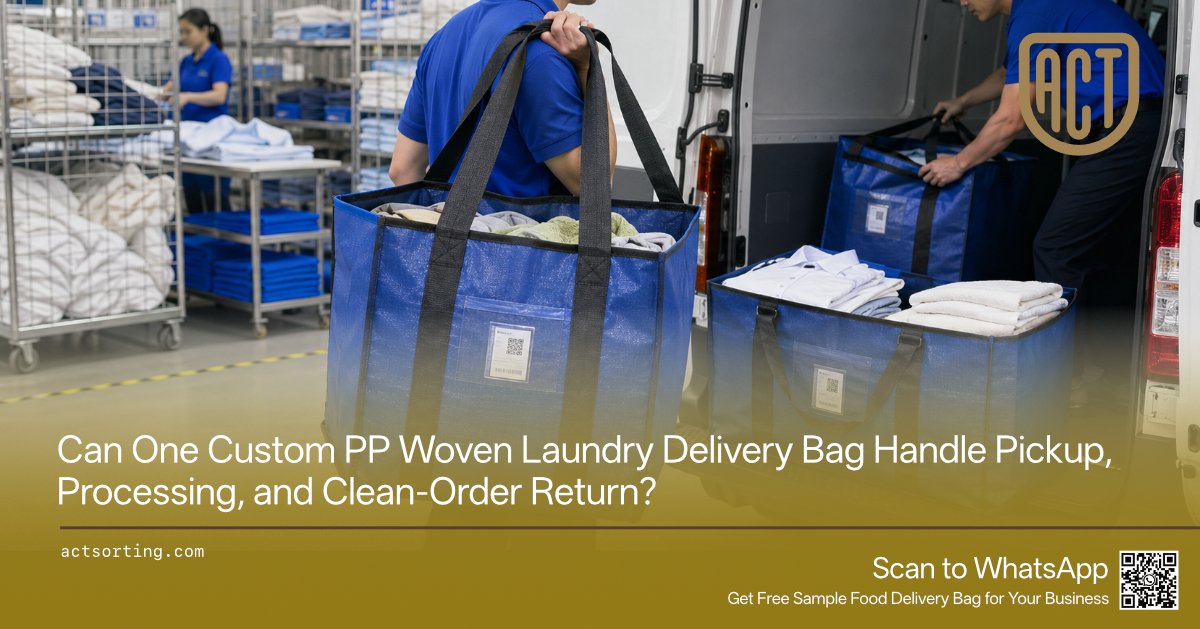
The requested design included long handles from two opposite sides, allowing the courier to join them above the bag and carry it with one hand. A hook-and-loop handle wrap was also considered to keep the straps together and reduce pressure on the hand. The customer also wanted a rigid or reinforced bottom to prevent clean clothing from sliding, bunching, or losing its folded shape during vehicle transport. Custom dimensions, colors, logo printing, and an identification area for an NFC tag, QR code, or order label were also required.
These modifications are technically practical, but they should not be treated as isolated accessories. The handles, bottom panel, body material, identification area, closure, and dimensions must work together as one operating system. A bag with strong handles but a weak bottom will still deform. A rigid base with an excessively tall body may still allow folded garments to collapse sideways. A QR code is not useful if it sits on a folding line or abrasion area.
ACTSORTING has manufactured industrial logistics bags since 2013. The company operates a production facility covering more than 12,000 square meters in Yangchun, Guangdong, China, with over 400 experienced workers. Supported by BSCI and ISO9001 certification, ACTSORTING provides OEM & ODM manufacturing for PP Woven Logistic Sorting Bags, Parcel Delivery Bags, Parcel Sorting Sacks, Courier Sorting Totes, Van Loading Totes, and other reusable transport solutions for commercial operations across Europe and North America.
The objective of this project is not simply to place a laundry logo on an existing bag. It is to design a reusable transport tote that supports the real movements of couriers, laundry workers, vehicles, and customer orders.
1. One Bag Must Serve Two Very Different Laundry Stages
Dirty laundry and clean folded laundry behave very differently during transport. Collected clothing is usually soft, irregular, and relatively forgiving. It can settle into the bottom of a bag without creating an immediate service problem. Clean laundry is different. Once shirts, trousers, towels, and bedding have been folded, the order needs a stable rectangular space. If the bag collapses, tilts, or allows the contents to slide during vehicle movement, the garments may arrive creased or disorganized.
This means a basic soft laundry sack is not enough for the full pickup and delivery cycle. Traditional drawstring sacks work reasonably well for collection because they are lightweight and can adapt to different loads. During clean-order delivery, however, their lack of structure becomes a disadvantage. Folded clothing can shift toward one corner, stack height becomes uneven, and the courier may need to rearrange the order before handing it to the customer.
A customized PP Woven Logistic Sorting Bag can provide a better balance. The woven body remains lightweight and foldable when empty, while a reinforced base creates a stable platform for folded items. A rectangular footprint helps the contents remain in layers rather than collapsing into a narrow bottom. Side panels can still flex when the bag is used for irregular dirty laundry, but the bottom controls the overall shape during clean delivery.
The hygiene process also needs to be considered. If the same physical bag carries both dirty and clean laundry, the operator should establish a cleaning or liner system between stages. One practical option is a removable washable inner liner. Another is to place customer laundry inside separate sealed inner sacks while using the PP woven outer bag only as the transport structure. Color-coded inner liners can also distinguish dirty collection from clean return.
The most suitable design depends on how the laundry facility processes orders. If each customer’s garments remain inside an individual inner bag throughout washing and sorting, the outer tote mainly provides strength and transport organization. If garments are removed and later returned directly to the same outer bag, the interior should be easier to wipe, clean, and inspect.
The application value is clear. One standardized bag format can reduce the number of container types that the operator needs to purchase, store, train staff to use, and distribute among vehicles. At the same time, the structure can support both flexible pickup loads and carefully folded return orders.
2. Long Joining Handles Make One-Hand Courier Carrying More Practical
The requested handle design reflects a very real courier problem. Delivery workers often need one hand free for a phone, scanner, access card, building door, elevator button, or another customer order. Short side handles force the courier to carry the bag with two hands or hold one side awkwardly, especially when the bag has a wide rectangular shape.
A more practical solution uses long webbing handles attached to two opposite sides of the bag. The straps extend above the opening and meet at the center, allowing the courier to grip both handles together with one hand. This changes the carrying position from a two-sided lift into a single central grip, making the bag easier to move from the customer’s door to the vehicle.
The handles should not be attached only near the upper edge. A full laundry load creates repeated tension at the stitching points, particularly when the courier lifts the bag from the floor or pulls it from a van. Extending the webbing farther down the side panels distributes the load across a larger area and reduces stress around the upper seam. Cross-stitching or box-and-cross reinforcement can be added at critical attachment points.
For many commercial laundry delivery bags, webbing in the 25 to 38 mm range can provide a practical starting point, although the final width should be selected according to bag size, maximum load, and user comfort. Wider webbing spreads pressure across the hand but also adds material and stiffness. A sample should therefore be tested with a realistic load instead of being approved only from a drawing.
A hook-and-loop handle wrap is a useful addition. The wrap joins the two handles and creates a thicker, more comfortable grip. It also prevents the straps from separating while the courier walks. The wrap can be permanently attached to one handle so it does not become lost during daily use. A padded version may be considered if the expected load is high or the courier carries the bag over longer distances.
Handle length must also be controlled carefully. If the handles are too short, they will not meet comfortably above a full bag. If they are excessively long, the bag may hang too low and strike the courier’s legs. The correct length depends on bag height, expected fill level, and whether the bag will mainly be carried beside the body or lifted into a vehicle.
This design provides a clear operational benefit. Couriers can use one hand to carry the laundry bag while keeping the other hand available for access, scanning, communication, or additional equipment. The bag also remains more balanced because the load is lifted from both opposite sides rather than one corner.
3. A Reinforced Bottom Protects Clean and Folded Laundry
A reinforced bottom is one of the most important modifications for this application. Without it, a soft PP woven bag follows the shape of its contents. Dirty laundry may tolerate this movement, but folded garments need a stable horizontal platform.
When a vehicle turns, brakes, or drives over uneven roads, clothing stacks can slide across a soft base. The bottom may bend around other items in the vehicle, causing shirts and trousers to bunch against the side panels. By the time the courier reaches the customer, the order may no longer look as neat as it did at the laundry facility.
A rigid insert provides a flat supporting surface. One practical option is a removable HDPE or PP hollow-board panel placed inside a stitched or hook-and-loop sleeve at the bottom of the bag. This structure keeps the bag rectangular during transport while allowing the panel to be removed for cleaning, replacement, or compact storage.
A removable panel is particularly suitable when the same bag handles both dirty and clean laundry. The base can be removed and wiped separately, and damaged inserts can be replaced without discarding the entire bag. The sleeve should cover the board fully so the panel does not catch on garments or inner liners.
A fixed sewn-in panel is another option. It creates a cleaner integrated structure and prevents workers from forgetting to reinstall the insert. However, it may make washing and maintenance more difficult. It can also reduce foldability. The operator therefore needs to decide whether easy cleaning and compact storage are more important than a permanently assembled bottom.
The panel thickness should be chosen according to bag size and expected load. A very thin sheet may bend under stacked wet laundry, while an unnecessarily thick board adds weight and makes the bag harder to fold. Rather than selecting the thickest available insert, the supplier should test a practical panel under the expected load and vehicle conditions.
Side stability may also be needed for clean folded orders. A rigid bottom prevents the base from bending, but very tall soft side panels can still collapse inward. For wider bags carrying several stacks of folded clothes, optional removable side stiffeners, internal corner supports, or a lower-profile body may provide better shape control.
The best evidence is not how the empty sample looks. The sample should be filled with folded shirts, towels, or bedding, placed inside a delivery vehicle, driven through normal routes, and then opened at the final destination. If the clothing remains flat and organized, the structure is doing its job.
4. Material Selection Should Balance Durability, Weight, and Cleaning
Material selection should not be reduced to one question about thickness. A durable laundry logistics bag depends on fabric weight, yarn density, weave structure, lamination, seam construction, edge binding, and reinforcement around the base and handles.
Laminated PP woven fabric is a practical option for repeated pickup and delivery operations. It provides better resistance to tearing and abrasion than light promotional fabrics while remaining lighter than rigid transport containers. The laminated surface is also easier to wipe than untreated woven material, which is useful when bags handle laundry from many households.
For many projects, a laminated PP woven material in a mid-to-high commercial weight range, such as approximately 120 to 180 gsm, may be evaluated during sampling. The correct specification depends on bag dimensions, maximum load, dragging frequency, and required service life. A smaller tote carrying folded garments may not need the same fabric as a large collection bag carrying wet towels or bedding.
The bottom and lower corners require additional attention because workers may drag the bag across floors, loading bays, or vehicle surfaces. A stronger base layer, coated wear panel, or double-layer woven construction can protect these high-friction areas without making the entire bag unnecessarily heavy.
Moisture management is another concern. Dirty laundry may sometimes contain damp towels, sportswear, or cleaning cloths. A fully sealed body can trap odors and moisture, while an overly open structure may not protect clean clothes during return delivery. The final design may use a wipe-clean laminated body with controlled ventilation, removable liners, or separate inner bags depending on the operator’s hygiene process.
Edge binding should also withstand repeated folding and unfolding. Weak binding often begins to fray at the upper opening and corners. Reinforced sewing and suitable thread help the bag maintain its structure after frequent loading and vehicle movement.
The material recommendation should therefore be confirmed through sample testing. The buyer should test realistic laundry weight, one-hand carrying, floor contact, van loading, cleaning, folding, and repeated opening. A fabric that feels strong in a small swatch may behave differently when it becomes a large rectangular bag.
The practical benefit is a longer service life with manageable bag weight. Couriers do not need to carry an unnecessarily heavy container, while the operation avoids replacing torn or deformed bags after only a short period of use.
5. Bag Dimensions Must Match Laundry Volume and Delivery Vehicles
Custom dimensions are necessary because laundry orders do not follow one universal size. A single-person weekly laundry pickup may be relatively compact, while a family order, bedding collection, hotel towel batch, or commercial uniform service may require much more capacity.
The dimensions should begin with actual order data. The operator should review typical laundry volume, maximum load, folded stack dimensions, vehicle shelf measurements, door openings, and how many orders need to fit inside each vehicle. Without this information, a large bag may create more problems than it solves.
For clean folded laundry, a wide and relatively low rectangular bag is often more practical than a narrow, tall sack. A lower center of gravity reduces tipping, while the wider base gives garments more horizontal support. Excessive depth can cause several layers of clothing to press downward and become difficult for the courier to remove neatly.
Dirty laundry pickup may benefit from more vertical capacity because clothing can settle naturally. The challenge is to find a shape that remains flexible for collection but stable enough for return delivery. A reinforced rectangular base with moderately tall side panels can provide this compromise.
Vehicle fit must also be considered. If the bag is too wide, fewer customer orders fit beside each other. If it is too tall, it may not fit beneath shelves or through side doors comfortably. Long handles must also be included in the measurement because they can interfere with stacking or become trapped beneath other bags.
A useful design process begins by measuring the internal vehicle space and building a simple loading plan. For example, the operator may need four bags across the rear floor, two bags per shelf, or a certain number of customer orders per route. The bag dimensions can then be developed around this required arrangement.
ACTSORTING can manufacture custom length, width, height, opening size, handle length, label pocket size, and folded dimensions. Samples should be checked inside the actual vehicle rather than evaluated only in the office.
Correct dimensions create several benefits at once. Clean laundry remains better supported, couriers handle a manageable load, vehicles use space more efficiently, and the operator can standardize route capacity. The bag becomes part of the delivery system instead of an oversized container that workers must constantly rearrange.
6. NFC, QR Code, and Order Labels Improve Laundry Tracking
An on-demand laundry service needs to keep every customer order identifiable through pickup, processing, washing, folding, storage, loading, and final delivery. A reusable bag can become an important physical link in this tracking process.
A transparent label holder provides a simple solution for printed order cards, barcodes, customer references, route numbers, or delivery instructions. The pocket should be positioned near the upper side panel where workers can see and scan it without lifting the bag. It should remain away from the bottom, major folding lines, and handle reinforcement areas.
A QR code can be printed directly onto a durable label, inserted into a transparent pocket, or applied through a replaceable card. A permanent printed code is useful when the code identifies the bag itself. A replaceable order card is more suitable when the same bag serves different customers during every cycle.
NFC tags can be added inside a small protected patch or label compartment. The tag should be positioned where workers can tap it easily but where repeated folding, dragging, or pressure will not damage it. The upper side panel is usually more practical than the base. Because PP woven fabric does not create major radio interference, the tag can generally be integrated without complicated construction, although the final placement should still be tested with the operator’s devices.
For a mixed tracking system, the bag may include both a permanent asset ID and a replaceable customer-order label. The permanent NFC tag identifies the physical bag and its service history, while the removable QR or barcode card identifies the current laundry order.
This distinction is useful for large laundry fleets. Managers can track how many bags are in circulation, which bags are assigned to vehicles, when a bag needs cleaning or replacement, and which customer order is currently associated with it.
Logo printing and color coding can also support identification. Different colors may represent pickup zones, processing stages, service types, or clean and dirty handling. However, the color system should remain simple. Too many colors create another layer of confusion, especially when temporary workers join the operation.
The application value extends beyond tracking. Clear identification reduces mixed customer orders, supports faster scanning, improves route preparation, and gives the operator better control over reusable bag assets.
7. Closure and Interior Design Help Separate Dirty and Clean Handling
The original request focused on handles and the reinforced bottom, but the closure and interior design are also important when one bag format serves both pickup and clean delivery.
An open-top bag offers the fastest loading during collection, but it provides less protection for clean garments. A zipper offers better containment, yet a long zipper may slow frequent loading and become difficult to use when the bag is overfilled. A flap with hook-and-loop fastening can provide a practical middle option, giving quick access while covering the contents during vehicle transport.
The best closure depends on the operator’s process. If every customer’s laundry is already sealed inside an individual inner bag, the outer PP woven tote may only need a simple flap. If clean folded clothing sits directly inside the transport bag, stronger closure and interior protection become more important.
A removable liner can help separate dirty and clean stages. The operator may use one liner color for pickup and another for clean delivery, while the external bag remains the same. Washable liners also simplify hygiene control and protect the PP woven body from direct contact with damp or soiled garments.
Internal dividers may be useful when one customer order contains several categories, such as folded clothing, bedding, and delicate garments. However, permanent partitions can reduce flexibility for bulky pickup loads. Removable dividers or hook-and-loop panels may provide a better balance.
The interior should not contain exposed rough edges, sharp board corners, or loose webbing that could catch on folded clothing. Any rigid bottom insert should sit inside a closed sleeve, and reinforcement seams should remain smooth.
A clean-order bag should also open wide enough for workers to place folded stacks inside without forcing or bending them. The courier should be able to remove the complete order without turning the bag upside down or pulling individual garments through a narrow opening.
These design details protect presentation quality. The customer does not see the warehouse process, material specification, or reinforcement method. The customer sees whether the clean laundry arrives organized and professional. The bag therefore contributes directly to the final service experience.
8. A Useful Sample Must Be Tested in a Real Laundry Delivery Cycle
A custom sample is not merely a visual approval piece. It is a working prototype that should enter the real operation before mass production begins.
The first test should confirm dimensions and capacity. The bag should be filled with a typical dirty laundry order and then with a representative stack of clean folded clothing. Workers should check whether the opening is wide enough, whether the side panels collapse, and whether the reinforced bottom supports the load.
The second test should focus on the handles. A courier should carry the loaded bag with one hand using the joined straps and hook-and-loop wrap. The team should observe whether the bag hangs at a comfortable height, remains balanced, and avoids striking the courier’s legs. The handle wrap should remain secure and comfortable under realistic weight.
The third test should take place inside the vehicle. The bag should be loaded beside other customer orders, moved through normal driving conditions, and removed through the actual vehicle door. Clean folded clothing should then be inspected for sliding, bunching, or wrinkling.
The identification system should also be tested. Workers should scan the QR code, tap the NFC tag, insert and remove order cards, and confirm that labels remain visible from normal handling positions. If the card pocket becomes hidden when bags are placed side by side, the position should be adjusted before mass production.
Cleaning and folding tests are equally important. The removable bottom should come out easily but remain secure during use. The interior or liner should be practical to clean. The empty bag should fold into the expected storage size without damaging the label holder, NFC area, or reinforcement.
A practical test may include repeated loading, carrying, dragging, opening, folding, and vehicle cycles. The exact number depends on the project, but even a structured trial over several working days will reveal more than a sample displayed in a meeting room.
Once testing is complete, every approved change must be added to the final technical specification. Handle length, webbing width, bottom insert, material, dimensions, closure, label pocket, printing, and packaging should all match the confirmed sample.
The evidence of a good sample is not that it photographs well. It is that couriers and laundry workers can use it repeatedly without inventing new workarounds.
9. Bulk Pricing and Lead Time Depend on the Final Bag Structure
Buyers often request the minimum order quantity, sample price, unit cost, production time, and shipping estimate at the beginning of the discussion. These are reasonable questions, but a reliable quotation depends on the final product specification.
A basic PP woven laundry tote with standard fabric and simple printing will have a different cost from a bag with long reinforced handles, padded hook-and-loop wrap, removable rigid base, custom liner, zipper closure, NFC patch, large transparent pocket, and several printing colors.
Order quantity affects material purchasing, printing setup, cutting efficiency, sewing time, inspection, packing, and shipping cost. Larger quantities may reduce the unit cost because fixed setup expenses are spread across more pieces. However, the price should still be based on the approved structure rather than a rough photograph.
Sample cost and sample production time also depend on whether the design uses existing materials or requires custom colors, printing screens, special hardware, liners, or newly developed bottom components. A simple sample can be produced more quickly than a completely new ODM structure.
Mass-production lead time should account for material preparation, color confirmation, printing, cutting, sewing, assembly, inspection, and packaging. Shipping time and cost depend on carton volume, total weight, destination, transport method, and current freight conditions. A foldable PP woven bag has an advantage because it can usually be packed more compactly than rigid boxes, reducing shipping volume.
For an accurate proposal, the buyer should provide target dimensions, expected load, preferred material, closure type, bottom structure, handle requirements, identification method, logo artwork, color reference, quantity range, delivery destination, and required schedule.
ACTSORTING can then prepare different price levels according to order quantity and specification. A sample should be approved before the final mass-production order so both sides are working from the same product standard.
The purpose of this process is not to delay the quotation. It is to prevent an attractive but inaccurate price from becoming a badly designed bag later. In commercial procurement, the cheapest initial number is not useful if the final product fails to support the operation.
10. ACTSORTING Develops Custom Laundry Logistics Bags for Daily Operations
ACTSORTING’s ACD-WL-017 PP Woven Logistic Sorting Bag provides a practical starting structure for on-demand laundry pickup and delivery projects, but the final product can be adjusted according to the operator’s workflow.
For this application, a recommended development direction would include a rectangular laminated PP woven body, extended handles on two opposite sides, reinforced webbing attachment points, a permanently attached hook-and-loop handle wrap, a removable rigid bottom panel inside a washable sleeve, and a visible identification area for QR codes, NFC tags, or replaceable order cards.
The final dimensions should be based on average customer laundry volume and delivery vehicle space. A wider, moderately low structure will generally support folded clothing better than an excessively tall sack. Optional removable liners or internal covers can help manage the transition between dirty pickup and clean delivery.
ACTSORTING supports customization across material weight, dimensions, colors, printing, transparent pockets, NFC areas, handles, closures, bottom reinforcement, liners, internal dividers, folded size, and export packaging. Customers may provide an existing sample, drawing, photographs, vehicle dimensions, expected load, route data, logo artwork, or examples of current bag problems.
The company’s production facility in Yangchun, Guangdong covers more than 12,000 square meters and employs over 400 experienced workers. Since 2013, ACTSORTING has focused on industrial logistics bags for repeated commercial handling. BSCI and ISO9001 certification support responsible manufacturing and quality management.
For laundry operators, the value of a customized bag goes beyond transporting clothes. The correct design helps couriers carry orders more easily, supports cleaner vehicle loading, protects folded garments, improves customer-order identification, and reduces the number of different containers required across the operation.
A generic sack can collect laundry. A properly developed logistics tote can support the complete service cycle from the customer’s door to the laundry facility and back again.
Businesses developing a similar laundry pickup and delivery system can submit the expected bag dimensions, daily order volume, maximum load, vehicle measurements, preferred closure, cleaning method, identification system, logo, color requirements, and planned quantity. ACTSORTING can then develop a sample and manufacturing proposal based on the actual operating process.
FAQ
Q: Can a PP woven bag be used for both dirty laundry pickup and clean laundry delivery?
A: Yes, but the hygiene process should be considered carefully. A removable washable liner, separate inner laundry sack, or cleaning procedure is recommended when the same outer bag serves both stages. A reinforced bottom also helps protect clean folded garments during return delivery.
Q: What handle design is suitable for one-hand courier carrying?
A: Long webbing handles can be attached to two opposite sides and extended far enough to meet above the bag. A permanently attached hook-and-loop handle wrap can join the handles, improve grip comfort, and keep the bag balanced during one-hand carrying.
Q: What type of reinforced bottom is recommended?
A: A removable HDPE or PP hollow-board insert placed inside a closed, wipe-clean sleeve is a practical option. It keeps the base flat, supports folded clothing, and can be removed for cleaning, replacement, or compact storage.
Q: Can NFC tags, QR codes, and order labels be added?
A: Yes. ACTSORTING can add a protected NFC tag area, permanent printed QR code, transparent order-card holder, barcode pocket, or a combined identification system. The preferred location is usually on an upper side panel, away from floor abrasion and folding lines.
Q: What information is needed for a customized quotation?
A: Buyers should provide target dimensions, expected load, preferred material, handle requirements, bottom structure, closure type, identification method, logo artwork, color, order quantity, delivery destination, and required schedule. These details allow the sample cost, unit price, production time, and shipping plan to be calculated accurately.