

Table of Contents
- Laundry Delivery Bags Need to Carry Customer Identity, Not Just Clothes
- One Customer, One Bag Creates a Clearer Pickup Workflow
- Dirty Pickup and Clean Return Should Follow a Visible Bag System
- Large Identification Areas Make Route Sorting Faster
- Joinable Handles Improve Door-to-Door Laundry Collection
- A Rigid Bottom Keeps Laundry Orders Organized Inside Delivery Vehicles
- Color Coding Helps Separate Routes and Commercial Accounts
- Reusable Laundry Bags Need a Complete Return and Storage Cycle
- ACTSORTING Turns Laundry Workflows Into Customized Bag Specifications
- Standardized Bulk Production Supports Growing Laundry Networks
Laundry pickup and delivery looks simple until dozens of almost identical bags arrive at the same facility. One contains a residential customer’s weekly clothing, another belongs to a hotel department, several contain restaurant uniforms, and another has been returned for rewash. The textiles themselves rarely provide useful identification, so once an order enters a bag, that bag effectively becomes the physical identity of the customer order.
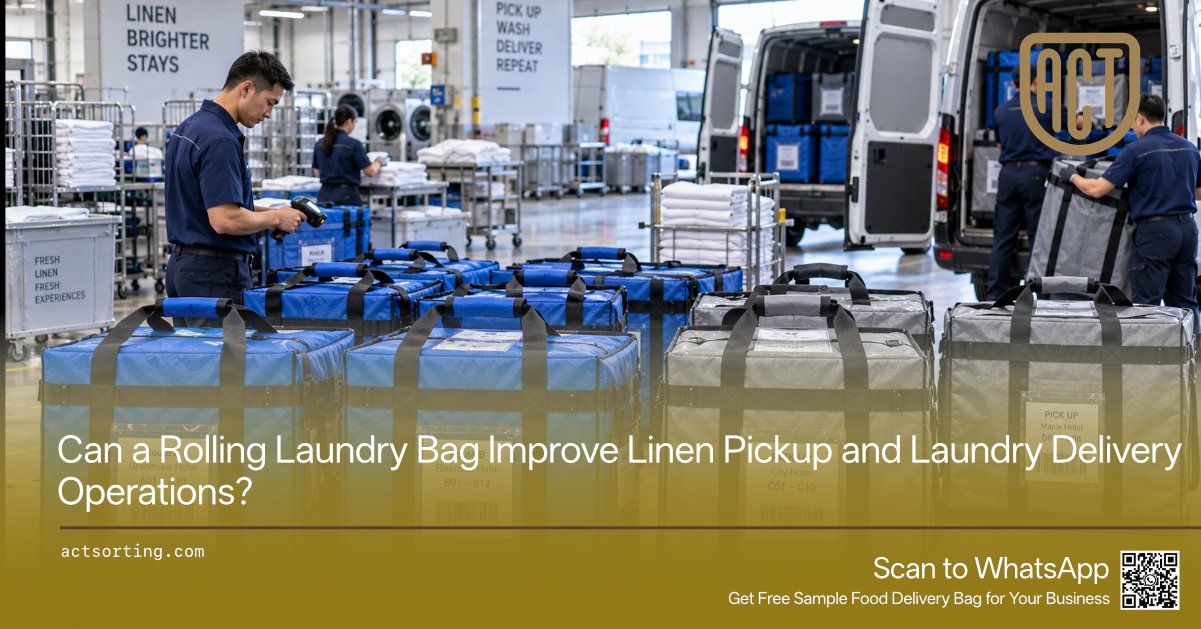
This is why a commercial Laundry Delivery Bag should do more than provide capacity. It should help employees identify the customer, understand whether the contents are dirty or clean, move the order between vehicle and facility, keep several bags organized during transport, and return the reusable equipment to the correct route. For laundromats, wash-and-fold services, hotel linen operators, uniform cleaning companies, apartment laundry services, and commercial laundry providers, these apparently small equipment details can determine whether a busy route remains orderly or turns into an afternoon of checking tags and reopening bags.
ACTSORTING has specialized in commercial logistics bags since 2013 and operates a manufacturing facility of more than 12,000 square meters in Yangchun, Guangdong, China, with more than 400 employees. Supported by BSCI and ISO9001 certification, ACTSORTING provides OEM & ODM manufacturing for Laundry Delivery Bags, Laundry Pickup Bags, reusable sorting bags, and other commercial transport solutions. Custom options can include dimensions, fabric, handles, Velcro handle sleeves, rigid bottom panels, colors, identification pockets, closures, logos, route markings, and packaging. The goal is not simply to make a stronger laundry sack, but to build a reusable bag around the entire pickup-clean-return cycle.
1. Laundry Delivery Bags Need to Carry Customer Identity, Not Just Clothes
Laundry logistics involves more handoffs than the customer usually sees. A residential order may move from the customer’s apartment to a delivery vehicle, receiving area, sorting station, washing process, finishing area, packing table, dispatch area, another vehicle, and finally back to the customer. Commercial linen and uniform routes can involve even more intermediate handling. At every point, employees need to know who owns the textiles and what should happen next.
A generic black laundry sack creates very little visual information. If several similar bags arrive together, workers depend on small tags, handwritten notes, or memory. These methods may survive low-volume days, but they become unreliable as the number of customers and routes grows. A better Laundry Delivery Bag provides a large, consistent identification area that remains visible while the bag is standing, carried, staged, or loaded inside a vehicle.
ACTSORTING can customize transparent document pockets for customer cards, route sheets, barcodes, QR codes, hotel department information, or internal order numbers. Permanent information such as a branch number, account code, or reusable bag ID can also be printed directly onto the bag while temporary customer information changes with every cycle. This creates a simple but important distinction between “which reusable bag is this?” and “which customer order is currently inside it?” The result is faster receiving, clearer sorting, and fewer moments when employees need to open several bags simply to work out what they are looking at.
2. One Customer, One Bag Creates a Clearer Pickup Workflow
For residential wash-and-fold and subscription laundry services, assigning one clearly identified bag to one customer can simplify the physical workflow considerably. The driver arrives, collects the prepared Laundry Pickup Bag, confirms its identification, and places the complete customer order into the vehicle as one unit. The same physical grouping remains intact when the order enters the laundry facility.
Larger customers can use several numbered bags while still preserving the relationship between them. A hotel account, for example, might use bags marked 01/04, 02/04, 03/04, and 04/04. A restaurant group may separate uniforms by branch while retaining one consistent bag format. Instead of receiving anonymous piles of clothing, the facility receives clearly defined customer units that can move through receiving and sorting with less manual interpretation.
Bag size should reflect the actual laundry profile rather than simply maximizing capacity. Household clothing and bedding may suit a tall flexible format, while hotel linen or workwear may require larger dimensions and stronger handles. ACTSORTING can customize these dimensions while maintaining the same label position, handle structure, logo, and identification system across several bag sizes. This creates a standardized family of Laundry Delivery Bags rather than a collection of unrelated sacks purchased whenever the previous supply runs out.
3. Dirty Pickup and Clean Return Should Follow a Visible Bag System
Laundry delivery is unusual because the same route carries textiles in two completely different conditions. Dirty laundry moves toward the facility, while finished laundry moves back toward the customer. If both flows use identical bags without clear status identification, employees need to rely heavily on temporary labels and internal procedures to avoid mistakes.
A visible bag system can reduce that dependence. Different colors, webbing colors, printed wording, or identification cards can distinguish incoming pickup bags from clean-return bags. A residential service might use one color for collected laundry and another for finished orders. A hotel operator might separate housekeeping linen, restaurant textiles, staff uniforms, and guest laundry. The specific color system is less important than consistency: every employee should understand what the visual difference means.
This approach also works well with a bag-exchange model. A driver delivering a clean order can collect another prepared pickup bag from the same customer, keeping reusable equipment circulating through the service. The bag therefore becomes part of a closed-loop system rather than disposable packaging. ACTSORTING can manufacture coordinated pickup and return bags using the same dimensions and branding while differentiating them through colors, printing, pockets, or other visible features. The advantage is not cosmetic variety; it is reducing the amount of operational information that employees need to keep only in their heads.
4. Large Identification Areas Make Route Sorting Faster
A laundry route can contain many customers with very similar bags. Once those bags are loaded into a van, a small tag tied around a handle becomes a fairly poor information system. Labels disappear between neighboring bags, paper tags fold over, and employees end up moving equipment simply to find the customer name.
Large identification pockets solve a much more practical problem than they may appear to. A transparent pocket on the side or front of the Laundry Delivery Bag can hold a route card, customer name, delivery address, service type, barcode, or QR code in a fixed location. Drivers learn where to look, sorting employees can identify the order before touching the bag, and route scanning becomes more predictable.
Pocket position should reflect how the bags are actually transported. If the bags stand side by side inside the vehicle, a side-facing identification area may be more useful than a label on the top. Some operations may benefit from pockets on two surfaces so information remains visible regardless of orientation. ACTSORTING can customize the dimensions and position of these areas around the customer’s existing paperwork rather than forcing the laundry company to redesign labels around a stock bag. It is a small example of why commercial bag design should begin with the workflow rather than the catalog.
5. Joinable Handles Improve Door-to-Door Laundry Collection
Laundry drivers repeatedly carry bags over short distances: from a customer door to an elevator, from an apartment lobby to a vehicle, from the vehicle into the laundry facility, and later through the same sequence in reverse. Handles therefore deserve more attention than simply checking whether the bag has two of them.
Long webbing handles can make a large laundry load easier to carry, but two separate straps often fall to opposite sides of the bag or twist when the bag is placed down. A Velcro handle sleeve can join them into one thicker grip, allowing the driver to pick up the bag with one hand and keeping the handles organized between stops. This is especially useful when the other hand is holding a phone, scanner, keys, or vehicle door.
ACTSORTING can customize handle length, webbing width, attachment position, reinforcement, and the size of the Velcro handle sleeve according to expected load. This matters because laundry may be soft, but it is not necessarily light. Towels, bedding, workwear, and damp textiles can create substantial weight, so the webbing should transfer that load into reinforced sections of the bag rather than concentrating stress at a small stitching point. The result is a Laundry Pickup Bag designed for repeated route handling rather than merely for being carried once across a room.
6. A Rigid Bottom Keeps Laundry Orders Organized Inside Delivery Vehicles
Completely flexible laundry sacks tend to take the shape of whatever is around them. Inside a delivery vehicle, several bags can sag into one another, spread across the floor, obscure their identification areas, and gradually form an impressive but operationally useless pile of textiles.
A rigid or reinforced bottom gives each Laundry Delivery Bag a more predictable footprint. The bag can stand upright during receiving, staging, vehicle loading, and customer handoff while the sidewalls remain flexible enough to accommodate clothing and linen. Clean folded garments stay better organized, and employees can arrange several customer orders in rows rather than allowing each bag to expand into whatever space happens to be available.
The bottom can be removable or integrated depending on the cleaning and storage process. It can also receive additional reinforcement because this area experiences repeated contact with vehicle floors, corridors, receiving areas, and other surfaces. ACTSORTING can customize the bottom board, outer material, corner reinforcement, and webbing so the structured base works with the rest of the bag rather than feeling like a separate component added afterward.
For delivery fleets, this improves more than appearance. Standardized footprints make vehicle loading easier to plan, keep identification pockets visible, and reduce the chance that one soft bag collapses underneath another customer’s order. In a route-based business, equipment that stays where employees put it is already contributing something useful.
7. Color Coding Helps Separate Routes and Commercial Accounts
Laundry companies frequently serve several customer types at once. Residential orders, hotels, restaurants, gyms, salons, factories, and other commercial accounts may all enter the same facility. If every bag uses the same fabric, webbing, and printing, employees depend almost entirely on written labels to understand where each order belongs.
Color coding can add an immediate visual layer. Different bag colors can identify major service categories, while webbing colors can distinguish routes or branches without requiring an entirely different product. A hotel laundry program might assign one color to housekeeping linen and another to restaurant textiles. A multi-route residential service could keep the main bag color consistent while changing handle or binding colors for different delivery zones.
The system should remain simple. Sixteen colors and an internal legend nobody can remember are not an improvement. The objective is to let employees recognize the broad category instantly and then confirm the exact customer through the identification pocket or barcode.
ACTSORTING can integrate body color, webbing color, permanent printing, customer logos, route codes, and transparent ID areas within the same bag specification. This allows branding and operational information to coexist. A logo explains who owns the equipment; a route code explains what employees should do with it. For commercial laundry programs, the second function is often considerably more useful at 7:30 on a Monday morning.
8. Reusable Laundry Bags Need a Complete Return and Storage Cycle
A reusable Laundry Delivery Bag does not finish its job when the clean order reaches the customer. The equipment still needs to return, be inspected, cleaned where required, stored, and redeployed. Ignoring this half of the cycle often produces bags that work well while full but become irritating equipment once empty.
The bag should therefore remain manageable during return transport. Flexible sidewalls can reduce empty volume, while a removable or suitably designed rigid bottom can balance standing stability with storage needs. Handles should stay together instead of tangling with other bags. Permanent bag IDs help operators count and redistribute reusable equipment between routes or branches, reducing the familiar problem of one depot accumulating too many bags while another suddenly has none.
Material selection should also reflect the company’s cleaning procedure. Some laundry operators may require only routine surface wiping, while others have more frequent internal maintenance processes. The construction should avoid unnecessary areas that trap dirt and should allow the bag to dry before being stored. ACTSORTING can take these requirements into account during material and structural development.
A useful reusable bag therefore needs to support the entire cycle: pickup, vehicle transport, receiving, processing, clean-order packing, dispatch, delivery, empty return, cleaning, storage, and reuse. It is less glamorous than describing the bag as “durable,” but it is also considerably closer to what determines whether reusable equipment actually lowers operating friction.
9. ACTSORTING Turns Laundry Workflows Into Customized Bag Specifications
A wash-and-fold startup, a hotel linen service, and an industrial uniform operator all move textiles, but they should not automatically receive the same Laundry Delivery Bag. The average load, route structure, vehicle layout, customer identification method, and handling frequency can be completely different.
ACTSORTING’s OEM & ODM development can begin with those real operating conditions. Customers can provide an existing bag, drawings, photographs, dimensions, average laundry volume, common load, vehicle arrangement, current identification method, and known failure points. From this information, the product specification can be developed around the workflow.
A residential pickup service may prioritize long handles with a Velcro grip, a customer ID pocket, and a stable removable bottom. A hotel account may need larger capacity, department coding, and stronger webbing. A uniform cleaning company may require several colors and permanent account identification. Closures can also be selected according to the route: some operations prioritize fast open access while others need a covered or zipped top during vehicle transport.
This is the practical reason to choose ACTSORTING. The customization is not limited to changing the logo on a stock bag. Dimensions, fabric, handles, reinforcement, bottom structure, identification, color, closure, and packaging can be combined into one controlled specification. The product is built around what employees actually do with it.
10. Standardized Bulk Production Supports Growing Laundry Networks
Once a laundry company finds a bag specification that works, consistency becomes more valuable than novelty. Drivers learn how the handles feel, sorting teams know where to find the identification card, warehouse staff understand how the bags stand and stack, and commercial customers become familiar with the equipment assigned to their accounts.
Problems appear when future orders gradually drift away from the original product. Handles become shorter, pocket dimensions change, colors differ between batches, or the bottom panel is altered because another supplier interpreted the design differently. The company then owns several versions of what was supposed to be one standard Laundry Delivery Bag.
ACTSORTING can use the approved sample and confirmed specification as the basis for bulk and repeat production. Dimensions, materials, color, handle length, webbing, Velcro handle sleeve, bottom structure, identification pocket, closure, logo, route markings, and packaging can be defined before manufacturing. With more than 12,000 square meters of production space, over 400 employees, and BSCI and ISO9001 certification, ACTSORTING can support customized commercial orders, repeat purchases, dedicated account variations, and expansion into additional routes or locations.
For laundromats, wash-and-fold companies, commercial laundries, hotel linen operators, uniform services, and subscription laundry businesses, the useful procurement question is therefore not simply “What laundry bag should be purchased?” It is “What physical bag system should every employee and customer encounter throughout the route?”
A well-designed Laundry Delivery Bag helps answer that question by keeping the order identifiable, the handles manageable, the vehicle organized, and the reusable equipment consistent from pickup to clean return.
FAQ
Q: Can ACTSORTING customize Laundry Delivery Bags for residential pickup and delivery?
A: Yes. Dimensions, fabrics, colors, long handles, Velcro handle sleeves, rigid bottoms, closures, customer identification pockets, logos, route markings, and other details can be customized around residential laundry pickup and delivery workflows.
Q: Can Laundry Pickup Bags be designed for one-handed carrying?
A: Yes. Two long webbing handles can be joined with a Velcro handle sleeve to create a more convenient single grip, while reinforced attachment areas support repeated commercial handling.
Q: Can the bags include customer IDs, barcodes, or route information?
A: Yes. Transparent document pockets, permanent equipment numbers, customer codes, barcode areas, QR code positions, route markings, hotel department information, and other identification features can be customized.
Q: Can a Laundry Delivery Bag have a rigid bottom without making the entire bag rigid?
A: Yes. A rigid or reinforced bottom can create a stable rectangular base while the sidewalls remain flexible for clothing, linen, empty storage, and normal route handling.
Q: Why choose ACTSORTING for commercial laundry bag projects?
A: ACTSORTING has specialized in commercial logistics bags since 2013, operates a 12,000+ square meter manufacturing facility with more than 400 employees, holds BSCI and ISO9001 certification, and supports OEM & ODM development, customized bulk manufacturing, repeat production, and standardized multi-route laundry bag programs.