

Table of Contents
- A Logistics Sorting Bag Quote Is Only as Accurate as the Specification
- Dimensions Alone Do Not Define the Real Capacity of a Delivery Bag
- Material Specifications Need More Detail Than “Strong Woven Fabric”
- Handles, Webbing, and Reinforcement Should Follow the Actual Load
- Closures and Openings Need to Match the Parcel Handling Process
- Route Label Pockets Should Be Specified Before Sampling
- Folding, Storage, and Empty Return Requirements Belong in the RFQ
- Sample Approval Needs a Clear Reference for Bulk Production
- ACTSORTING Turns Operational Requirements Into Manufacturable Specifications
- Better RFQs Create More Consistent Bulk Orders and Repeat Production
Introduction
A procurement team sends the same Logistics Sorting Bag inquiry to five suppliers and receives five very different quotations. One is surprisingly cheap. One is almost twice the price. Another supplier asks twenty questions before quoting anything.
At first, this looks like a pricing problem. In reality, it is often a specification problem.
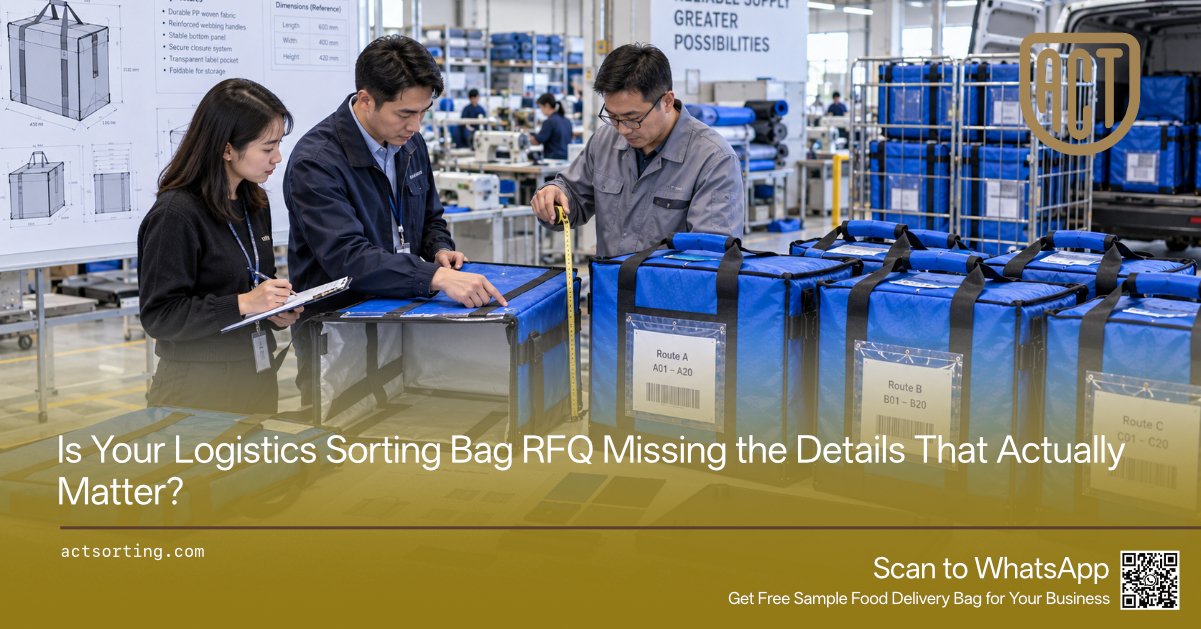
“Logistics Sorting Bag, 60 × 45 × 40 cm, blue, logo printed, 5,000 pcs” sounds reasonably clear until manufacturing begins. What type of woven material should be used? Is the size internal or external? How much load should the bag carry? Should the bottom be reinforced? How long are the handles? Does the webbing run only around the opening or continue underneath the bag? Is the top open, zipped, or closed with hook-and-loop? What size route card needs to fit the transparent pocket? Does the empty bag need to fold flat for return transport?
Two factories can quote exactly the same basic inquiry while planning to manufacture two completely different products.
For courier companies, e-commerce fulfillment centers, postal operators, 3PL providers, distribution networks, and Amazon DSP-style delivery operations, this creates a serious procurement risk. A low quotation may simply represent a lighter material, simpler reinforcement, smaller usable capacity, cheaper closure, or construction that does not match the real warehouse and last-mile workflow.
The purpose of a good RFQ is therefore not to make the document complicated. It is to define the details that materially affect product performance, price, and repeatability.
ACTSORTING has specialized in commercial logistics bags since 2013. The company operates a manufacturing facility covering more than 12,000 square meters in Yangchun, Guangdong, China, supported by more than 400 experienced workers. With BSCI and ISO9001 certification, ACTSORTING provides OEM & ODM manufacturing for Logistics Sorting Bags, Parcel Sorting Sacks, Courier Sorting Totes, Last-Mile Delivery Totes, Van Loading Totes, and other reusable logistics equipment.
The most useful role of a manufacturer begins before mass production. It begins when a procurement request such as “make this bag stronger” is translated into material, dimensions, reinforcement, webbing, closure, identification, and construction details that can actually be sampled, approved, and reproduced.
1. A Logistics Sorting Bag Quote Is Only as Accurate as the Specification
A quotation appears precise because it contains a price. That does not necessarily mean the product behind the price is equally precise.
If an RFQ only specifies dimensions, quantity, color, and logo, every supplier needs to fill the missing technical details with its own assumptions. One factory may quote a lighter woven body with simple handles. Another may include a laminated material, reinforced bottom, extended webbing, transparent route pocket, and stronger closure. Both suppliers can reasonably claim that they quoted a Logistics Sorting Bag according to the inquiry.
The resulting prices are not directly comparable because the products are not directly comparable.
This is particularly common when buyers use photographs as the main specification. A reference image may show the general shape, but it rarely reveals material weight, internal reinforcement, bottom structure, seam construction, or how the handles are attached. Two visually similar bags can behave very differently after months of commercial use.
A stronger RFQ should explain where and how the bag will operate. Is it used for warehouse sorting, van loading, doorstep delivery, hub transfer, returns, or several stages together? Will workers drag it across floors? Does it carry mostly poly mailers, mixed cartons, or dense products? Is it opened fifty times per shift or only once at the destination?
These details give the manufacturer enough context to recommend a construction rather than simply copying a photograph.
ACTSORTING can work from technical drawings, existing samples, damaged bags, reference images, current specifications, or a description of the operating workflow. The objective is to remove assumptions before those assumptions become thousands of finished products.
Procurement works considerably better when every supplier is actually pricing the same bag. A revolutionary concept, apparently.
2. Dimensions Alone Do Not Define the Real Capacity of a Delivery Bag
Length, width, and height are essential, but three numbers do not fully describe how a Logistics Sorting Bag behaves when loaded.
The first question is where those dimensions are measured. A finished external size includes seams, material thickness, reinforcement, and construction. Internal usable capacity can be slightly different. If a buyer compares a current bag’s internal space with a supplier’s external dimensions, the new product may arrive technically correct but operationally smaller.
Shape also matters. A 60 × 45 × 40 cm rectangular tote with a stable base behaves differently from a flexible sack using the same nominal measurements. A reinforced bottom can maintain more usable floor area, while a completely soft construction may narrow as the load settles.
The opening dimensions should be considered separately. Large cartons may fit inside the final bag volume but remain difficult to insert if the opening is too narrow. This is especially relevant for Courier Sorting Totes and Last-Mile Delivery Totes carrying mixed e-commerce packages.
Capacity should therefore be connected to actual parcel dimensions and route volume. Procurement teams can provide examples of common cartons, maximum parcel size, approximate load, and the number of packages normally placed inside one tote. The manufacturer can then evaluate whether the proposed dimensions make sense.
Vehicle and warehouse compatibility should also be included. A bag that gains five centimeters in width may suddenly fit one fewer unit across a van shelf or roll cage. A taller bag may interfere with stacking or obscure route labels. These details can matter more than gaining a small amount of theoretical volume.
ACTSORTING can customize dimensions around parcel profiles, warehouse racks, roll cages, van interiors, staging layouts, and folded storage requirements. If several capacities are needed, the same construction and identification system can be maintained across a coordinated product family.
A useful RFQ therefore specifies not only “60 × 45 × 40 cm,” but what those dimensions are expected to accomplish.
3. Material Specifications Need More Detail Than “Strong Woven Fabric”
Material descriptions are one of the largest sources of quotation differences.
Terms such as “durable fabric,” “strong PP woven,” or even “industrial-grade material” describe an intention rather than a complete specification. The supplier still needs to decide the fabric structure, density, lamination, weight, surface treatment, and reinforcement strategy.
Material selection should begin with the failure mode the operation is trying to prevent.
A Parcel Sorting Sack dragged frequently across warehouse floors needs abrasion protection around the base and lower corners. A Last-Mile Delivery Tote used mainly between van and customer may prioritize lower weight and convenient handling. A bag exposed to rain or wet loading areas may benefit from a laminated surface. A tote carrying rigid cartons may need greater puncture resistance around sidewalls.
Using the heaviest possible material everywhere is not automatically the correct answer. It increases product weight, cost, folded volume, and employee handling effort. Targeted reinforcement can often produce a better balance by placing stronger material where the bag actually receives stress.
The RFQ should therefore describe both material expectations and operating conditions. If the buyer already has a successful fabric specification, it can be provided directly. If the existing product is failing, damaged samples or photographs can help the manufacturer understand whether the problem comes from abrasion, puncture, seam construction, or load distribution.
ACTSORTING can develop combinations of woven material, lamination, reinforced panels, bottom protection, corner reinforcement, and webbing according to the workflow. This creates a more meaningful specification than asking every factory for its interpretation of “very strong material.”
The material should solve the working problem. It should not simply sound reassuring in a spreadsheet.
4. Handles, Webbing, and Reinforcement Should Follow the Actual Load
Handles are easy to overlook because almost every delivery bag has them. The important differences become visible only after the tote is loaded repeatedly.
A handle does not work independently. Load moves from the grip into the webbing, through the stitching, into the bag body, and finally around the parcels inside. A strong piece of webbing attached to a weak side panel can still fail. Additional stitching concentrated in the wrong location does not necessarily improve load distribution.
A better RFQ should describe how employees carry the Logistics Sorting Bag. Is it normally lifted by one person? Are two side handles required for heavier loads? Should long handles allow shoulder carrying? Does the driver need one-handed handling? Is the bag mainly dragged, lifted from a van shelf, or transferred between roll cages?
Webbing layout can then follow the handling method.
For higher loads, webbing may extend farther down the side panels or continue underneath the bottom to distribute force. Handle attachment zones can receive additional reinforcement. Side grips can help workers control the bag during vehicle loading even if longer top handles remain the primary carrying method.
The expected load should also be stated realistically. “Maximum load” should not become an imaginary number added because larger numbers look better on a product page. The useful specification is the normal operating range and the type of parcel mix the bag carries.
ACTSORTING can customize webbing width, handle length, grip position, reinforcement patches, bottom support, and stitching structure according to these requirements. The approved sample then provides a physical reference for how those components should appear in production.
The procurement question is not simply “Does this bag have reinforced handles?”
It is “Where does the load go when somebody actually picks it up?”
5. Closures and Openings Need to Match the Parcel Handling Process
An RFQ that requests “zipper closure” may still leave several important questions unanswered.
How wide should the zipper opening be? Does it open across one side or around several panels? Does the bag need fast repeated access during sorting, or should it remain closed during hub transfer? Will employees frequently place oversized cartons inside? Does a top flap provide enough containment, or does the operation require a full zipper?
Different logistics stages create different priorities.
Parcel Sorting Sacks used beside warehouse lanes may need fast open access because workers continuously add packages. A Van Loading Tote may remain open while the vehicle is prepared but require a secure closure during movement. A door-to-door Logistics Sorting Bag containing several small mailers may need better containment so nothing falls out during the walk to the customer.
Hook-and-loop closures can provide quick access for some applications. Zippers may offer stronger enclosure but add cost and additional components that need to withstand repeated use. Flaps can cover the opening without requiring workers to align a zipper around an overfilled load.
The opening dimensions also matter. A large-capacity bag with a narrow mouth frustrates workers every time a carton enters or leaves. Over time, employees may stop using the closure correctly because the product itself encourages them to work around it.
ACTSORTING can customize opening structure, zipper length, flap dimensions, hook-and-loop position, reinforcement, and handle placement around the customer’s actual parcel flow.
This is why closure should be specified as a workflow requirement rather than merely selected from a list of components. “Secure during transport, fast access at each stop” tells the manufacturer considerably more than “zipper required.”
6. Route Label Pockets Should Be Specified Before Sampling
Transparent identification pockets frequently appear simple until the first bulk order reaches the warehouse.
Then somebody discovers that the route sheet does not fit.
Or the pocket sits behind the handle.
Or workers load the bags sideways inside the van, making the label impossible to see.
Or the pocket opening faces downward when the bag is folded.
A good RFQ should specify the actual document or barcode format used by the operation. If route cards measure a certain size, that information should be provided. If employees scan through the transparent material, the required barcode position should be understood during development.
Pocket location should follow the handling process.
Warehouse teams may need front-facing identification during sorting. Drivers may need side-facing labels when bags stand next to each other inside the van. Multi-site operators may want permanent depot information printed separately from temporary route cards.
Some customers may also require QR codes, asset numbers, warehouse IDs, customer codes, or RFID-ready areas. These features should be planned as a system rather than accumulated randomly across future orders.
ACTSORTING can customize transparent pocket dimensions, material, opening direction, edge reinforcement, quantity, and position. The same label layout can then remain consistent across different Logistics Sorting Bag sizes.
This matters because standardized identification reduces training friction. Workers learn where the route information is located regardless of which capacity they are using.
A transparent pocket costs very little compared with the entire delivery operation. Naturally, this makes it exactly the sort of tiny detail capable of annoying everyone when specified badly.
7. Folding, Storage, and Empty Return Requirements Belong in the RFQ
Procurement specifications usually describe the bag while full.
Operations also need to manage it while empty.
Reusable Logistics Sorting Bags may return from routes, accumulate inside vehicles, move between depots, or remain in warehouse storage before the next shift. If the empty bag is bulky, stiff, or difficult to bundle, the reverse logistics system pays for transporting and storing equipment that currently contains nothing.
Foldability should therefore be defined during product development.
Does the bag need to collapse completely flat? Can the bottom panel be removable? Should integrated straps secure the folded tote? How many empty bags need to fit into a vehicle compartment, pallet, shelf, or return cage?
Material stiffness and reinforcement affect these answers. An extremely rigid full-body structure may provide excellent shape while loaded but perform poorly during empty return. A more balanced construction can use reinforcement around high-stress areas while allowing the larger body panels to collapse.
ACTSORTING can customize fold lines, securing straps, removable supports, bottom boards, and material combinations according to the customer’s storage process. Folded dimensions can also be considered alongside the normal finished dimensions.
This becomes particularly important for large reusable fleets. A network operating thousands of Courier Sorting Totes has thousands of empty totes to manage after delivery waves finish.
The useful RFQ therefore describes the complete circulation cycle: deployment, loading, transport, delivery, empty return, storage, and reuse.
The bag spends part of its career full and part of it carrying absolutely nothing. Procurement unfortunately has to care about both.
8. Sample Approval Needs a Clear Reference for Bulk Production
A good sample solves only half of the sourcing problem.
The other half is reproducing it.
Procurement teams often approve a physical sample after several revisions, then place a large order assuming every detail is automatically understood. If the final specification has not been documented clearly, mass production can still drift away from the approved product.
Dimensions may change slightly. Reinforcement patches may become smaller. A different material may look similar but behave differently. Handle position can move. Transparent pockets may be stitched several centimeters away from the approved location. Printing colors can vary.
Each difference may appear minor in isolation. Across several thousand Logistics Sorting Bags, those differences can affect warehouse compatibility, vehicle loading, handling, and brand consistency.
Sample approval should therefore create a manufacturing reference. The final bag dimensions, material, reinforcement, webbing, handle length, closure, pocket size, pocket position, printing, color, folded structure, and packaging should correspond to an agreed specification.
The approved physical sample remains useful because some construction details are easier to understand in three dimensions than on a spreadsheet. The technical document makes those details easier to reproduce and inspect.
ACTSORTING can use the confirmed sample and specification as the basis for bulk production. In-process and final inspection can then compare manufactured units against the approved requirements rather than against somebody’s memory of what the sample looked like three months earlier.
This is particularly important for repeat orders. A logistics network should not need to rediscover its own bag specification every time replenishment is required.
Sample approval should therefore answer one question clearly: what exactly has been approved for production?
9. ACTSORTING Turns Operational Requirements Into Manufacturable Specifications
Many buyers know exactly what is wrong with their current Logistics Sorting Bag without knowing the manufacturing term for the solution.
“The bottom wears out too quickly.”
“The handles are uncomfortable.”
“The route card keeps falling out.”
“The bag collapses while workers load it.”
“It fits the warehouse but not the van.”
“The new batch feels different from the previous one.”
These are useful starting points.
ACTSORTING’s OEM & ODM process can translate those operational problems into product decisions. Premature bottom wear may lead to targeted reinforcement or different surface construction. Unstable bags may require a more structured base. Poor handling may require different webbing positions or handle lengths. Lost route cards may require a redesigned pocket. Vehicle compatibility may require dimensional changes.
This is a more productive development process than asking the customer to become a bag engineer before contacting the factory.
ACTSORTING has specialized in commercial logistics bags since 2013. Its Yangchun manufacturing facility covers more than 12,000 square meters and employs more than 400 experienced workers. BSCI and ISO9001 certification provide additional support for structured commercial production.
The company can support development from existing samples, drawings, photographs, defect reports, or operational descriptions through sampling, revision, bulk production, and repeat manufacturing.
For procurement teams, that creates a useful reason to choose ACTSORTING: the supplier can participate in defining the product instead of merely quoting whatever details happened to appear in the first email.
A good manufacturer should not make the RFQ more mysterious. It should help remove the mystery before production begins.
10. Better RFQs Create More Consistent Bulk Orders and Repeat Production
A detailed RFQ does not exist to create paperwork. Its purpose is to make pricing, sampling, production, inspection, and future replenishment refer to the same product.
When material, dimensions, load, webbing, reinforcement, closure, identification, folding, and packaging requirements are clear, suppliers can provide more comparable quotations. The procurement team can understand why one construction costs more than another instead of comparing unexplained unit prices.
Sampling also becomes faster because fewer basic decisions remain unresolved. The first prototype is more likely to reflect the actual workflow, and later revisions can focus on meaningful improvements rather than correcting assumptions.
Bulk production benefits even more. An approved specification provides a clear reference for manufacturing and inspection. When the customer orders another 5,000 units six months later, the product does not need to be rebuilt from scattered emails and old photographs.
This is especially valuable for multi-depot logistics networks. A standardized Logistics Sorting Bag can maintain the same dimensions, route pocket, handle system, color, closure, and folding structure across different warehouses and replenishment orders.
ACTSORTING’s manufacturing capacity supports customized commercial orders, multi-site programs, seasonal procurement, and repeat production. The same core specification can also be adapted into several coordinated sizes without losing the overall equipment standard.
For courier companies, postal operators, e-commerce fulfillment centers, 3PL providers, and delivery fleets preparing a new Logistics Sorting Bag RFQ, the most useful starting point is the operation itself.
Define where the bag is used, what it carries, how employees move it, what usually fails, how route information is displayed, how it fits into vehicles, and what happens after it becomes empty. From there, dimensions, materials, handles, reinforcement, closures, and other manufacturing details can be developed into a specification that suppliers can actually quote and reproduce.
The cheapest RFQ is only useful when everyone is quoting the same product.
Otherwise, procurement is not comparing prices. It is comparing assumptions with currency symbols attached.
FAQ
Q: What information should be included in a Logistics Sorting Bag RFQ?
A: A useful RFQ should include application, dimensions, expected parcel types, normal load, material requirements, handles, webbing, reinforcement, closure, route label pocket, color, printing, folding requirements, packaging, quantity, and any vehicle or warehouse compatibility requirements.
Q: Can ACTSORTING develop a specification from an existing delivery bag?
A: Yes. ACTSORTING can work from physical samples, photographs, drawings, current specifications, damaged bags, or descriptions of operational problems to develop a customized Logistics Sorting Bag specification.
Q: Should route label pocket dimensions be included in the RFQ?
A: Yes. Providing the actual route card, barcode sheet, or document dimensions helps ensure the transparent pocket is correctly sized and positioned for warehouse and delivery use.
Q: Does the approved sample need a separate technical specification?
A: It is strongly recommended. The physical sample provides a useful construction reference, while documented dimensions, materials, reinforcement, handles, closures, pockets, colors, printing, and packaging make bulk and repeat production easier to control.
Q: Why choose ACTSORTING for custom Logistics Sorting Bag projects?
A: ACTSORTING has specialized in commercial logistics bags since 2013, operates a 12,000+ square meter manufacturing facility with more than 400 employees, holds BSCI and ISO9001 certification, and supports OEM & ODM development, sampling, customized bulk manufacturing, multi-site programs, and repeat production.