

Table of Contents
- Parcel Locker Routes Create Different Challenges From Door-to-Door Delivery
- One Parcel Delivery Bag per Destination Simplifies Multi-Parcel Stops
- Pre-Sorted Parcel Bags Reduce Searching at Locker Stations
- Clear Identification Helps Drivers Recognize Each Delivery Group
- Secure Closures Keep Parcels Contained During Vehicle-to-Locker Transfers
- Pickup Points Need Separate Bags for Deliveries and Customer Returns
- Bag Dimensions and Handles Should Match Urban Delivery Environments
- Overflow Parcels and Failed Locker Deliveries Need a Clear Exception Process
- Why Choose ACTSORTING for Parcel Locker Delivery Bags?
- Standardized Bulk Manufacturing Supports Growing Pickup Point Networks
Introduction
A courier arrives at a parcel locker station with thirty packages assigned to the same location. The vehicle is parked nearby, the handheld scanner is ready, and the locker system is operating normally. Yet before loading the first compartment, the driver spends several minutes searching through loose cartons and poly mailers to identify which packages belong to that particular locker station.
The problem is not necessarily the delivery technology. It is the physical organization of parcels inside the vehicle.
Parcel lockers and pickup and drop-off (PUDO) points have become important alternatives to traditional doorstep delivery. Instead of visiting every customer individually, courier networks can consolidate multiple parcels at designated collection locations. However, these concentrated delivery stops create their own handling requirements. Drivers may need to unload numerous parcels, scan each shipment, locate available locker compartments, manage oversized items, and collect customer returns before continuing to the next destination.
When parcels are transported loosely, much of the operational advantage can disappear during unloading and identification.
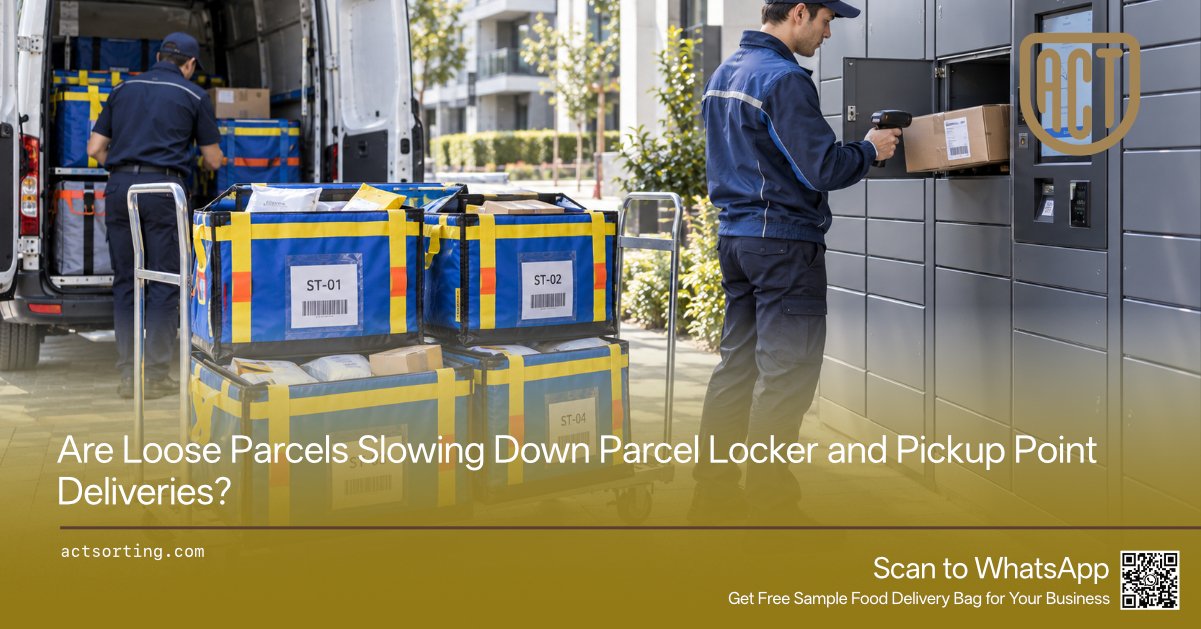
A reusable Parcel Delivery Bag provides a practical way to organize these concentrated delivery groups. Parcels assigned to the same locker station or pickup point can be consolidated into one identified bag, transported through the van loading process, and carried to the destination without repeatedly searching through unrelated shipments.
For courier companies, postal operators, e-commerce delivery networks, 3PL providers, parcel locker operators, and regional pickup point networks, the objective is to make every concentrated delivery stop easier to prepare, handle, and complete.
ACTSORTING has specialized in commercial logistics bags since 2013. The company operates a manufacturing facility covering more than 12,000 square meters in Yangchun, Guangdong, China, with more than 400 employees. Supported by BSCI and ISO9001 certification, ACTSORTING provides OEM & ODM manufacturing for Parcel Delivery Bags, Parcel Sorting Sacks, Courier Sorting Totes, Last-Mile Delivery Totes, Van Loading Totes, and other customized logistics equipment.
With customizable dimensions, reinforced woven materials, transparent route pockets, closures, handles, and identification systems, ACTSORTING helps logistics operators develop reusable bags around their actual delivery processes rather than relying on generic transport sacks.
1. Parcel Locker Routes Create Different Challenges From Door-to-Door Delivery
Traditional doorstep delivery usually involves moving one or several parcels from a vehicle to a specific customer address. Parcel locker delivery works differently. A single locker station may receive packages belonging to numerous customers, with each parcel requiring individual identification and assignment to an appropriate compartment.
This concentration creates operational advantages, but it also introduces a larger unloading task at each stop. A courier may arrive with twenty or thirty packages for one locker bank, followed by another group for a nearby pickup point. Without suitable physical organization, those groups can become mixed inside the vehicle, especially when several destinations are served during one route.
The driver must distinguish parcels assigned to the current location from those intended for later stops. Small poly mailers may become hidden beneath larger cartons, while irregular packages may shift during transportation. If parcels are loaded loosely, employees may need to search the entire vehicle section before confirming that every package for the locker station has been found.
A Parcel Delivery Bag creates a clearer boundary around each destination group. Parcels intended for one locker station can be placed into an identified tote during warehouse preparation and remain together until delivery. The bag does not replace scanning or compartment assignment, but it reduces the physical searching required before those processes begin.
ACTSORTING can customize bag capacity, identification areas, closures, and carrying structures according to the number and type of parcels normally delivered to each location. This makes the product particularly relevant to courier networks that operate repeated routes across urban locker stations and commercial pickup points.
2. One Parcel Delivery Bag per Destination Simplifies Multi-Parcel Stops
A useful organizing principle for parcel locker delivery is to treat each destination as a distinct physical delivery unit.
Consider a courier route covering eight locker stations and several convenience-store pickup points. Each location may receive a different number of parcels, ranging from a few small mailers to several large cartons. If all parcels are loaded loosely, the driver must repeatedly identify which shipment belongs to which destination.
A destination-based Parcel Delivery Bag system makes this separation more visible. Each bag can carry parcels assigned to a particular station, with a large identification card showing the locker location, route number, or pickup point code.
At the destination, the driver retrieves the assigned bag, carries it toward the locker station, and processes the parcels individually. Once the delivery is completed, the empty bag returns to the vehicle for reuse. For destinations with particularly high volume, several numbered bags can represent the same stop without losing their relationship to one another.
This approach is equally useful for PUDO locations. A convenience store accepting parcels on behalf of a courier company can receive a clearly identified delivery group rather than a collection of unrelated cartons that must be reorganized at the counter.
ACTSORTING can develop coordinated bag sizes for different stop volumes while maintaining consistent handles, route pockets, colors, and closures. Smaller Courier Sorting Totes may serve low-volume pickup points, while larger Parcel Delivery Bags support busy locker stations.
The operational benefit is clearer destination separation and fewer unnecessary handling movements before individual parcels enter the final delivery process.
3. Pre-Sorted Parcel Bags Reduce Searching at Locker Stations
The loading process at a parcel locker can become inefficient when the driver needs to alternate constantly between scanning, searching, and repositioning packages.
A small parcel might be buried underneath several cartons. An oversized package may require a different handling procedure. A shipment assigned to another station might accidentally appear among the current stop’s parcels.
These interruptions create unnecessary movement around the vehicle and locker installation.
Pre-sorting parcels into reusable bags can reduce that friction. During warehouse preparation, employees can group parcels according to locker destination and place them inside the corresponding Parcel Delivery Bag. Where useful, different bag capacities or internal dividers can help separate smaller packets from larger cartons.
This does not mean the bag determines which locker compartment will be used. Actual compartment assignment still depends on the operator’s system, package dimensions, and available locker capacity. The purpose of the bag is to organize the physical delivery group before the driver begins interacting with the locker.
For stations receiving a mixture of mailers and rigid cartons, ACTSORTING can customize rectangular openings that allow employees to access the contents more easily. A reinforced bottom can help the bag maintain its shape while standing beside the delivery vehicle, while flexible sidewalls keep the empty product manageable after unloading.
The company can also develop several bag dimensions within the same product family. This allows the courier network to select a practical capacity according to parcel mix rather than using an oversized sack for every stop.
Choosing ACTSORTING allows these structural details to be developed around real sorting and delivery conditions. The objective is to keep the driver’s attention on processing parcels rather than repeatedly searching for them.
4. Clear Identification Helps Drivers Recognize Each Delivery Group
Parcel locker routes depend heavily on accurate destination identification. Several locker stations may operate within the same neighborhood, and pickup points may have similar names or addresses. Drivers therefore need a reliable way to connect the physical bag with the correct delivery location.
A reusable Parcel Delivery Bag can support this through large transparent identification pockets and permanent equipment markings.
The transparent pocket may hold a route card showing the locker station code, destination number, stop sequence, barcode, or other operational information. A permanent printed area can identify the depot, operator, or reusable bag asset number.
Separating temporary destination information from permanent equipment identification makes the same bag usable across different routes without losing its asset identity.
Pocket position is particularly important inside delivery vehicles. If several bags stand next to each other, identification placed only on the top may become difficult to read. A front or side pocket can remain visible during loading and retrieval.
ACTSORTING can customize pocket dimensions, transparent material, attachment structure, opening direction, and location according to the courier company’s existing documents. Different bag capacities can retain the same identification layout so employees know where to look regardless of size.
The system should also avoid unnecessarily exposing customers’ personal information on the exterior. Destination codes and operational route identifiers are often more appropriate than displaying customer names or addresses where unrelated people can read them.
For courier procurement teams, these details make the Parcel Delivery Bag more than a container. It becomes a physical extension of the route identification process, supporting faster recognition and more consistent handling across multiple depots.
5. Secure Closures Keep Parcels Contained During Vehicle-to-Locker Transfers
A courier transporting parcels to a locker station may need to carry several items across parking areas, pedestrian walkways, building entrances, or other public spaces before reaching the installation.
Loose packages are awkward to handle during this movement. Small poly mailers can shift between cartons, while employees may struggle to carry several packages and operate a scanner at the same time.
A Parcel Delivery Bag consolidates the group into one carrying unit, but the opening must provide suitable containment.
ACTSORTING can customize zipper closures, hook-and-loop flaps, covered openings, or other fastening structures according to the handling requirements. A secure closure helps keep small parcels inside the bag while the driver moves between vehicle and destination.
The design should still allow efficient access. At a locker station, the courier needs to remove parcels individually, scan them, and place them into assigned compartments. A closure that is difficult to operate repeatedly may encourage workers to leave the bag open throughout the stop.
The best configuration therefore depends on the balance between transport security and access frequency.
A wide opening can make the contents easier to see, while a practical flap or zipper provides containment during movement. Reinforced handles help employees carry the bag comfortably, and a stable bottom can keep it upright while parcels are removed.
For ACTSORTING, the important manufacturing consideration is integrating these features rather than treating them as unrelated additions. Closure position, handle layout, opening dimensions, and bag structure should work together.
The result is a product that supports controlled parcel handling without creating unnecessary complexity during delivery.
6. Pickup Points Need Separate Bags for Deliveries and Customer Returns
Parcel locker and PUDO operations are not always one-directional.
A courier may deliver parcels to a pickup point and collect outgoing shipments, customer returns, or undelivered items during the same visit. This creates two physical flows that need to remain separate: inbound parcels being delivered to the location and outbound parcels returning to the carrier network.
If both groups are placed together inside the vehicle, employees may need to sort them again at the next facility. More importantly, incorrect grouping can create confusion about whether a parcel has been delivered to the pickup point or collected for onward processing.
A coordinated bag system can help maintain this distinction.
One Parcel Delivery Bag may contain shipments arriving at the pickup point, while another clearly identified bag receives returns or outgoing parcels. Different colors, printed markings, or removable route cards can make the direction of movement visible.
For example, a courier network may use one color for outbound delivery and another for returns collection. Larger operations may also identify exception shipments separately. The specific system should match the customer’s established workflow and scanning procedures.
ACTSORTING can customize bag body colors, webbing colors, transparent identification pockets, printed depot codes, and closures to support these separate flows. The same core construction can be maintained across both categories, making handling and storage more consistent.
This is especially useful for PUDO networks operating through convenience stores, retail counters, fuel stations, and other commercial locations where parcel handling must fit alongside normal business activity.
The bag does not replace shipment-level scanning. It helps preserve the physical separation established by that scanning, reducing the chance that incoming and outgoing parcels become mixed during transport.
7. Bag Dimensions and Handles Should Match Urban Delivery Environments
A parcel locker may be located beside a shopping center, outside a residential complex, inside a transport hub, or along a busy commercial street. Pickup points can operate from relatively small retail premises with narrow entrances and limited storage space.
These conditions create practical requirements for the Parcel Delivery Bag.
An oversized tote may provide impressive capacity but become difficult to carry through pedestrian areas or narrow shop entrances. A very tall bag may make it harder to retrieve small parcels from the bottom. A poorly positioned handle may interfere with the opening when the driver needs frequent access.
ACTSORTING can customize dimensions according to average parcel size, maximum expected load, vehicle storage layout, carrying distance, and delivery environment.
For smaller pickup points, a compact rectangular Courier Sorting Tote may be more practical than a large flexible sack. Busier locker installations may require larger bags with stronger handles and reinforced bottoms.
Handle construction should match the expected load. Long webbing handles can provide convenient carrying, while additional side handles may help employees lift bags from vehicle shelves or loading areas. Extended webbing and reinforced attachment points can distribute weight more effectively across the bag body.
Material selection also matters. Laminated woven surfaces can provide useful protection against normal dirt and temporary moisture exposure, while reinforced lower panels support repeated contact with floors and vehicle interiors.
The advantage of OEM & ODM manufacturing is that these requirements can be combined into one specification. ACTSORTING can develop a bag around the actual route rather than asking every courier to adapt to a generic product.
8. Overflow Parcels and Failed Locker Deliveries Need a Clear Exception Process
Not every parcel assigned to a locker station will necessarily enter a compartment successfully.
A locker bank may be full, the required compartment size may be unavailable, or an individual parcel may need to be redirected according to the carrier’s operating procedure. Some shipments may also require delivery to an alternative pickup point.
These exceptions create a physical handling problem.
If unsuccessful deliveries are placed back among the remaining route parcels without clear identification, the driver may later struggle to distinguish processed shipments from unresolved ones. The parcels may then require additional sorting at the depot.
A Parcel Delivery Bag system can support clearer exception handling by separating parcels that still require action.
The driver can retain unsuccessful shipments in a designated return or exception tote after recording the relevant status in the carrier’s system. A different color, identification pocket, or printed status area can help prevent these parcels from becoming mixed with normal deliveries.
ACTSORTING can customize smaller exception bags as part of a coordinated logistics bag family. These products may share materials, handles, and identification layouts with standard Parcel Delivery Bags while using different colors or markings.
Foldability becomes useful here as well. Once a delivery bag is emptied at the locker station, it can be collapsed and returned to the van, leaving space for collected returns and unresolved shipments.
This creates a more organized relationship between successful deliveries, outgoing returns, and failed-delivery exceptions.
The business value is not that the bag prevents locker failures. It cannot create an empty compartment where none exists. Its value is keeping the resulting parcel groups physically organized so the courier can follow the correct next procedure.
9. Why Choose ACTSORTING for Parcel Locker Delivery Bags?
A courier company purchasing equipment for locker and pickup point operations needs more than a generic woven bag.
The bag must work with route identification, warehouse sorting, vehicle loading, short-distance carrying, repeated parcel access, and reverse logistics. Different destinations may also require different capacities, while the network still benefits from standardized construction.
ACTSORTING specializes in developing commercial logistics bags around these practical requirements.
Founded in 2013, ACTSORTING operates a manufacturing facility covering more than 12,000 square meters in Yangchun, Guangdong, China, with more than 400 employees. BSCI and ISO9001 certification provide additional support for commercial procurement and structured manufacturing processes.
The company’s OEM & ODM capabilities allow customers to customize material, dimensions, reinforcement, handles, closures, transparent pockets, colors, printing, folding structures, and packaging according to the delivery operation.
For example, a courier network can establish one standard Parcel Delivery Bag for normal locker deliveries, a larger model for high-volume stations, and a separate color-coded bag for returns collection. All three can share the same route pocket position, handle structure, and overall identification system.
Existing samples, technical drawings, reference photographs, parcel profiles, van dimensions, and operational feedback can help define the product before mass production.
This is the practical reason to choose ACTSORTING. Instead of simply selecting a stock bag and printing a courier logo, procurement teams can develop a coordinated reusable bag system around the network’s delivery and return processes.
That matters when a product is expected to operate repeatedly across dozens of depots and hundreds of delivery routes.
10. Standardized Bulk Manufacturing Supports Growing Pickup Point Networks
Parcel locker and PUDO networks depend on repeatable operations.
A courier working in one city should not need to learn a completely different bag system when transferring to another depot. Route identification should appear in familiar locations, closures should operate consistently, and bag dimensions should remain compatible with the company’s vehicle and staging equipment.
This becomes difficult when different facilities purchase bags independently or replacement orders gradually introduce changes to the original specification.
One batch may have shorter handles. Another may use a smaller transparent pocket. Different dimensions can affect vehicle loading, while inconsistent colors can weaken the intended separation between deliveries and returns.
ACTSORTING can use approved samples and confirmed technical specifications as references for bulk manufacturing. Material construction, dimensions, tolerances, reinforcement, handles, closures, identification pockets, printing, colors, folded structure, and packaging can be defined before production.
This supports coordinated equipment programs across multiple depots and delivery regions.
Large courier networks may also need different bag sizes for different parcel volumes. Standardizing key construction features across these sizes allows the company to retain one recognizable system while accommodating varied route requirements.
ACTSORTING’s manufacturing facility and workforce support customized bulk orders, seasonal requirements, repeat procurement, and multi-location logistics programs.
For parcel delivery companies, postal operators, 3PL providers, locker network operators, and PUDO service providers dealing with loose parcels, slow unloading, destination confusion, mixed returns, or inconsistent delivery equipment, the next Parcel Delivery Bag project should begin with the complete pickup point workflow.
Procurement teams can provide average parcel quantities per stop, typical parcel dimensions, expected load, delivery vehicle arrangement, route identification format, closure preference, handle requirements, return procedures, colors, branding, and target quantity for a customized manufacturing proposal.
Parcel lockers can automate the customer collection process, but the parcels still need to reach the correct locker station first.
A well-designed Parcel Delivery Bag helps keep that part of the journey organized.
FAQ
Q: Can Parcel Delivery Bags be used for parcel locker replenishment and delivery?
A: Yes. Reusable Parcel Delivery Bags can consolidate shipments assigned to the same locker station, making it easier for couriers to identify, transport, and unload parcel groups before scanning and placing individual shipments into available compartments.
Q: Can ACTSORTING customize route identification pockets for locker stations?
A: Yes. Transparent identification pockets can be customized for locker station codes, destination numbers, barcodes, QR codes, route cards, depot identifiers, and other operational documents.
Q: Can different bag colors separate deliveries from customer returns?
A: Yes. ACTSORTING can customize body colors, webbing colors, printed markings, and removable identification cards to help distinguish incoming deliveries, collected returns, and exception shipments.
Q: Are Parcel Delivery Bags suitable for small retail pickup points?
A: Yes. Compact Courier Sorting Totes and customized Parcel Delivery Bags can be developed according to pickup point space, parcel volume, carrying requirements, and vehicle dimensions.
Q: Why choose ACTSORTING for custom Parcel Delivery Bags?
A: ACTSORTING has specialized in commercial logistics bags since 2013, operates a 12,000+ square meter manufacturing facility with more than 400 employees, holds BSCI and ISO9001 certification, and supports OEM & ODM development, customized bulk manufacturing, coordinated product ranges, and repeat orders.