

Table of Contents
- Delivery Routes Rarely Go Exactly as Planned
- Pre-Sorted Parcel Delivery Bags Make Routes Easier to Divide
- Emergency Driver Handoffs Should Not Require Re-Sorting Every Parcel
- Clear Route Identification Connects Physical Bags With Digital Delivery Records
- Secure Closures Keep Parcels Together During Vehicle Transfers
- Bag Dimensions and Handles Matter When Parcels Move Between Vehicles
- Failed Deliveries and Customer Returns Need Separate Handover Procedures
- Standardized Delivery Totes Support Flexible Courier Fleet Operations
- Why Choose ACTSORTING for Custom Parcel Delivery Bags?
- Consistent Bulk Production Helps Courier Networks Prepare for Disruptions
Introduction
A courier starts the morning with a full delivery van and a carefully planned route. By midday, something changes. The vehicle develops a mechanical problem, one driver falls behind schedule, or an unexpected concentration of parcels makes it impossible to complete every stop within the planned delivery window. The dispatcher decides to transfer part of the remaining route to another driver.
The decision may take only a few minutes. Physically transferring the parcels can take considerably longer.
When packages are loaded individually, employees must identify which shipments belong to the reassigned route, locate them inside the vehicle, separate them from unrelated parcels, verify the transfer, and load everything into another van. Small mailers can become mixed with cartons, while packages for neighboring delivery zones may be difficult to distinguish without repeated scanning.
A reusable Parcel Delivery Bag can make this process more manageable by keeping related parcels inside clearly identified transport units. Rather than transferring dozens of loose packages individually, courier teams can move complete route groups using bags designed for repeated sorting, vehicle loading, delivery, and reassignment.
For courier companies, postal operators, e-commerce delivery networks, third-party logistics providers, and Amazon DSP-style operations, this creates an important advantage: routes become easier to reorganize when circumstances change.
ACTSORTING has specialized in commercial logistics bags since 2013. The company operates a manufacturing facility covering more than 12,000 square meters in Yangchun, Guangdong, China, with more than 400 employees. Supported by BSCI and ISO9001 certification, ACTSORTING provides OEM & ODM manufacturing for Parcel Delivery Bags, Parcel Sorting Sacks, Courier Sorting Totes, Last-Mile Delivery Totes, Van Loading Totes, and other reusable logistics equipment.
With customizable bag dimensions, reinforced woven materials, secure closures, transparent identification pockets, reinforced handles, and foldable structures, ACTSORTING helps delivery operators develop equipment that remains practical even when the original route plan no longer works.
1. Delivery Routes Rarely Go Exactly as Planned
Last-mile delivery networks invest considerable effort in route planning. Dispatch systems assign parcels to vehicles, calculate delivery sequences, and distribute workloads according to delivery areas and expected operating conditions. However, the physical delivery process remains exposed to circumstances that software cannot completely predict.
Vehicles break down. Drivers become unavailable. Traffic conditions change. Individual stops take longer than expected. A business delivery may involve more packages than originally anticipated, while an apartment complex may require additional time for building access. During peak periods, these interruptions can accumulate until a route needs additional support.
Courier operations commonly address such situations by reassigning stops, arranging another vehicle, or sending a support driver to collect part of the remaining workload. This is sometimes described as route rescue, particularly when another courier takes over deliveries that the original driver is unlikely to complete.
The difficulty is that a route may be digitally divisible but physically disorganized. A dispatcher can reassign twenty stops in the system, yet the corresponding parcels may be scattered across different areas of the original vehicle. Drivers must then search through cartons, envelopes, and mailers while determining which shipments belong to the reassigned work.
A Parcel Delivery Bag system can reduce this mismatch between digital planning and physical handling. When parcels are grouped into smaller, identifiable delivery units during warehouse preparation, part of the route can be transferred without dismantling the entire vehicle load.
The bag does not replace route-management software or shipment-level verification. It makes the physical side of route adjustment easier to control, especially when dispatchers and drivers need to act quickly.
2. Pre-Sorted Parcel Delivery Bags Make Routes Easier to Divide
Route flexibility begins before the delivery vehicle leaves the warehouse.
If parcels are placed into one large container without meaningful internal separation, dividing the workload later becomes difficult. A courier may need to remove unrelated packages to reach a particular delivery group, creating unnecessary handling and increasing the chance of mixing shipments.
A more flexible approach uses several Parcel Delivery Bags assigned to defined route sections. One bag may contain parcels for a particular neighborhood, another for a group of apartment buildings, and another for a commercial delivery area. The specific grouping can follow the courier company’s route-planning system.
For example, a driver covering three residential districts might carry separate Last-Mile Delivery Totes for each district. If the final district needs to be reassigned, the corresponding bags can be identified and transferred without searching through all the packages intended for earlier stops.
This does not mean every stop requires its own bag. Excessive subdivision would introduce unnecessary equipment and handling. The useful approach is to create route groups large enough for efficient normal delivery but small enough to be reassigned when necessary.
ACTSORTING can customize Parcel Delivery Bag dimensions according to common parcel sizes, expected load, van shelving, and preferred route grouping. Different capacities can use the same identification pocket location, handles, closures, and color system, allowing warehouse employees to prepare consistent delivery units.
A reinforced rectangular bottom can help each bag maintain its shape during vehicle loading, while flexible sidewalls allow the empty equipment to collapse after use. This combination supports both route organization and practical vehicle storage.
The operational benefit is not simply faster warehouse sorting. It is preserving enough structure in the physical load that dispatchers retain more options when a delivery plan changes during the day.
3. Emergency Driver Handoffs Should Not Require Re-Sorting Every Parcel
Consider a courier van that becomes unavailable halfway through its route. Another driver arrives to collect the remaining deliveries. If the parcels are loose, both employees may need to search the vehicle, compare tracking numbers, identify the correct shipments, and rebuild the load inside the replacement van.
The transfer can become especially complicated when the original vehicle contains completed-delivery exceptions, customer returns, undelivered packages, and parcels assigned to different remaining areas. Without physical separation, employees must interpret the entire vehicle load before deciding what can be transferred.
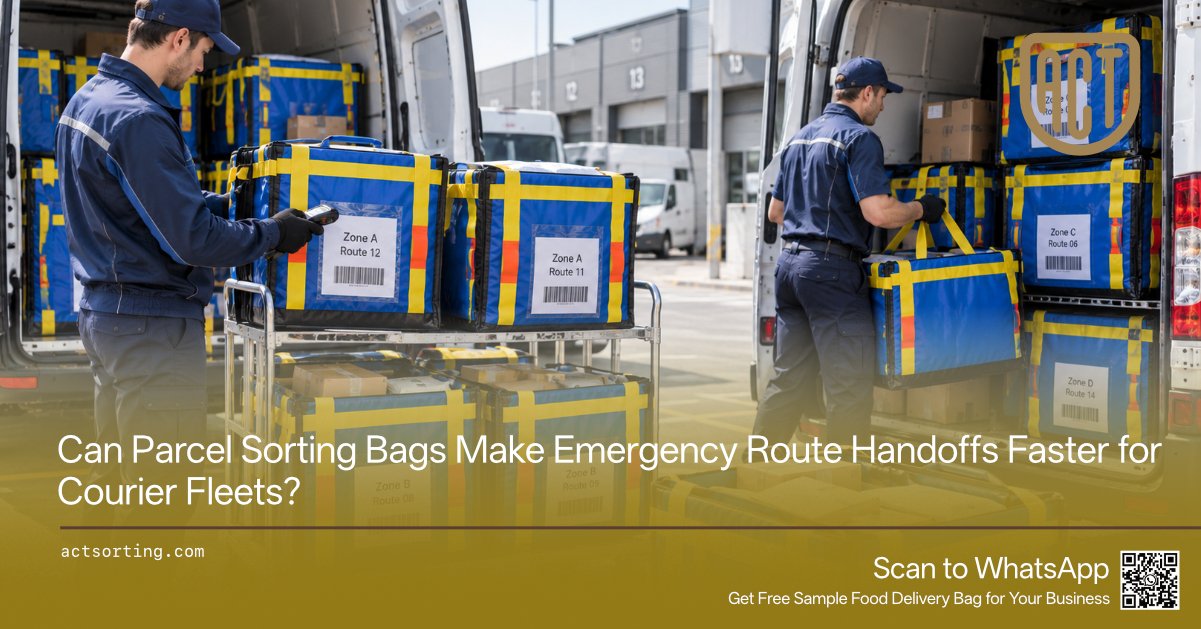
A standardized Parcel Delivery Bag offers a clearer starting point. Each remaining route group can stay inside its assigned tote, with a visible route or zone identification card attached to the exterior. Employees can verify the contents against the digital manifest, record the required handover scans, and move the complete group into the support vehicle.
This distinction is important: the bag simplifies physical handling, but custody confirmation must still follow the carrier’s required procedures. A label showing a route number is not proof that every expected parcel is present. Shipment-level verification and transfer records remain necessary.
ACTSORTING can develop Courier Sorting Totes with wide openings for inspection, closures that secure the contents during movement, and reinforced handles positioned for convenient lifting between vehicles. Transparent identification pockets can display route references without requiring employees to open each bag.
For operations handling different parcel volumes, coordinated bag sizes can make the transfer more manageable. Smaller totes may contain compact residential delivery groups, while larger bags hold higher-volume sections.
The result is a physical handover system that supports route reassignment instead of turning every disruption into an improvised sorting session beside a disabled vehicle.
4. Clear Route Identification Connects Physical Bags With Digital Delivery Records
A Parcel Delivery Bag becomes significantly more useful when employees can identify its assignment immediately.
During normal warehouse operations, workers may recognize delivery groups through staging lanes, vehicle positions, or established loading sequences. During an emergency handover, those contextual clues may disappear. The replacement driver may be unfamiliar with the original vehicle layout, and the parcels may need to move into a completely different loading arrangement.
Large transparent identification pockets help preserve route information through these changes. Depending on the customer’s system, the pocket can hold a delivery zone card, route number, stop range, barcode, QR code, or other operational document.
ACTSORTING can customize pocket dimensions and positions to match existing route labels. A front-facing pocket may support warehouse staging, while a side-facing pocket can remain visible when several Van Loading Totes stand beside each other.
Permanent markings provide a separate function. Depot codes, equipment numbers, ownership information, or asset identification can remain printed on the bag while the temporary route card changes between shifts.
This separation matters during handovers. Employees need to know both which delivery group the bag currently contains and which reusable equipment unit they are transferring.
Color coding can provide another layer of identification. For example, a courier network may use different colors for delivery zones or route groups, while printed information provides the exact assignment. Colors should complement scanning and route records rather than replace them.
A consistent pocket position across multiple bag sizes also reduces training requirements. A support driver receiving unfamiliar equipment can still find the route information in the expected location.
For courier fleets, this is one of the practical reasons to choose customized Parcel Delivery Bags. The identification system can be developed around the network’s existing procedures instead of forcing employees to adapt to a generic pocket that happens to be attached somewhere on the bag.
5. Secure Closures Keep Parcels Together During Vehicle Transfers
Vehicle-to-vehicle parcel transfers create different handling conditions from normal warehouse sorting.
A bag may be lifted from a cargo shelf, placed temporarily on the ground, carried across a loading area, and positioned inside another vehicle. During these movements, parcels can shift, particularly when the bag contains a mixture of cartons and small poly mailers.
An open Parcel Delivery Bag may provide quick access, but it also creates opportunities for smaller items to fall out or become separated from the assigned route group.
Secure closures help maintain physical containment during transfers. Depending on the operation, the bag may use a zipper, hook-and-loop flap, covered opening, or another fastening structure that balances accessibility with protection.
ACTSORTING can customize these features according to how often employees open the bag and the types of parcels normally carried. A tote primarily used for warehouse-to-vehicle transfers may have different closure requirements from one opened repeatedly during doorstep delivery.
The opening also needs to remain practical when the bag is partially full. As deliveries are completed, the shape of the contents changes. A closure that works only when the tote is fully loaded may become inconvenient later in the route.
Reinforcement around the opening and closure attachment areas can help the structure withstand repeated access. The position of carrying handles should also avoid interfering with loading and closing.
For route rescue operations, secure containment supports a straightforward physical principle: the parcels assigned to one delivery group should remain together while moving between vehicles.
This does not make the bag a tamper-proof container or eliminate the need for proper custody procedures. It provides a more controlled way to transport the grouped parcels during an already disrupted delivery operation.
6. Bag Dimensions and Handles Matter When Parcels Move Between Vehicles
A courier network may operate several vehicle types, from larger delivery vans to smaller commercial vehicles used for urban routes or temporary support. A Parcel Delivery Bag that works well inside one vehicle should remain practical when transferred to another.
Oversized bags can create difficulties when the receiving vehicle has less cargo space. A tall tote may not fit beneath the available shelving, while an excessively wide bag may occupy space intended for several smaller route groups.
This makes dimensional compatibility an important part of equipment standardization.
ACTSORTING can develop Parcel Delivery Bag sizes around common vehicle layouts and typical parcel profiles. A coordinated product range can provide different capacities while maintaining similar handles, identification pockets, closures, and construction.
Handle design deserves particular attention during emergency transfers. Employees may need to lift the same bag several times in a short period: from the original van, onto a trolley or staging surface, and into the replacement vehicle.
Reinforced webbing handles should distribute the load into suitable areas of the bag body. Additional side handles can provide better control during lifting, while longer carrying handles may help workers transport lighter bags over short distances.
A reinforced bottom can support the load and reduce deformation when the bag is placed on vehicle floors or temporary staging surfaces. The upper structure can remain more flexible so the empty bag does not occupy unnecessary space.
The objective is not to create the largest possible transport sack. It is to establish manageable physical units that can move between vehicles without requiring employees to rebuild the parcel group every time.
ACTSORTING’s OEM & ODM capabilities allow dimensions, material, reinforcement, and handle configuration to be considered together, producing a bag that supports the entire delivery network rather than one specific loading arrangement.
7. Failed Deliveries and Customer Returns Need Separate Handover Procedures
Not every parcel inside a courier vehicle is still waiting for its first delivery attempt.
As the route progresses, the vehicle may accumulate failed deliveries, customer returns, collected parcels, address exceptions, or shipments requiring further processing. These items can have different next destinations and handling requirements.
When another driver takes over part of the route, the distinction becomes important. Parcels assigned to the reassigned stops should not become mixed with customer returns or exception shipments that remain the original driver’s responsibility.
A reusable bag system can support this separation through designated equipment categories.
For example, the courier company may assign one color of Parcel Delivery Bag to normal outbound delivery groups and another to returns or exceptions. Transparent pockets can display the relevant status, while permanent markings identify the bag itself.
ACTSORTING can customize these colors, printed descriptions, pocket positions, and closure structures as part of a coordinated logistics bag family. Smaller exception totes may be useful when the volume of unsuccessful deliveries is limited, while larger bags can support routes with substantial return collections.
The handling process should remain connected to the carrier’s tracking system. Simply placing a parcel inside a return bag does not establish its shipment status. Employees still need to record the required scans and follow the correct operational procedure.
However, physical separation reduces the chance of an exception parcel being mistaken for a normal outstanding delivery.
During a driver handover, this becomes particularly valuable. The receiving courier can take over the assigned delivery groups without also inheriting an unidentified mixture of parcels requiring different actions.
The benefit is a clearer boundary between work being reassigned and work that has already moved into another operational status.
8. Standardized Delivery Totes Support Flexible Courier Fleet Operations
Emergency route handovers are easier when the entire courier network uses compatible equipment.
If different depots purchase unrelated bags, drivers may encounter different dimensions, handles, closures, and identification systems whenever they provide support outside their normal delivery area.
One depot may use large open sacks. Another may use smaller zippered totes. A third may place route cards on a different panel. Each variation adds another small adjustment during an already time-sensitive operation.
Standardizing Parcel Delivery Bags across facilities reduces these differences.
A courier network can define common requirements for bag dimensions, route identification, material, closures, reinforcement, handle positions, and folding structure. Different capacities may still be necessary, but they can follow the same design principles.
For instance, a standard Courier Sorting Tote may serve most residential routes, while a larger Last-Mile Delivery Tote supports commercial delivery groups. Both can share the same route pocket position and color language, making them easier for employees to recognize.
This standardization also supports temporary staffing and cross-depot assistance. Workers already familiar with the equipment can begin handling delivery groups without learning a completely different physical organization system.
ACTSORTING can manufacture coordinated bag families based on an approved specification. Custom dimensions, colors, printing, closures, and reinforcement can be standardized across the product range.
For logistics operators, this is a practical procurement advantage. Instead of treating each bag purchase as an isolated transaction, the company can develop a reusable equipment system that supports normal operations, route adjustments, staff changes, and future expansion.
The real value appears when another driver can receive a reassigned delivery group and immediately understand how the equipment is intended to work.
9. Why Choose ACTSORTING for Custom Parcel Delivery Bags?
Parcel delivery equipment needs to work under more conditions than those shown in a product photograph.
A bag may spend the morning inside a warehouse sorting lane, several hours inside a delivery van, part of the afternoon being carried into residential buildings, and the end of the day folded among returned equipment. When a route is disrupted, it may also need to move between vehicles or drivers.
ACTSORTING develops Parcel Delivery Bags around these repeated commercial handling requirements.
Founded in 2013, the company operates a manufacturing facility covering more than 12,000 square meters in Yangchun, Guangdong, China, with more than 400 employees. BSCI and ISO9001 certification provide additional support for responsible manufacturing and structured quality management.
For courier procurement teams, the practical advantage is the ability to customize the product according to the actual delivery workflow.
ACTSORTING can work from existing bag samples, reference photographs, technical specifications, parcel dimensions, vehicle measurements, and operational feedback. Material, dimensions, handles, reinforcement, closures, identification pockets, colors, logos, folding structures, and packaging can be developed together.
A network struggling with route transfers may require more visible identification and manageable bag capacities. Another operation may prioritize stronger carrying handles because employees regularly move loaded totes between vehicles. A multi-depot courier company may need consistent colors and pocket layouts across several sizes.
These requirements can be addressed during OEM & ODM sampling before the design moves into bulk manufacturing.
This is the central reason to choose ACTSORTING: the company can translate practical logistics problems into a customized product specification, then support repeat production as the delivery network grows.
The goal is not merely to manufacture another reusable sack. It is to produce equipment that fits the way couriers actually work, including the days when the route plan needs to change.
10. Consistent Bulk Production Helps Courier Networks Prepare for Disruptions
A delivery network cannot rely on standardized equipment if each replenishment order produces a slightly different product.
Small manufacturing variations can affect operational compatibility. A bag that becomes wider may no longer fit the intended vehicle shelf. A shorter handle may change how employees lift it. A smaller transparent pocket may no longer fit the route card. A different closure may require drivers to adjust their handling process.
These differences are especially inconvenient when equipment moves between depots or is used by temporary support drivers.
ACTSORTING can use the approved sample and confirmed technical specification as the reference for bulk manufacturing. Materials, dimensions, tolerances, reinforcement, webbing, handle length, closure, identification pocket, printing, colors, folding structure, and packaging can be defined before production.
This helps preserve compatibility across different production batches and future replenishment orders.
A courier network may begin with a pilot program in one depot, evaluate the bag under normal and reassigned routes, and then expand the approved specification across additional locations. Different capacities can be introduced while retaining common identification and handling features.
ACTSORTING’s manufacturing facility and workforce support customized commercial orders, multi-depot deployment, seasonal procurement, and repeat production.
For courier companies, postal networks, e-commerce delivery fleets, 3PL providers, and DSP-style operators, a Parcel Delivery Bag program should therefore consider more than normal daily loading. Procurement teams should evaluate whether the bags remain manageable when routes are divided, vehicles change, drivers exchange workloads, and exception parcels require separate handling.
Customers can provide typical parcel dimensions, average load, route grouping method, vehicle types, handle requirements, closure preferences, identification format, colors, logo artwork, and expected order quantity to develop a customized specification with ACTSORTING.
Delivery plans will occasionally fail. Vehicles, traffic, and human schedules are not especially interested in behaving perfectly.
A well-designed Parcel Delivery Bag cannot prevent those disruptions, but it can make the parcels considerably easier to reorganize when they happen.
FAQ
Q: Can Parcel Delivery Bags help courier companies transfer routes between drivers?
A: Yes. Parcels can be organized into clearly identified delivery groups, making it easier to locate and physically transfer assigned shipments between drivers or vehicles. Shipment verification and handover records should still follow the courier company’s established procedures.
Q: Can ACTSORTING customize bags for different delivery route sizes?
A: Yes. ACTSORTING can develop coordinated Parcel Delivery Bags and Courier Sorting Totes in different dimensions while maintaining consistent materials, handles, closures, route pockets, colors, and branding.
Q: Can route identification pockets support barcodes and QR codes?
A: Yes. Transparent pockets can be customized for route numbers, stop ranges, depot information, barcode cards, QR codes, driver assignments, and other operational documents.
Q: Can delivery bags separate normal parcels from failed deliveries and returns?
A: Yes. Different bag colors, printed markings, transparent identification areas, and dedicated exception totes can help maintain physical separation between outbound deliveries, customer returns, and unsuccessful shipments.
Q: Why choose ACTSORTING for customized courier delivery bags?
A: ACTSORTING has specialized in commercial logistics bags since 2013, operates a 12,000+ square meter manufacturing facility with more than 400 employees, holds BSCI and ISO9001 certification, and supports OEM & ODM development, customized bulk manufacturing, multi-depot programs, and repeat orders.