

Table of Contents
- Multi-Carrier Warehouses Face More Complicated Parcel Sorting Requirements
- Carrier-Dedicated Parcel Sorting Bags Keep Different Shipment Streams Separate
- Clear Identification Reduces Wrong-Carrier Handover Risks
- Different Carrier Collection Times Require Better Staging Organization
- Standardized Bag Dimensions Improve Sorting Lane and Roll Cage Utilization
- Reinforced Handles and Bottoms Support Repeated Warehouse Transfers
- Exception Parcels Need a Separate Sorting and Reverification Process
- Reusable Logistic Sorting Bags Support More Efficient Equipment Circulation
- Why Choose ACTSORTING for Customized Multi-Carrier Sorting Bags?
- Consistent Bulk Production Supports 3PL Warehouses and Regional Logistics Networks
Introduction
A third-party logistics warehouse may process thousands of parcels every day, but those shipments do not necessarily travel through the same delivery network. One group may be collected by a national postal operator, another by a regional courier company, and another by a specialized last-mile delivery provider. Each carrier can have different parcel acceptance rules, label formats, collection schedules, and destination requirements.
The difficulty begins when all these parcels share the same warehouse floor.
A carton prepared for Carrier A may be placed beside packages assigned to Carrier B. An employee working near a busy sorting lane may accidentally place a small poly mailer into the wrong container. Another parcel may reach the loading dock after its assigned carrier has already completed collection. Although every shipment has a valid tracking number, physical sorting mistakes can still interrupt the delivery process.
For third-party logistics providers, e-commerce fulfillment centers, parcel consolidation warehouses, distribution operators, and multi-carrier shipping facilities, maintaining clear separation between different shipment streams is an essential part of daily operations.
Logistic Sorting Bags and Parcel Sorting Bags can help establish that separation. By organizing parcels into clearly identified reusable containers, warehouse teams can maintain distinct carrier groups throughout sorting, staging, verification, and outbound handover.
Rather than relying on loose piles of cartons and temporary floor markings, employees can use standardized sorting bags to represent specific carriers, shipping services, destination groups, or collection batches. Transparent identification pockets, color-coded materials, reinforced handles, and consistent bag dimensions make those groups easier to recognize and transfer.
ACTSORTING has specialized in commercial logistics bags since 2013. The company operates a manufacturing facility covering more than 12,000 square meters in Yangchun, Guangdong, China, with more than 400 employees. Supported by BSCI and ISO9001 certification, ACTSORTING provides OEM & ODM manufacturing for Logistic Sorting Bags, Parcel Sorting Bags, reusable courier totes, and customized parcel handling equipment.
With customizable woven polypropylene materials, reinforced bottoms, transparent identification pockets, closures, webbing handles, colors, dimensions, and printing, ACTSORTING helps logistics operators develop sorting bags around the requirements of multi-carrier warehouse operations.
The objective is simple: every parcel should remain in the correct carrier stream from initial sorting to the moment it leaves the warehouse.
Multi-Carrier Warehouses Face More Complicated Parcel Sorting Requirements
A warehouse handling shipments for one delivery provider usually follows a relatively consistent sorting process. Parcels may be separated by destination, delivery route, or dispatch batch, but the overall carrier network remains the same. Multi-carrier 3PL warehouses face a more complicated situation because different shipments may need to follow entirely different outbound procedures even when they originate from the same fulfillment operation.
Consider an e-commerce fulfillment center preparing orders for several retailers. Some shipments are assigned to a postal network, others to an express courier, and others to regional delivery partners. Each provider may require a different label format, parcel acceptance process, collection deadline, or handover location. The warehouse must therefore organize parcels not only by destination but also by the carrier responsible for transporting them.
Problems appear when these distinctions are unclear on the warehouse floor. Two cartons may look identical even though their shipping labels assign them to different carriers. A worker may scan the correct tracking number but place the package into the wrong physical group. Once several parcels are mixed, correcting the mistake can require additional handling, rescanning, and communication between departments.
Logistic Sorting Bags provide a practical way to maintain clearer boundaries between shipment streams. Each bag can represent an assigned carrier, service level, destination group, or outbound collection batch. Employees can place parcels into the corresponding container rather than allowing different carrier shipments to accumulate together.
ACTSORTING can customize bag dimensions, identification pockets, and visual markings to match these sorting requirements. The result is a more structured physical process that supports the warehouse’s existing scanning and shipping systems without requiring employees to rely entirely on memory.
Carrier-Dedicated Parcel Sorting Bags Keep Different Shipment Streams Separate
One of the simplest ways to reduce carrier mixing is to assign clearly distinguishable Parcel Sorting Bags to different shipment streams. Instead of placing all completed parcels into similar containers, the warehouse can establish a consistent visual system that helps employees recognize the correct destination group.
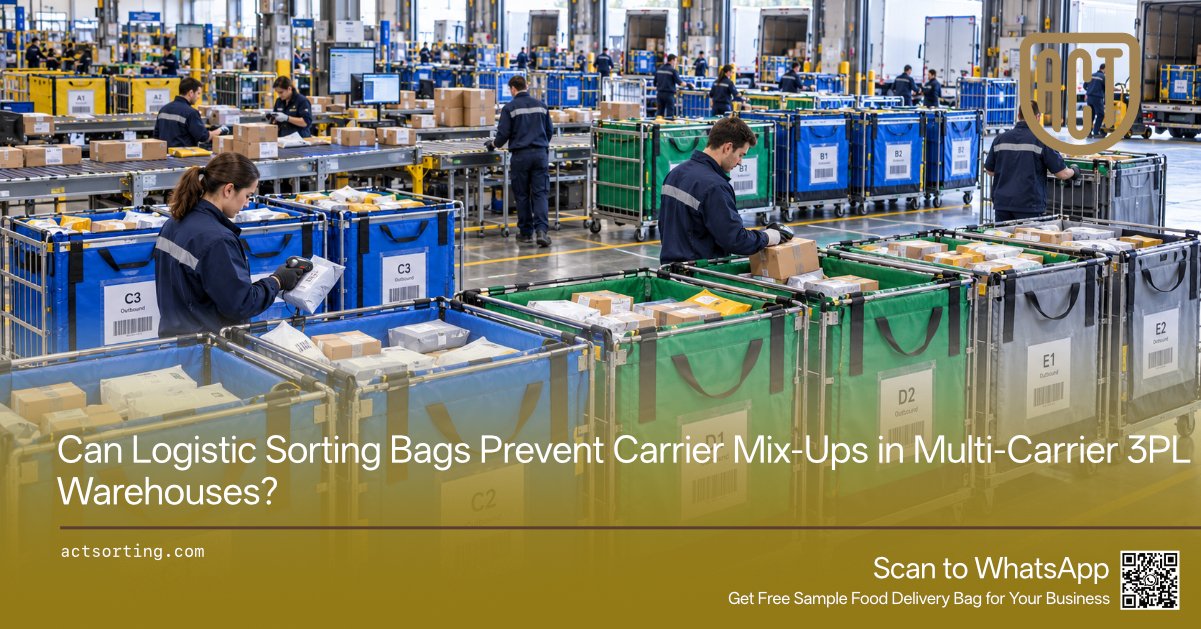
For example, a fulfillment facility may use blue sorting bags for one outbound carrier, green bags for another, and gray bags for regional courier collections. Alternatively, the bag body may remain the same color while webbing, binding, printed identification panels, or removable cards distinguish each carrier.
The correct approach depends on the number of shipping partners and the warehouse’s existing sorting procedures. A facility working with only three carriers may benefit from simple color separation, while a larger 3PL operation handling numerous shipping services may require a combination of carrier codes, barcode identification, and clearly defined staging areas.
Color alone should not determine where a parcel belongs. Carrier assignments still need to be confirmed through the warehouse management system and required scanning procedures. However, visual separation provides an additional opportunity for employees to notice that a parcel is entering an unexpected container.
ACTSORTING can manufacture coordinated Parcel Sorting Bags using different body colors, webbing colors, permanent printing, and transparent identification pockets. This allows procurement teams to establish a standardized bag family while maintaining visible differences between carrier groups.
For facilities handling large quantities of mixed e-commerce shipments, the benefit is improved physical separation during high-volume sorting. Employees can recognize the intended carrier group more quickly, supervisors can identify incorrectly positioned containers more easily, and completed parcel groups remain organized as they move toward the loading dock.
Clear Identification Reduces Wrong-Carrier Handover Risks
Carrier separation becomes particularly important during the final handover process. A warehouse may finish sorting correctly but still encounter problems when completed parcel groups move from staging areas into roll cages, collection zones, or outbound vehicles.
If several Logistic Sorting Bags look identical, employees may need to examine individual parcel labels or open multiple containers to determine which carrier should receive them. This creates unnecessary handling and increases the chance of placing a completed bag in the wrong collection area.
Large transparent identification pockets provide a practical solution. The pocket can display the carrier name or operational code, service category, destination hub, collection batch, barcode, or other shipping information required by the warehouse. A fixed pocket location also makes the information easier to find during sorting and loading.
ACTSORTING can customize pocket dimensions according to the customer’s existing route cards or carrier documents. Front-facing identification may be useful during sorting, while side-facing pockets can improve visibility when bags stand next to each other inside roll cages. Some operations may benefit from identification on more than one surface.
Permanent equipment identification can remain separate from temporary shipment information. A reusable bag may have a fixed asset number or warehouse ownership code, while the carrier assignment card changes according to the current sorting batch.
This distinction allows the same physical equipment to support different shipping programs without losing traceability within the warehouse’s reusable asset system.
For commercial logistics operators, consistent identification is more useful than adding labels wherever space happens to remain. ACTSORTING can incorporate the required label positions into the original OEM & ODM specification, helping warehouse teams maintain a recognizable identification system across different bag sizes and production batches.
Different Carrier Collection Times Require Better Staging Organization
Not every carrier arrives at the warehouse at the same time. Some operators collect parcels several times per day, while others follow a single scheduled pickup window. Express services may require earlier preparation, and regional carriers may have different collection arrangements depending on the destination.
These differences create pressure around outbound staging.
A warehouse may need to prepare one carrier’s shipments immediately while continuing to sort parcels for another provider. If completed bags, unfinished sorting groups, and late-arriving parcels occupy the same space without clear identification, employees can struggle to determine which containers are ready for collection.
Logistic Sorting Bags can support a more structured staging process by keeping parcels assigned to each collection group together. Temporary identification cards can show carrier information, collection batch, or scheduled dispatch window. Completed bags can move into designated staging lanes, while unfinished groups remain in the sorting area until verification is complete.
This approach is particularly useful for 3PL warehouses operating several collection waves throughout the day. Once one carrier’s collection has finished, the corresponding staging area can be cleared and prepared for the next outbound group without disturbing parcels assigned to other providers.
ACTSORTING can customize transparent pockets, bag dimensions, colors, and closures to support this process. Where appropriate, different identification card formats can distinguish completed shipments from groups still waiting for sorting or verification.
The bag itself does not establish whether a shipment has met the carrier’s acceptance requirements. That determination remains part of the operator’s scanning and handover procedures. Its role is to preserve the physical organization of parcels according to those procedures.
For warehouse managers, this creates a clearer relationship between collection schedules and staging space, reducing unnecessary movement when multiple carriers operate within overlapping dispatch periods.
Standardized Bag Dimensions Improve Sorting Lane and Roll Cage Utilization
A multi-carrier warehouse needs to accommodate different parcel volumes without allowing sorting equipment to consume excessive floor space. Some carriers may receive hundreds of parcels during a collection period, while others handle relatively small groups of specialized shipments.
Using the same large bag for every carrier can create unnecessary material usage and staging congestion. Conversely, bags that are too small may force employees to divide one carrier group into many separate containers, increasing the number of units that need to be identified and checked during handover.
Standardized bag dimensions can help balance these requirements. A warehouse may establish two or three approved capacities for different parcel volumes while maintaining consistent construction, identification pockets, and handling features.
ACTSORTING can customize Parcel Sorting Bags according to common parcel dimensions, sorting lane width, roll cage measurements, loading equipment, and expected working capacity. A rectangular bottom can help the bag maintain a predictable footprint inside staging areas, while reinforced side panels or optional support structures may improve handling stability.
The opening should also match the intended parcel mix. A wide rectangular opening can make it easier to place mixed cartons and poly mailers inside the bag without repeatedly adjusting the upper fabric. For operations using roll cages, dimensions can be developed around the available internal space so employees can organize several sorting bags within the same transport unit.
This is one reason procurement teams benefit from working with a customizable manufacturer. Instead of purchasing generic bags and later discovering that the dimensions interfere with existing warehouse equipment, customers can provide roll cage sizes, parcel profiles, and staging requirements during product development.
The benefit is more predictable equipment placement and better use of available warehouse space, particularly when multiple carrier groups need to remain separated before collection.
Reinforced Handles and Bottoms Support Repeated Warehouse Transfers
Parcel Sorting Bags in a multi-carrier warehouse may move several times before they leave the facility. Employees fill them at sorting stations, reposition them inside staging lanes, transfer them into roll cages, and finally move them toward outbound loading areas.
These repeated movements place stress on the bag’s handles, lower corners, seams, and bottom structure.
A sorting bag may contain a mixture of lightweight poly mailers and rigid cartons. Although the individual parcels are manageable, their combined weight can become substantial. If the handle webbing is attached to an insufficiently reinforced section of fabric, repeated lifting may weaken the stitching or surrounding material.
Similarly, bags that frequently contact concrete floors or metal roll cages can experience abrasion around the bottom and lower sidewalls. Reinforcing these areas can help extend practical service life without making the entire bag unnecessarily heavy.
ACTSORTING can customize woven polypropylene materials, laminated surfaces, reinforced bottoms, extended webbing, corner protection, and handle configurations according to the expected load and handling method.
Long webbing handles may suit certain transport requirements, while shorter side handles can provide better control when employees lift bags into roll cages. Some warehouses may benefit from multiple carrying positions depending on how the equipment moves through the facility.
The construction should also consider foldability. A completely rigid bag may remain stable while loaded but occupy unnecessary storage space when empty. ACTSORTING can combine targeted reinforcement with flexible body panels to balance strength, weight, and storage efficiency.
For 3PL operators, this creates a more practical reusable sorting tool. Durable construction helps reduce premature replacement, while suitable handles and dimensions make repeated transfers easier for warehouse employees.
Exception Parcels Need a Separate Sorting and Reverification Process
Multi-carrier logistics operations inevitably encounter shipments that cannot immediately follow the normal sorting process. A parcel may have an unreadable label, an incorrect carrier assignment, a missing shipping document, or dimensions that require special handling.
These parcels need to remain separate from completed outbound groups until the issue has been resolved.
If employees place exception shipments inside normal Parcel Sorting Bags simply to clear the sorting area, those parcels may accidentally enter the wrong carrier’s collection. Correcting the problem later can require additional tracking, communication, and transportation.
A dedicated exception process provides a clearer alternative. Parcels requiring further verification can be placed inside identified exception bags or a designated inspection area. After the warehouse confirms the correct carrier, service, and shipment status, the parcel can move into the appropriate outbound group.
ACTSORTING can manufacture exception sorting bags with distinct colors, printed markings, and transparent identification pockets. These bags can use the same reinforced handles, woven materials, and basic construction as standard Logistic Sorting Bags while remaining visually recognizable.
Different exception categories may also require separate handling. A parcel awaiting relabeling is not necessarily in the same situation as an oversized shipment or a package assigned to a carrier that has already completed collection. The warehouse should define these categories according to its operating procedures.
The advantage of using standardized exception bags is that unresolved parcels remain visible rather than disappearing among completed shipments. Supervisors can identify where further action is required, and sorting teams can maintain clearer separation between verified outbound groups and parcels still requiring attention.
A good sorting system does not assume every parcel will follow the expected process. It provides a controlled location for the parcels that do not.
Reusable Logistic Sorting Bags Support More Efficient Equipment Circulation
Reusable sorting bags do not finish their working cycle when the outbound carrier collects the parcels. Depending on the operating model, empty bags may return to the warehouse after unloading, remain within a closed logistics network, or circulate between associated facilities.
This creates another equipment management requirement.
If empty bags are difficult to fold, they may occupy unnecessary storage space. If the warehouse cannot identify which location owns them, equipment may accumulate in one facility while another experiences shortages. Different carrier programs can also create confusion when temporary shipment labels remain attached after the bag becomes empty.
ACTSORTING can customize flexible woven structures, folding methods, permanent equipment IDs, removable identification cards, and integrated securing straps to support the return process.
The distinction between bag ownership and temporary carrier assignment is particularly important. A permanent warehouse asset number can remain on the bag, while the carrier card is removed or replaced after each sorting cycle. This allows the same reusable equipment to be reassigned where the operator’s process permits it.
Material selection should also account for repeated use. Laminated woven surfaces may provide practical advantages for routine cleaning, while reinforced lower sections can protect areas exposed to warehouse floors and transport equipment.
For larger 3PL networks, standardized empty-bag dimensions can simplify storage and redistribution. Employees can fold, count, and prepare bags for the next sorting wave without managing numerous incompatible products.
ACTSORTING’s OEM & ODM capabilities allow these return requirements to influence the original product specification. The bag can be designed for both loaded transportation and empty circulation rather than being optimized for only one stage of its working life.
Why Choose ACTSORTING for Customized Multi-Carrier Sorting Bags?
A 3PL warehouse handling several delivery providers needs more than a collection of generic reusable sacks. The sorting equipment must support carrier separation, identification, staging, repeated handling, and compatibility with existing warehouse infrastructure.
ACTSORTING develops Logistic Sorting Bags and Parcel Sorting Bags around these practical requirements.
Founded in 2013, ACTSORTING operates a manufacturing facility covering more than 12,000 square meters in Yangchun, Guangdong, China, with more than 400 employees. BSCI and ISO9001 certification provide additional support for responsible manufacturing and structured quality management.
For commercial logistics customers, ACTSORTING offers OEM & ODM customization covering woven material selection, lamination, dimensions, reinforced bottoms, webbing handles, transparent identification pockets, closures, color coding, logo printing, and folding structures.
The company can work from existing samples, technical drawings, warehouse photographs, roll cage measurements, parcel profiles, and current operational problems. This allows the bag specification to reflect the customer’s actual sorting environment.
For example, one warehouse may require multiple colors to distinguish carrier groups. Another may prioritize larger label pockets because the existing identification cards are difficult to read. A high-volume fulfillment center may need reinforced bottom panels and standardized dimensions to fit its roll cages.
These requirements can be evaluated during sampling before the project moves into commercial production.
ACTSORTING can also support coordinated product families rather than isolated bag models. Small, medium, and large Parcel Sorting Bags can share the same material standards, identification layout, and branding while serving different parcel volumes.
The practical reason to choose ACTSORTING is the ability to translate warehouse requirements into a manufacturable product specification and reproduce that design as the customer’s sorting operation develops.
Consistent Bulk Production Supports 3PL Warehouses and Regional Logistics Networks
A sorting bag system becomes easier to manage when the same product specifications remain available across warehouses and future purchase orders.
For a 3PL provider operating several fulfillment centers, inconsistencies between bag batches can create avoidable problems. Different dimensions may affect roll cage compatibility. Identification pockets positioned incorrectly may interfere with scanning procedures. Variations in handle length or reinforcement can change how employees move loaded bags.
These differences become particularly inconvenient when reusable equipment circulates between regional facilities or when employees transfer between locations.
ACTSORTING can use approved samples and confirmed technical specifications as references for bulk manufacturing. Materials, finished dimensions, tolerances, webbing, handle positions, reinforcement, identification pockets, closures, colors, printing, folding structures, and packaging can be established before production.
This supports standardized procurement across multiple facilities while allowing controlled variations for different carrier groups or parcel capacities.
Repeat production is equally important. E-commerce order volumes change throughout the year, and warehouses may require additional sorting equipment during promotional periods or seasonal peaks. New fulfillment centers may also need the same approved products when operations expand.
ACTSORTING’s manufacturing facility and workforce support customized bulk orders, multi-location procurement programs, seasonal requirements, and repeat manufacturing.
For third-party logistics providers, parcel consolidation facilities, e-commerce fulfillment centers, distribution warehouses, and courier networks handling multiple shipping partners, the next sorting bag project should begin with the carrier separation process.
Procurement teams can provide the number of carrier groups, average parcel volume, common carton sizes, roll cage measurements, identification card formats, preferred colors, expected load, closure requirements, branding, and target quantity to develop a customized Logistic Sorting Bags specification with ACTSORTING.
In a multi-carrier warehouse, sorting accuracy depends on maintaining clear boundaries between shipment streams. Well-designed Logistic Sorting Bags and Parcel Sorting Bags help preserve those boundaries from the first sorting station to the final carrier handover.
FAQ
Q: Are Logistic Sorting Bags suitable for multi-carrier 3PL warehouses?
A: Yes. Logistic Sorting Bags can help organize parcels by carrier, shipping service, destination group, or collection batch. Customized colors, identification pockets, and bag dimensions support physical separation between different shipment streams.
Q: Can ACTSORTING customize Parcel Sorting Bags with different carrier colors?
A: Yes. ACTSORTING can customize bag body colors, webbing colors, binding, printed markings, and transparent identification pockets according to the warehouse’s carrier separation system.
Q: Can Parcel Sorting Bags fit standard warehouse roll cages?
A: Bag dimensions can be developed according to the customer’s roll cage measurements, sorting equipment, staging layout, and expected parcel volume. Compatibility should be confirmed during sampling.
Q: Can separate sorting bags be produced for exception parcels and returns?
A: Yes. ACTSORTING can manufacture coordinated sorting bags with distinct colors, printed status information, identification pockets, and customized closures for exception handling, returns, and other warehouse procedures.
Q: Why choose ACTSORTING for bulk Parcel Sorting Bags?
A: ACTSORTING has specialized in commercial logistics bags since 2013, operates a manufacturing facility exceeding 12,000 square meters with more than 400 employees, holds BSCI and ISO9001 certification, and provides OEM & ODM development, customized bulk manufacturing, and repeat production support.