

Table of Contents
- First-Mile Parcel Collection Creates Sorting Problems Before Parcels Reach the Warehouse
- Merchant-Specific Parcel Sorting Bags Keep Different Pickup Orders Separate
- Clear Identification Improves Parcel Verification at Every Collection Stop
- Different Merchant Volumes Require Flexible Sorting Bag Capacities
- Reinforced Handles and Bottoms Support Repeated Vehicle Loading
- Secure Closures Protect Small Parcels During Multi-Stop Collection Routes
- Organized Sorting Bags Simplify Receiving at Regional Parcel Hubs
- Reusable Logistic Sorting Bags Need an Efficient Return and Storage System
- OEM & ODM Customization Connects Sorting Bags to First-Mile Collection Workflows
- Why Choose ACTSORTING for Commercial Parcel Sorting Bags?
Introduction
A courier vehicle stops outside a small online retailer’s warehouse to collect forty parcels. Twenty minutes later, the same driver collects another thirty packages from a clothing store, followed by several bags of e-commerce orders from a neighborhood parcel collection point. By the time the vehicle returns to the regional sorting hub, it contains shipments from multiple businesses, each with different order volumes, package sizes, and collection records.
Collecting the parcels is only part of the work. The more difficult question is what happens when the driver arrives at the warehouse and needs to unload everything.
If packages from different pickup locations have become mixed during transportation, warehouse employees may need to scan, separate, and reorganize them before normal destination sorting can begin. Small poly mailers can become trapped beneath cartons, unidentified parcels may require additional verification, and employees may struggle to reconcile the physical load with individual merchant collection records. The courier has completed the collection route, but the warehouse now needs to repeat part of the organization that should have been maintained during pickup.
This is where Logistic Sorting Bags and Parcel Sorting Bags can provide practical value. By keeping parcels from different merchants or collection stops inside clearly identified reusable containers, logistics companies can preserve their pickup groups throughout vehicle loading, transportation, and warehouse receiving. The bags create a physical boundary around each collection batch while allowing individual packages to remain accessible for scanning and subsequent destination sorting.
For courier companies, postal networks, e-commerce logistics providers, parcel collection operators, third-party logistics companies, and regional distribution centers, the objective is to reduce unnecessary rehandling between the first pickup and the initial sorting process.
ACTSORTING has specialized in commercial logistics bags since 2013. The company operates a manufacturing facility covering more than 12,000 square meters in Yangchun, Guangdong, China, with over 400 employees. Supported by BSCI and ISO9001 certification, ACTSORTING provides OEM & ODM manufacturing for Logistic Sorting Bags, Parcel Sorting Bags, Courier Sorting Totes, and other reusable parcel handling equipment. Customers can customize woven materials, dimensions, reinforced bottoms, webbing handles, transparent identification pockets, closures, colors, logos, and folding structures according to their collection workflows.
For first-mile logistics, a well-designed sorting bag does more than carry parcels. It helps preserve the work completed at every pickup location until the shipments reach the next processing stage.
First-Mile Parcel Collection Creates Sorting Problems Before Parcels Reach the Warehouse
First-mile parcel collection connects merchants, stores, warehouses, and collection points with the wider delivery network. Unlike last-mile distribution, where parcels have already been assigned to delivery routes, first-mile operations gather shipments from multiple sources before they enter a sorting facility. The driver may collect five parcels from one merchant and several hundred from another during the same route, often working within scheduled pickup windows and limited vehicle space.
The difficulty is that collected parcels may share the same vehicle without sharing the same operational identity. Each merchant has separate collection records, shipment quantities, and handover requirements. If packages are loaded loosely, the driver may gradually create a mixed cargo area where cartons and mailers from several businesses sit together. The packages still carry shipping labels, but their original collection groups become harder to recognize without scanning individual items again.
This can create additional work at the receiving facility. Employees may need to determine which packages belong to each collection batch, investigate discrepancies between recorded and received quantities, or isolate parcels with incomplete information. In a busy regional hub, that work competes with the primary task of sorting shipments toward their next destinations.
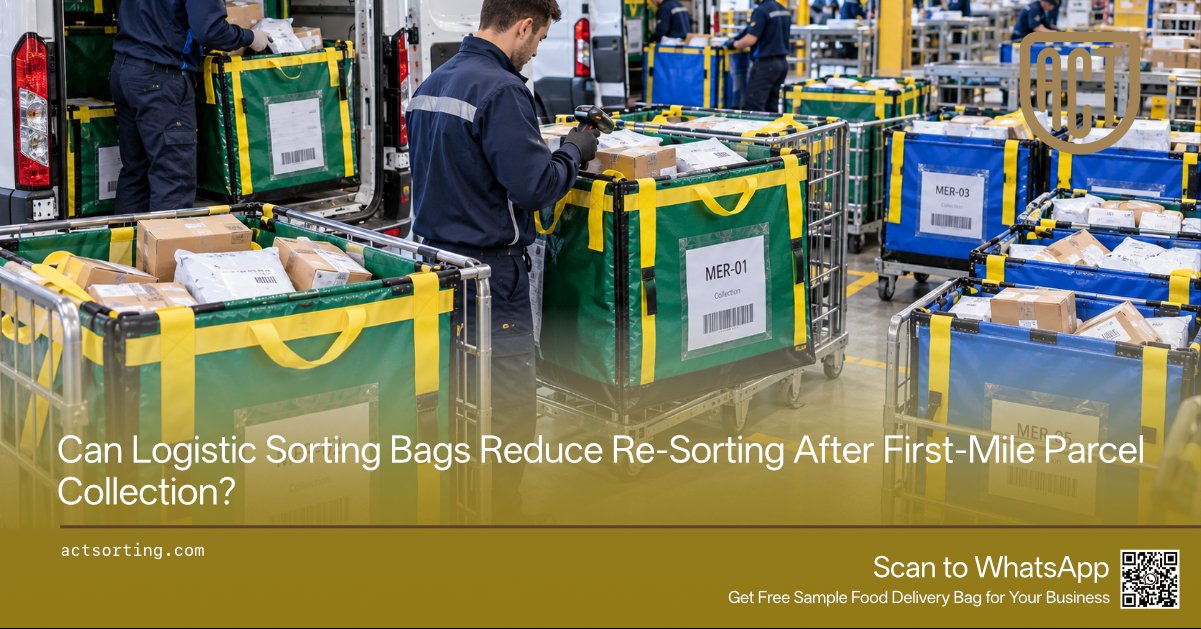
Logistic Sorting Bags can maintain collection groups as physical units. At each merchant location, packages can be placed into an identified bag, or an existing merchant-prepared bag can be collected after the appropriate verification. The completed unit travels with the vehicle until it reaches the sorting facility, where receiving employees can identify its origin before opening it for further processing.
This approach does not eliminate shipment-level scanning or guarantee that every merchant has prepared its parcels correctly. It reduces the chance that otherwise distinct pickup groups become mixed during transportation. For operators collecting shipments from many locations, that distinction can make receiving more orderly and exception investigation easier.
Merchant-Specific Parcel Sorting Bags Keep Different Pickup Orders Separate
A first-mile collection route often involves several merchants with very different shipping profiles. A clothing retailer may generate dozens of flexible poly mailers, an electronics seller may prepare rigid cartons, and a local fulfillment provider may hand over packages of many different dimensions. If all those shipments enter the same vehicle without physical separation, the driver may spend additional time organizing them while the route is already underway.
Merchant-specific Parcel Sorting Bags provide a practical grouping method. Each bag can be assigned to a store, pickup account, or collection batch, with identification showing the corresponding merchant or stop reference. Packages belonging to that group remain inside the same container until the next controlled handover. If a merchant produces more parcels than one bag can accommodate, several bags can carry matching references and sequence numbers, such as Bag 1 of 3 or Bag 2 of 3.
This structure is particularly useful when drivers collect from shopping districts, retail fulfillment locations, business parks, and small e-commerce warehouses. A courier can place the completed bag inside the vehicle without creating a loose pile that must later be separated from other merchants’ shipments. When the vehicle returns to the hub, receiving staff can recognize the group and follow the appropriate intake procedure.
ACTSORTING can customize Parcel Sorting Bags according to merchant volume, common parcel dimensions, and expected carrying load. A compact model may suit smaller shops, while larger rectangular bags can accommodate higher-volume collection points. The bags can share consistent webbing, closures, identification pocket positions, and materials, allowing employees to recognize the same equipment system regardless of capacity.
The benefit is not that every merchant needs a permanently dedicated bag. Reusable bags can be reassigned between collection cycles where the operator’s process permits it. What matters is that each active collection group retains a clear identity during transportation and receiving, reducing the need to reconstruct that grouping after the parcels reach the warehouse.
Clear Identification Improves Parcel Verification at Every Collection Stop
The physical organization of collected parcels becomes much more reliable when employees can identify each sorting bag without opening it. On a multi-stop collection route, the driver may handle several visually identical bags in rapid succession. A small handwritten note or loosely attached paper label can become hidden, damaged, or separated from the correct bag during vehicle loading.
A large transparent identification pocket provides a consistent place for collection information. Depending on the courier company’s existing procedures, the pocket can hold a merchant code, pickup location, collection batch number, route card, barcode, QR code, or other reference. The driver can confirm the bag’s assignment at collection, while warehouse employees can use the same information during receiving.
Pocket position should reflect how the bag is handled. A front-facing pocket may be convenient when employees collect bags from a shop entrance, while a side-facing identification area may remain more visible when several Parcel Sorting Bags are arranged beside one another inside the vehicle. ACTSORTING can customize pocket dimensions, placement, opening direction, and reinforcement according to the customer’s existing identification cards and scanning process.
Permanent equipment identification should remain separate from temporary collection information. A reusable bag may carry a fixed asset number, depot code, or ownership marking while its merchant assignment changes with each collection cycle. This allows the logistics operator to manage its equipment inventory without confusing the identity of the bag with the identity of the parcels currently inside.
For first-mile operations, this distinction supports clearer handovers. The driver can identify which collection group is being loaded, the receiving facility can match that group with the collection record, and reusable equipment can be tracked independently. The result is a more consistent physical process that supports the digital shipment information already used by the logistics network.
Different Merchant Volumes Require Flexible Sorting Bag Capacities
One of the challenges in first-mile collection is the variation in parcel volume between merchants. A small retail store may prepare only a handful of outgoing packages each day, while an established online seller may generate several hundred shipments during the same collection period. Using one oversized bag for every merchant wastes vehicle space, but using bags that are too small increases the number of physical units drivers must handle.
A more practical system offers several standardized capacities. Smaller Parcel Sorting Bags can accommodate compact pickup groups, while larger Logistic Sorting Bags support higher-volume merchants or consolidated collection points. The dimensions should reflect not only the number of parcels but also their typical size, weight, and shape. A bag carrying mostly clothing mailers requires different capacity planning from one containing rigid household-product cartons.
ACTSORTING can customize length, width, height, opening dimensions, and bottom structure around the expected parcel profile. Rectangular bag bodies can provide a predictable footprint for vehicle organization, while wide openings allow employees to load mixed cartons and mailers without repeatedly adjusting the upper fabric. Where the intended application requires additional stability, reinforced bottoms or removable support panels can be considered.
Vehicle compatibility should be included during development. First-mile collection vehicles may have different shelving arrangements, cargo dimensions, and loading methods. A large bag that is convenient inside a warehouse can become awkward when employees need to place several units inside a smaller commercial vehicle. Standardized capacities should therefore be selected around both merchant volumes and vehicle storage requirements.
Choosing ACTSORTING allows logistics operators to develop coordinated bag families instead of purchasing unrelated sizes from several suppliers. The same identification pocket, handle style, color system, and material specification can be retained across different capacities, making equipment easier for drivers and warehouse teams to recognize and manage.
Reinforced Handles and Bottoms Support Repeated Vehicle Loading
First-mile collection bags often experience more handling than their appearance suggests. A bag may begin the day empty inside a depot, move into a courier vehicle, be carried into a merchant’s dispatch area, receive parcels, return to the vehicle, and later be unloaded at the regional sorting hub. Once emptied, it may reenter the same collection cycle.
These repeated movements place stress on webbing handles, seams, lower corners, and bottom panels. The combined weight of several cartons can become substantial, particularly when a bag contains dense retail products rather than lightweight mailers. If handles attach to insufficiently reinforced fabric, repeated lifting may weaken the surrounding stitching. A bottom that regularly contacts concrete floors or vehicle surfaces may also experience concentrated abrasion.
ACTSORTING can customize reinforced woven materials, extended webbing handles, attachment patches, lower corner protection, and additional bottom layers according to expected commercial loads. Handle placement should follow the actual movement method. Long carrying handles may be practical for lighter bags, while shorter side handles can provide greater control when lifting larger units from store floors or vehicle cargo areas.
The objective is not to make every panel unnecessarily thick. Stronger material should be concentrated around areas exposed to repeated load and contact. A reinforced bottom can support the weight of mixed parcels, while more flexible sidewalls allow the bag to remain manageable when empty.
These details become especially relevant for networks performing several collection waves each day. A reusable Logistic Sorting Bag may pass through numerous loading and unloading movements before reaching the end of its service life. Consistent construction helps reduce premature wear and allows employees to use familiar handling methods across different collection locations.
For procurement teams, this is one reason to evaluate the complete bag structure rather than comparing only fabric thickness and unit price. The useful product is one whose handles, bottom, seams, and body remain suited to repeated commercial handling.
Secure Closures Protect Small Parcels During Multi-Stop Collection Routes
First-mile collection vehicles often carry a mixture of small parcels, lightweight poly mailers, document envelopes, and rigid cartons. As the driver visits additional merchants, loaded bags may be repositioned inside the vehicle to create space for new collection groups. These movements can cause packages to shift, particularly when the containers remain open.
A secure closure can help keep smaller parcels inside their assigned collection bag during transportation. The appropriate design depends on the frequency of access and the types of shipments being carried. A zipper may provide more complete enclosure for certain workflows, while a hook-and-loop flap or covered opening may allow faster access when employees regularly add packages.
ACTSORTING can customize closure style, opening width, flap dimensions, zipper position, and upper-edge reinforcement according to the customer’s requirements. A bag intended for a single collection handover may have different access needs from one used repeatedly during a multi-stop route. In either case, the closure should remain practical when the bag is partially filled and should not interfere with the carrying handles.
The opening must also accommodate the parcel mix. A narrow opening may create unnecessary difficulty when employees load medium-size cartons, even if the bag has adequate internal capacity. A wider rectangular opening can improve access, while the selected closure provides containment once loading is complete.
For collection routes involving many small packages, this balance between accessibility and containment is important. The goal is to allow employees to load parcels efficiently without leaving them exposed throughout every vehicle movement. The bag provides an additional physical boundary around each merchant group, supporting cleaner handovers and reducing the likelihood of loose parcels becoming mixed with neighboring collections.
Organized Sorting Bags Simplify Receiving at Regional Parcel Hubs
When a first-mile collection vehicle reaches the regional sorting hub, employees need to transfer the collected shipments into the facility’s receiving and sorting process. The speed and accuracy of this handover depend partly on how well the parcels were organized during collection.
A vehicle filled with loose mixed packages gives the receiving team little physical information about where the shipments originated. Employees may need to unload cartons individually, scan parcels, and separate collection groups before beginning the next stage. This can create congestion around receiving areas, especially when several vehicles arrive close together.
When parcels remain inside identified Logistic Sorting Bags, employees can unload clearer physical groups. The bag identification indicates the merchant, collection point, or pickup batch, while shipment-level scans confirm the parcels received. After the required checks, the contents can enter the warehouse’s normal destination sorting process.
This distinction is essential. A merchant-specific bag is not necessarily a destination-sorted bag. The parcels inside may be traveling to many different cities, regions, or delivery networks. The purpose of the first-mile container is to preserve the collection group until the receiving process is complete, not to replace subsequent sorting by destination.
ACTSORTING can customize bag structures for this transition. Reinforced handles support unloading, wide openings allow employees to access the contents, and transparent identification pockets help receiving staff locate the relevant collection reference without searching through the parcels. Standardized bag dimensions may also improve compatibility with receiving platforms, roll cages, and temporary staging arrangements.
For logistics operators, the operational advantage is continuity. Parcels collected as one group remain recognizable when they arrive at the hub, making it easier to reconcile incoming batches before the shipments move into the next sorting stage.
Reusable Logistic Sorting Bags Need an Efficient Return and Storage System
Reusable sorting bags offer practical value only when the logistics company can return them to service efficiently. After parcels are emptied at the regional hub, the bags need to be inspected, organized, stored, and redistributed to collection vehicles or merchant locations according to the operating model.
This creates a reverse movement that is easy to overlook during procurement. A bag may perform well while full but become inconvenient if its structure occupies excessive space when empty. For courier networks operating hundreds of collection stops, accumulated empty bags can consume substantial vehicle and depot storage space if they cannot be folded or bundled effectively.
ACTSORTING can customize flexible woven structures, folding methods, reinforced wear zones, and securing straps to support empty equipment circulation. Depending on the application, removable bottom components may help balance loading stability with compact storage. Permanent bag IDs can also assist operators in counting and redistributing reusable equipment between facilities.
The return process should reflect who owns and controls the bags. Some networks may keep sorting bags entirely within courier operations, transferring parcels from merchant containers at the collection point. Others may provide reusable bags to regular merchants and collect filled units during scheduled visits. These models require different inventory and handover procedures.
Material selection should support repeated handling and cleaning where necessary. Laminated woven surfaces may make routine wiping more practical, while reinforced bottom panels protect areas exposed to loading floors and vehicle contact. The bag should remain usable throughout multiple cycles without requiring a new container for every collection.
For procurement teams, evaluating the full cycle is more valuable than evaluating only the outbound trip. The ideal Logistic Sorting Bag supports pickup, transportation, warehouse receiving, empty return, storage, and redeployment as one connected process.
OEM & ODM Customization Connects Sorting Bags to First-Mile Collection Workflows
Different first-mile logistics networks use different collection methods. A courier collecting from small retail stores may need compact bags with quick-access openings, while a network serving large e-commerce merchants may prioritize higher capacity, stronger handles, and clearly visible batch identification. Parcel collection points may also require standardized containers that fit existing shelves or storage areas.
A suitable sorting bag specification should begin with the actual workflow. Procurement teams can provide information about merchant types, average parcel counts, common dimensions, expected load, collection frequency, vehicle layout, scanning procedures, and existing equipment problems. This helps determine which features are operationally useful rather than adding unnecessary components.
ACTSORTING’s OEM & ODM capabilities cover bag dimensions, woven material selection, laminated surfaces, reinforced bottoms, webbing handles, closures, transparent identification pockets, colors, logos, printed collection codes, and folding structures. Customers can provide existing samples, technical drawings, reference photographs, or descriptions of current handling difficulties during product development.
For example, a network may report that small merchant packages become mixed inside collection vehicles. The new design may require smaller identifiable bags and secure closures. Another operator may need larger transparent pockets because its existing batch documents do not fit standard holders. A high-volume collection service may require stronger bottoms and longer webbing attachment areas because loaded bags are handled repeatedly throughout the day.
ACTSORTING can use these requirements to develop samples that are evaluated under normal collection and receiving conditions. Employees can load representative parcels, move the bags between merchant and vehicle, check identification, unload them at the hub, and evaluate empty storage. The resulting feedback can guide adjustments before bulk production.
The advantage is a product designed around the customer’s first-mile process rather than a generic sack that happens to have enough internal capacity.
Why Choose ACTSORTING for Commercial Parcel Sorting Bags?
A reusable first-mile sorting bag needs to serve several different operational environments. It may begin at a merchant’s dispatch area, travel inside a collection vehicle, pass through a regional warehouse, and return empty for another pickup cycle. Its performance depends on how well the material, handles, identification, closure, bottom reinforcement, and dimensions work together.
ACTSORTING develops Logistic Sorting Bags and Parcel Sorting Bags around these repeated commercial requirements. Founded in 2013, the company operates a manufacturing facility covering more than 12,000 square meters in Yangchun, Guangdong, China, with over 400 employees. BSCI and ISO9001 certification provide additional support for structured manufacturing and responsible production practices.
For courier companies, e-commerce collection networks, postal operators, 3PL providers, and regional logistics hubs, ACTSORTING offers customization that goes beyond changing a logo or selecting a different bag color. Product dimensions can be matched to vehicle space and merchant parcel profiles, handles can be developed around expected loads, and transparent identification pockets can support the customer’s existing collection records.
The company can also manufacture coordinated sorting bag ranges. Small, medium, and large bags may use different capacities while retaining consistent identification, material standards, webbing construction, and branding. This helps drivers and receiving staff work with familiar equipment regardless of which merchant or collection route they are handling.
Bulk manufacturing consistency is equally important. Once the sample and technical specification are approved, ACTSORTING can use them as references for production requirements covering dimensions, materials, stitching, reinforcement, closures, pocket positions, colors, printing, and packaging. This helps support repeat orders and expansion into additional collection routes without changing the equipment system unnecessarily.
For companies planning to improve first-mile parcel collection, the next sorting bag project should begin with the movement between merchant and regional hub. Provide typical pickup quantities, common parcel sizes, expected load, vehicle arrangements, collection identification requirements, handle and closure preferences, material needs, colors, branding, and target order quantity to develop a customized manufacturing proposal.
The first sorting decision in parcel logistics is not always about the final destination. Sometimes it is simply about making sure parcels collected from different businesses remain organized until the warehouse is ready to process them.
Well-designed Logistic Sorting Bags and Parcel Sorting Bags help preserve that organization, reducing unnecessary rehandling between the first collection stop and the regional sorting hub.
FAQ
Q: What are Logistic Sorting Bags used for in first-mile parcel collection?
A: Logistic Sorting Bags help group parcels collected from merchants, retail stores, e-commerce warehouses, and parcel collection points before transportation to a regional sorting facility. They support pickup identification, handling, and receiving organization.
Q: Can Parcel Sorting Bags be customized for different merchant collection volumes?
A: Yes. ACTSORTING can manufacture sorting bags in different capacities with customized dimensions, reinforced handles, bottoms, closures, and identification pockets while maintaining a consistent product system.
Q: Can ACTSORTING add merchant codes, QR codes, or barcode identification areas?
A: Yes. Transparent identification pockets, printed merchant codes, asset numbers, barcode areas, QR code positions, and other operational markings can be customized according to the customer’s collection and receiving procedures.
Q: Are reusable Logistic Sorting Bags suitable for repeated collection routes?
A: Yes. Material, reinforcement, handles, closures, and foldable structures can be developed for repeated commercial handling. The appropriate specification depends on parcel load, collection frequency, operating environment, and return procedures.
Q: Why choose ACTSORTING for bulk Parcel Sorting Bags?
A: ACTSORTING has specialized in commercial logistics bags since 2013, operates a manufacturing facility exceeding 12,000 square meters with more than 400 employees, holds BSCI and ISO9001 certification, and supports OEM & ODM development, customized bulk production, coordinated bag ranges, and repeat orders.