

Table of Contents
- Destination Groups Break When Loose Parcels Travel Between Sorting Hubs
- Sizing Bags from Manual Lifts, Pallet Footprint, and Trailer Clearance
- Closures That Stay Shut from Outbound Sort to Inbound Dock
- Woven Bodies at Open Docks: What Laminated Faces Do and Do Not Do
- Handle Placement and Pallet Fit for Manual and Mechanized Loading
- Identification Faces That Support Handover at a Second Site
- How Filled Bags Ride in the Trailer Without Treating the Bag as Cargo Restraint
- Identifying and Handing Over Destination Groups at the Receiving Hub
- Empty Bags on the Backhaul: Fold and Density Checked on the Sample
- What Buyers Should Send for a Linehaul Sorting-Bag Build
Destination Groups Break When Loose Parcels Travel Between Sorting Hubs
A hub-to-hub linehaul is a different job from moving a destination group across one building. Cartons sorted for a receiving hub, an inbound door, or a region have to leave the origin sort, ride in a trailer for the length of the trip, and be accepted by a team that did not pack them. When those parcels are loaded as a loose pile, the group begins to come apart long before the receiving dock. Small packages slide into gaps at the threshold or under other cartons; items for one inbound door mix with items for another; a carton left on the origin dock, or crushed at the bottom of a mixed stack, is easy to miss. Hours later, the trailer can arrive looking full, but the destination count no longer matches the origin sort, and the receiving hub has to rebuild groups it never packed.
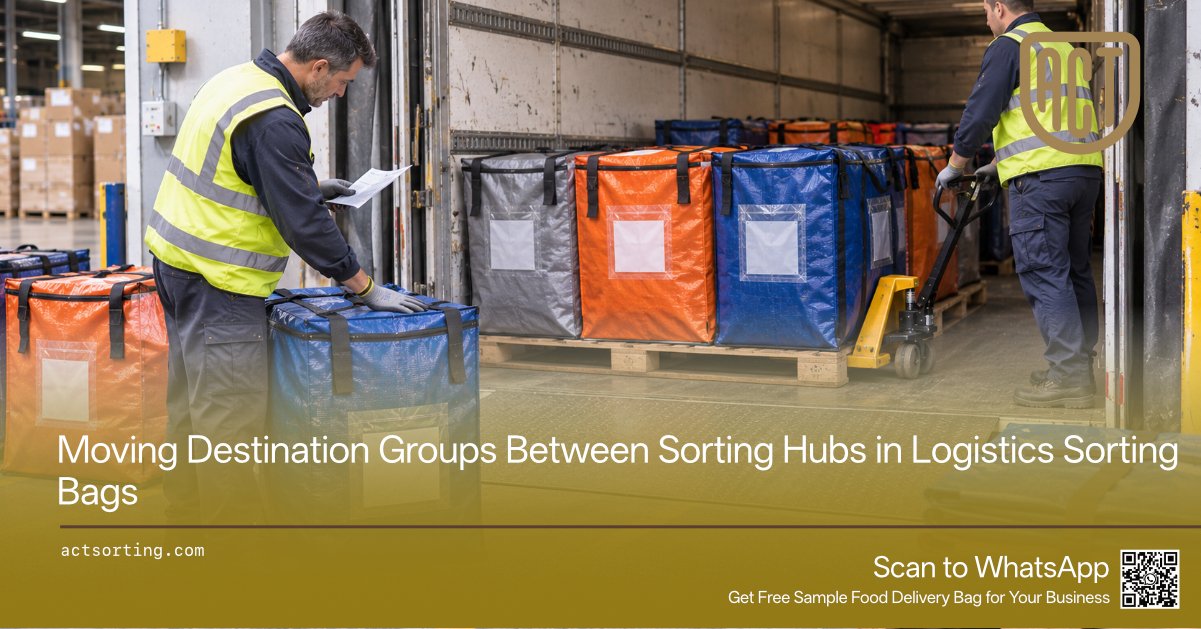
The useful loading unit for that trip is the bag. Parcels for one destination are packed and closed at the origin sort, then staged as filled bags—on a pallet the site already uses, or, only where the filled bag is genuinely small enough to lift, as a single unit on the dock—before they enter the trailer. The bag keeps that destination together for the whole facility-to-facility ride. The trailer, the dock, and the pallet are only the environment. A trailer is built to move volume between hubs. It does not, by itself, keep one inbound door’s parcels from mixing with another, or tell a receiving team which load belongs to which destination. Reusable logistics sorting bags take on that grouping work so a destination load can travel between hubs and still arrive as the group that left the origin sort.
A filled bag that stands on a pallet or on the trailer floor still has to survive the length of the trip and a handover at the other end. Grouping the parcels is not the same as restraining the load, and it is not the same as a receiving check. The cycle to design is: sort and close the bag by destination at origin; load it by the method the dock already uses—pallet and existing lift equipment, or a manual lift only where the filled bag is actually handled that way; stand it for the linehaul; identify and accept it at the receiving hub; open it at the inbound sort; and send empty bags back in a fold that has been checked on that bag.
Sizing Bags from Manual Lifts, Pallet Footprint, and Trailer Clearance
Bag size for a linehaul destination group should be taken from how the bag is actually loaded, not from a catalog litre figure. The first distinction is the loading method. A large filled sorting bag should not be assumed to enter the trailer as a two-person carry. Manual handling is a real path only when the filled bag is light and compact enough for the people on that dock to lift, and when the site already moves bags that way. In that case, the limits are the clear lift across the dock plate, the door, and the threshold, and how many such bags a team can move without setting a load down mid-path. Handle projection, side straps, and label pockets belong in that clearance, and the filled outer size should be quoted as the bag will travel, with the mouth closed when a zipper or fold-over lid is used.
When bags are palletized, size is taken from the pallet the site already uses and from the equipment that moves that pallet: a pallet jack, a forklift, or whatever lift already works at that door. The questions are how many filled bags stand in a single layer on the pallet without hanging over the edge, whether the packed height still clears the trailer door and the dock leveler, and whether the load on the pallet stays stable under the wrap or other restraint the operator already uses. A bag that would pass a door as a hand-carried unit can still be the wrong footprint for the pallet, too tall once it stands with others, or too narrow to sit stably without overhang. Standing a second layer of filled bags on the first should not be treated as the usual way to pack a pallet or a trailer. That arrangement belongs in the brief only when the site already requires two-layer loading and the stability and load conditions of that stack have been checked.
If the same bag program has to serve more than one loading method or more than one door, size should be locked against the tighter recurring condition—the smaller pallet, the lower door, or the manual lift that is still required at one site—not against the most generous trailer on the yard. Photographs of the pallet, the door, and the dock, with a tape in frame, plus a note of how bags actually move today, give a better basis than a requested capacity in litres. From those constraints a filled outer size can be worked out and then checked on a sample against the pallet and the door. Until that check is done, the size remains a sample dimension, not a fit that can be assumed for every trailer or every pallet on the yard.
Closures That Stay Shut from Outbound Sort to Inbound Dock
The mouth has two jobs in this cycle, and they pull in different directions. At the outbound sort, the bag has to accept parcels quickly, often from a belt or a nearby stack, while a destination group is still being built. On the dock and in the trailer, that same mouth has to stay shut for the length of the trip, including any wait at either dock, so the group does not spill on a plate, at a threshold, or when the trailer moves. The next people to open the bag are usually at the receiving sort—in a different building, and in a team that did not pack it. An open-top body is faster at a continuous sort face: there is no slider to run and no lid to clear before the next carton goes in. The cost appears as soon as the bag is tilted, bumped, or stood on a moving floor. An open mouth can shed the upper layer on a dock plate, along a trailer threshold, or against a neighboring bag when the trailer takes a corner or a brake. For a hub-to-hub trip, that risk lasts for the whole ride, not only for a short move across one site.
A zipper lid or a fold-over lid is the usual way to close the bag for travel. The mouth is filled at the sort, closed before the bag is loaded, and opened again at the inbound sort so the destination group can be processed as a unit. PP woven parcel sorting bags with a zipper lid and multi-point handles show one construction used when the bag must travel closed and still be lifted or positioned from more than one side. A zipper with more than one pull can be useful when bags stand close together on a pallet or a trailer floor, because the mouth can be opened from the side that still faces the aisle or the door. A fold-over lid, when specified, covers the mouth without a zipper line; it has to be designed so the flap stays down in travel and does not add a bulky fold that catches on a door frame or a pallet edge. Neither closure is a cargo lock, a seal record, or a substitute for however the operator already secures the trailer or pallet load. Closing the bag keeps the destination group inside the textile. It does not lock the trailer, record who opened the load, or restrain neighboring cargo.
The brief should say whether the bag must travel closed, not only that a “secure mouth” is wanted. If bags only move a short distance at one site, some operations will accept an open-top bag that is not filled above a working line and is handled with care on the plate. If the bag must ride a linehaul trailer between hubs, a closable mouth is usually the more practical tradeoff, at the cost of a few seconds at each sort face and a zipper or flap that still has to clear the door. That choice is settled on a sample in the real sequence—fill, close, load by the method the dock already uses, ride the linehaul, hand over at the receiving hub, and open at the inbound sort—rather than as a locked specification taken from a catalog page.
Woven Bodies at Open Docks: What Laminated Faces Do and Do Not Do
An outbound or inbound dock is often an open edge: rain and spray at the door, water on the plate, a wet trailer floor, or a wipe-down after a spill. The bag body that stands in that environment is commonly a PP woven fabric, either left uncoated or given a laminated or coated outer face. In many of those open-dock conditions, a laminated or coated face sheds splash more readily than an uncoated weave and is easier to wipe down, because water and dirt sit on a smoother surface instead of wetting into the yarn. That difference matters when bags are set down on a damp plate, brushed against a wet door seal, or cleaned between trips. It is a facing choice, not a reason to treat the bag as a weather enclosure.
Water can still enter at seams, along a zipper line, and through an uncoated or differently finished interior. A bag left sitting in standing water on a dock plate or a trailer floor is outside what a coated face is meant to do; the coating does not seal stitch holes or close a mouth that has been left open. Uncoated interiors can wet out even when the outer face looks dry. If the site needs the body to shed splash and accept a wipe-down, laminated or coated PP woven should be named as a required option. If the site is still comparing constructions, the facing can be left open and compared on a sample against the actual dock: splash, damp floors, and whatever wipe-down the operator already uses.
The rest of the body still has to match the linehaul cycle. A stiffer coated face can help a floor-standing sorting bag hold a clearer wall when it is only partly filled, but it can also make a tight fold slightly bulkier, which is a packing point rather than a reason to reject the facing. An uncoated weave remains a workable body where splash is rare and a softer hand is preferred; it simply will not shed water or wipe as cleanly in the conditions above. Material choice should be written as an option tied to the dock the bag will actually stand on, not as a general upgrade applied to every program.
Handle Placement and Pallet Fit for Manual and Mechanized Loading
Handles should be designed against the loading method the dock actually uses, not against a default picture of two people carrying every filled bag into the trailer. Where a bag is genuinely handled by hand—positioning it on a pallet, pulling it forward on a dock, or carrying a smaller filled bag that the site already lifts that way—end handles help guide the bag in line with the plate or the pallet edge, and side or mid-body handles give a more balanced lift when two people set the bag down. A grip only at the very top can pinch the mouth shut or, on an open-top bag, tip the upper layer out as the bag is angled. A grip too near the base is hard to use once the bag is filled. Extra loops that are never used in the real sequence add snag points without adding a lift.
For palletized or other mechanized loading, the filled bag does not have to be carried over the trailer threshold. The pallet jack, forklift, or other lift the site already uses does that work. Handles still matter for placing bags on the pallet in a single layer, squaring a bag to the pallet edge, and taking a bag off the pallet at the receiving dock. They are not a substitute for that equipment, and they are not a reason to specify a bag so large that only a difficult manual lift would move it. Webbing that continues under the base can carry a manual lift through the handle and the bottom panel instead of ending in a short stitch line; specify that construction and check it on a sample. It is not a published load rating, and no kilogram figure should be read into the webbing.
Pallet fit is part of the same layout. The filled footprint should sit on the pallet size already in use without hanging over the edge, and neighboring bags should stand in a single layer so the load on the pallet can be wrapped or otherwise stabilized by the method the operator already uses. Handles and pockets should not be the parts that catch a wrap, a pallet stringer, or a neighboring bag, and they should not be treated as the structure that holds a second layer. The brief should state whether bags are placed on pallets and moved with existing lift equipment, or are still lifted by hand at any point in the cycle, so handle placement and footprint can be checked on a sample against that pallet and that door.
Identification Faces That Support Handover at a Second Site
Once filled bags stand on a pallet or on a trailer floor, they sit close together, often against a wall or against other bags, and they will be read by a receiving team that did not pack them. The destination mark has to work at that second site: at the inbound door, on the dock, and at the stack where the group will be opened. A large color field on a body panel can be recognized from the trailer door before anyone walks the length of the floor. A clear label pocket, or a printed destination mark on a wall that faces the aisle or the door, can be read without rotating the bag or opening the mouth. A pocket or mark placed only on the top panel is a poor fit for this environment: the top is the first surface to disappear when bags stand tightly, when a flap is folded down, or when another bag sits nearby.
Bags with a route-label pocket give a changeable card a fixed window on the body, so a destination, a door number, or a hub code can be swapped between trips without reprinting the textile. The useful placement is a wall that will still face the aisle or the door once the bag is stood on the pallet or in the trailer, not a face that will be turned to the wall or buried between neighboring bags. If more than one wall may face the door, a pocket on a second face, or a color field visible from more than one side, is worth stating in the brief. A printed destination mark is more durable than a card, but it is less flexible when the same bag must serve more than one inbound door. An optional barcode on the card or on the printed mark can be added when the receiving team already reads barcodes as part of its check; it is a readable mark on the bag, not a claim that the site runs a warehouse management system or a digital tracking program. The bag supplies a readable face; the operator decides what card, mark, or code goes on it.
Color, pocket size, printed artwork, and any barcode should be included only when the operator already requires them, together with which wall must remain visible from the door. If bags of more than one destination will share a trailer, the identification plan has to work at the inbound door, because that is where a misread face sends a whole group to the wrong inbound stack or leaves a misloaded bag unnoticed. The layout should be checked on a sample stood among other bags, not only on a bag photographed alone on a table.
How Filled Bags Ride in the Trailer Without Treating the Bag as Cargo Restraint
The bag’s job in the trailer is to keep one destination group together for the length of the trip. It is not a certified cargo restraint, a lashing system, or a trailer-safe rated device, and a flexible textile body should not be described as the equipment that secures the load.
How the bags were loaded shapes how they ride. When bags travel on a pallet, they should stand in a single layer on the pallet the site already uses, within the pallet footprint, and the pallet should be stabilized by the method the operator already accepts—wrap, straps, or load bars applied around the pallet or the floor load. The bag does not become that restraint. Bag webbing, handles, and side straps are handling points. They should not be treated as certified anchors to an ordinary trailer ring, a side wall, or a pallet stringer, and a strap run from a handle to a ring does not turn the bag into a tested lashing system.
When a smaller bag is still loaded by hand and stood on the trailer floor, the same limit applies: the bag groups the parcels; it does not restrain neighboring cargo. Floor-standing bags on the pallet floor or on the trailer floor are the usual starting point. In that position the bag takes the weight of the parcels on its base and may lean against a wall or against neighboring bags, but that lean is not a restraint method. A flexible PP woven body will still shift, tip, or settle as the trailer moves if the load around it is left loose.
A flexible PP woven bag is also not a default load-bearing platform for another fully loaded bag. A second layer of filled bags places weight on a soft body that will sag, and it can put load onto the lower bag’s mouth, zipper, or handles—parts that were not built as stacking structure. Two-layer stacking belongs in the brief only when the site already requires it and the stability and load conditions of that arrangement have been checked. Until that requirement is stated and checked, filled bags should stand in a single layer, on the pallet or on the trailer floor, with whatever restraint method the operator already uses for the rest of the load.
Identifying and Handing Over Destination Groups at the Receiving Hub
At the receiving hub the work is a handover, not only an unload. The team at this door did not pack the bags, and it may be receiving more than one destination on the same trailer. The useful sequence is to read the identification faces at the inbound door, confirm that the bags match the destinations expected on that trip, move each accepted bag out as a unit—on its pallet with the site’s existing equipment, or by hand only where the bag is actually handled that way—and open it at the receiving sort so that destination can be processed together. Logistics sorting bags with reinforced carry handles and a clear identification pocket are used in that same inter-hub cycle: identified from the door, moved closed, and opened only at the receiving sort.
The check at the door is what catches a misload or a mis-unload before the group is broken. A misload is a bag packed for a different hub or a different inbound door that has traveled on this trailer. A mis-unload is a bag pulled off at the right site but sent to the wrong inbound stack. A large color field, a route card in a label pocket, a printed destination mark, or an optional barcode the team already knows how to read can all support that check. They do not require a warehouse management system or a digital tracking program to be useful; a visual match against a trip list, a door board, or a simple count of bags per destination is already a handover. Dumping the contents onto the trailer floor or into a mixed pile on the dock undoes the origin sort and also erases the chance to see that a bag was on the wrong trailer or is heading to the wrong stack.
The move out of the trailer should follow the loading method used at origin: move the pallet with the equipment already at the door, or lift a hand-handled bag closed, clear the threshold, and set the base down before the zipper or lid is opened. Partly emptying a bag on the trailer floor to “make it lighter” leaves loose parcels that are no longer part of a counted, identified group. If a filled bag cannot be moved as a unit with the equipment and people at the door, the pack, the pallet arrangement, or the bag size should be revisited at origin; the inbound dock is a late place to discover that the outbound load cannot be accepted as groups. Repeated dock and trailer cycles will scuff a base, wear a handle root, and work a zipper line. That wear is a normal result of the path, not a published life figure. A bag whose grouping or whose identification face has failed is a poor candidate for another linehaul trip, because the receiving team would have to open it to find out where it belongs.
Empty Bags on the Backhaul: Fold and Density Checked on the Sample
After the inbound sort, empty bags still have to ride back, often in leftover trailer space, on a returning pallet, or in a spare corner of the same door that just unloaded filled groups. If empties travel open and unstuffed, they occupy far more volume than the textile needs, and a backhaul that could have carried freight or a compact stack of returns is instead filled with unused bags. That wasted space is a real cost in a hub-to-hub cycle, because every trip has a return. The procurement value of a workable empty fold is to send more empties in less leftover space, or to free space on the return trailer for freight.
There is no single fold that can be assumed for every sorting bag. A zipper lid, a bulky label pocket, a coated face that holds a crease less tightly than a soft uncoated body, or a more rigid base will each change how the empty bag actually flattens, how thick the pack is, and how many folded empties share a pallet or a leftover bay. The fold motion, the folded size, and the backhaul packing density should be checked on a physical sample of the bag that will be used, against that body, rather than copied from a general fold sequence. A method that works on a soft, open-mouth sack may not produce a stable, compact pack on a zipper bag with a stiff coated face.
What the brief can usefully state is a target: how many empty bags should share the leftover trailer space or the return pallet the site actually has, and whether empties travel loose, strapped as a bundle, or stacked on a pallet the return trip already uses. The sample should be folded and packed to that target, and the count should be taken from that pack, not from an assumed centimetre size. Until that check is done, an empty-return claim is only a direction to verify, not a guaranteed count for every trailer that leaves the receiving hub. A single size program will usually stack more evenly than a mixed set of bodies, which is worth stating if more than one filled size is already required for different doors.
What Buyers Should Send for a Linehaul Sorting-Bag Build
A workable brief separates confirmed requirements from choices that are still open, and it can be organized around how the bag will be loaded, how it will travel, and how it will be handed over at the other hub. It does not have to be finished before the first contact. Reference photographs, an existing bag already in use, or a rough account of the transport requirement give ACTSORTING enough to review the application and talk through a custom build.
Where the need is manual handling, the brief should say so plainly, together with how a filled bag is lifted today and at which points in the cycle a person still carries it. Photos of the dock path, the door, and the threshold, with a tape in frame, help size a bag that is actually meant to be lifted by hand, rather than a bag so large that a two-person carry into the trailer becomes the hidden default. Handle placement can then be set against those lifts and checked on a sample.
Where the need is pallet transport, the useful starting points are the pallet size already in use, how many filled bags stand in a single layer on that pallet, packed height versus door clearance, and the lift equipment already at the dock—a pallet jack, a forklift, or another method the operator already runs. A note on whether two-layer loading is already required, and how the pallet is already wrapped or restrained, keeps the bag from being asked to do the pallet’s or the trailer’s restraining work. The filled footprint and handle layout can be checked on a sample against that pallet.
Where the need is inter-site handover, the brief should state which destinations share a trailer, which wall of the bag must remain readable at the inbound door, and whether a large color field, a route card, a printed destination mark, or an optional barcode is already used for the check. It should also say how a misload or a mis-unload is caught today, even if that check is a visual match or a simple bag count. Empty-fold pack targets for backhaul, and whether a laminated or coated face is already required for splash or wipe-down, complete the cycle. Color, logo, unique identity numbers, and barcode artwork belong in the brief only if the operator already requires them.
Expected load can be stated as an operating condition to discuss; it is not turned into a published rating. Items still undecided can be listed as choices for a sample, not as hidden defaults. Reference photos, an existing sample, or a rough transport requirement are enough to start the conversation. ACTSORTING develops reusable logistics sorting bags and parcel sorting bags around this kind of linehaul brief, and can advise on size, loading method, closures, identification faces, and empty-bag backhaul once the operating cycle is clear. Photos, drawings, approximate dimensions, or an existing sample are all useful starting points for a sampleable OEM inquiry on a hub-to-hub destination sorting bag.
FAQ
Q: How should bag size be chosen for destination groups that ride in a linehaul trailer?
A: Start from the loading method, not from a catalog litre figure. A large filled sorting bag should not be assumed to enter the trailer as a two-person carry. If bags are still handled by hand, measure the dock path, door, and threshold, and size to what the team can actually lift. If bags travel on pallets, size from the pallet already in use, how many filled bags stand in a single layer without overhang, packed height versus door clearance, and the lift equipment already at the dock. Standing a second layer of filled bags on the first is not the usual packing pattern; include it only if the site already requires it and the stack has been checked. If more than one door or loading method is in use, size to the tighter recurring condition. Check the result on a sample against the pallet and the door.
Q: Can the sorting bag be used as a cargo restraint inside the trailer?
A: No. The bag keeps one destination group together for the trip. It is not a certified cargo restraint, a lashing system, or a trailer-safe rated device, and a flexible textile body should not be treated as the equipment that secures the load. When bags travel on a pallet, the pallet should be stabilized by the method the operator already uses—wrap, straps, or load bars around the pallet or the floor load. Ordinary trailer rings, walls, or pallet stringers are not automatically reliable attachment points for bag webbing, and handles or side straps should not be treated as certified anchors. A flexible PP woven bag is also not a default platform for another fully loaded bag.
Q: Is an open-top or a zipper better for bags that travel between sorting hubs?
A: The sequence decides it. An open top is faster at a continuous sort face but can spill on a dock plate, at a trailer threshold, or when the trailer moves, and the mouth has to stay shut for the length of the trip until a receiving team that did not pack the bag opens it. A zipper lid or a fold-over lid lets the mouth be closed for loading and the linehaul, then opened again at the inbound sort, at the cost of time and a closure line that must still clear the door. Neither closure is a cargo lock or a seal record, and neither restrains the rest of the trailer or pallet load. State in the brief whether the bag has to ride closed; settle the tradeoff on a sample rather than locking a catalog default.
Q: Can filled bags be stacked in two layers on the trailer floor or on a pallet?
A: Not as the usual packing pattern. A flexible PP woven bag is not a default load-bearing platform for another fully loaded bag, and handles, mouths, and straps are not default stacking structures. Two-layer stacking belongs in the brief only when the site already requires it and the stability and load conditions of that arrangement have been checked. Until then, filled bags should stand in a single layer on the pallet or on the trailer floor, with whatever restraint method the operator already uses for the rest of the load.
Q: What information helps ACTSORTING quote a linehaul sorting-bag build?
A: A complete brief is helpful, but contact can start without one. Reference photographs, an existing bag sample, or a rough account of the transport requirement give ACTSORTING enough to review the application and talk through a custom build. Where more is available, it helps to organize the brief around three needs: manual handling (where a person still lifts a filled bag, and the path and door that lift uses); pallet transport (pallet size already in use, bags per pallet in a single layer, packed height, and existing lift equipment); and inter-site handover (which destinations share a trailer, which identification face must remain readable at the inbound door, and how a misload or mis-unload is caught today). Add, where already specified, closure preference, empty-fold pack targets, laminated or coated facing, color, logo artwork, unique-ID or barcode rules, and expected load as an operating condition to discuss. Photos, drawings, approximate dimensions, or an existing sample are useful starting points for a sampleable OEM inquiry on logistics and parcel sorting bags.