

Table of Contents
- Conveyor Problems Often Begin With the Bag, Not the Machine
- Loose Handles and Straps Can Catch During Automated Movement
- Unstable Bag Shapes Slow Chutes, Roll Cages, and Sorting Lanes
- Parcel Delivery Bags Need Openings That Work With Fast Loading
- Label Holders Must Survive Scanning and Conveyor Contact
- Reinforced Bottoms Reduce Damage During Repeated Transfers
- Standardized Dimensions Improve Equipment Compatibility
- Foldable Construction Should Not Create Uncontrolled Collapse
- ACTSORTING Connects OEM & ODM Design With Real Warehouse Equipment
- Stable Bulk Production Keeps Every Facility Using the Same System
Introduction
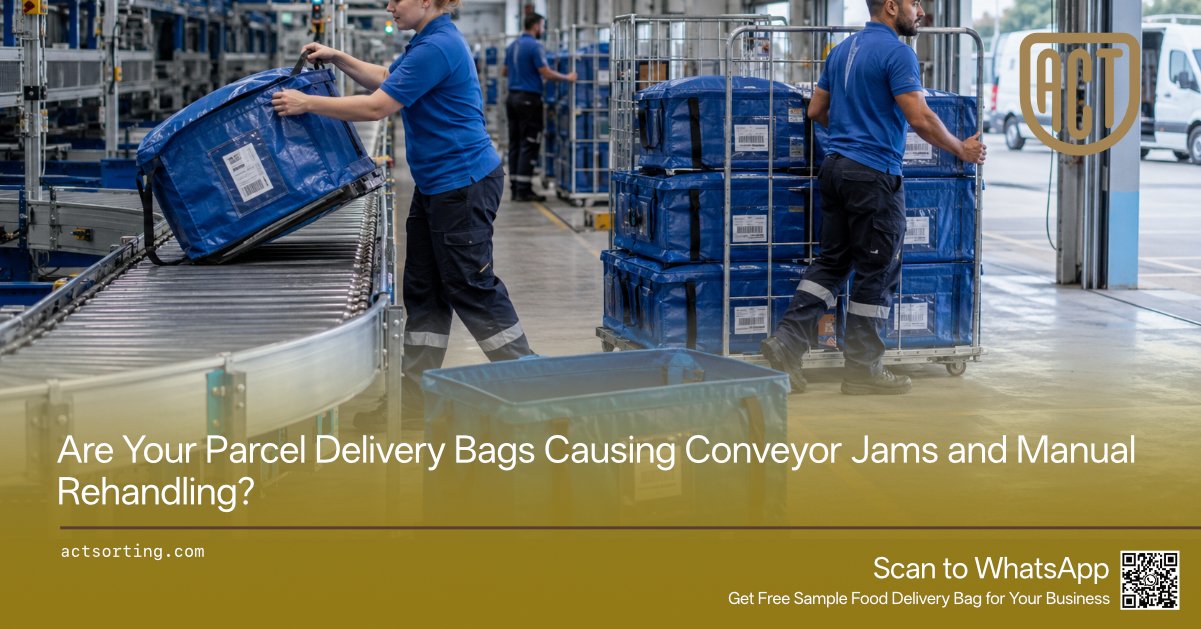
When a parcel sorting line stops, the machine usually receives the blame first. Warehouse teams check the scanner, conveyor motor, sensor, belt alignment, or chute angle. Sometimes the real cause is much simpler: a loose strap has caught against the side rail, an overloaded Parcel Delivery Bag has collapsed across the lane, or a badly positioned handle has become trapped between two moving containers.
These incidents do not always create a complete shutdown. More often, they create repeated manual intervention. Workers pull bags away from conveyor edges, untangle webbing, lift fallen parcels, push unstable sacks through narrow transfer points, and move bags by hand because the equipment cannot handle them reliably. The system continues running, but employees quietly perform the work the bag design failed to support.
For parcel delivery companies, e-commerce fulfillment centers, courier sorting hubs, postal operators, regional distribution centers, and Amazon DSP-style delivery stations, this manual rehandling creates a hidden labor cost. A bag that needs only ten extra seconds of worker attention may not appear serious. If the same problem affects hundreds of Parcel Sorting Sacks during every shift, however, it reduces throughput, increases physical handling, and makes automated equipment less valuable.
A suitable Parcel Delivery Bag should move predictably through the customer’s real environment. Handles should remain controlled rather than hanging into moving equipment. The body should maintain enough shape to travel through sorting lanes without becoming a loose fabric obstacle. Label holders should remain visible without creating snag points. Bottom panels should survive repeated movement across belts, rollers, floors, cages, and loading ramps. Dimensions should match conveyor clearances, roll cages, staging racks, and delivery vans.
ACTSORTING has specialized in industrial logistics bags since 2013. The company operates a manufacturing facility covering more than 12,000 square meters in Yangchun, Guangdong, China, supported by over 400 experienced workers. Its product range includes Parcel Delivery Bags, Parcel Sorting Sacks, Courier Sorting Totes, Last-Mile Delivery Totes, Van Loading Totes, and DSP Delivery Supplies for commercial logistics operations across Europe and North America.
With BSCI and ISO9001 certification, ACTSORTING provides OEM & ODM manufacturing services covering materials, dimensions, colors, logo printing, transparent label holders, closure systems, handle positions, webbing layouts, reinforced wear zones, foldable structures, and large-volume repeat production. Choosing ACTSORTING means working with a manufacturer that can develop the bag around the sorting equipment, warehouse layout, and vehicle system rather than expecting the operation to adjust around a generic sack.
1. Conveyor Problems Often Begin With the Bag, Not the Machine
Modern distribution centers use conveyors, powered rollers, gravity lanes, chutes, carts, and roll cages to reduce manual handling. The equipment is designed to move predictable loads. Problems begin when the Parcel Delivery Bag behaves unpredictably.
A soft bag may twist as it moves. One corner may drag while another rises. Loose fabric can extend beyond the expected footprint and touch guide rails. If the bag is partially filled, parcels may settle to one side and make the load unstable. If it is overfilled, the body may bulge beyond the conveyor width or press against neighboring sacks.
These problems force workers to intervene. They straighten bags before transfer points, push them through narrow sections, or remove them from the conveyor entirely. The warehouse may have invested heavily in automated movement, yet employees still spend part of every shift escorting difficult bags through the system like troublesome luggage.
The interruption also creates safety and productivity concerns. When a bag stops unexpectedly, the next tote may collide with it. Workers enter the conveyor area to correct the position, increasing unnecessary contact with moving equipment. Parcels may spill if the opening is unsecured or if the tote tips during the jam.
ACTSORTING can develop Parcel Delivery Bags according to conveyor width, transfer height, roller spacing, chute dimensions, maximum load, and expected fill level. A more rectangular base may travel more predictably than an irregular sack. Reinforced side panels can reduce uncontrolled bulging. The fabric weight and folding structure can be adjusted so the body remains flexible for storage without becoming shapeless during movement.
The handles, label holders, closure, and reinforcement must be considered together. Improving one feature while ignoring the others can create a new snag point. For example, a stronger strap may last longer but create more conveyor interference if it hangs loosely below the bag.
This equipment-aware design process is one reason logistics buyers choose ACTSORTING. The manufacturer can work from warehouse photographs, existing product samples, conveyor measurements, roll cage dimensions, and current failure reports. The result is a bag developed around actual transfer conditions rather than one selected only from a catalog.
The benefit is fewer manual corrections, more stable material flow, and better use of existing warehouse equipment. Evidence appears when bags move through the same transfer points repeatedly without a worker waiting nearby to rescue them.
2. Loose Handles and Straps Can Catch During Automated Movement
Handles are essential for lifting, dragging, and van loading, but they become a risk when they are too long, badly positioned, or unsupported during conveyor movement. A loose strap can fall beneath the bag, catch on a roller, wrap around a guide, or become trapped between two totes.
This is especially common when one bag design is expected to perform several jobs. Long handles may be useful when workers carry the tote by hand, but those same handles may hang outside the bag footprint during automated transfer. Side loops may help drivers remove a Van Loading Tote from a shelf but create contact points on narrow conveyor lanes.
The solution is not simply to shorten every handle. Workers still need a practical grip, and different operations require different carrying methods. The design needs controlled webbing that remains accessible during manual handling and contained during movement.
ACTSORTING can customize handle length, width, position, attachment pattern, storage loops, and securing methods. Hook-and-loop retainers can hold longer straps against the bag body when not in use. Side handles can be placed within the tote’s profile. Top webbing can be designed to lie flat rather than fall into the opening or beneath the base.
Extended webbing may distribute the load more effectively while also controlling strap movement. Reinforcement panels and cross-stitching protect attachment points, but the layout should avoid creating stiff projections that catch against conveyor guides.
The customer’s workflow determines the best structure. A Courier Sorting Tote that moves mostly by conveyor may need compact, low-profile handles. A Last-Mile Delivery Tote carried repeatedly by drivers may require longer grips with a simple method for securing them during warehouse transfer. A large Parcel Sorting Sack may need multiple handling points but still require the webbing to remain close to the body.
Choosing ACTSORTING gives buyers access to this type of application-based development. The company does not need to treat the handle as an isolated accessory. It can be designed in relation to the conveyor, bag dimensions, load, closure, and folding method.
The advantage is controlled webbing. The benefit is fewer snags, fewer line interruptions, and safer manual handling. The evidence appears when workers no longer need to tuck straps into the bag by hand before every transfer, an oddly repetitive task that no warehouse originally planned to pay for.
3. Unstable Bag Shapes Slow Chutes, Roll Cages, and Sorting Lanes
Parcel bags are often expected to remain flexible, foldable, and lightweight. These qualities are valuable, but too little structural control creates problems during warehouse movement.
A completely soft Parcel Delivery Bag can collapse around the parcels inside. Its base becomes irregular, its sides bulge unpredictably, and its opening falls inward. On a gravity chute, the bag may rotate instead of sliding cleanly. Inside a roll cage, unstable sacks consume more space because they cannot stack or stand consistently. In a staging lane, bags may fall into walkways or cover neighboring route labels.
The problem becomes more obvious when bags are only partially filled. A full tote may hold its shape through parcel pressure, while a half-full tote folds around the load and becomes difficult to move. Delivery routes do not always produce the same fill level, so the design should remain usable across different volumes.
ACTSORTING can adjust material stiffness, panel construction, bottom design, opening reinforcement, and optional removable supports. A rectangular base helps the tote sit more evenly. Reinforced upper edges can keep the opening accessible. Side panels can provide enough structure to reduce collapse without turning the bag into a rigid container.
Removable bottom boards or dividers may also improve stability for certain applications. They can support shape during use and be removed when the bag needs to fold compactly. The material and thickness should match the expected load rather than adding unnecessary weight.
Roll cage compatibility is another practical consideration. The bag dimensions should use the cage space effectively without bulging through the metal sides or becoming difficult to remove. Handles need to remain accessible after the tote is placed beside other bags. Labels should face outward rather than disappearing against the cage wall.
For high-volume sorting lanes, shape consistency improves visual control. Workers can arrange bags more neatly, read route labels more easily, and move full units without rebuilding them. The warehouse also gains a more predictable equipment footprint.
ACTSORTING’s OEM & ODM capability allows these features to be developed from real measurements and operational requirements. This is more useful than simply selecting a large or small stock bag and hoping its shape behaves correctly after loading.
The benefit is smoother movement through chutes, cages, staging lanes, and vehicles. Evidence appears when the same tote remains stable at different fill levels instead of changing personality every time the parcel mix changes.
4. Parcel Delivery Bags Need Openings That Work With Fast Loading
A bag can have the correct volume and still slow down parcel sorting if its opening is badly designed. Narrow mouths catch cartons. Soft upper edges collapse inward. Long straps fall across the loading area. A closure flap may need to be held aside with one hand while the worker loads parcels with the other.
These delays are especially costly beside conveyors and sorting stations, where workers repeat the same loading movement hundreds of times. The bag should remain open, visible, and easy to access without requiring constant adjustment.
ACTSORTING can customize the opening width, upper-edge reinforcement, side-panel shape, closure structure, and handle position. A wide rectangular opening may support mixed cartons more effectively than a narrow sack mouth. Reinforced edge binding can help the opening maintain shape. Removable supports may provide additional structure during loading while preserving foldability after use.
The closure should match the handling stage. Open-top Parcel Sorting Sacks may provide maximum speed inside a controlled warehouse. Hook-and-loop flaps can offer fast coverage during staging or last-mile delivery. Zippers may be more suitable when the tote moves between facilities and requires stronger containment.
The opening design must also consider the largest common parcel. A bag may technically hold the required volume but still force workers to angle or push cartons through an undersized mouth. This increases seam stress and damages box corners.
Label holders and handles should remain outside the active loading area. A transparent pocket positioned too close to the opening may bend or tear when packages enter. Top straps should lie flat or remain secured rather than dropping between parcels.
Choosing ACTSORTING allows the customer to develop these elements as one system. The company can review common parcel dimensions, sorting height, conveyor position, worker movement, closure frequency, and required folded size before creating the sample.
The advantage is smoother loading. The benefit is less repeated hand movement, fewer caught cartons, and faster route preparation. The evidence is visible when workers can load the Parcel Delivery Bag continuously without stopping to reopen, untangle, or reposition it.
A bag opening is used far more often than most marketing features printed on a product page. It deserves slightly more attention than being treated as whatever space remains after the side panels are sewn together.
5. Label Holders Must Survive Scanning and Conveyor Contact
Transparent label holders help connect the physical bag to route information, but their position can create problems during automated handling. A pocket that projects beyond the bag body may catch against guide rails. A holder placed too low may scrape conveyor surfaces. A loosely sewn edge may peel away after repeated contact.
At the same time, the label must remain visible and easy to scan. Hiding the pocket in a protected location is not useful if workers cannot read it while bags are staged, stacked, or loaded inside cages.
ACTSORTING can customize pocket dimensions, transparent material, edge binding, opening direction, and placement. The holder can sit flush against the bag body to reduce snagging. Upper-front positions may provide visibility without floor contact. Side pockets can support scanning after the tote enters a roll cage or vehicle shelf.
Some operations need label holders on two surfaces. One pocket may face the warehouse lane, while another remains visible during van loading. Permanent printed bag numbers or depot codes can provide backup identification if a removable route card is damaged.
The transparent material should tolerate repeated folding, wiping, abrasion, and scanner contact. It should remain clear enough for barcode reading and flexible enough not to crack during storage. The edge stitching should protect the pocket without creating a stiff protrusion.
ACTSORTING can also provide areas for QR codes, barcodes, serial numbers, or customer-supplied RFID tags. These features may support route assignment, asset tracking, inspection history, or multi-site inventory control.
The reason to choose ACTSORTING here is not simply that the factory can sew a transparent pocket. It is that the pocket can be developed according to the customer’s scanner position, document size, bag orientation, and equipment contact points.
The advantage is protected identification. The benefit is faster scanning and fewer damaged route labels. Evidence appears when bags complete repeated warehouse cycles without pockets tearing away, clouding quickly, or turning into another item workers repair with clear tape.
6. Reinforced Bottoms Reduce Damage During Repeated Transfers
The bottom of a Parcel Delivery Bag may contact more surfaces than any other part of the product. It moves across conveyor belts, rollers, metal chutes, concrete floors, loading ramps, roll cage bases, van shelves, and outdoor pavement.
Each surface creates a different type of wear. Conveyor movement produces repeated friction in similar areas. Roll cages may press against corners or edges. Concrete introduces grit that damages the weave. Metal ramps can scrape coatings and concentrate pressure around the lower seams.
A weak bottom wears through before the rest of the bag reaches the end of its useful life. Once holes appear, parcels may catch against equipment, fall out, or become exposed to dirt and moisture. Workers then stop the process, transfer the contents, rescan the route, and remove the damaged tote.
ACTSORTING can reinforce the base through denser woven material, lamination, coated wear zones, double-layer panels, corner protection, edge binding, and extended webbing. The correct option depends on the load, floor type, movement distance, and expected circulation cycle.
Targeted reinforcement is usually more practical than increasing the weight of the entire bag. Workers still need lightweight Courier Sorting Totes that are easy to fold and lift. Strengthening the actual contact zones protects service life without creating unnecessary bulk.
The base dimensions and shape also influence performance. A rectangular bottom can distribute the load more evenly and travel more predictably through equipment. Irregular or sagging bases may increase friction at isolated points and cause the bag to rotate during transfer.
ACTSORTING’s experience in logistics bags helps connect material choice with movement conditions. Customers can provide worn samples, defect photographs, conveyor details, floor descriptions, and expected loads. The factory can then recommend a reinforced structure based on the failure pattern.
The benefit is fewer worn bottoms, fewer parcel spills, and lower replacement frequency. Evidence appears after repeated transfers, when the base remains functional instead of becoming a patchwork of tape and local repairs.
A bag that spends half its working life being pushed, dragged, or conveyed should probably have a bottom designed for more than looking neat in a product photograph.
7. Standardized Dimensions Improve Equipment Compatibility
A logistics bag must fit several systems at once. It may need to pass through a conveyor clearance, sit inside a roll cage, align with a staging lane, fit a van shelf, and fold onto a return pallet.
If the dimensions are inconsistent, one small variation can affect several operating stages. A bag that is slightly wider may rub against conveyor guides. A taller tote may no longer fit beneath a cage shelf. A deeper bag may reduce the number of units loaded into a van.
These differences are especially damaging across large bulk orders. The approved sample may work perfectly, but production variation can create groups of bags that behave differently. Workers then identify certain units as “the tight ones” or “the awkward batch,” which is not usually part of the official specification.
ACTSORTING can develop dimensions from conveyor widths, cage interiors, rack measurements, van shelves, pallet layouts, parcel profiles, and existing samples. Finished size, opening dimensions, folded size, seam allowances, and tolerances can be confirmed before production.
A customer may choose several standardized models. A smaller Courier Sorting Tote can serve compact routes, a medium Parcel Delivery Bag can handle standard sorting, and a larger Parcel Sorting Sack can support bulky or high-volume groups. All models can share the same label position, colors, handles, and visual identity.
Standardization makes training and inventory easier. Workers know which model belongs at each sorting station. Fleet managers understand expected vehicle capacity. Procurement teams manage fewer incompatible products. New warehouses can launch using approved equipment rather than creating another local variation.
Choosing ACTSORTING gives customers access to repeat production based on confirmed specifications. Later orders can remain compatible with the same conveyor, cage, warehouse, and vehicle system.
The advantage is equipment fit. The benefit is fewer jams, fewer loading changes, and more predictable throughput. Evidence appears when different production batches move through the same warehouse equipment without requiring local adjustments.
A two-centimeter difference looks insignificant in an email attachment. It becomes much more interesting when 5,000 bags need to pass through a fixed-width conveyor lane.
8. Foldable Construction Should Not Create Uncontrolled Collapse
Foldable Parcel Delivery Bags save warehouse and vehicle space when empty. This is one of their strongest advantages over rigid containers. The design challenge is making the tote compact after use without allowing it to collapse uncontrollably during sorting.
A bag that folds too easily may close around parcels during loading, sag across conveyor surfaces, or fall into neighboring lanes. A bag that is too stiff may travel well but occupy excessive return and storage space.
ACTSORTING can balance these requirements through material selection, panel design, reinforced edges, removable bottom supports, fold lines, and integrated straps. The bag can maintain useful shape during handling and still collapse into a compact format when empty.
The folding method should be simple enough for workers to use. If it requires removing several loose parts or following a complicated sequence, employees may avoid folding the bags correctly. Integrated straps or hook-and-loop retainers can keep the folded tote compact during empty returns.
The folded dimensions can also be standardized for pallet and shelf storage. Permanent warehouse codes should remain visible when the bag is folded, allowing empty units to be sorted without reopening them.
For multi-site networks, this improves equipment circulation. Empty Courier Sorting Totes can return through hubs using less transport space. Spare stock can move between warehouses during peak periods. Delivery vans regain capacity for returns or pickups as route bags become empty.
ACTSORTING can test the sample through repeated opening, loading, conveyor movement, folding, bundling, and storage. This reveals whether the material retains useful structure and whether reinforcement interferes with compact folding.
The advantage is controlled flexibility. The benefit is stable active use and efficient empty returns. Evidence appears when the same bag can move through automated equipment in the morning and fold neatly onto a return pallet in the afternoon.
A foldable tote should know when to stand and when to collapse. Asking warehouse workers to negotiate that distinction manually during every shift rather defeats the purpose.
9. ACTSORTING Connects OEM & ODM Design With Real Warehouse Equipment
Many customized bag projects begin with a size, color, logo, and quantity. These details are necessary, but they do not explain how the product must behave inside the customer’s operation.
ACTSORTING can begin with a broader set of information: conveyor dimensions, chute width, roll cage size, staging layout, parcel profile, expected load, vehicle measurements, label format, scanning process, closure frequency, folding method, and current failure points.
Customers can provide technical drawings, warehouse photographs, worn samples, defect reports, videos of the current handling process, or measurements from existing equipment. The factory can then develop the Parcel Delivery Bag around the complete workflow.
A conveyor snag problem may require shorter secured handles, a flatter label pocket, and more stable side panels. A chute problem may require a rectangular base and controlled fabric stiffness. A roll cage problem may require different tote dimensions and outward-facing labels. A repeated bottom failure may require targeted reinforcement instead of a heavier entire body.
ACTSORTING supports customization across PP woven materials, laminated fabrics, coated sections, dimensions, colors, logo printing, transparent pockets, barcode areas, RFID-ready holders, openings, closures, handles, webbing, reinforcements, dividers, folding straps, warehouse codes, packaging, and carton labels.
The company’s background matters. Since 2013, ACTSORTING has focused on logistics bags rather than treating them as an occasional side product. Its 12,000+ square meter factory, more than 400 employees, BSCI certification, and ISO9001 certification support both development and scalable production.
This is the central marketing reason to choose ACTSORTING: the customer receives more than a sewing service. The project can connect product construction with warehouse equipment, route flow, van loading, and long-term repeat orders.
The benefit is fewer compromises after delivery. Workers do not need to tape straps, cut pockets, add boards, or avoid certain conveyor lanes. The approved bag enters the operation closer to the way it was actually intended to work.
10. Stable Bulk Production Keeps Every Facility Using the Same System
A successful sample is only the beginning. Large logistics networks need thousands of bags to behave like the approved product, followed by repeat orders that remain compatible months or years later.
Mass production introduces more fabric rolls, cutting batches, sewing stations, workers, printing processes, pockets, handles, closures, and inspection points. Without stable control, dimensions drift, materials change, straps move, and reinforcement becomes inconsistent.
ACTSORTING uses the approved sample and confirmed technical specification as the reference for bulk manufacturing. Material, dimensions, tolerances, color, printing, label holder position, handle length, webbing layout, closure, reinforcement, folded size, packaging, and carton markings can be confirmed before production.
In-process inspection helps identify variation before the entire order is completed. Final checking can review finished measurements, sewing, handles, closures, pockets, printing, appearance, folding, and packing.
This consistency is particularly important when several warehouses use the same Parcel Delivery Bag system. A tote produced for one facility should fit the same conveyor clearance, cage, van shelf, and route process at another site. Replacement stock should not introduce a new dimension or handle layout.
ACTSORTING supports initial sampling, pilot orders, customized bulk production, seasonal procurement, multi-site rollout, and repeat replenishment. Its production scale allows customers to expand from one approved model into a coordinated range of Parcel Sorting Sacks, Courier Sorting Totes, Last-Mile Delivery Totes, and Van Loading Totes.
The commercial reason to choose ACTSORTING is reduced supply risk. Procurement works with a manufacturer capable of maintaining the approved design, supporting larger quantities, and adapting the product when the operation changes.
For logistics teams dealing with conveyor snags, unstable sacks, damaged label pockets, worn bottoms, incompatible dimensions, or excessive manual rehandling, the next project should begin with the actual transfer process.
Provide the target size, parcel type, conveyor and cage measurements, expected load, handle requirements, label format, closure preference, material, color, logo, quantity, and current operational problems to receive a customized proposal.
A Parcel Delivery Bag should move parcels through the system. It should not become another object the system needs help moving.
FAQ
Q: Can ACTSORTING customize Parcel Delivery Bags for conveyor systems?
A: Yes. Bag dimensions, base shape, material stiffness, handle position, label pockets, closures, and reinforcement can be developed according to conveyor width, roller spacing, chute dimensions, transfer points, and expected load.
Q: Can loose handles be secured during automated movement?
A: Yes. ACTSORTING can customize shorter handles, low-profile webbing, securing loops, hook-and-loop retainers, and other structures that keep straps controlled while remaining accessible for manual handling.
Q: Are foldable Parcel Sorting Sacks suitable for automated warehouses?
A: Yes, when the material, base, side panels, openings, handles, and folding structure are designed for the equipment. Foldable construction can provide compact storage without uncontrolled collapse during active use.
Q: Can label holders be designed to avoid conveyor snagging?
A: Yes. Transparent pockets can be positioned flush against protected areas of the bag, with customized dimensions, edge binding, opening direction, and material for visibility and repeated scanning.
Q: Why choose ACTSORTING for customized logistics bags?
A: ACTSORTING has specialized in logistics bags since 2013 and operates a 12,000+ square meter factory with over 400 employees. It supports OEM & ODM development, BSCI and ISO9001 certified production, bulk orders, and consistent repeat manufacturing.