
Table of Contents
- Heavy Grocery Orders Create a Different Handling Problem
- Beverage Loads Put More Pressure on Grocery Bags Than Volume Suggests
- Wheels Turn Dense Grocery Orders Into Easier Mobile Loads
- Reinforced Bottom Structures Support Bottles, Cans, and Bulk Products
- Telescopic Handles Improve Control Without Requiring Continuous Lifting
- High-Capacity Rolling Grocery Bags Need Better Internal Organization
- Stable Bag Dimensions Improve Vehicle Loading and Order Staging
- OEM & ODM Customization Should Begin With the Actual Grocery Mix
- Why Commercial Grocery Operators Choose ACTSORTING
- Stable Bulk Production Supports Supermarkets and Grocery Delivery Fleets
Introduction
A grocery order can look relatively small and still be surprisingly heavy.
Two cases of bottled water, several bottles of milk, cooking oil, canned food, rice, beverages, cleaning products, and other dense household goods can create a load that occupies less space than a large paper-product order but requires significantly more effort to move.
This is where conventional grocery bags begin to show their limitations.
The bag may technically hold the products, but employees still need to carry the entire load. If the order becomes too heavy, workers divide it into several smaller bags. That creates additional pieces to label, stage, load, count, and deliver.
For supermarkets, online grocery platforms, dark stores, grocery delivery companies, retail fulfillment centers, and commercial food distributors, high-density grocery orders therefore create both a handling problem and an order-management problem.
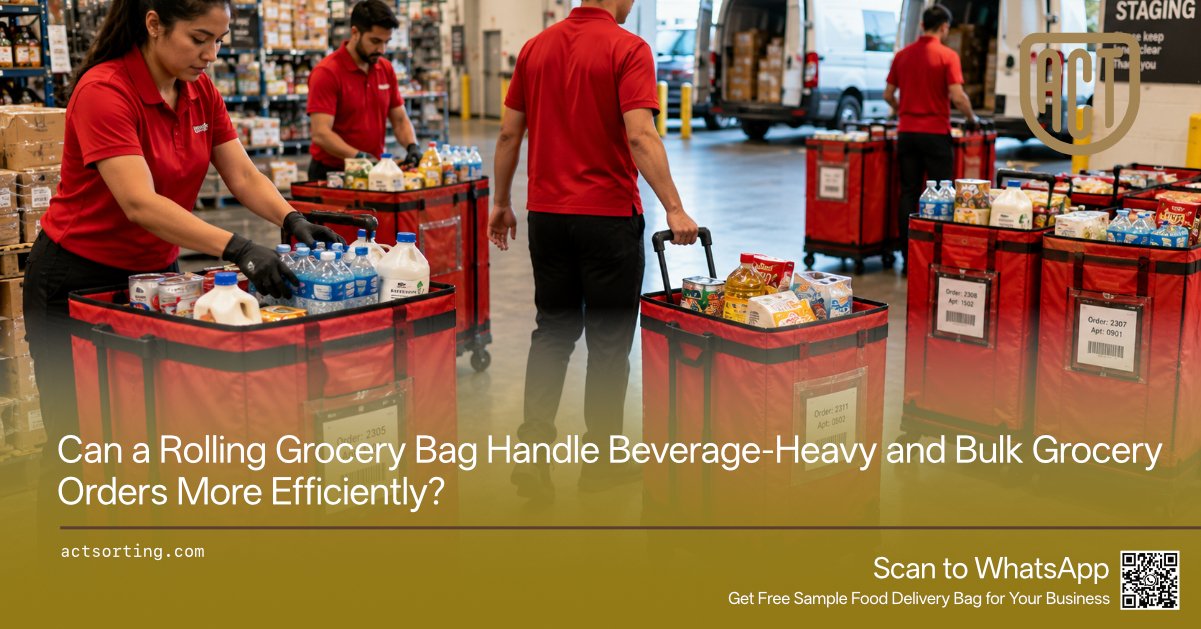
A Rolling Grocery Bag can reduce this friction by combining a large reusable grocery bag body with an integrated wheeled base and telescopic pull handle. Instead of carrying the full load across every section of the workflow, employees can roll the order across suitable store floors, staging areas, loading zones, parking areas, lobbies, and other flat surfaces.
ACTSORTING has specialized in commercial logistics bags since 2013. The company operates a manufacturing facility covering more than 12,000 square meters in Yangchun, Guangdong, China, with more than 400 experienced workers.
Supported by BSCI and ISO9001 certification, ACTSORTING provides OEM & ODM manufacturing for Rolling Grocery Bags, reusable grocery delivery bags, commercial sorting totes, and customized logistics bag solutions.
Customers can customize bag dimensions, woven materials, laminated surfaces, wheel structures, telescopic handles, reinforced bases, lifting handles, closures, internal dividers, transparent order pockets, colors, logos, and packaging.
A commercial Rolling Grocery Bag should not simply hold a heavy grocery order.
It should make that order easier to move.
1. Heavy Grocery Orders Create a Different Handling Problem
Not all grocery orders should be evaluated by volume alone. A large bag filled with paper towels may be bulky but relatively easy to move. The same bag filled with bottled drinks, canned products, cooking oil, sauces, rice, or household cleaning liquids can become difficult to carry long before the bag appears full.
This difference matters in online grocery fulfillment because workers may handle the same order several times. The order moves from picking to consolidation, from consolidation to staging, from staging to the pickup or loading area, and eventually from the delivery vehicle to the customer. If employees lift the full weight during every movement, a dense order creates repeated manual handling throughout the process.
The usual solution is to divide the order into several smaller grocery bags. This reduces the weight of each individual piece, but it introduces another operational cost. One customer order becomes four, five, or six separate physical units. Each bag must remain associated with the same order, and every piece needs to arrive at the correct vehicle and final handoff point.
A Rolling Grocery Bag offers a different approach. More of the dense grocery order can remain consolidated inside one larger wheeled unit. Workers can pull the load across suitable surfaces and lift it only when the environment requires it, such as during vehicle loading or when crossing stairs and thresholds.
ACTSORTING can customize Rolling Grocery Bag capacity according to the customer’s average and maximum grocery load rather than simply increasing volume. A beverage-heavy supermarket operation may need a lower and more stable design, while a general grocery delivery service may prefer a taller structure for mixed products.
Choosing ACTSORTING allows the product dimensions, wheel system, bottom structure, and handles to be developed around the real load. That distinction matters because “large capacity” and “suitable for heavy grocery orders” are not automatically the same thing.
2. Beverage Loads Put More Pressure on Grocery Bags Than Volume Suggests
Bottled drinks are one of the clearest examples of a high-density grocery product. They occupy a relatively predictable amount of space, but their combined weight increases quickly. Water, milk, juice, soft drinks, cooking oil, and canned beverages all concentrate substantial load near the bottom of the bag.
This creates stress in several areas at once. The bottom structure carries the majority of the weight. The lower corners receive pressure when the bag changes direction. The wheel attachment points experience repeated load during rolling. Pulling forces travel through the handle structure and lower frame. If the bag needs to be lifted, the webbing and carrying handles suddenly receive the full load.
A conventional soft grocery tote may have enough internal volume but not the correct structure for this repeated movement. The body can sag around dense products, the bottom can deform, and the load may shift heavily toward one side.
ACTSORTING can develop the lower structure of a Rolling Grocery Bag around these conditions. Reinforced woven materials, additional bottom layers, support panels, webbing reinforcement, and a more stable rectangular base can help distribute dense grocery loads more evenly.
The objective is not simply to make the entire bag extremely thick. Targeted reinforcement keeps additional material around the areas that experience the greatest load while allowing the upper body to remain more practical for handling and storage.
This is one reason commercial buyers choose ACTSORTING rather than treating the product as an oversized consumer shopping trolley. Grocery fulfillment equipment needs to be developed around commercial load patterns, not occasional personal shopping.
The benefit is a Rolling Grocery Bag that remains more stable when the customer order contains products that are physically dense rather than merely bulky.
3. Wheels Turn Dense Grocery Orders Into Easier Mobile Loads
The core advantage of a Rolling Grocery Bag appears when the order needs to move horizontally.
A supermarket employee may need to move a completed grocery order from a picking area to a staging section. Later, another worker moves it to curbside pickup. A delivery driver moves the same order from the store to the vehicle, then from the vehicle toward the customer.
Without wheels, every movement requires carrying or using another trolley.
A separate trolley can work, but it creates another piece of equipment that needs to be stored, located, loaded, unloaded, and returned. The Rolling Grocery Bag combines the order container and the movement function into one unit.
This is particularly useful for beverage-heavy orders because the weight remains inside the bag rather than being transferred repeatedly between different pieces of equipment.
The wheel system needs to match the load and environment. Smooth supermarket floors create different requirements from parking areas, loading zones, or residential building entrances. Wheel size, mounting structure, base stability, and turning behavior all affect the user experience.
ACTSORTING can customize the rolling system according to expected commercial use. The bag body, lower frame, wheels, handle, and reinforcement are considered together so the weight travels through a controlled structure.
The advantage is reduced dependence on continuous lifting. The benefit is smoother movement of high-density grocery orders through more stages of the fulfillment process.
A twenty-kilogram grocery order remains twenty kilograms. Wheels simply stop requiring the employee’s arms to personally negotiate with all twenty kilograms during every horizontal movement.
4. Reinforced Bottom Structures Support Bottles, Cans, and Bulk Products
The bottom of a Rolling Grocery Bag performs two jobs. It supports the grocery products and connects the soft bag body to the rolling structure.
That makes it one of the most important parts of the product.
Dense products naturally settle toward the base. Bottles may stand upright, canned goods create concentrated pressure, and large packaged products can push against the lower corners. During rolling, vibration and direction changes repeatedly move this load across the bottom structure.
If the base is too soft, the bag may sag between supporting components. If reinforcement is concentrated incorrectly, the tote may lean or roll unevenly. Weak attachment areas can also allow stress to accumulate around the wheels or frame.
ACTSORTING can customize reinforced bottoms using stronger woven material, laminated layers, support panels, additional webbing, lower corner reinforcement, and structured integration with the wheeled base.
The exact structure depends on the expected product mix. A supermarket mainly handling general household groceries may require one specification, while a wholesale or beverage-oriented operator may need stronger lower support.
The base should also remain practical to clean. Grocery operations can involve leaking bottles, wet products, dust, or residue from store and vehicle floors. Laminated or smoother surfaces can make routine wiping easier where required.
Choosing ACTSORTING gives procurement teams the ability to specify these structural requirements before bulk production. Customers can provide load information, damaged samples, photographs of existing products, or expected grocery categories during development.
A good bottom structure is easy to ignore because nothing dramatic happens. The bag stands correctly, rolls correctly, and keeps working. Industrial products tend to be at their most impressive when nobody needs to discuss them during the shift.
5. Telescopic Handles Improve Control Without Requiring Continuous Lifting
The wheel system reduces carrying, but the driver or store employee still needs a practical way to control the bag.
A telescopic pull handle allows the Rolling Grocery Bag to move more like mobile equipment than a conventional soft tote. The employee extends the handle during movement and retracts it when the bag enters staging or vehicle storage.
Handle height matters in commercial operations because many different employees may use the same equipment. A handle that is too low forces taller workers to pull the bag at an awkward angle. A loose structure makes turning more difficult when the load is dense.
The connection between the handle and lower structure also needs reinforcement. Pulling a beverage-heavy grocery order produces significantly more force than pulling a lightly loaded personal shopping trolley.
ACTSORTING can customize handle configuration, extension length, grip, attachment structure, and supporting webbing according to bag dimensions and expected load.
Traditional carrying handles should still remain available. There will always be sections of a route where wheels cannot help, such as vehicle loading, steps, curbs, or unsuitable surfaces. Reinforced webbing handles allow workers to lift the bag temporarily without using the telescopic handle as an improvised carrying point.
This combination of rolling and lifting makes the product more versatile.
The practical reason to choose ACTSORTING is that these components can be designed as part of the same system. The handle is not simply attached after the bag dimensions have already been decided.
The benefit is better control during normal rolling and safer, more predictable handling when temporary lifting is required.
6. High-Capacity Rolling Grocery Bags Need Better Internal Organization
Increasing capacity creates another problem: products can become harder to organize.
A large Rolling Grocery Bag may contain bottles, boxes, packaged food, household products, small grocery items, and soft bags at the same time. Without internal organization, smaller products settle between larger items while heavy products shift toward the lowest point.
This can slow unloading and create unnecessary pressure on fragile groceries.
ACTSORTING can customize internal divider systems where the workflow requires them. Removable dividers can create separate sections for beverages, packaged foods, household goods, or smaller items. The exact layout can follow the customer’s typical order profile.
A divider does not need to make the bag rigid. Lightweight removable structures can provide useful separation while allowing the body to remain reusable and manageable.
For beverage-heavy loads, one section can keep bottles or cans more controlled while lighter products remain in another compartment. This reduces uncontrolled movement when the bag changes direction.
The bag opening should support the same organization. A wide rectangular mouth gives workers a clearer view of the interior and makes bulky products easier to load. Handles and closures should remain outside the main loading path.
ACTSORTING can coordinate internal dividers, bag dimensions, opening structure, bottom support, and identification during OEM & ODM development.
The advantage is better control of a mixed grocery load. The benefit is easier packing, faster unloading, and reduced pressure between heavy and fragile products.
More capacity is useful only when the extra space remains manageable. Otherwise, a large bag becomes a mobile archaeological site where the customer’s yogurt is eventually discovered beneath eight bottles of sparkling water.
7. Stable Bag Dimensions Improve Vehicle Loading and Order Staging
A Rolling Grocery Bag must fit the spaces around it.
Supermarket staging areas have limited floor space. Delivery vans have fixed cargo dimensions. Store doorways, elevators, aisles, and loading areas create additional physical limits.
This means capacity should not be increased without considering footprint.
A bag that is extremely wide may carry more groceries but occupy too much space inside the delivery vehicle. A very tall model may become unstable under a dense load. A poorly proportioned tote may be difficult to park neatly beside other completed orders.
ACTSORTING can develop bag dimensions from store layouts, staging positions, van interiors, door openings, and expected load. Rectangular bodies can help create a more predictable footprint for commercial operations.
For stores managing large numbers of online orders, standardized dimensions are particularly valuable. Employees know how many Rolling Grocery Bags fit in a staging row. Delivery teams understand how many units can be loaded inside a vehicle.
The same design can also include transparent order pockets positioned so identification remains visible while the bags stand side by side.
If different capacities are required, ACTSORTING can create a coordinated product family. A standard model serves normal orders, while a larger reinforced version handles beverage-heavy or bulk grocery baskets. Both can use the same visual identity, handle system, label position, and branding.
Choosing ACTSORTING therefore gives commercial buyers more than custom capacity. The product can be developed around the surrounding equipment and storage environment.
The result is a Rolling Grocery Bag that uses space more predictably rather than solving one capacity problem by creating another inside the van.
8. OEM & ODM Customization Should Begin With the Actual Grocery Mix
The best Rolling Grocery Bag specification begins with the products it needs to carry.
Customers should consider common grocery categories, average order weight, maximum expected load, beverage share, bulky household products, vehicle size, store layout, movement distance, and operating surface.
This information helps determine which areas need reinforcement and which dimensions make sense.
ACTSORTING can begin development from existing samples, drawings, photographs, product lists, store layouts, or descriptions of current handling problems.
The customer may report that current bags become unstable with bottled water. The new design may need a lower center of gravity and stronger base. Another operation may struggle with too many separate bags per customer, requiring more capacity and internal organization. A delivery fleet may need a narrower design to fit vehicles and apartment elevators.
Customization can include bag dimensions, woven materials, laminated surfaces, wheels, telescopic handles, carrying webbing, reinforced bases, internal dividers, closures, transparent order pockets, colors, logos, store codes, and packaging.
This is where ACTSORTING’s experience becomes useful. Since 2013, the company has focused on commercial logistics bags and can connect the bag structure with actual handling requirements.
The sample should then be tested with real grocery products, not only lightweight filler materials. Workers should load beverages, packaged goods, and common household products, roll the bag through the expected environment, lift it where necessary, park it in staging, and place it inside the delivery vehicle.
That testing reveals whether the Rolling Grocery Bag actually solves the customer’s problem.
A sample full of empty cardboard boxes can demonstrate volume. It is somewhat less informative about what happens when the same space contains forty kilograms of real groceries.
9. Why Commercial Grocery Operators Choose ACTSORTING
Commercial grocery companies need more than a supplier capable of producing one wheeled bag.
They need a manufacturer that can support product development, structural adjustment, customized branding, bulk production, and future repeat orders.
ACTSORTING has specialized in logistics and commercial bag manufacturing since 2013. Its production facility in Yangchun, Guangdong covers more than 12,000 square meters and employs over 400 experienced workers.
BSCI and ISO9001 certification support responsible manufacturing and structured quality management.
For Rolling Grocery Bag projects, ACTSORTING can customize the product around the customer’s load, workflow, store environment, and vehicle system.
The wheel structure can match commercial movement. The base can be reinforced for dense grocery loads. Telescopic and lifting handles can support different movement stages. Transparent pockets can connect the physical order with the customer’s digital fulfillment system.
The bag can also carry the customer’s visual identity through custom colors, logo printing, store codes, route identification, and other practical markings.
This combination is the main reason to choose ACTSORTING.
The company is not positioning the Rolling Grocery Bag as a consumer shopping accessory. It can be developed as reusable equipment for supermarkets, online grocery fulfillment, dark stores, curbside pickup, commercial food delivery, and other large-scale grocery operations.
The customer gets a product built around the work rather than a generic trolley that happens to have enough space for groceries.
10. Stable Bulk Production Supports Supermarkets and Grocery Delivery Fleets
One successful Rolling Grocery Bag sample is not enough for a commercial grocery program.
A supermarket chain may need hundreds or thousands of units. A delivery company may deploy the same equipment across several cities. New stores open, bags require replacement, and seasonal promotions increase demand.
The approved design therefore needs to be repeatable.
ACTSORTING can use the confirmed sample and technical specification as the reference for bulk manufacturing. Bag material, dimensions, wheel configuration, telescopic handle structure, lifting handles, reinforcement, internal dividers, closures, label pockets, colors, printing, and packaging can all be established before production.
Consistency matters because small changes can affect operations. A wider bag may no longer fit the planned vehicle layout. A different handle height changes how workers use the equipment. A weaker base behaves differently under beverage-heavy loads.
The company’s 12,000+ square meter manufacturing facility and workforce of more than 400 employees support customized commercial orders, multi-store rollouts, seasonal procurement, and repeat production.
This manufacturing continuity is another reason grocery operators choose ACTSORTING.
Customers can begin with a pilot model, evaluate it in real supermarket or delivery conditions, adjust the design, and then move toward larger deployment.
For supermarket chains, online grocery platforms, dark stores, grocery delivery fleets, and commercial food distributors facing heavy beverage orders, repeated manual carrying, fragmented grocery bags, or unstable high-density loads, the next project should begin with the real order profile.
Provide average order weight, maximum load, common grocery categories, bag dimensions, store environment, vehicle space, wheel requirements, handle requirements, internal organization, branding, and target quantity to receive a customized proposal from ACTSORTING.
A Rolling Grocery Bag does not make bottled water lighter.
It makes the delivery system considerably less interested in carrying it by hand.
FAQ
Q: Is a Rolling Grocery Bag suitable for bottled water and beverage-heavy grocery orders?
A: Yes, when the bag is developed for the expected load. ACTSORTING can customize the reinforced bottom, wheel structure, telescopic handle, carrying webbing, material, and dimensions according to beverage-heavy grocery applications.
Q: Can ACTSORTING customize the capacity of a Rolling Grocery Bag?
A: Yes. Width, depth, height, opening dimensions, internal organization, and overall structure can be developed according to average order size, maximum load, store layout, staging space, and delivery vehicle dimensions.
Q: Can internal dividers be added for heavy and fragile grocery products?
A: Yes. Removable or customized divider systems can help separate beverages, packaged foods, smaller items, and other grocery categories according to the customer’s workflow.
Q: Can the Rolling Grocery Bag still be lifted when wheels cannot be used?
A: Yes. Reinforced carrying handles can be added alongside the telescopic rolling handle so employees can lift the bag temporarily for vehicle loading, steps, thresholds, and other unsuitable surfaces.
Q: Why choose ACTSORTING for commercial Rolling Grocery Bags?
A: ACTSORTING has specialized in logistics bags since 2013, operates a 12,000+ square meter factory with over 400 employees, holds BSCI and ISO9001 certification, and supports OEM & ODM development, customized bulk manufacturing, multi-store programs, and repeat production.