

Table of Contents
- Online Grocery Orders Create a Staging Problem Before They Create a Delivery Problem
- A Rolling Grocery Bag Keeps One Customer Order Together
- Clear Order Identification Reduces Pickup and Dispatch Confusion
- Wheeled Grocery Totes Make Staging Areas Easier to Reorganize
- Large-Capacity Bags Can Reduce the Number of Separate Order Pieces
- Structured Bottoms Help Grocery Orders Stay Stable During Waiting and Movement
- Rolling Grocery Bags Can Support Curbside Pickup, Delivery, and Dark Store Operations
- OEM & ODM Customization Connects the Bag to the Store’s Fulfillment System
- ACTSORTING Builds Rolling Grocery Bags for Commercial Grocery Programs
- Stable Bulk Production Supports Multi-Store Rollouts and Repeat Orders
Introduction
Online grocery fulfillment creates a problem that traditional in-store shopping does not have: the customer is no longer carrying the order through the store.
Employees pick the items, consolidate them, label the order, move it into a staging area, wait for the customer or driver, locate the correct order again, and finally transfer it toward the pickup point or delivery vehicle. During busy periods, dozens or hundreds of completed grocery orders may wait at the same time.
This makes staging one of the most important parts of the workflow.
A grocery order that is picked correctly can still create trouble if it is split across several bags, placed in the wrong staging position, mixed with another order, or difficult to move when the customer arrives. Employees may spend more time looking for the correct pieces than actually handing the order over.
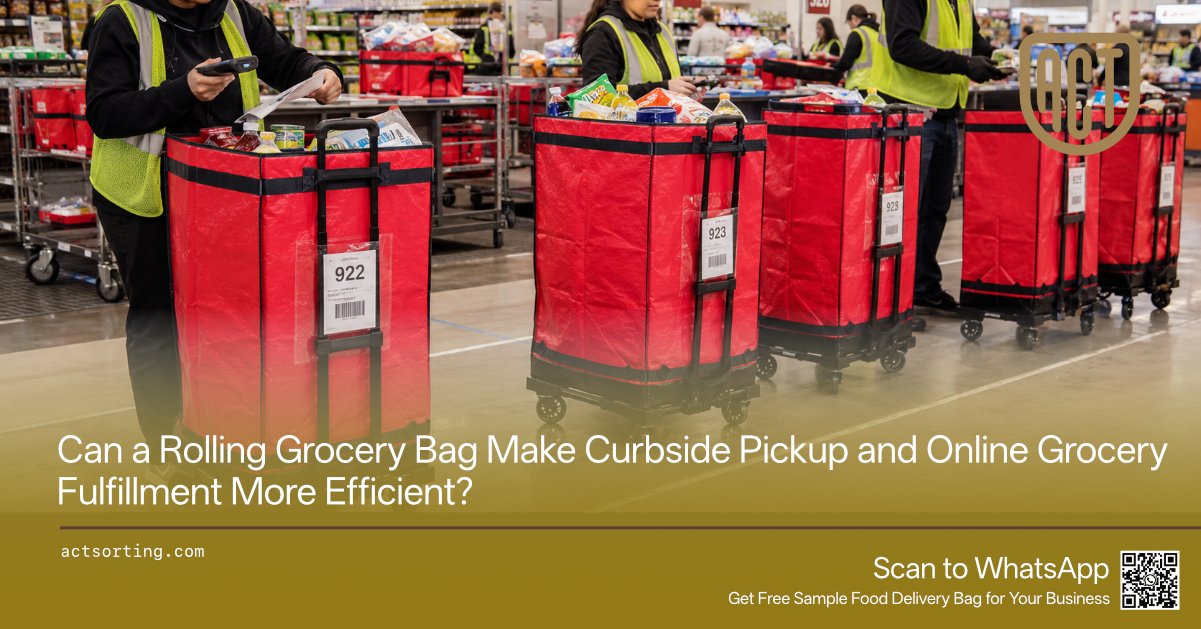
A Rolling Grocery Bag can help turn a completed customer order into a larger, more visible, easier-to-move fulfillment unit. Instead of treating each shopping bag as a separate item, the business can consolidate multiple grocery products inside one wheeled tote with a clear identification area, reinforced base, pull handle, and reusable bag structure.
For supermarket chains, online grocery platforms, dark stores, curbside pickup operations, retail fulfillment centers, and grocery delivery companies, this creates a different value from simply reducing carrying effort. The Rolling Grocery Bag can support order organization between picking and final handoff.
ACTSORTING has specialized in commercial logistics bags since 2013. The company operates a manufacturing facility covering more than 12,000 square meters in Yangchun, Guangdong, China, with more than 400 experienced workers.
Supported by BSCI and ISO9001 certification, ACTSORTING provides OEM & ODM manufacturing for reusable delivery bags, sorting totes, wheeled grocery bags, and customized commercial bag systems. Rolling Grocery Bag projects can be developed around dimensions, woven materials, laminated surfaces, telescopic handles, wheel systems, bottom reinforcement, colors, logo printing, transparent order pockets, closures, internal dividers, and bulk production requirements.
Choosing ACTSORTING means the product can be designed around the actual grocery fulfillment process instead of being treated as a consumer shopping trolley with a larger logo.
For retailers managing high volumes of online grocery orders, that difference matters.
1. Online Grocery Orders Create a Staging Problem Before They Create a Delivery Problem
A traditional supermarket customer selects products, places them in a cart, pays, and leaves with the order. Online grocery fulfillment separates these actions across multiple employees and operating areas.
A picker collects the products. Another employee may verify the order. The groceries move into ambient, chilled, or frozen staging. A curbside employee later retrieves the order. A delivery driver may then load it into a vehicle.
The completed order can therefore spend significant time waiting between picking and handoff.
During quiet periods, this is manageable. During evening peaks, weekends, holiday promotions, or large online campaigns, staging areas become crowded quickly. Grocery bags are placed on shelves, racks, carts, floors, or temporary holding areas. Several bags belonging to the same customer may be separated simply because there is no suitable space to keep them together.
This creates an identification problem.
Suppose one customer order consists of six conventional grocery bags. Employees need to ensure that all six remain associated with the same order. If one bag is placed on the neighboring shelf, the customer may receive an incomplete order even though every item was picked correctly.
The problem becomes more complicated when employees are working quickly. Multiple customers may have similar names, order numbers, or pickup times. Temporary staff may not understand the local staging layout as well as experienced employees.
A Rolling Grocery Bag provides a larger physical unit for consolidating more of the order. Instead of six small independent pieces, the operation may be able to place more of the groceries inside one wheeled tote with one visible order identification point.
This does not eliminate the need for scanning or software. It creates a clearer physical counterpart to the digital order.
ACTSORTING can customize transparent order pockets, barcode windows, printed store codes, route information areas, and body colors so the Rolling Grocery Bag fits the customer’s existing identification system.
This is one reason grocery operators choose ACTSORTING for OEM & ODM development. The bag does not need to operate as a generic container. It can become part of the staging process.
The benefit is fewer loose order pieces, clearer visual control, and faster retrieval when the customer or driver arrives.
Online grocery fulfillment already requires software to remember what the customer ordered. The staging area does not also need to test whether employees can remember where all seven bags went.
2. A Rolling Grocery Bag Keeps One Customer Order Together
Order consolidation becomes increasingly important as basket size grows.
A small grocery order may fit easily inside one reusable tote. A family-size order can include beverages, cereal boxes, household products, packaged food, produce, paper products, and several dense items at the same time.
Traditional grocery bags often divide this order into multiple pieces.
Every additional piece introduces another opportunity for separation. One bag goes to the wrong shelf. Another remains in the chilled area. One reaches the driver while another stays behind the staging rack. The order may be correct in the system but physically incomplete at handoff.
A large Rolling Grocery Bag can reduce this fragmentation by allowing more of the order to travel together.
The rectangular bag body can provide useful internal volume for packaged groceries, while the wheeled base makes the larger consolidated load easier to move through suitable store and pickup areas.
This does not mean every grocery product should be placed in one enormous compartment without organization. Chilled, frozen, fragile, or incompatible items may still require separate handling according to the customer’s workflow. The objective is to reduce unnecessary fragmentation where consolidation makes operational sense.
ACTSORTING can customize capacity according to average order size, common product mix, store aisle width, vehicle dimensions, and staging space.
A supermarket chain may need a standard Rolling Grocery Bag for typical online orders and a larger version for high-volume baskets. Both models can use the same colors, logo, transparent order pocket, handle design, and identification system.
Internal dividers can also help separate different product groups within one bag. Bottled drinks may remain away from lighter packaged goods. Household cleaning products can occupy a dedicated section. Smaller items can remain visible instead of disappearing under large grocery cartons.
The advantage is physical order integrity.
Employees see one larger identified fulfillment unit instead of a collection of loosely related shopping bags. When the customer arrives, the employee retrieves the Rolling Grocery Bag and moves the consolidated order toward the pickup location.
Choosing ACTSORTING allows these dimensions and internal structures to be developed around the real grocery assortment rather than forcing the operation into an off-the-shelf trolley size.
The benefit is fewer missed pieces, easier handoff verification, and a clearer relationship between one digital order and one physical grocery unit.
3. Clear Order Identification Reduces Pickup and Dispatch Confusion
A Rolling Grocery Bag becomes much more useful when employees can identify it immediately.
Online grocery staging areas move quickly. Workers need to recognize customer orders, pickup windows, delivery routes, store numbers, order status, or driver assignments without opening every tote.
A small label attached to the wrong side of the bag can create unnecessary delay. If the bag is parked against a wall, the label may disappear. If another tote is placed in front of it, workers need to move equipment simply to check the order number.
ACTSORTING can customize transparent identification holders on the front, side, or multiple surfaces of the Rolling Grocery Bag.
These pockets may carry order numbers, barcodes, QR codes, customer identifiers, staging-zone cards, delivery-route information, or store-level documents.
For operations using barcode or QR scanning, the pocket can be positioned where employees can access it without bending the bag or moving the handle structure. The transparent material and pocket dimensions can be selected according to the actual document format.
Permanent printed identification can provide another layer.
A supermarket chain may print a store code, equipment number, regional depot, ownership information, or asset ID directly onto the bag while daily order information remains removable.
Color can also support staging.
For example, one color may indicate curbside pickup while another represents home delivery. Different webbing colors may distinguish store zones. A large printed area may identify ambient, chilled transfer, returns, or another operational category.
The exact system should follow the retailer’s existing workflow. Adding colors without a consistent rule simply creates a more cheerful form of confusion.
ACTSORTING’s OEM & ODM capability allows the identification system to be planned alongside the handle, wheel, closure, and body structure.
This is a practical reason to choose ACTSORTING rather than sourcing a generic Rolling Grocery Bag and attempting to modify it locally after delivery.
The advantage is faster order recognition. The benefit is shorter retrieval time, fewer wrong handoffs, and easier supervision during busy pickup periods.
A customer waiting in a curbside space is usually not interested in watching three employees inspect fifteen identical red bags while trying to determine which one contains their cereal.
Good identification makes the physical workflow move at the same speed as the digital order system.
4. Wheeled Grocery Totes Make Staging Areas Easier to Reorganize
Staging areas rarely remain static throughout the day.
Morning orders accumulate before customers arrive. Delivery batches may be grouped by route. Curbside orders move closer to the pickup entrance as their scheduled windows approach. High-volume promotions create temporary overflow areas. Staff continually reorganize completed orders to keep the space usable.
If every loaded grocery bag must be carried or placed on a separate trolley, changing the staging layout requires additional handling.
A Rolling Grocery Bag already includes its own movement system.
Employees can pull the loaded tote from one staging position to another across suitable flat surfaces without unloading the groceries or locating a separate cart.
This flexibility can be useful in supermarket backrooms, dark stores, retail fulfillment centers, large pickup areas, and warehouse-style grocery operations where orders frequently move before final dispatch.
The wheel configuration needs to match the environment.
A bag primarily moving through smooth indoor supermarket floors may have different requirements from one regularly crossing loading areas or paved pickup zones. Wheel diameter, mounting structure, stability, and lower reinforcement all affect performance.
The handle also matters. Employees need enough control to reposition the bag without pulling the body into an unstable angle. A telescopic structure can extend for movement and retract when the tote is parked.
ACTSORTING can develop the wheeled base and handle system around the expected load, floor surface, bag dimensions, and movement distance.
The staging footprint should also be considered.
A very wide Rolling Grocery Bag may offer impressive capacity but consume too much floor space. A narrower rectangular design may allow more orders to park beside each other while remaining easy to pull from the row.
This is where customization becomes operational rather than cosmetic.
Choosing ACTSORTING allows the customer to provide staging-rack dimensions, aisle widths, door openings, parking positions, and typical order volume before the final bag size is confirmed.
The benefit is a grocery tote that fits the physical staging area and remains easy to reorganize.
When online order volume changes every hour, equipment that can move with the workflow is more useful than equipment that requires the workflow to move around it.
5. Large-Capacity Bags Can Reduce the Number of Separate Order Pieces
Grocery fulfillment becomes harder to control as the number of individual bags per customer increases.
If 100 orders average five separate bags each, employees are not managing 100 physical units. They are managing approximately 500. Every piece must remain associated with the correct customer.
Large-capacity Rolling Grocery Bags can reduce that number for suitable product categories.
The goal is not simply maximum volume. Capacity needs to remain practical for the expected load, wheel structure, store environment, and vehicle.
A very large bag filled with lightweight paper products may be easy to move. The same volume filled with bottled water creates a completely different load. ACTSORTING can therefore develop dimensions and reinforcement according to both volume and weight.
Rectangular bag bodies can use internal space more efficiently for boxed groceries and packaged goods. A stable bottom helps the bag maintain shape while employees load different products.
Internal dividers can provide additional organization. One section may hold smaller packaged foods, another may handle beverages, and another may separate household goods.
For stores managing different order sizes, a coordinated product range may make more sense than one universal bag.
A medium Rolling Grocery Bag can serve normal online orders. A larger model can handle family-size or bulk purchases. Smaller reusable totes may remain available for compact orders.
ACTSORTING can maintain the same visual identity across the range, including color, logo, order pocket location, webbing, handle style, and store coding.
This creates a standardized fulfillment system rather than several unrelated bags.
Choosing ACTSORTING helps grocery operators balance consolidation with practical handling. The company can work from real order data, common product dimensions, maximum expected load, and store layouts when developing the size.
The operational benefit is fewer separate order pieces to label, stage, locate, count, and hand over.
That sounds mundane because it is mundane. Unfortunately, mundane problems repeated thousands of times are exactly how logistics departments acquire large expenses.
6. Structured Bottoms Help Grocery Orders Stay Stable During Waiting and Movement
A Rolling Grocery Bag spends significant time standing still.
After picking, the bag may wait in a staging area. After moving to curbside, it may remain beside the pickup point. Inside a delivery vehicle, it may stand upright between stops.
This makes bottom stability important.
Heavy grocery products naturally settle downward. Bottled drinks, canned goods, cooking oil, packaged liquids, and dense household items can create concentrated load at the base.
If the bottom structure sags excessively, the bag may lean or become difficult to roll. Products can shift toward one side, placing uneven pressure on the wheels and frame.
ACTSORTING can develop reinforced bottom structures using additional woven layers, support panels, webbing reinforcement, frame integration, and protected lower corners.
The objective is to distribute the load across the wheeled base rather than allowing the flexible bag body to deform around heavy grocery items.
A stable rectangular bottom also improves staging.
The bag can stand more consistently alongside other orders. Employees can arrange several Rolling Grocery Bags in organized rows without each tote spreading unpredictably across the floor.
The bottom structure must still work with the reusable nature of the product.
Depending on the design, removable or integrated support components can provide structure while allowing the soft bag body to remain manageable during storage or transportation.
The wheel attachments need particular attention because they experience repeated movement under load. The transition between flexible fabric and rigid rolling components should be reinforced according to the expected use.
ACTSORTING’s manufacturing experience allows the lower bag structure, reinforcement, webbing, wheels, and handle system to be developed together rather than sourced as unrelated components.
This integrated construction is another reason grocery operators choose ACTSORTING for customized projects.
The advantage is greater stability during staging and movement. The benefit is easier organization, smoother rolling, and reduced stress around the lower bag body.
A grocery fulfillment bag should wait patiently for its customer. It should not slowly lean sideways until employees begin using neighboring orders as structural support.
7. Rolling Grocery Bags Can Support Curbside Pickup, Delivery, and Dark Store Operations
The Rolling Grocery Bag is not limited to one grocery fulfillment model.
Its value depends on where the order moves and how often employees handle it.
In curbside pickup, the bag can move from staging to the customer’s vehicle. The order remains consolidated during the handoff, and employees can roll heavier grocery baskets across the pickup area instead of carrying multiple bags.
In home delivery, the Rolling Grocery Bag can support movement between staging and the delivery van, then from the vehicle toward residential buildings or other suitable destinations.
In dark stores, where most or all orders are prepared for digital customers, standardized wheeled bags can become part of the fulfillment equipment fleet. Orders move from picking to staging to dispatch without entering a traditional customer checkout process.
Retail fulfillment centers may use Rolling Grocery Bags for larger consolidated orders moving through wide indoor aisles. Grocery wholesalers or business-delivery services may also use larger versions for packaged food and household supply orders.
Each application creates different design priorities.
Curbside operations may prioritize fast identification and easy movement over short distances. Delivery fleets may need stronger wheels, compact vehicle fit, and additional lifting handles. Dark stores may prioritize standardized dimensions and dense staging layouts.
ACTSORTING can adjust dimensions, materials, wheel structure, telescopic handles, reinforced carrying handles, closures, label pockets, and internal organization according to the business model.
This flexibility matters because the keyword Rolling Grocery Bag covers a wide range of products online. Many search results focus on personal shopping carts designed for individual consumers.
ACTSORTING takes a different position.
The product can be developed for repeated commercial use, large-volume procurement, branded grocery programs, supermarket chains, dark stores, and delivery operators.
That distinction should be clear to procurement teams.
Choosing ACTSORTING means working with a manufacturer that can adapt the bag to the operational environment rather than offering only a fixed retail trolley.
The bag still rolls. The interesting part is what the business can build around that movement.
8. OEM & ODM Customization Connects the Bag to the Store’s Fulfillment System
A commercial Rolling Grocery Bag works best when it fits the operation that already exists.
The product should therefore be developed around questions such as:
How large is the average grocery order? How much does a typical loaded bag weigh? How wide are the store aisles? Where are completed orders staged? How far do employees move them? What type of floor or pavement do the wheels cross? How much space is available inside delivery vehicles? What order label or barcode system is already used?
These details affect the product more than a generic capacity number.
ACTSORTING can begin an OEM & ODM project from an existing bag, drawing, reference photograph, store layout, target dimensions, order data, or current handling problem.
The bag body can be customized in woven PP or other suitable material according to the customer’s requirements. Laminated surfaces can improve cleanability and moisture resistance for appropriate applications.
Wheel configuration, telescopic handle, lifting straps, base reinforcement, opening, closure, transparent order pocket, internal divider, body color, logo, store code, and packaging can also be customized.
For example, a supermarket chain may request a narrow Rolling Grocery Bag to fit between staging racks. A dark store may require large route labels on two sides. A delivery company may need reinforced carrying handles because workers frequently lift the bag into vans. Another operator may require stronger bottom support for beverage-heavy orders.
The sample should be tested in the real workflow.
Employees should load the normal product mix, roll the bag through the store, park it in staging, scan the order label, move it toward pickup, lift it into a vehicle where relevant, and return it empty.
This reveals whether the bag dimensions, wheel movement, handle height, identification, and internal organization actually work.
Choosing ACTSORTING gives customers the ability to refine this design before large-scale production.
That is a more useful form of customization than simply asking which logo file should be printed on the front.
9. ACTSORTING Builds Rolling Grocery Bags for Commercial Grocery Programs
ACTSORTING’s value in a Rolling Grocery Bag project comes from combining bag manufacturing with commercial customization and scalable production.
Since 2013, the company has focused on logistics and reusable delivery bag manufacturing. Its production facility in Yangchun, Guangdong covers more than 12,000 square meters and employs more than 400 experienced workers.
BSCI and ISO9001 certification support responsible manufacturing and quality management.
For grocery operators, the practical benefit is the ability to develop a product around business requirements rather than consumer retail preferences.
ACTSORTING can customize Rolling Grocery Bags for supermarket chains, online grocery fulfillment centers, dark stores, curbside pickup programs, delivery fleets, retail distribution operations, and other commercial users.
Available customization can include bag dimensions, woven materials, laminated surfaces, body colors, logo printing, order label holders, store codes, wheel configurations, telescopic handles, carrying webbing, bottom reinforcement, internal dividers, closures, and packaging.
The company can also support coordinated equipment families.
A customer may require one Rolling Grocery Bag for standard orders and another larger version for high-volume grocery baskets. Both can follow the same branding, label location, handle language, and visual identity.
This makes training easier and creates more consistent equipment across stores.
The reason to choose ACTSORTING is therefore broader than factory capacity alone.
Customers gain a manufacturer that can support requirement analysis, sampling, structural adjustment, bulk manufacturing, and later repeat orders. If the first field test shows that the wheel structure needs adjustment or the order pocket should move, the design can be optimized before wider rollout.
For commercial grocery programs, this flexibility reduces the risk of buying thousands of identical units before discovering that the product does not fit the staging rack or van.
A customized bag should solve the workflow first.
The logo can celebrate that achievement afterward.
10. Stable Bulk Production Supports Multi-Store Rollouts and Repeat Orders
A product that works in one pilot store must still work when it is deployed across fifty or five hundred locations.
This is where production consistency becomes critical.
If Rolling Grocery Bag dimensions change between batches, some units may no longer fit staging spaces. If wheel structures vary, employees experience different rolling behavior. If the telescopic handle length changes, the operating experience becomes inconsistent. If order pockets appear in different positions, training materials become less reliable.
A supermarket chain needs the same equipment logic across locations.
ACTSORTING can use the approved sample and confirmed technical specification as the reference for bulk manufacturing. Material, finished dimensions, tolerances, wheel configuration, handle structure, webbing, bottom reinforcement, closure, label pocket, color, printing, and packaging can be defined before production.
In-process checking can help identify variation during manufacturing, while final inspection can review finished construction and confirmed requirements.
This matters during repeat orders as well.
Online grocery programs grow. New stores join the system. Seasonal promotions create additional demand. Equipment eventually needs replenishment. A successful Rolling Grocery Bag should therefore be reproducible after the initial order.
ACTSORTING’s manufacturing facility and workforce support customized commercial orders, multi-store deployments, seasonal procurement, and future replenishment.
This is another reason to choose ACTSORTING for larger grocery programs.
The supplier relationship does not need to end when the first container leaves the factory. The approved design can become a continuing product specification that supports future expansion.
For supermarket chains, dark stores, curbside pickup operators, and grocery delivery companies dealing with crowded staging areas, fragmented orders, slow pickup retrieval, and repeated movement between store and vehicle, the next Rolling Grocery Bag project should begin with the staging workflow.
Provide the expected dimensions, grocery order profile, average and maximum load, store layout, staging conditions, wheel requirements, handle requirements, label format, color, logo, target quantity, and current fulfillment pain points to receive a customized proposal from ACTSORTING.
Online grocery fulfillment is ultimately a physical operation attached to a digital order.
A good Rolling Grocery Bag helps keep those two things connected until the groceries reach the customer.
FAQ
Q: Is a Rolling Grocery Bag suitable for curbside pickup operations?
A: Yes. A commercial Rolling Grocery Bag can help consolidate grocery orders and allow employees to move completed orders from staging to curbside pickup areas across suitable surfaces without carrying every individual bag separately.
Q: Can ACTSORTING customize order label and barcode pockets?
A: Yes. Transparent pockets can be customized in size, position, orientation, and quantity for order numbers, barcodes, QR codes, route documents, store identification, or other fulfillment information.
Q: Can Rolling Grocery Bags be customized for dark stores and online grocery fulfillment centers?
A: Yes. ACTSORTING can customize dimensions, wheel systems, handles, materials, colors, closures, order pockets, internal dividers, bottom reinforcement, and branding according to dark store and online grocery workflows.
Q: Can one customer order be consolidated inside a Rolling Grocery Bag?
A: Depending on the order size, product mix, temperature-handling requirements, and selected bag capacity, a Rolling Grocery Bag can reduce the number of separate physical pieces used for one order and make staging and handoff easier to manage.
Q: Why choose ACTSORTING for commercial Rolling Grocery Bags?
A: ACTSORTING has specialized in logistics bags since 2013, operates a 12,000+ square meter factory with over 400 employees, holds BSCI and ISO9001 certification, and supports OEM & ODM development, pilot projects, customized bulk production, multi-store rollout, and repeat orders.