
Table of Contents
- Apartment Grocery Delivery Creates a Different Last-Mile Problem
- Rolling Grocery Bags Reduce Carrying Between Vehicle and Building Entrance
- Elevators and Long Corridors Make Wheels More Valuable
- Large-Capacity Bags Keep Multi-Bag Grocery Orders Together
- Strong Wheels and Stable Bases Matter in Urban Delivery Environments
- Telescopic Handles Improve Control During Repeated Building Deliveries
- Order Identification Helps Drivers Manage Multiple Apartment Deliveries
- OEM & ODM Customization Matches Different Urban Delivery Workflows
- Why Grocery Delivery Operators Choose ACTSORTING
- Stable Bulk Production Supports City-Wide Delivery Programs
Introduction
The final 100 meters of grocery delivery can sometimes be harder than the previous 10 kilometers.
A driver may reach the customer’s building quickly, but the order still needs to move from the vehicle to the lobby, through security access, into an elevator, along a corridor, and finally to the customer’s door. In large apartment complexes, this distance can be significant.
The problem becomes even more obvious with large grocery baskets. Bottled drinks, packaged foods, household products, frozen items, paper goods, and bulk purchases may create several separate bags for one customer. Carrying them by hand often requires multiple trips between the building and the delivery vehicle.
For grocery delivery companies, supermarkets, dark stores, urban fulfillment centers, and residential delivery operators, these extra movements reduce route efficiency.
A Rolling Grocery Bag provides another option.
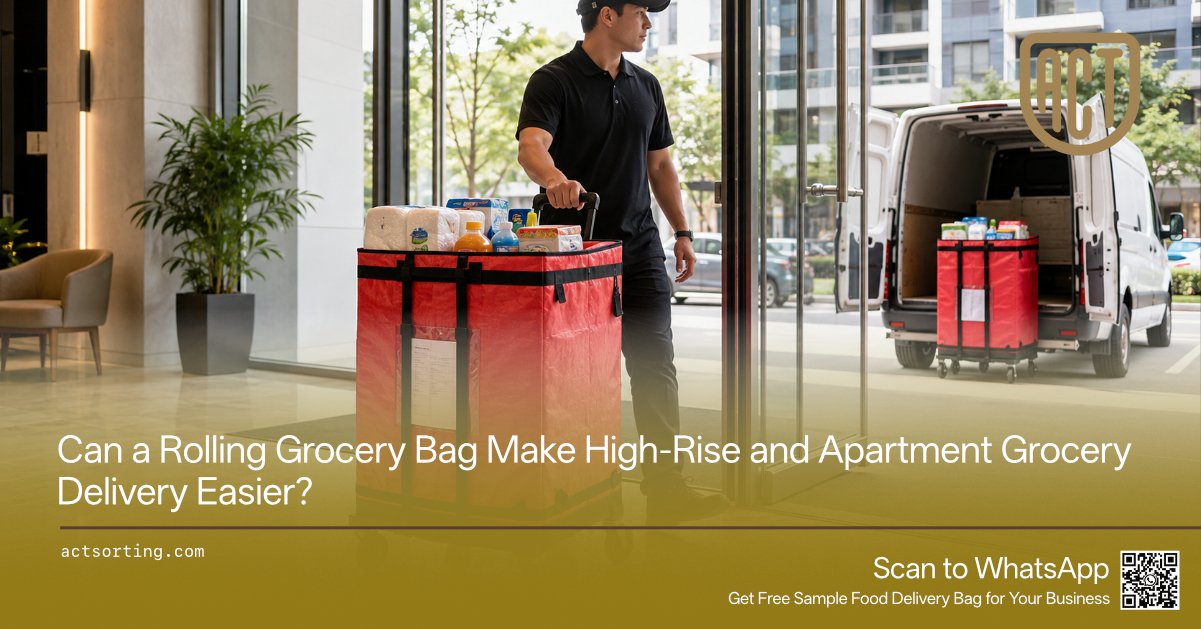
By combining a large reusable grocery bag with an integrated wheeled base and telescopic pull handle, more of the customer order can be moved as one unit across suitable urban surfaces. Drivers can roll the order through parking areas, building entrances, elevators, corridors, and other flat environments instead of carrying the entire load continuously.
This makes the Rolling Grocery Bag particularly relevant to high-density residential delivery.
ACTSORTING has specialized in commercial logistics bags since 2013. The company operates a manufacturing facility covering more than 12,000 square meters in Yangchun, Guangdong, China, supported by more than 400 experienced employees.
With BSCI and ISO9001 certification, ACTSORTING provides OEM & ODM manufacturing for Rolling Grocery Bags, reusable grocery delivery bags, sorting totes, and other commercial logistics bag solutions.
Customers can customize bag dimensions, woven materials, laminated surfaces, wheel systems, telescopic handles, reinforced bases, lifting handles, closures, transparent order pockets, internal dividers, colors, logos, and packaging.
The goal is not simply to put wheels underneath a grocery bag.
It is to make the final stage of urban grocery delivery easier to manage.
1. Apartment Grocery Delivery Creates a Different Last-Mile Problem
Suburban grocery delivery often allows the driver to park relatively close to the customer’s entrance. Apartment delivery can be completely different.
The driver may park underground, outside a gated complex, beside a loading area, or several dozen meters from the building entrance. After entering the property, the order may still need to pass through a lobby, security desk, elevator, and long corridor.
One delivery can therefore involve several separate carrying stages.
A small grocery order may not create much difficulty. A large household order is another story. Six separate shopping bags can mean several trips or an awkward attempt to carry everything at once.
This consumes time at each stop.
A Rolling Grocery Bag allows more groceries to remain consolidated inside one mobile unit. The driver pulls the loaded bag from the vehicle toward the building and continues rolling it through appropriate indoor areas.
The benefit becomes clearer when one driver serves several apartment buildings during a route. Saving a few minutes at each building can improve the overall delivery rhythm.
ACTSORTING can customize the Rolling Grocery Bag according to the average grocery order and delivery environment. Dimensions can be adjusted for residential elevators, building doors, van storage, and expected load.
A narrow but taller design may work better in apartment corridors than a very wide tote. Another operation may prefer a lower and wider structure for stability.
Choosing ACTSORTING gives grocery delivery operators the ability to develop the product around real urban delivery conditions instead of accepting a generic personal shopping trolley.
The bag becomes part of the last-mile workflow.
2. Rolling Grocery Bags Reduce Carrying Between Vehicle and Building Entrance
The distance between a delivery van and an apartment entrance is easy to underestimate.
A driver may park 20 meters from one building and 80 meters from another. Some residential complexes require deliveries to enter through designated loading areas rather than the main entrance.
Without a rolling solution, the driver must carry the grocery order throughout this distance or use a separate cart.
A separate trolley works, but it introduces another piece of equipment. The driver must store it inside the vehicle, unfold it, load the grocery bags onto it, move the order, unload everything again, and return the trolley to the van.
A Rolling Grocery Bag integrates the container and transport function.
The groceries remain inside the same bag while the wheels support movement across suitable surfaces. When the driver arrives at the building, there is no need to transfer multiple grocery bags onto another cart.
This is particularly useful for beverage-heavy orders. Bottled water, soft drinks, milk, cooking oil, canned food, and other dense products can make a grocery order uncomfortable to carry even when the total distance is relatively short.
The wheeled base reduces continuous carrying, while reinforced lifting handles remain available when the bag needs to cross a step or enter a vehicle.
ACTSORTING can customize wheel configuration, bag dimensions, lower reinforcement, lifting handles, and telescopic pull handles according to expected commercial use.
This integrated design is one reason grocery operators choose ACTSORTING.
The value is not simply in the wheels. It is in eliminating unnecessary transfers between bag, trolley, vehicle, and customer handoff.
3. Elevators and Long Corridors Make Wheels More Valuable
High-rise delivery usually contains one environment where a Rolling Grocery Bag performs particularly well: long, flat interior distances.
Apartment lobbies, elevators, corridors, underground parking areas, and building access passages are often ideal for wheeled movement.
The driver can pull the grocery order through the lobby rather than carrying several separate bags. Inside the elevator, the Rolling Grocery Bag remains one consolidated unit. When the doors open, the driver continues toward the customer’s apartment.
This reduces the need to put bags down repeatedly.
With conventional grocery bags, drivers may place several pieces on the floor while waiting for an elevator, pick them up again, move them through the corridor, and repeat the process at the door.
Every additional handling movement creates another opportunity for a small item to be left behind or for one bag to become separated from the order.
A Rolling Grocery Bag provides a clearer physical unit.
The bag should remain narrow enough for elevators and corridors while still providing useful capacity. The wheelbase should also remain stable during turns, particularly when the bag is heavily loaded.
ACTSORTING can develop body width, height, depth, handle configuration, and wheel position according to the customer’s intended delivery environment.
For urban grocery delivery operators, this is an important advantage of customization.
The ideal Rolling Grocery Bag for a large supermarket parking lot may not be the ideal model for apartment towers.
ACTSORTING allows the design to follow the route.
4. Large-Capacity Bags Keep Multi-Bag Grocery Orders Together
One of the biggest operational risks in apartment grocery delivery is order fragmentation.
A customer may have five or six separate bags. The driver unloads four, walks toward the building, and later discovers that one small bag is still inside the van.
The problem is not that the grocery order was picked incorrectly. It is that the physical order was divided into too many pieces.
A large-capacity Rolling Grocery Bag can reduce the number of independent units that need to be managed.
Several grocery bags or products can be consolidated inside one larger wheeled tote. The driver sees one clearly identified order rather than several loose pieces distributed around the vehicle.
This also makes building access easier.
Instead of trying to carry multiple handles through a security door, the driver can pull one larger bag. At the customer’s door, the contents can be transferred or handed over according to the operator’s delivery process.
ACTSORTING can customize capacity according to average order size, maximum expected load, vehicle dimensions, and apartment delivery conditions.
Internal dividers can support better organization. Heavy beverages can remain in one section while lighter packaged products stay separate. Smaller items can remain visible instead of falling beneath bulky goods.
Transparent order pockets can display route numbers, customer order IDs, apartment numbers, or barcode information.
The benefit is stronger physical order integrity.
For grocery delivery companies handling many residential stops, reducing the number of separate pieces per customer can simplify loading, unloading, and final handoff.
A six-bag order may look perfectly manageable on a warehouse table. It becomes considerably less charming when the driver is standing in an elevator holding all six at once.
5. Strong Wheels and Stable Bases Matter in Urban Delivery Environments
Urban delivery surfaces are not perfectly smooth.
A Rolling Grocery Bag may move across warehouse floors, parking garages, paving stones, building thresholds, elevator joints, sidewalks, and corridors during one delivery cycle.
The wheels and lower structure therefore determine whether the product remains useful.
Small weak wheels may perform well in a showroom but struggle when the loaded bag crosses repeated floor joints or slightly uneven pavement. A poorly reinforced wheel attachment can also place excessive stress on the fabric base.
ACTSORTING can customize the wheel structure according to expected load and operating surfaces.
The lower section of the bag can include reinforced woven material, additional support panels, webbing, and protected attachment areas to distribute load into the wheeled base.
A stable rectangular bottom is particularly useful for grocery products because dense items naturally settle downward. Bottled beverages and canned goods can create significant concentrated weight.
The bag should remain upright during waiting and movement rather than leaning excessively as the load shifts.
Targeted reinforcement also helps maintain reasonable overall bag weight. The strongest materials can be concentrated around the base and wheel system instead of making the entire body unnecessarily stiff.
This engineering balance is one of the reasons to choose ACTSORTING for a commercial Rolling Grocery Bag project.
The company can develop the soft bag body and rolling structure as one product rather than treating the wheels as an accessory added after the bag has already been designed.
The result is a more practical piece of grocery delivery equipment.
6. Telescopic Handles Improve Control During Repeated Building Deliveries
The pull handle is one of the most frequently used components on a Rolling Grocery Bag.
During apartment delivery, the driver may extend and retract it repeatedly throughout the route. The handle therefore needs to feel practical, remain stable under load, and integrate correctly with the bag structure.
A telescopic handle allows the pulling position to extend during movement and become more compact when the bag is stored inside the vehicle.
The handle height should suit normal commercial use. A structure that is too short forces taller employees to pull the bag at an uncomfortable angle. A loose handle creates poor control when turning inside corridors or entering elevators.
ACTSORTING can customize handle length, grip, mounting structure, reinforcement, and relationship with the bag body.
The design should also include normal carrying handles because wheels cannot solve every movement.
Drivers may encounter stairs, curbs, vehicle loading heights, or narrow entrances where the bag needs to be lifted temporarily. Reinforced webbing handles provide an alternative grip for these situations.
The best Rolling Grocery Bag therefore combines rolling and lifting rather than pretending every delivery route contains perfectly flat floors from warehouse to kitchen.
Choosing ACTSORTING allows these handling methods to be considered during product development.
The benefit is a bag that remains useful across more of the route instead of performing well only during the easiest section.
7. Order Identification Helps Drivers Manage Multiple Apartment Deliveries
Urban grocery routes may contain many customer orders inside one vehicle.
When several Rolling Grocery Bags look identical, the driver needs a clear identification system to avoid pulling the wrong order from the van.
Transparent label holders can display customer order numbers, route information, apartment details, delivery sequence, barcodes, or QR codes.
ACTSORTING can customize pocket dimensions and position according to the customer’s existing workflow.
A front pocket may remain visible while the bag is parked upright. A side pocket may be easier to scan when several bags are loaded next to each other inside the vehicle.
Some grocery delivery operators may benefit from identification on more than one side.
Permanent printed numbers can also provide reusable equipment identification, while removable cards carry daily customer information.
Color coding may support route organization.
Different bag colors or webbing colors can identify delivery zones, vehicles, route waves, or store locations. The system should remain simple and consistent across the operation.
The purpose is not decoration.
The driver should be able to open the vehicle, identify the correct Rolling Grocery Bag quickly, confirm the order, and begin the delivery without moving several unrelated bags first.
ACTSORTING can integrate these identification features with the wheel frame, handle structure, closure, and body design.
This is another reason commercial grocery operators choose ACTSORTING rather than sourcing generic consumer shopping trolleys.
The product can be built around order management, not merely transportation.
8. OEM & ODM Customization Matches Different Urban Delivery Workflows
Not every city delivery route looks the same.
Some drivers serve high-rise apartments. Others handle mixed residential and office deliveries. Some routes use vans, while others operate smaller vehicles. Some buildings offer delivery access close to elevators, while others require significant walking.
This means one Rolling Grocery Bag specification may not fit every operator.
ACTSORTING’s OEM & ODM process can begin with the real delivery environment.
Customers can provide average order size, common grocery products, expected load, vehicle measurements, elevator dimensions, corridor conditions, wheel requirements, handle preferences, and current delivery pain points.
The product can then be customized in:
- Bag dimensions
- Woven material
- Laminated surfaces
- Wheel configuration
- Telescopic handle structure
- Reinforced lifting handles
- Bottom reinforcement
- Transparent order pockets
- Internal dividers
- Closures
- Colors
- Logo printing
- Store or route identification
- Packaging
A high-rise delivery operator may prioritize a narrow body and stable wheels. A supermarket fleet may need larger capacity and stronger vehicle-loading handles. A premium grocery service may prioritize easy-clean surfaces and consistent branded appearance.
The sample can then be tested under real route conditions.
Workers should load common groceries, roll the bag through parking areas and corridors, enter elevators, turn through doors, lift it into vehicles, and return it empty.
This is where useful product development happens.
Choosing ACTSORTING means the final bag can reflect that testing rather than remaining a fixed off-the-shelf design.
9. Why Grocery Delivery Operators Choose ACTSORTING
ACTSORTING has focused on commercial logistics bag manufacturing since 2013.
The company operates a production facility covering more than 12,000 square meters in Yangchun, Guangdong, China, with over 400 experienced workers.
BSCI and ISO9001 certification support responsible manufacturing and structured quality management.
For Rolling Grocery Bag projects, ACTSORTING combines bag manufacturing experience with OEM & ODM development and commercial-scale production.
This is important because the product includes more than textile construction.
The wheel structure, telescopic handle, bottom reinforcement, body dimensions, lifting points, closure, order identification, and internal organization need to work together.
ACTSORTING can support the project from initial specification and sampling through structural adjustment, bulk production, and later repeat orders.
This reduces the risk of buying a product that looks suitable in a catalog but performs poorly during real grocery delivery.
For supermarket chains and grocery delivery companies, long-term supply is also important.
A successful urban delivery program may expand into additional cities, stores, or routes. The supplier needs to reproduce the same approved product rather than creating slightly different versions with every purchase.
That ability to combine customization with repeat production is a central reason to choose ACTSORTING.
The company is not simply selling a bag with wheels.
It is manufacturing reusable delivery equipment around the customer’s operating system.
10. Stable Bulk Production Supports City-Wide Delivery Programs
A pilot project may begin with a small group of drivers.
If the Rolling Grocery Bag improves the workflow, the next requirement can quickly become hundreds or thousands of units.
At that stage, consistency matters.
Bag dimensions need to remain compatible with the vehicle fleet. Wheels need to follow the approved configuration. Telescopic handles need the same operating structure. Reinforcement needs to remain in the correct locations. Transparent pockets must match existing labels.
ACTSORTING can use the approved sample and technical specification as the reference for bulk manufacturing.
Material, dimensions, tolerances, handle structure, wheel configuration, reinforcement, webbing, closures, label pockets, colors, printing, and packaging can be confirmed before production.
This supports supermarket chains and grocery delivery operators that want to standardize the same Rolling Grocery Bag across multiple routes or cities.
Repeat production matters as well.
Bags eventually require replenishment. New drivers join. New stores open. Delivery capacity expands. A stable manufacturing partner helps the operator continue using the same equipment system.
ACTSORTING’s manufacturing facility and workforce support customized bulk orders, regional rollouts, seasonal requirements, and recurring production.
For grocery delivery companies dealing with long apartment corridors, repeated trips between van and building, heavy household orders, too many separate grocery bags, or inefficient high-rise handoffs, a commercial Rolling Grocery Bag can provide a more practical alternative.
Provide the expected dimensions, average grocery order, maximum load, delivery environment, vehicle space, wheel requirements, handle requirements, order identification format, logo, colors, and target quantity to receive a customized proposal from ACTSORTING.
The delivery van may cover most of the distance.
But in high-rise grocery delivery, the final few hundred meters are where the Rolling Grocery Bag earns its place.
FAQ
Q: Is a Rolling Grocery Bag suitable for apartment grocery delivery?
A: Yes. A commercial Rolling Grocery Bag can help drivers move consolidated grocery orders across parking areas, lobbies, elevators, corridors, and other suitable flat surfaces while reducing repeated manual carrying.
Q: Can ACTSORTING customize the bag for narrow elevators and corridors?
A: Yes. Width, height, depth, wheelbase, handle structure, capacity, and other dimensions can be developed according to the customer’s urban delivery environment and vehicle requirements.
Q: Can Rolling Grocery Bags carry beverage-heavy grocery orders?
A: The specification can be developed according to the expected load. ACTSORTING can customize reinforced bottoms, wheel structures, webbing, handles, and bag materials for heavier grocery applications.
Q: Can order numbers or barcodes be added to the bag?
A: Yes. Transparent pockets, printed equipment numbers, barcode areas, QR code locations, route markings, store codes, and other identification features can be customized.
Q: Why choose ACTSORTING for commercial Rolling Grocery Bags?
A: ACTSORTING has specialized in logistics bags since 2013, operates a 12,000+ square meter factory with over 400 employees, holds BSCI and ISO9001 certification, and supports OEM & ODM development, customized bulk manufacturing, repeat orders, and multi-location grocery delivery programs.