
Table of Contents
- Grocery Orders Create a Different Handling Problem From Ordinary Parcels
- Wheels Reduce Repeated Carrying Between Picking, Staging, and Delivery
- A Telescopic Handle Makes Large Grocery Loads Easier to Move
- Large Rectangular Bag Bodies Keep Grocery Orders Together
- Rolling Grocery Bags Can Improve Supermarket Picking and Curbside Operations
- Strong Bottom Structures Matter When the Bag Rolls Under Load
- Grocery Delivery Requires More Than Simply Adding Wheels to a Bag
- OEM & ODM Customization Connects the Rolling Bag to the Store Workflow
- ACTSORTING Builds Rolling Grocery Bags for Commercial Operations
- Stable Bulk Production Supports Grocery Chains and Multi-Store Programs
Introduction
A grocery delivery order behaves very differently from a normal parcel route.
One customer may order bottled drinks, canned food, vegetables, packaged meat, household products, snacks, and several heavy multipacks at the same time. The order is not necessarily difficult because one item is extremely heavy. The problem is the combined load. Store employees and delivery workers may carry the same grocery order several times before it reaches the customer: from the picking area to staging, from staging to the pickup zone, from the store to the vehicle, and finally from the vehicle to an apartment entrance, office, or customer door.
A conventional reusable grocery bag works well while the load remains manageable. As order size increases, however, workers begin carrying multiple bags at once, making additional trips, or lifting a large loaded tote through every stage of the order. The bag itself may be durable, but the handling process is inefficient.
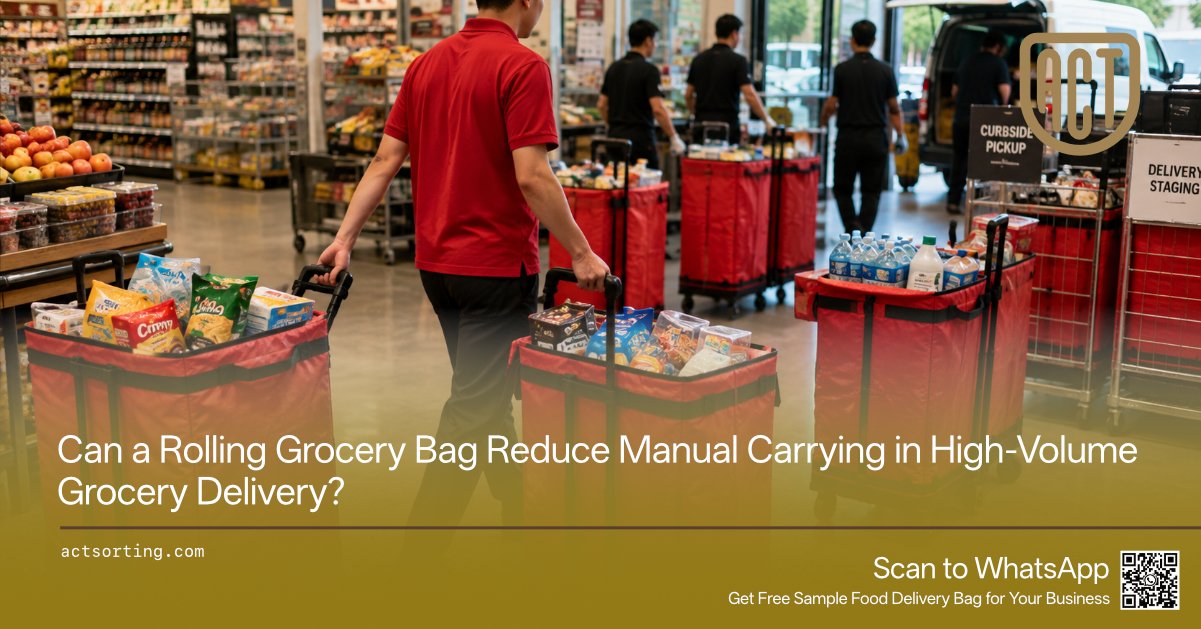
A Rolling Grocery Bag changes that movement. By combining a large reusable bag body with an integrated wheeled base and pull handle, workers can roll a consolidated grocery order across store floors, warehouse areas, loading zones, parking areas, and other suitable surfaces instead of carrying the entire load continuously.
For supermarket chains, grocery delivery companies, dark stores, retail fulfillment centers, curbside pickup operations, food distributors, and store-to-door delivery services, this can turn the bag from a simple container into a piece of mobile handling equipment.
ACTSORTING has specialized in industrial and commercial logistics bags since 2013. The company operates a manufacturing facility covering more than 12,000 square meters in Yangchun, Guangdong, China, with more than 400 experienced workers. Supported by BSCI and ISO9001 certification, ACTSORTING provides OEM & ODM manufacturing for reusable delivery bags, sorting bags, commercial totes, and customized wheeled bag solutions.
Rolling Grocery Bag projects can be developed around bag dimensions, material, wheel structure, pull-handle configuration, reinforcement, closures, colors, logos, identification areas, internal organization, and bulk production requirements.
The important question is not whether a grocery bag can hold the order.
It is whether employees need to carry that order every time it moves.
1. Grocery Orders Create a Different Handling Problem From Ordinary Parcels
Parcel delivery operations often divide individual cartons into route groups. Grocery fulfillment creates a different physical load. Multiple products belonging to one customer need to remain together, and the combined order may contain a mixture of dense and bulky items.
Bottled water and beverages add weight quickly. Canned products concentrate weight at the bottom. Household paper products consume volume without much weight. Fresh groceries and packaged foods may need to remain upright and organized. A large family order can therefore become awkward long before the bag itself reaches its maximum capacity.
Store employees may first collect the items with a cart or picking trolley. Once the order is complete, the groceries still need to be transferred into a customer order bag, moved into staging, loaded for pickup or delivery, and transported to the final handoff.
If the bag has no wheels, each movement normally requires lifting.
One large order may not seem problematic. Across hundreds of daily grocery orders, however, repeated lifting becomes a significant part of the fulfillment workflow. Workers may divide one order into several smaller bags simply because each individual bag is easier to carry. That increases the number of pieces that must be labeled, staged, loaded, counted, and delivered.
A Rolling Grocery Bag allows more of the order to remain consolidated while reducing the need to carry the full load continuously. Workers can use the pull handle to move the loaded bag across appropriate flat surfaces and lift it only when necessary, such as entering a vehicle, crossing stairs, or passing an obstacle.
This distinction matters for commercial buyers. ACTSORTING does not position the Rolling Grocery Bag only as a personal shopping accessory. It can be developed as reusable equipment for grocery fulfillment, supermarket logistics, and delivery operations where the same bag moves through repeated commercial handling cycles.
The operational benefit is fewer unnecessary carrying movements and better order consolidation. Instead of treating every grocery order as several separate shopping bags, the business gains one larger mobile unit that can follow the order through more stages of fulfillment.
2. Wheels Reduce Repeated Carrying Between Picking, Staging, and Delivery
The value of wheels becomes clear when the grocery order moves repeatedly through the operation.
A store employee finishes picking an order and needs to move it 30 meters to a chilled or ambient staging area. Later, another employee moves it from staging to curbside pickup. A delivery worker transfers the same order from the store to a vehicle and later moves it from the vehicle toward the customer.
Without wheels, the employee either carries the loaded bag or places it onto another cart. Using a separate cart solves part of the problem but creates another piece of equipment that needs to be available, stored, retrieved, and returned.
A Rolling Grocery Bag integrates the movement function into the bag itself.
Once loaded, the bag can roll through suitable sections of the workflow without requiring another trolley. The employee pulls the same unit that already contains the customer’s groceries. At the staging area, the bag remains the order container. When dispatch begins, the same bag moves toward the vehicle.
This can be especially useful for dark stores, supermarket backrooms, residential delivery services, large retail complexes, and curbside pickup programs where orders move over relatively long indoor or paved distances.
Wheel selection and mounting structure therefore matter. The wheels need to support the expected loaded weight and remain stable during repeated movement. The base must distribute the load into the wheeled structure rather than allowing the fabric body to absorb all the stress.
ACTSORTING can develop the wheel and base structure according to the required capacity, bag dimensions, and intended operating surface. The objective is not to bolt a pair of wheels onto a conventional shopping sack and hope physics remains cooperative.
Choosing ACTSORTING allows grocery operators to develop the Rolling Grocery Bag as an integrated product, where the bag body, lower reinforcement, wheels, frame, and pulling structure are considered together.
The result is a reusable grocery bag designed not only to contain the order but also to move it.
3. A Telescopic Handle Makes Large Grocery Loads Easier to Move
Wheels solve only half of the problem. Workers also need a practical way to control the loaded bag.
A suitable pull handle changes the posture and movement required to move a large grocery order. Instead of gripping soft webbing near the top of a loaded bag and carrying the entire weight, the employee can extend the handle and roll the load behind or beside them across appropriate surfaces.
For commercial grocery operations, handle height matters because employees have different body heights and use the equipment repeatedly. A telescopic structure can provide a more practical pulling position while retracting when the bag needs to be stored or transported.
The connection between the handle and the bag body is equally important. A loaded Rolling Grocery Bag creates pulling forces around the lower frame and handle attachment points. These areas need reinforcement so the fabric does not carry forces it was never designed to manage alone.
ACTSORTING can customize the handle structure, extension length, grip, mounting position, supporting webbing, and reinforcement according to bag capacity and use.
The handle also needs to coexist with normal bag handling. Employees may still need to lift the unit over thresholds or into a vehicle. Additional webbing handles can provide lifting points for these movements while the telescopic handle remains dedicated primarily to rolling.
This combination creates a more versatile product. Workers roll the grocery order across store floors and parking areas, then use reinforced carrying handles when rolling is not possible.
The advantage is reduced dependence on continuous manual carrying. The benefit is a smoother movement process for larger grocery orders, especially when the distance between picking, staging, vehicle loading, and customer handoff is significant.
For grocery delivery operations, that can make a meaningful difference because the same worker may handle many customer orders during one shift.
4. Large Rectangular Bag Bodies Keep Grocery Orders Together
A wheeled structure creates the most value when the bag itself can consolidate a useful grocery order.
Small shopping bags force workers to divide one customer’s items into several pieces. Each additional bag needs to remain associated with the same order. During busy periods, one piece may remain in staging while the rest of the order reaches the vehicle. Drivers must also confirm that all bags belonging to the customer have been loaded.
A larger rectangular Rolling Grocery Bag can keep more of the order inside one handling unit.
The rectangular structure is particularly useful for packaged groceries because cartons, bottles, trays, and retail products generally use space more efficiently inside a defined box-like shape than inside a narrow flexible sack.
Bag dimensions should still reflect the actual product mix. A very tall bag may become difficult to organize if small items settle at the bottom. An excessively wide bag may become cumbersome inside store aisles or delivery vehicles. The correct height, width, and depth depend on order volume, store layout, vehicle space, and expected load.
ACTSORTING can customize Rolling Grocery Bag dimensions rather than forcing every customer into one standard capacity. A supermarket chain may require one model for normal grocery orders and a larger version for family-size or bulk purchases.
Internal organization can also be added where useful. Removable dividers can separate bottles from lighter packaged foods, create different sections for customer orders, or help prevent small grocery items from disappearing beneath larger products.
Transparent identification holders or printed order areas can support staging and dispatch. A worker can identify the customer order, route, store number, or delivery batch without reopening the bag.
The benefit is stronger order consolidation. Fewer separate pieces mean fewer items to count during staging and loading, while the wheeled design makes the larger consolidated load more manageable.
Capacity becomes useful only when the handling system can actually move it. This is precisely where the Rolling Grocery Bag differs from simply making an ordinary grocery tote enormous and wishing everyone involved good luck.
5. Rolling Grocery Bags Can Improve Supermarket Picking and Curbside Operations
The Rolling Grocery Bag is particularly relevant to supermarket fulfillment because grocery orders often move through several short-distance stages before reaching a vehicle.
Consider a curbside pickup workflow. Employees pick the order inside the store, consolidate the groceries, place the completed order into staging, and wait for the customer to arrive. Once the vehicle is outside, the order needs to move from staging through the store or pickup area to the parking space.
A large conventional reusable bag still needs to be carried or placed onto a separate trolley. A rolling model can move directly from staging to the customer vehicle.
The same principle applies to grocery delivery. Completed bags may wait in route groups before drivers arrive. When dispatch begins, workers can roll several orders toward the loading area instead of carrying each large tote individually.
Dark stores can benefit as well. These facilities often process online grocery orders without normal customer shopping traffic, making fulfillment speed and equipment movement particularly important. A standardized Rolling Grocery Bag can become part of the order workflow from packing to staging and dispatch.
Identification is important in all of these scenarios. ACTSORTING can add transparent card holders, printed store numbers, route codes, order zones, colors, or customized branding to make each bag easier to assign.
Different colors may distinguish frozen, chilled, ambient, pickup, or delivery workflows when the customer’s operational system requires it. The exact design should follow the actual store process rather than add color simply for decoration.
This is where ACTSORTING’s OEM & ODM capability becomes commercially relevant. The bag can be developed around how a supermarket actually moves online orders, not merely around how a consumer carries groceries home.
For procurement teams evaluating grocery fulfillment equipment, this distinction matters. The intended buyer is not someone purchasing one shopping trolley for Saturday morning. It is an operation potentially deploying hundreds or thousands of reusable units across stores, fulfillment centers, and delivery routes.
6. Strong Bottom Structures Matter When the Bag Rolls Under Load
A conventional grocery tote places most of its load directly through the bag bottom. A Rolling Grocery Bag must transfer that load into a wheeled base while remaining stable during movement.
This creates additional structural requirements.
Heavy products such as bottled drinks, cooking oil, canned food, and bulk groceries naturally settle toward the bottom. When the bag rolls over joints, thresholds, or slightly uneven surfaces, the lower structure experiences repeated impact and vibration.
A weak base can deform, causing the bag to lean or allowing the load to press unevenly against the wheels. Fabric around wheel and frame attachment points may also experience concentrated stress if reinforcement is insufficient.
ACTSORTING can develop stronger lower structures using reinforced woven materials, additional bottom layers, support panels, webbing, frame integration, and protected wheel attachment areas.
The goal is to create a stable connection between the flexible bag body and the harder rolling components.
The bottom also needs abrasion resistance. There will still be moments when workers tilt, lift, or reposition the bag and parts of the base contact floors or pavement. Targeted reinforcement protects these contact zones without unnecessarily increasing the weight of the entire bag.
For commercial use, wheels themselves should be considered replaceable or serviceable where the final design requires it. A reusable Rolling Grocery Bag may remain structurally usable even after rolling components experience substantial wear. Designing the system with maintenance in mind can help extend the practical equipment life.
Choosing ACTSORTING provides access to product development around these structural details. The company can review expected load, wheel configuration, operating surfaces, bag dimensions, and carrying requirements before the bulk order is finalized.
A rolling product is only useful while it rolls properly. Once one wheel begins behaving like it has developed independent career ambitions, the original efficiency advantage disappears rather quickly.
7. Grocery Delivery Requires More Than Simply Adding Wheels to a Bag
Wheels are the most visible feature of a Rolling Grocery Bag, but they should not distract from the rest of the product.
The bag still needs durable fabric, strong seams, reliable handles, suitable capacity, practical openings, identification, and a structure that protects groceries during movement.
The opening is particularly important. Grocery workers may load boxes, bottles, bags, and irregular retail products rapidly. A narrow top slows packing and makes large products difficult to insert. A wide rectangular opening allows workers to see and organize the interior more easily.
Closure requirements depend on the operation. A supermarket staging bag may remain open during picking and then use a flap or zipper before movement. A delivery operation may need stronger containment because the bag enters a vehicle and travels through several stops.
Handles remain necessary even with wheels. Workers may need to lift the Rolling Grocery Bag over steps, into a van, or across unsuitable surfaces. Reinforced webbing handles provide these secondary lifting points.
The bag should also remain reasonably manageable when empty. A large commercial structure that becomes impossible to store after use creates another operational problem. Depending on the wheeled frame design, the soft bag portion can be developed to collapse or compress when not carrying groceries.
ACTSORTING can coordinate these features through OEM & ODM development. Fabric, capacity, telescopic handle, wheels, closures, lifting handles, label pockets, internal organization, reinforcement, color, and branding can be considered as parts of one product.
This integrated approach is an important reason to choose ACTSORTING. The company is not simply supplying a wheel accessory or adapting a consumer trolley. It can develop a reusable grocery logistics bag for repeated commercial handling.
The wheels attract attention. The value comes from everything around them working properly.
8. OEM & ODM Customization Connects the Rolling Bag to the Store Workflow
Different grocery businesses use very different fulfillment models.
A supermarket chain may stage online orders behind each store. A dark store may operate entirely around digital orders. A grocery wholesaler may handle larger cartons and heavier loads. A residential delivery service may need bags that move from vans into apartment buildings. A curbside operation may care more about fast movement from staging to customer vehicles.
These businesses should not automatically receive the same Rolling Grocery Bag.
ACTSORTING’s OEM & ODM process can begin with store layout, common order size, maximum expected load, vehicle space, wheel requirements, handle height, product mix, staging method, and storage process.
Customers can provide an existing sample, technical drawing, reference photograph, required dimensions, or descriptions of current handling problems.
The bag can then be customized in size, woven material, lamination, body color, wheel structure, telescopic handle, reinforcement, lifting straps, closure, transparent order pocket, logo printing, internal divider, bottom construction, and packaging.
For example, a grocery chain struggling with heavy beverage orders may require a more strongly reinforced bottom and robust wheel structure. A store with narrow aisles may prioritize a narrower body. A delivery company may need route identification on both front and side panels so the order remains visible inside the vehicle.
The sample should be tested under realistic conditions. Workers should fill it with common grocery products, roll it through the store, move it across the loading area, lift it into the delivery vehicle, pull it again at the destination, and return it empty.
This testing reveals details that a static product photograph never will: whether the loaded bag remains stable, whether the handle height feels practical, whether the wheels track properly, and whether the body dimensions work inside real aisles and vehicles.
Choosing ACTSORTING gives grocery operators the ability to turn this feedback into a manufacturable product rather than accepting a fixed off-the-shelf trolley design.
9. ACTSORTING Builds Rolling Grocery Bags for Commercial Operations
The phrase Rolling Grocery Bag can describe many products, from a small personal shopping trolley to large reusable equipment for grocery fulfillment.
ACTSORTING focuses on the commercial side of that spectrum.
Since 2013, the company has developed and manufactured logistics bags for sorting, transport, delivery, and reusable circulation. Its production facility in Yangchun, Guangdong covers more than 12,000 square meters and employs more than 400 experienced workers.
BSCI and ISO9001 certification support responsible manufacturing and structured quality management. More importantly for commercial buyers, ACTSORTING combines bag manufacturing experience with OEM & ODM capability and large-volume production.
For Rolling Grocery Bag projects, customers can customize the bag body, dimensions, material, lamination, wheel configuration, pull handle, lifting handles, lower reinforcement, closures, transparent card pockets, internal divisions, colors, logo printing, store identification, and packaging.
This matters for supermarket chains and grocery delivery companies because the product usually needs to fit an existing system. Store aisles have fixed widths. Staging racks have fixed dimensions. Vans have limited cargo space. Employees follow established picking and dispatch processes.
ACTSORTING can develop the bag around these constraints.
That is the practical reason to choose ACTSORTING. The company is not only offering a wheeled bag. It can support the process from requirement analysis and sample development through customized bulk manufacturing and later repeat orders.
If the first operating period reveals that the wheels need to change, the bag needs a different height, or the base needs additional reinforcement, the product can be optimized for the next production cycle.
Commercial grocery equipment should improve as the operator learns from real use. A capable manufacturing partner makes that possible.
10. Stable Bulk Production Supports Grocery Chains and Multi-Store Programs
A Rolling Grocery Bag becomes much more demanding when a customer needs 1,000, 5,000, or more units instead of one sample.
The wheels need to remain consistent. Pull handles need the same extension and mounting structure. Bag dimensions need to fit the same store and vehicle equipment. Reinforcement must appear in the same locations. Colors, logos, closures, and identification pockets need to follow the approved design.
Small inconsistencies become large operational problems when the product is deployed across many stores.
A grocery chain may train employees around one approved Rolling Grocery Bag. If later batches arrive with a different height, weaker handle structure, smaller wheels, or altered capacity, the original workflow becomes less reliable.
ACTSORTING can use the approved sample and confirmed technical specification as the production reference. Material, dimensions, tolerances, wheel structure, handle configuration, reinforcement, closure, printing, label pocket, color, and packing requirements can be established before bulk manufacturing.
The company’s more than 12,000 square meters of manufacturing space and workforce of over 400 employees support customized commercial orders, repeat replenishment, seasonal requirements, and multi-location rollout.
This scale is one of the reasons grocery operators can choose ACTSORTING for larger programs. The same supplier can support initial development and later production rather than forcing the customer to restart the project after the sample stage.
ACTSORTING can also support coordinated product ranges. One grocery operator may require a standard Rolling Grocery Bag for normal orders and a larger reinforced version for high-volume grocery delivery. Both can share the same colors, logo, order pocket, handle language, and visual identity.
For supermarket chains, grocery fulfillment operators, dark stores, curbside pickup programs, and delivery companies dealing with large orders and repeated manual carrying, the next equipment project should begin with the complete movement path.
Provide the expected bag dimensions, average and maximum grocery load, common product types, store layout, operating surface, vehicle dimensions, wheel requirements, handle requirements, closure, logo, target quantity, and current handling pain points to receive a customized proposal from ACTSORTING.
A grocery order will always have weight.
The Rolling Grocery Bag simply makes sure employees do not have to carry all of it every time the order moves.
FAQ
Q: What is a Rolling Grocery Bag for commercial grocery operations?
A: A commercial Rolling Grocery Bag combines a reusable high-capacity grocery bag with an integrated wheeled base and pull handle, allowing grocery orders to be rolled through suitable picking, staging, loading, curbside, and delivery environments instead of being carried continuously.
Q: Can ACTSORTING customize the wheels and telescopic handle?
A: Yes. Wheel configuration, lower support structure, telescopic handle, grip position, attachment points, lifting handles, and reinforcement can be developed according to expected load, dimensions, and operating conditions.
Q: Can Rolling Grocery Bags be customized for supermarket chains?
A: Yes. ACTSORTING can customize dimensions, colors, logos, store codes, order pockets, internal dividers, closures, wheels, handles, and reinforcement for supermarket, dark-store, curbside pickup, and grocery delivery programs.
Q: Can a Rolling Grocery Bag handle large or heavy grocery orders?
A: The capacity depends on the selected material, dimensions, base structure, wheel system, handles, and reinforcement. ACTSORTING can develop the specification around the customer’s average and maximum expected grocery load.
Q: Why choose ACTSORTING for customized Rolling Grocery Bags?
A: ACTSORTING has specialized in commercial logistics bags since 2013, operates a 12,000+ square meter production facility with over 400 employees, holds BSCI and ISO9001 certification, and supports OEM & ODM development, customized bulk production, multi-store rollout, and repeat orders.