
Table of Contents
- Commercial Laundry Delivery Creates a Different Handling Problem
- Wheels Reduce Manual Carrying Between Guest Rooms, Laundry Rooms, and Vehicles
- Large-Capacity Rolling Laundry Bags Keep Linen Loads Together
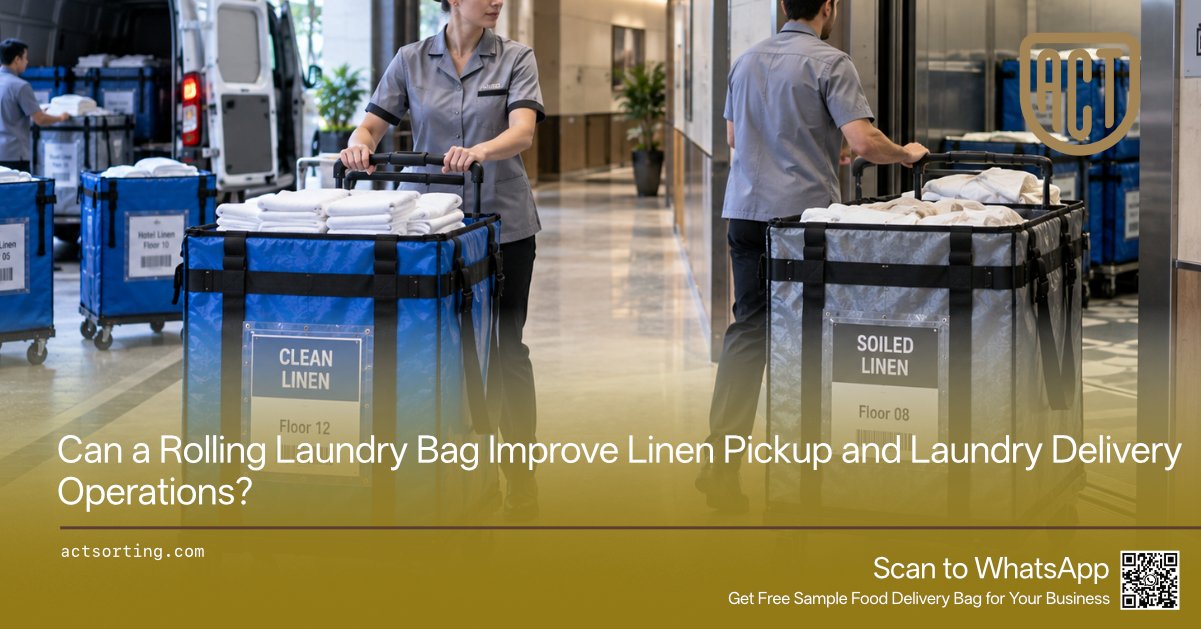
- Clean and Soiled Linen Need Clear Physical Separation
- Stable Bottoms and Strong Handles Matter Under Heavy Textile Loads
- Clear Identification Helps Prevent Hotel and Customer Linen Mix-Ups
- Rolling Laundry Bags Improve Hotel, Hospital, and Commercial Laundry Routes
- Easy-Clean Materials Support Repeated Laundry Circulation
- ACTSORTING Customizes Rolling Laundry Bags Around Real Delivery Workflows
- Stable Bulk Production Supports Multi-Site Laundry Programs
Introduction
Commercial laundry operations move far more than clothing.
Hotels send sheets, pillowcases, duvet covers, towels, bathrobes, table linen, and staff uniforms between guest floors, laundry rooms, loading areas, and external laundry facilities. Restaurants generate tablecloths, napkins, kitchen textiles, and uniforms. Professional laundry companies collect bags from multiple customers, transport soiled items to processing facilities, and return clean textiles according to route and account.
The textiles themselves are soft. The load is not.
A large bag filled with towels or damp linen can become heavy very quickly. Employees may need to carry the same load from a hotel floor to an elevator, from the elevator to a service area, from the building to a vehicle, and later from the vehicle into a commercial laundry facility.
A Rolling Laundry Bag can reduce this repeated manual carrying by combining a large reusable textile bag with a wheeled base and telescopic pull handle. Workers can roll loaded bags through hotel corridors, laundry rooms, service elevators, loading areas, warehouses, and other suitable flat surfaces while retaining lifting handles for stairs, vehicle loading, and other obstacles.
For commercial laundries, hotel groups, resorts, linen rental companies, restaurants, healthcare facilities, uniform services, and outsourced laundry operators, the product can become part of a closed-loop collection and delivery system rather than simply another large sack.
ACTSORTING has specialized in commercial logistics bags since 2013. The company operates a manufacturing facility covering more than 12,000 square meters in Yangchun, Guangdong, China, supported by more than 400 experienced workers.
With BSCI and ISO9001 certification, ACTSORTING provides OEM & ODM manufacturing for reusable laundry delivery bags, rolling collection bags, commercial sorting totes, and customized textile logistics solutions.
Bag dimensions, woven materials, laminated surfaces, telescopic handles, wheel structures, lifting webbing, closures, identification pockets, rigid bottom support, colors, logos, customer codes, and packaging can all be customized.
A commercial laundry bag should do more than hold linen.
It should help the linen move through the entire collection, washing, sorting, delivery, and return cycle with less unnecessary handling.
1. Commercial Laundry Delivery Creates a Different Handling Problem
Parcel and grocery logistics usually involve many rigid individual items. Laundry operations are different because dozens of soft textile items combine into one large, dense load.
Sheets and towels compress easily, so workers continue adding more items until the bag appears full. Once lifted, however, the total weight may be considerably higher than expected. Damp towels or partially wet linen add even more weight.
Traditional laundry sacks solve the containment problem but not the movement problem.
A housekeeper may fill a large bag on a hotel floor and then drag or carry it toward the service elevator. Another employee moves it through the basement. A driver later lifts it into a vehicle. At the commercial laundry, the same sack is moved again for sorting.
The textile may pass through several hands before washing even begins.
Rolling Laundry Bags can reduce some of these manual transfers. Once the linen is loaded, the worker can pull the same unit through suitable corridors and service areas rather than transferring the contents onto a separate cart.
This is particularly useful in larger hotels, resorts, hospitals, student residences, serviced apartments, and industrial laundry facilities where collection points are spread across substantial distances.
ACTSORTING can customize the bag according to expected textile volume, maximum load, corridor width, elevator dimensions, vehicle space, and collection process.
A hotel-floor collection bag may need a relatively narrow footprint for corridors and service elevators. A commercial laundry route bag may prioritize larger capacity and stronger lower reinforcement.
Choosing ACTSORTING allows these requirements to shape the product from the beginning.
The objective is not maximum theoretical volume. It is useful capacity that employees can actually move through the building.
2. Wheels Reduce Manual Carrying Between Guest Rooms, Laundry Rooms, and Vehicles
Laundry logistics often involves long horizontal movements.
A hotel employee may move linen along a corridor before reaching the elevator. A laundry worker may transport completed loads across a large processing facility. Drivers may pull bags from loading areas to vehicles or between customer service entrances and collection points.
These are exactly the movements where wheels create value.
Instead of carrying the entire textile load, employees can use the telescopic handle to roll the bag across suitable surfaces.
The advantage becomes greater as the bag fills.
Towels, bedding, uniforms, and table linen can create substantial combined weight. Dividing everything into smaller bags makes individual loads easier to carry but increases the number of physical units that need to be counted, labeled, collected, and returned.
A larger Rolling Laundry Bag allows the operation to maintain better load consolidation while reducing continuous carrying.
ACTSORTING can customize the wheel structure based on expected commercial use. Smooth hotel corridors may require a different configuration from loading bays or industrial laundry floors. The lower frame, wheel attachment, bag body, and handle structure should work as one system.
Traditional lifting handles remain important.
The bag still needs to enter delivery vehicles, cross thresholds, or move through locations where wheels cannot be used. Reinforced side or upper handles provide additional lifting points without requiring workers to use the telescopic pull handle incorrectly.
This combination makes the product useful through more stages of the route.
A wheeled bag will not convince a staircase to become flat. It can, however, stop employees from carrying a heavy linen load through the entire building simply because one staircase exists somewhere along the journey.
3. Large-Capacity Rolling Laundry Bags Keep Linen Loads Together
Laundry operations depend heavily on batch control.
One bag may contain linen from a specific hotel floor. Another may belong to a particular restaurant. A commercial laundry may collect separate loads from dozens of customer accounts during one route.
If the textile load is divided across too many small bags, tracking becomes more difficult.
A large-capacity Rolling Laundry Bag can consolidate more linen into one clearly identified unit.
This is particularly useful for hotel bedding and towels, which occupy significant volume but can be compressed inside a flexible textile bag. The rectangular structure can provide a more predictable footprint than an irregular soft sack, making staging and vehicle loading easier.
Capacity still needs to be controlled.
An excessively large bag may encourage overloading, particularly when employees are collecting dense or damp textiles. ACTSORTING can therefore customize dimensions according to expected linen type and maximum target load rather than simply making the bag as large as physically possible.
Different capacities may also be useful within the same system.
A hotel group may use a medium Rolling Laundry Bag for floor collection and a larger model for central laundry transfer. A commercial laundry operator may use different sizes for hotels, restaurants, salons, gyms, or uniform-service customers.
ACTSORTING can keep the visual language consistent across these models through common colors, identification pockets, webbing layouts, logos, and customer-code positions.
This creates a recognizable equipment family rather than a collection of unrelated sacks.
The benefit is easier batch control, fewer individual bags per collection, and more predictable movement from customer site to laundry facility.
4. Clean and Soiled Linen Need Clear Physical Separation
One of the most important rules in laundry logistics is simple: clean textiles and soiled textiles should not become confused.
The operational reality can make this harder than it sounds.
The same delivery route may collect used linen from one customer while returning clean linen to another. Hotel service areas may contain both outbound soiled loads and incoming clean bedding. Commercial laundry facilities handle multiple processing stages at the same time.
The bag system should make these categories immediately visible.
ACTSORTING can customize Rolling Laundry Bags using different body colors, webbing colors, printed text, large identification panels, or permanent codes.
For example, one color may be assigned to soiled linen while another represents processed clean linen. Different colors may also represent hotels, departments, customer categories, or route groups.
Transparent pockets can carry temporary documents such as customer name, hotel floor, collection date, laundry batch, route number, delivery status, or barcode labels.
Permanent printing can identify the laundry company, bag number, depot, or ownership information.
The important point is consistency.
If blue represents clean linen in one facility, it should not suddenly represent soiled linen at another location within the same operating system. Standardization reduces dependence on employee memory and makes mistakes easier to notice visually.
ACTSORTING can manufacture these identification features directly into the bag instead of forcing operators to rely on adhesive labels or handwritten tags after delivery.
This is a practical reason to choose ACTSORTING for a commercial laundry project.
Customization can support the process itself, not merely place a logo on the side.
A very expensive washing process becomes rather less impressive if the clean sheets then spend the afternoon sitting inside the wrong unidentified sack.
5. Stable Bottoms and Strong Handles Matter Under Heavy Textile Loads
Soft textiles create unusual load behavior.
Unlike cartons, laundry settles and shifts inside the bag. Towels and bedding compress downward, while uneven textile distribution can make one side heavier than another.
If the base is too flexible, the bag may sag around the wheel structure. If the lower support is insufficient, repeated rolling under load can place excessive stress around the wheel attachments.
ACTSORTING can customize reinforced bases using stronger woven materials, supporting panels, additional webbing, corner reinforcement, and integrated lower structures.
The objective is to create a stable connection between the flexible bag body and the wheeled base.
Handles require similar attention.
Workers may need to lift the fully loaded Rolling Laundry Bag into a van or over a threshold. The lifting webbing needs to transfer this load through reinforced areas of the bag body instead of concentrating all force around a small stitched point.
Extended webbing can help distribute load more effectively. Reinforcement patches can protect attachment areas. Handle length and position can also be adjusted according to the expected lifting method.
The telescopic handle performs a different job. It controls the bag during rolling rather than replacing the reinforced lifting handles.
ACTSORTING can develop these components together based on the expected textile volume, load, wheel configuration, and operating environment.
This integrated design is important because adding wheels to a soft laundry sack changes how forces move through the product.
The bag is no longer merely hanging from webbing. It is rolling, turning, tilting, parking, and occasionally being lifted while fully loaded.
Commercial equipment tends to punish designs that ignore such details with impressive efficiency.
6. Clear Identification Helps Prevent Hotel and Customer Linen Mix-Ups
Commercial laundries may process textiles for many customers at the same time.
Hotel A may use white sheets that look almost identical to Hotel B. Restaurants may send similar table linen. Uniform-service customers may have garments separated by company, department, or employee.
The physical container therefore becomes part of customer identification.
A Rolling Laundry Bag can include a large transparent pocket for customer cards, route sheets, barcode labels, laundry batch documents, hotel floor information, or delivery notes.
ACTSORTING can customize pocket dimensions, position, opening direction, and quantity according to the customer’s document format.
Identification should remain visible while the bags are staged.
A pocket placed too low may disappear behind another bag. A card holder positioned behind the telescopic handle may become difficult to scan. For some operations, front and side identification may be useful so workers can recognize the bag from different directions.
Permanent asset information can remain separate from temporary laundry information.
A bag may carry a fixed serial number, laundry facility code, or ownership marking while the customer card changes every cycle.
This helps reusable equipment return to the correct operator after delivery.
QR codes, barcodes, or RFID-ready pockets can also be incorporated where the customer already uses digital tracking systems.
The benefit is clearer batch control and reduced risk of customer mix-ups.
For a commercial laundry, returning perfect linen to the wrong hotel is still a failure. The detergent does not receive bonus points for having done its part correctly.
7. Rolling Laundry Bags Improve Hotel, Hospital, and Commercial Laundry Routes
The same basic product can support several laundry environments, but each has different priorities.
Hotels and resorts often need movement through corridors, service elevators, housekeeping areas, basements, and loading docks. A narrower Rolling Laundry Bag may improve maneuverability while still providing useful linen capacity.
Commercial laundry plants may prioritize larger loads, repeated industrial handling, strong identification, and movement between sorting, washing, finishing, and dispatch areas.
Restaurants generate tablecloths, napkins, kitchen textiles, aprons, and staff uniforms. These loads may be smaller but require clear customer separation and repeated pickup schedules.
Healthcare and care facilities may have additional operational requirements for textile segregation and handling procedures. Product specifications should therefore follow the facility’s actual process and applicable hygiene requirements rather than assume one universal bag design.
Uniform rental and workwear services may use Rolling Laundry Bags to collect garments from factories, offices, hospitality sites, or service businesses before returning processed items.
ACTSORTING can adapt dimensions, materials, identification, closures, wheels, handles, and colors for these different applications.
This is where the product moves beyond the narrow idea of a laundry sack.
The Rolling Laundry Bag becomes reusable transport equipment connecting collection, processing, dispatch, and return.
For procurement teams, that means the correct specification should be based on the complete route, not simply the amount of linen that fits inside.
8. Easy-Clean Materials Support Repeated Laundry Circulation
A reusable laundry bag circulates between areas specifically associated with dirty textiles and clean textiles. Cleaning and inspection therefore need to be considered during product development.
The appropriate process depends on the operator and application, but the bag itself should not make routine maintenance unnecessarily difficult.
ACTSORTING can customize laminated woven materials and smoother surfaces where easier wiping is required.
The inner and outer structure can also avoid unnecessary areas where lint, dust, or residue accumulates. A wide opening makes inspection easier, while removable support components can provide better access during cleaning where required.
Soiled linen bags may encounter moisture, dust, hair, detergent residue, or textile fibers during repeated use.
The base receives particularly frequent contact with floors, vehicles, and loading areas. A reinforced surface selected for both abrasion and practical cleaning can improve long-term usability.
The bag should also dry properly before compact storage.
If damp reusable equipment is folded immediately, moisture can remain trapped between surfaces. The design and operating procedure should therefore allow inspection and drying before the bag returns to storage.
ACTSORTING can discuss material requirements, cleaning procedures, and circulation frequency during OEM & ODM development.
The objective is not to make unsupported claims that one fabric magically solves every hygiene requirement. Laundry operators already have cleaning protocols for good reasons.
The product simply needs to fit those protocols rather than fight them.
9. ACTSORTING Customizes Rolling Laundry Bags Around Real Delivery Workflows
Commercial laundry operations vary significantly.
A hotel may move linen internally before an external laundry company collects it. Another hotel may operate its own laundry. A centralized laundry plant may serve dozens of hotels and restaurants. Uniform companies may follow scheduled pickup routes with completely different load patterns.
ACTSORTING’s OEM & ODM process can begin with the actual workflow.
Customers can provide expected bag dimensions, average textile load, corridor and elevator restrictions, vehicle size, wheel requirements, collection method, clean/soiled separation rules, identification format, and current handling problems.
The product can then be customized in material, lamination, dimensions, wheel configuration, telescopic pull handle, carrying handles, reinforced base, closures, colors, logos, transparent document pockets, barcode areas, internal organization, and packaging.
Existing samples or photographs of current equipment can also help identify weaknesses.
A customer may report that workers struggle with heavy hotel towel bags. The new model may require stronger wheels and lower reinforcement. Another customer may have frequent linen mix-ups, making large identification panels the higher priority.
This problem-driven development is one reason to choose ACTSORTING.
Since 2013, the company has focused on commercial logistics bags and can combine flexible textile manufacturing with structural customization for repeated transport operations.
Its production facility covers more than 12,000 square meters and employs over 400 experienced workers, while BSCI and ISO9001 certification support responsible manufacturing and quality management.
ACTSORTING can therefore support the project from sampling through customized bulk production and later repeat orders.
The bag is developed around the laundry route instead of asking the laundry route to adapt around whatever sack happened to be available.
10. Stable Bulk Production Supports Multi-Site Laundry Programs
Laundry equipment often needs to be standardized across several locations.
A hotel group may want the same Rolling Laundry Bags across multiple properties. A commercial laundry company may supply reusable collection bags to dozens of customers. A uniform service may operate several depots and delivery routes.
Consistency becomes important at this scale.
Bag dimensions should remain compatible with vehicles and elevators. Clean and soiled color systems need to remain unchanged. Transparent pockets should fit the same documents. Wheel and handle structures should behave consistently.
ACTSORTING can use the approved sample and confirmed technical specification as the reference for mass production.
Material, finished dimensions, tolerances, wheel configuration, telescopic handle, carrying webbing, reinforcement, closure, pockets, colors, printing, and packaging can be confirmed before manufacturing.
Repeat production is equally important.
Reusable laundry bags eventually require replenishment. New hotel accounts join the network. Existing customers expand. Additional bags are needed during seasonal occupancy peaks.
The replacement equipment should remain compatible with the original system.
ACTSORTING’s manufacturing facility and workforce support customized bulk orders, hotel-group programs, commercial laundry rollouts, and recurring production.
For hotels, resorts, commercial laundries, restaurants, linen rental companies, and uniform services dealing with heavy textile loads, long internal transport distances, customer mix-ups, or too many separate laundry sacks, a Rolling Laundry Bag can provide a more practical collection and delivery system.
Provide the expected bag dimensions, linen categories, average and maximum load, corridor or elevator restrictions, vehicle requirements, clean/soiled identification system, wheel structure, handle requirements, logo, quantity, and current operational pain points to receive a customized proposal from ACTSORTING.
Laundry may be soft.
Moving several hundred kilograms of it through a hotel every day most certainly is not.
FAQ
Q: What is a Rolling Laundry Bag used for?
A: A commercial Rolling Laundry Bag can collect and transport bedding, towels, uniforms, table linen, and other textiles through hotels, laundry facilities, loading areas, vehicles, and customer delivery routes while reducing repeated manual carrying on suitable surfaces.
Q: Can ACTSORTING customize Rolling Laundry Bags for hotels?
A: Yes. Dimensions, colors, clean and soiled identification, wheels, telescopic handles, carrying webbing, document pockets, reinforcement, logos, and other features can be customized for hotel and resort laundry operations.
Q: Can clean and soiled linen use different bag colors?
A: Yes. ACTSORTING can customize body colors, webbing colors, printed text, customer codes, transparent identification pockets, and other visual systems to support the operator’s linen-separation workflow.
Q: Can Rolling Laundry Bags include barcode or customer label holders?
A: Yes. Transparent pockets, barcode areas, QR-code positions, permanent asset IDs, hotel codes, route labels, and customer identification can be incorporated according to the laundry operator’s tracking system.
Q: Why choose ACTSORTING for commercial laundry delivery bags?
A: ACTSORTING has specialized in commercial logistics bags since 2013, operates a 12,000+ square meter manufacturing facility with over 400 employees, holds BSCI and ISO9001 certification, and supports OEM & ODM development, customized bulk production, multi-site programs, and repeat orders.