

Table of Contents
- Manual Parcel Sorting Still Plays an Important Role in Local Delivery Networks
- Floor-Based Parcel Sorting Creates Unnecessary Handling and Confusion
- Logistic Sorting Bags Turn Delivery Zones Into Organized Sorting Units
- Wide Openings and Stable Bottoms Support Faster Manual Parcel Handling
- Standardized Bag Capacities Help Prevent Overfilled Sorting Containers
- Barcode Pockets Connect Physical Sorting Bags With Digital Route Records
- Roll Cage Compatibility Makes Warehouse-to-Vehicle Transfers Easier
- Flexible Sorting Stations Help Depots Handle Seasonal Parcel Surges
- Shift Handover and Empty Bag Circulation Require a Consistent System
- Why Choose ACTSORTING for Customized Logistic Sorting Bags?
Introduction
Not every courier warehouse operates with automated conveyor belts, robotic sorting equipment, or advanced parcel handling systems. Across regional delivery networks, many smaller depots still depend on employees who scan incoming parcels, identify their destinations, and place them into the appropriate sorting containers before dispatch vehicles begin their routes.
This approach can be practical for facilities with moderate parcel volumes, limited warehouse space, or rapidly changing delivery territories. However, manual sorting introduces its own operational challenges. Parcels can accumulate on the floor, sorting areas become difficult to distinguish, and employees may need to handle the same package several times before it reaches the correct delivery vehicle.
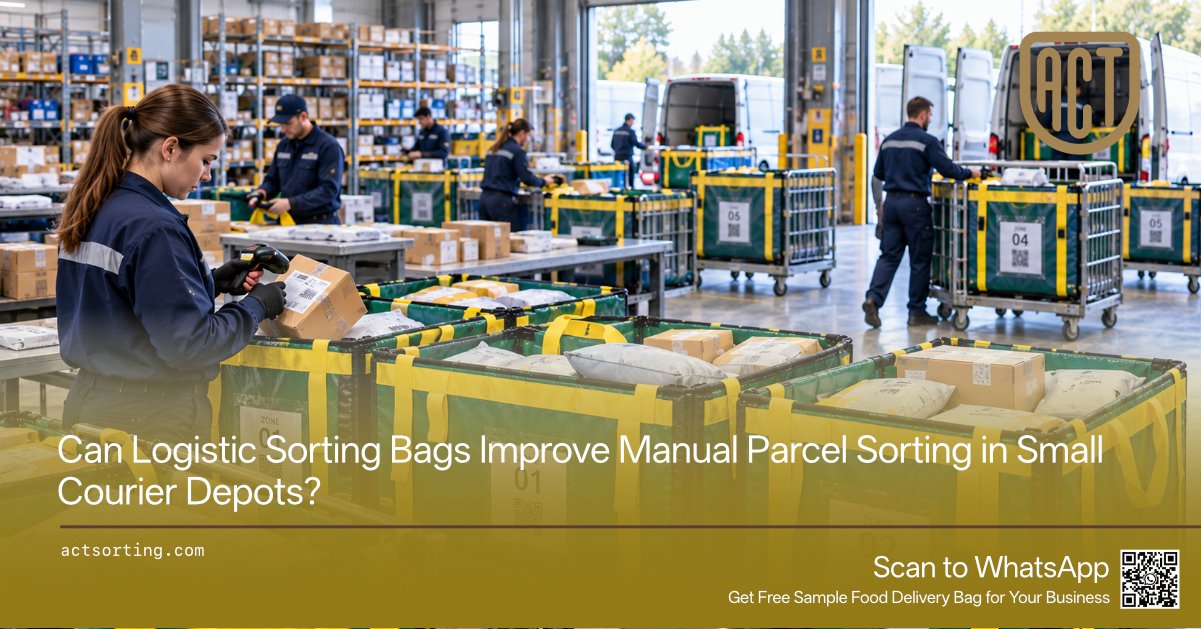
Consider a local courier depot receiving mixed shipments from a regional distribution center. Several employees unload cartons and poly mailers, scan each tracking label, and separate parcels according to neighborhood or delivery route. Without clearly defined containers, packages may be placed into temporary floor piles that gradually spread beyond their assigned areas. As additional shipments arrive, employees must repeatedly reorganize those piles while preparing for the next dispatch window.
Logistic Sorting Bags and Parcel Sorting Bags provide a straightforward physical solution. Instead of creating loose groups on the warehouse floor, employees can sort parcels into reusable bags assigned to specific delivery zones. Each bag becomes an identifiable handling unit that can be moved into a roll cage, transferred to a staging area, and loaded into the appropriate vehicle.
For local courier companies, postal delivery stations, regional parcel operators, e-commerce distribution facilities, and third-party logistics providers, this creates an opportunity to improve manual sorting without requiring every facility to invest in a fully automated sorting line.
ACTSORTING has specialized in commercial logistics bags since 2013. The company operates a manufacturing facility covering more than 12,000 square meters in Yangchun, Guangdong, China, with more than 400 employees. Supported by BSCI and ISO9001 certification, ACTSORTING provides OEM & ODM manufacturing for Logistic Sorting Bags, Parcel Sorting Bags, Courier Sorting Totes, and other reusable logistics equipment. Materials, dimensions, reinforced bottoms, carrying handles, transparent identification pockets, closures, and colors can be customized according to the requirements of individual sorting facilities.
The objective is to make manual parcel sorting easier to organize, easier to verify, and easier to transfer into the next delivery stage.
Manual Parcel Sorting Still Plays an Important Role in Local Delivery Networks
Large parcel distribution centers often rely on automated sorting technology to process high shipment volumes. Smaller delivery stations operate under different conditions. Their daily workload may not justify complex machinery, their warehouse footprint may be limited, or their delivery territories may change frequently enough that a flexible manual system remains useful.
In these facilities, workers typically unload mixed parcels, scan tracking labels, identify the required delivery zone, and place each package into a corresponding sorting area. Once a route group is complete, employees move the parcels to a dispatch staging location where the assigned driver collects them.
The quality of this process depends heavily on physical organization. A warehouse management system may correctly identify the delivery destination, but employees still need a clearly defined place to put the parcel. If the sorting station relies on loose piles or temporary floor markings, the workspace can become increasingly difficult to manage as shipment volumes rise.
Logistic Sorting Bags provide a reusable structure for this process. Each bag can represent a delivery neighborhood, route number, postal area, or another sorting category. Employees have a defined physical destination for each scanned parcel, while supervisors can identify the status of different route groups by examining the bags and their corresponding labels.
ACTSORTING can manufacture sorting bags in coordinated sizes according to the depot’s parcel volume and available space. A smaller local station may require compact sorting units, while a busier regional facility may use larger rectangular bags positioned inside metal roll cages.
The advantage is flexibility. Operators can establish an organized manual sorting system around their existing procedures and adjust the number or placement of bags as operational requirements change.
Floor-Based Parcel Sorting Creates Unnecessary Handling and Confusion
One of the most common problems in space-constrained sorting facilities is the accumulation of loose parcels on warehouse floors. Employees may initially place shipments in clearly marked areas, but those groups can gradually expand as more packages arrive.
A stack of cartons may spread into a neighboring delivery zone. Small poly mailers can become trapped beneath larger boxes, and employees may accidentally place new arrivals on top of the wrong parcel group. When the loading team begins preparing vehicles, workers often need to gather and reorganize the same parcels again.
This creates repeated handling that contributes little to the actual delivery process. Each additional movement also creates another opportunity for a package to be misplaced, dropped, or mixed with an unrelated route.
Parcel Sorting Bags help establish clearer boundaries around each sorting group. Instead of treating the floor itself as the container, employees place packages inside a designated bag. The bag can remain in a fixed sorting position during receiving and then move as a complete unit when the route is ready for staging.
For facilities using metal roll cages, several bags can be arranged within the cage according to its dimensions and the required sorting categories. This keeps parcel groups physically separated without relying solely on floor markings.
ACTSORTING can customize rectangular bag structures, reinforced bottoms, and wide openings to accommodate mixed cartons and mailers. The finished dimensions can be developed around the depot’s available sorting space, allowing operators to establish more predictable positions for each category.
A defined sorting bag does not eliminate scanning mistakes, but it provides a clearer physical destination for correctly scanned parcels. That distinction becomes valuable when multiple employees are working within a relatively small warehouse.
Logistic Sorting Bags Turn Delivery Zones Into Organized Sorting Units
Manual sorting becomes easier to manage when each delivery zone corresponds to a clearly identifiable physical container. Instead of remembering where different parcel groups have accumulated, employees can follow a consistent system of route numbers, bag locations, and identification cards.
For example, a neighborhood delivery station may divide its service territory into several route groups. Each group receives a designated Parcel Sorting Bag with a visible route card. Employees scan incoming parcels and place them into the corresponding bag. If a route generates more parcels than one bag can comfortably accommodate, the depot can assign additional numbered units to the same route.
The bags can then be moved from the receiving area to dispatch staging without requiring workers to rebuild the parcel groups. This is particularly useful when the employees responsible for unloading and sorting are not the same people who later load the vehicles.
ACTSORTING can customize transparent route pockets, printed zone identifiers, barcode areas, and bag colors according to the operator’s existing sorting rules. Different colors may distinguish route clusters or delivery territories, while printed codes and scanning information provide more precise identification.
The system should remain understandable even when staffing changes. New employees and temporary workers benefit from consistent bag positions, standardized label locations, and clear route assignments. Supervisors can also inspect the sorting area more easily when incomplete, completed, and exception groups are physically distinct.
The practical objective is not to create a complicated identification system. It is to ensure that the information produced by the scanning process corresponds to an equally clear physical location.
Wide Openings and Stable Bottoms Support Faster Manual Parcel Handling
During manual sorting, employees may place hundreds of cartons and poly mailers into receiving containers during a single working period. The opening and bottom construction of a sorting bag can influence how conveniently that process operates.
A completely flexible bag may collapse when empty. Workers then need to hold the opening with one hand while placing a parcel inside with the other. When handling large cartons, this can become awkward because the package may catch against folded fabric or the upper edge.
A more suitable design can include a wide rectangular opening, reinforced upper sections, or structures intended to work with existing bag supports and roll cages. A stable bottom can help the bag maintain a predictable footprint while parcels accumulate inside.
ACTSORTING can customize the opening dimensions, woven material, upper-edge reinforcement, sidewall construction, and bottom panels according to the customer’s sorting arrangement. Some facilities may prefer bags that stand independently under suitable loading conditions, while others may use frames or cages that provide external support.
The bag should also remain easy to empty and fold. Excessive rigidity may help maintain shape during sorting but become inconvenient when employees need to store large quantities of empty bags. Removable support panels or targeted reinforcement can provide a compromise where the application requires it.
For manual sorting depots, these construction decisions matter because employees repeatedly interact with the opening throughout the day. A bag that stays accessible reduces unnecessary adjustments and allows workers to concentrate on reading labels and placing parcels into the correct group.
Standardized Bag Capacities Help Prevent Overfilled Sorting Containers
Sorting bags need sufficient capacity for their assigned parcel groups, but larger is not automatically better. A bag that holds too much may become difficult to lift, while a small container may fill before the sorting wave is complete.
Local courier depots frequently process mixed parcels with different dimensions and weights. One delivery zone may contain mostly lightweight e-commerce mailers, while another includes rigid cartons and heavier household products. The same number of shipments can therefore produce very different handling requirements.
Standardized bag capacities help employees manage these variations. A depot may establish several approved sizes for different parcel profiles or use multiple bags when a route exceeds the normal working capacity.
ACTSORTING can customize bag dimensions, woven materials, reinforced handles, and bottom construction around the expected load. Capacity planning should consider the actual weight and shape of typical parcels rather than simply maximizing the available internal volume.
Operators should also define when employees should stop filling a bag. Visible fill limits or established loading procedures can help prevent bags from becoming difficult to handle. When additional capacity is required, another identified bag can be assigned to the same route instead of forcing more parcels into the original container.
This approach creates more predictable handling during warehouse transfers and vehicle loading. Employees can use consistent lifting methods, and supervisors can recognize when a route requires additional physical sorting units.
For ACTSORTING, offering coordinated bag sizes allows customers to balance capacity, handling convenience, and warehouse space without abandoning a standardized identification system.
Barcode Pockets Connect Physical Sorting Bags With Digital Route Records
Even in facilities that rely mainly on manual parcel handling, barcode scanning and digital shipment records are essential for maintaining delivery accuracy. The role of Logistic Sorting Bags is to support those records through visible and consistent physical identification.
A warehouse may assign parcels to delivery zones through a scanning system, but employees still need to recognize which bag corresponds to the assigned route. If identification cards are small, poorly positioned, or frequently lost, workers may need to stop sorting and confirm the correct container.
Transparent identification pockets provide a designated location for route information. They can hold printed zone numbers, route codes, barcode cards, QR codes, dispatch references, or other operational documents. A consistent pocket position allows employees to find the information quickly regardless of bag size.
ACTSORTING can customize transparent pocket dimensions, attachment methods, position, and opening direction. The design should reflect the customer’s current identification format rather than requiring a new labeling system simply because the bag has an inconvenient pocket.
Permanent equipment identification can also be incorporated separately. A reusable bag may carry a fixed depot or asset number while its temporary route assignment changes between sorting waves. This helps operators distinguish reusable equipment from the parcels being processed.
The bag itself does not verify that every parcel inside belongs to the correct route. Shipment scanning and the operator’s established verification procedures remain necessary. However, visible bag identification reduces uncertainty about where a scanned parcel should be placed and which physical group is being transferred.
For smaller courier depots, this creates a practical connection between relatively simple manual handling equipment and the digital systems already used to control shipments.
Roll Cage Compatibility Makes Warehouse-to-Vehicle Transfers Easier
Sorting is only one stage of the delivery depot’s workflow. Once parcels have been grouped by route, the completed sorting units need to move toward vehicle loading areas.
Many local logistics facilities use metal roll cages, wheeled trolleys, or similar handling equipment to move parcels between receiving, staging, and dispatch locations. If the sorting bags do not fit these structures properly, employees may need to rearrange the contents or transfer parcels into different containers before loading.
That additional handling reduces the benefit of sorting parcels into bags in the first place.
ACTSORTING can customize Parcel Sorting Bags according to the internal dimensions of existing roll cages, the number of route groups carried in each cage, and the required bag orientation. Rectangular bottoms can help maintain predictable positioning, while reinforced handles provide convenient lifting points when employees transfer bags from cages into vehicles.
The bottom design should reflect the actual handling surfaces. A reinforced woven base may be sufficient for many facilities, while specialized runner structures can be considered for applications involving repeated sliding on compatible shelves.
Bag height is also important. A container that is too tall may be difficult to remove from a roll cage or place under a vehicle shelf. A wider bag may offer greater volume but reduce the number of sorting units that fit beside one another.
By developing bags around existing equipment, procurement teams can preserve the organized route groups established during sorting. The same physical unit can move from its sorting position into staging and then toward vehicle loading without unnecessary repacking.
This is one of the practical reasons to choose customized Logistic Sorting Bags instead of generic woven sacks with dimensions unrelated to the warehouse’s handling equipment.
Flexible Sorting Stations Help Depots Handle Seasonal Parcel Surges
Parcel volumes rarely remain constant throughout the year. Online shopping promotions, holiday periods, local events, and changes in delivery contracts can produce temporary increases in the number of shipments passing through a regional depot.
For facilities without extensive automation, accommodating these changes often means adding temporary sorting positions, extending operating hours, or reallocating warehouse floor space.
Reusable Logistic Sorting Bags support this flexibility because additional sorting units can be introduced without requiring permanent conveyor installations or extensive changes to the building.
A depot can establish temporary route sections using additional bags, identification cards, roll cages, and clearly marked staging positions. When the increased parcel volume subsides, empty bags can be folded and stored until the next period of higher demand.
ACTSORTING can manufacture coordinated sorting bag ranges with standardized dimensions, colors, materials, and identification pockets. This makes temporary equipment easier to integrate with the normal sorting operation.
However, adding more bags does not automatically increase the number of parcels employees can process. Staffing, scanning capacity, receiving space, and vehicle schedules still determine the overall throughput of the facility. The purpose of flexible bag deployment is to provide additional organized sorting positions where the operational capacity already exists or can be expanded.
For procurement teams, this makes reusable sorting bags a useful component of seasonal preparation. Additional equipment can follow an existing specification, allowing temporary sorting areas to use familiar handling and identification procedures.
Shift Handover and Empty Bag Circulation Require a Consistent System
Smaller courier depots may operate multiple sorting waves or staff shifts throughout the day. One team may unload incoming parcels, another may complete sorting, and a later group may prepare the completed bags for vehicle dispatch.
When employees change shifts, unfinished sorting groups need to remain clearly identifiable. A bag may be partially filled, waiting for additional parcels, or ready for final verification. Without a consistent handover system, the next team may struggle to determine which groups are complete and which still require attention.
Transparent identification pockets and standardized bag positions can support clearer handovers. Temporary cards or established staging categories can distinguish sorting status, route assignment, and other operational information. Permanent bag numbers can help track the reusable containers independently of their current contents.
After dispatch, the bags must eventually return to service. Empty sorting bags may be collected from vehicles, inspected for wear, cleaned when necessary, folded, and redistributed to the next sorting area.
ACTSORTING can customize flexible woven structures, reinforced wear zones, folding methods, and securing straps according to the customer’s storage and return process. Laminated surfaces may be useful when routine cleaning is required, while durable webbing and bottom reinforcement support repeated handling.
For a facility operating limited warehouse space, compact empty storage is particularly important. Bags that fold efficiently can be kept in designated areas rather than occupying valuable space needed for incoming parcels.
This completes the operating cycle: receiving, manual sorting, route verification, staging, vehicle loading, empty return, and redeployment. A reusable Parcel Sorting Bag should work across all these stages instead of performing well only while filled with packages.
Why Choose ACTSORTING for Customized Logistic Sorting Bags?
Manual parcel sorting facilities need equipment that is straightforward to use, compatible with existing warehouse layouts, and suitable for repeated commercial handling. The right bag should support clear route identification, efficient loading, manageable carrying, and practical storage without adding unnecessary complexity.
ACTSORTING develops Logistic Sorting Bags and Parcel Sorting Bags around these requirements.
Founded in 2013, ACTSORTING operates a manufacturing facility covering more than 12,000 square meters in Yangchun, Guangdong, China, with more than 400 employees. BSCI and ISO9001 certification provide additional support for structured manufacturing and responsible production practices.
The company’s OEM & ODM capabilities include customized woven polypropylene materials, laminated surfaces, dimensions, reinforced bottoms, webbing handles, transparent route pockets, closures, color systems, printing, and folding structures. These features can be developed according to the operating conditions of individual depots rather than relying on a single standard bag for every application.
For example, a small courier station may require compact rectangular bags that fit existing metal roll cages. Another facility may need wider openings because employees sort mixed cartons manually. A regional delivery operator may prioritize reinforced handles and standardized identification pockets to support repeated transfers across several depots.
ACTSORTING can work from existing bag samples, technical drawings, reference photographs, roll cage dimensions, warehouse layouts, and operational feedback. Product requirements can be evaluated during sampling before commercial production begins.
Manufacturing consistency is also important when the customer expands its equipment fleet. Once the final specification is approved, materials, dimensions, handle placement, reinforcement, identification pockets, printing, and other details can provide references for bulk manufacturing and repeat orders.
For local courier companies, postal delivery stations, regional logistics providers, e-commerce distribution facilities, and third-party logistics operators, ACTSORTING offers a way to develop reusable sorting equipment around existing manual workflows.
Procurement teams can provide typical parcel sizes, expected loads, daily sorting volume, route group requirements, roll cage measurements, warehouse space limitations, preferred bag capacities, identification formats, colors, branding, and target quantity to develop a customized product specification.
Manual parcel sorting does not need to be disorganized simply because it is not automated. With clearly identified containers, consistent handling structures, and equipment designed around existing warehouse processes, Logistic Sorting Bags and Parcel Sorting Bags can help smaller courier depots create a more controlled path from incoming parcels to completed delivery routes.
FAQ
Q: Are Logistic Sorting Bags suitable for small courier warehouses without automated sorting systems?
A: Yes. Logistic Sorting Bags can help organize manually scanned parcels by delivery zone, route, or other categories. Their size, opening, identification pockets, and handling structures can be customized for different depot layouts.
Q: Can Parcel Sorting Bags be used inside metal roll cages?
A: Yes. ACTSORTING can customize sorting bag dimensions according to the customer’s roll cage measurements, expected parcel load, and handling requirements. Compatibility should be confirmed during sampling.
Q: Can sorting bags include barcode pockets and color-coded delivery zones?
A: Yes. ACTSORTING can customize transparent route identification pockets, barcode areas, QR code positions, body colors, webbing colors, and printed markings to support the customer’s existing sorting procedures.
Q: Are reusable Logistic Sorting Bags suitable for seasonal parcel volume increases?
A: Yes. Additional sorting bags can provide flexible physical sorting positions during higher-volume periods. Foldable construction can also help depots store empty equipment when demand decreases.
Q: Why choose ACTSORTING for bulk Parcel Sorting Bags?
A: ACTSORTING has specialized in commercial logistics bags since 2013, operates a manufacturing facility exceeding 12,000 square meters with more than 400 employees, holds BSCI and ISO9001 certification, and supports OEM & ODM development, customized bulk production, and repeat manufacturing.