

Table of Contents
- Reverse Logistics Creates a Different Sorting Challenge
- Returned Parcels Should Be Separated Before Detailed Processing
- Logistic Sorting Bags Help Organize Returns by Processing Destination
- Clear Identification Supports Return Tracking and Warehouse Reconciliation
- Different Return Categories Require Different Bag Configurations
- Reinforced Construction Supports Repeated Returns Handling
- Parcel Sorting Bags Can Improve Transfers Between Returns Processing Stations
- Exception Returns Need More Than a Standard Sorting Bag
- Reusable Sorting Bags Support Multi-Warehouse Reverse Logistics Operations
- Why Choose ACTSORTING for Customized Reverse Logistics Sorting Bags?
Introduction
A regional e-commerce warehouse receives several hundred returned parcels from courier collection routes, retail pickup points, and failed delivery operations. Some packages contain products that customers no longer want, others have been returned because the recipient could not be reached, and a smaller group may contain damaged goods or shipments requiring additional verification. Although these parcels arrive at the same warehouse, they do not necessarily belong in the same processing workflow.
The challenge begins when returned shipments are unloaded without clear physical separation. Cartons accumulate around receiving stations, poly mailers become mixed with undelivered packages, and warehouse employees must repeatedly scan and reorganize the same parcels before determining where they should go next. As additional returns arrive, the receiving area can become congested, while the warehouse’s normal outbound operations continue competing for space and handling resources.
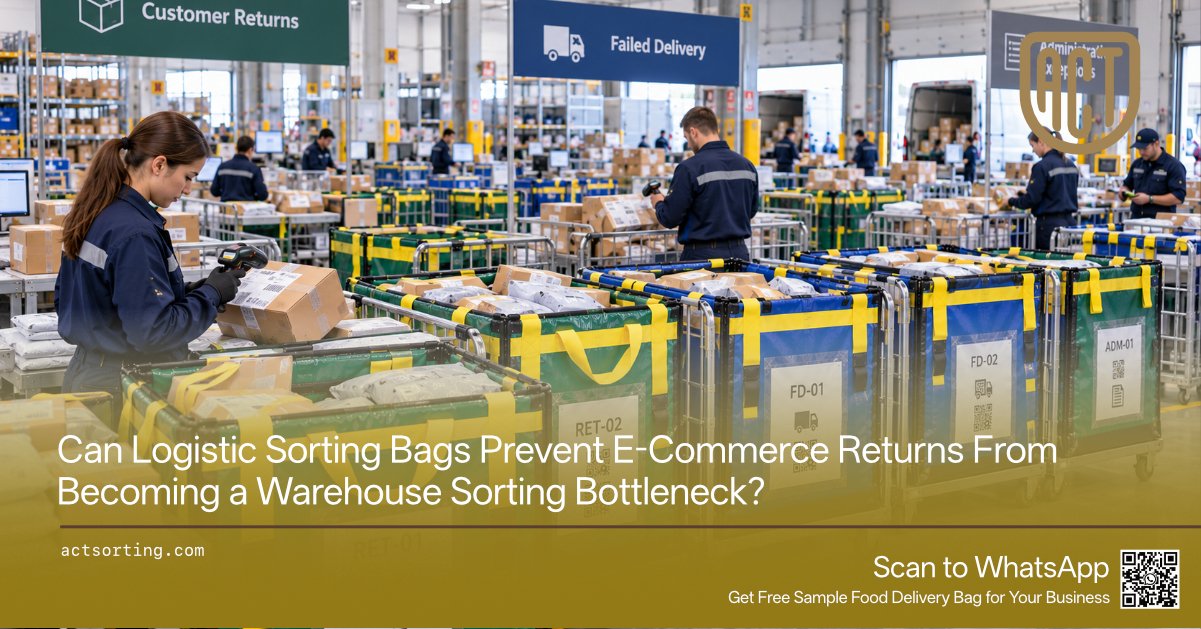
Logistic Sorting Bags and Parcel Sorting Bags provide a practical way to organize returned parcels into identifiable processing groups. Instead of allowing incoming returns to accumulate as loose packages, warehouse operators can use reusable sorting bags to separate shipments according to their documented return category, merchant, destination facility, or next processing step. This helps maintain physical organization while barcode scanning, inspection, and inventory procedures determine the appropriate disposition of each item.
For e-commerce fulfillment centers, third-party logistics providers, courier networks, retail distribution warehouses, and reverse logistics operators, these reusable bags can form part of a more structured returns handling system.
ACTSORTING has specialized in commercial logistics bags since 2013. The company operates a manufacturing facility covering more than 12,000 square meters in Yangchun, Guangdong, China, with more than 400 employees. Supported by BSCI and ISO9001 certification, ACTSORTING provides OEM & ODM manufacturing for Logistic Sorting Bags, Parcel Sorting Bags, Courier Sorting Totes, and other reusable logistics equipment. Bag dimensions, woven materials, reinforced bottoms, handles, transparent identification pockets, closures, colors, and branding can be customized according to the requirements of individual returns processing operations.
The objective is not simply to store returned parcels. It is to prevent physically disorganized returns from creating unnecessary work before the warehouse can determine their next destination.
Reverse Logistics Creates a Different Sorting Challenge
Outbound parcel operations generally follow a forward-moving process. Products are picked, packed, labeled, sorted, and transferred into delivery networks according to their destinations. Reverse logistics introduces a different challenge because parcels entering the warehouse may need to follow several possible workflows after arrival. A returned shipment might be routed to a merchant’s fulfillment center, opened for product inspection, transferred to a specialized processing department, or held temporarily until missing information is resolved.
These differences make inbound return identification particularly important. A package marked as undeliverable is not necessarily equivalent to a customer-authorized product return. Similarly, a parcel arriving from a retail collection point may require a different processing procedure from one returned directly through a courier network. Even when packages have similar dimensions and shipping labels, the warehouse may need to handle them according to different return authorizations and commercial agreements.
Without physical separation, these different streams can become mixed during receiving. Workers may place cartons and mailers on temporary pallets or floor areas, expecting subsequent scanning to resolve the confusion. However, when incoming volume increases, the resulting piles can interfere with inspection stations, staging lanes, and internal transport routes.
Logistic Sorting Bags can create defined receiving units for return shipments that share an established processing category. For example, one bag may contain parcels assigned to a specific merchant’s returns program, while another carries undeliverable shipments awaiting the appropriate carrier process. Each bag can display a clear identification card and move through the warehouse without losing its assigned group.
The important distinction is that sorting bags support the handling process rather than determine the final disposition of the goods. Product condition, refund eligibility, inventory status, and return authorization must still be established through the operator’s scanning, inspection, and business procedures. The bag helps preserve the organization established by those decisions.
Returned Parcels Should Be Separated Before Detailed Processing
One of the most useful improvements a returns warehouse can make is to distinguish incoming parcels according to information already available at receiving. This initial separation should take place before detailed product inspection, which may require opening packages, verifying contents, and determining whether an item can be restocked, repaired, or handled through another approved process.
For example, an inbound receiving team may recognize three documented shipment categories: customer-authorized returns, failed-delivery parcels, and shipments requiring additional identification. These categories can be placed into separate Parcel Sorting Bags after the appropriate scans. The bags then move to their assigned processing areas instead of remaining together in one mixed receiving pile.
This approach creates a clearer relationship between the digital return record and the physical package. Employees can recognize which group a parcel belongs to without repeatedly examining every shipping label. When a bag reaches the next workstation, the receiving employee can confirm its identification and process the individual parcels according to the relevant procedure.
ACTSORTING can customize sorting bags with different colors, printed category markings, and transparent identification pockets. A warehouse may use one color for standard authorized returns and another for unresolved administrative exceptions, provided these distinctions are also supported by its operational records. Colors should be treated as visual aids rather than substitutes for scanning and verification.
The opening structure should also match the receiving process. Wide rectangular openings can make it easier for employees to place mixed cartons and poly mailers into designated bags, while reinforced bottom panels may help the containers maintain a stable footprint during sorting. For facilities using roll cages or trolleys, the finished dimensions can be customized around the available equipment.
By separating return streams before detailed processing, warehouses can create a more organized starting point for the departments responsible for inspection, inventory reconciliation, and subsequent transportation.
Logistic Sorting Bags Help Organize Returns by Processing Destination
A large returns facility may handle products belonging to multiple merchants, brands, or distribution networks. Even when these items arrive through the same courier service, the parcels may ultimately need to move to different processing locations.
Some returns may be directed to a merchant-specific inspection area. Others may require transportation to a separate regional facility. Undeliverable parcels may need to return to the originating fulfillment center, while certain shipments remain on hold until missing documentation is resolved.
When employees rely on loose parcels and temporary floor groupings, these distinctions can become difficult to maintain. A carton placed in the wrong area may need to be scanned again or transferred across the warehouse after the mistake is discovered.
Logistic Sorting Bags can help organize returns according to their confirmed next destination. Each bag can represent a particular merchant, processing department, destination hub, or transfer batch. Parcels can be consolidated into that physical group after verification, then moved together to the next appropriate location.
For example, a 3PL warehouse handling returns for several online retailers might prepare separate Parcel Sorting Bags for each retailer’s approved return flow. A bag identification card could show the merchant reference, processing batch, and destination department. Completed bags could then move into designated roll cages without requiring employees to rebuild the same parcel groups before every transfer.
ACTSORTING can develop coordinated sorting bag capacities around the volume of each processing stream. Smaller bags may suit low-volume merchant returns, while larger rectangular bags can accommodate high-volume groups of mixed parcels. Consistent handles, identification pocket positions, and colors help maintain a recognizable equipment system across different capacities.
The objective is to avoid repeated physical regrouping. Once the warehouse has confirmed where a group of returns needs to go, the sorting bag helps keep that group together until the next controlled handover.
Clear Identification Supports Return Tracking and Warehouse Reconciliation
Return shipments often involve more information than an ordinary outbound parcel. A warehouse may need to record the original order, return merchandise authorization (RMA), merchant account, carrier tracking number, return reason, and current processing status. These records are normally managed digitally, but the physical containers used inside the warehouse should support accurate identification.
A reusable Parcel Sorting Bag can include a transparent document pocket displaying the relevant batch information. Depending on the operator’s workflow, this might include a merchant code, RMA batch reference, receiving date, processing destination, or barcode linked to the warehouse management system.
The pocket should be large enough to accommodate the customer’s existing documents and positioned so employees can read or scan them without unnecessarily moving the bag. ACTSORTING can customize pocket dimensions, material, attachment method, opening direction, and placement according to the warehouse’s identification requirements.
Permanent equipment identification should remain separate from temporary return information. A bag may carry a fixed asset number or depot code while the contents change after each processing cycle. This allows the operator to distinguish the reusable container from the specific return batch assigned to it.
This distinction becomes valuable during reconciliation. When a bag moves from receiving to inspection, staff can confirm the physical group against the relevant digital record before processing individual packages. If the number of parcels differs from the expected count, the discrepancy can be investigated within a defined batch rather than across a much larger mixed pile.
However, identification pockets do not replace shipment-level traceability. A bag containing twenty returns still requires the operator to maintain records for the individual parcels. The purpose of the sorting bag is to create a recognizable physical grouping that supports those records and makes transfers easier to manage.
For warehouses handling returns from multiple merchants, consistent identification can reduce ambiguity at handover points and make reusable equipment more practical across different departments.
Different Return Categories Require Different Bag Configurations
Not every return stream needs the same container design. A warehouse receiving mostly clothing and accessories may handle lightweight poly mailers, while a facility processing household products may receive larger cartons with more variable weights. Returned goods can also require different levels of access depending on how frequently employees need to inspect individual packages.
For lightweight parcels, flexible Logistic Sorting Bags with practical carrying handles may provide an appropriate balance of capacity and storage efficiency. For mixed rigid cartons, a reinforced rectangular bottom and wider opening may be more suitable. Facilities that move return groups between buildings or processing stations may prefer secure closures that keep small packages contained during transportation.
ACTSORTING can customize bag dimensions, woven polypropylene materials, laminated surfaces, bottom reinforcement, webbing handles, zipper closures, hook-and-loop flaps, and identification pockets according to these requirements. Several capacities can be developed within the same product family, allowing the warehouse to match equipment size to typical parcel volume without abandoning standardized identification and handling features.
Internal separation may also be useful for certain applications. Removable dividers or designated sections can help organize approved parcel groups within the same bag, provided the arrangement does not interfere with scanning or make individual packages difficult to retrieve.
A critical limitation concerns damaged, leaking, contaminated, or otherwise hazardous returns. Ordinary woven sorting bags should not be treated as containment equipment for unknown chemical leaks, damaged batteries, or other hazardous conditions. These parcels require appropriate isolation, handling procedures, and suitable containers according to applicable safety requirements.
For routine, intact return parcels, however, selecting the right bag configuration can make collection, staging, and internal transfers more manageable. The strongest purchasing approach is to match each bag’s material, capacity, and construction to the actual return stream rather than expecting one universal product to handle every category.
Reinforced Construction Supports Repeated Returns Handling
Returned parcels may move through several physical stages before reaching their final processing destination. Employees unload bags from collection vehicles, position them inside receiving areas, transfer them to inspection stations, and sometimes move them again to merchant-specific staging zones. Once emptied, the bags return for another collection or sorting cycle.
These repeated movements create wear around carrying handles, lower corners, bottom panels, and seams. A Parcel Sorting Bag containing several cartons can become difficult to handle if its webbing is inadequately supported. Similarly, bags that regularly contact concrete floors or metal roll cages may experience concentrated abrasion around the underside.
ACTSORTING can customize reinforced webbing handles, extended attachment areas, laminated woven materials, additional bottom layers, and lower corner protection according to the expected load and handling process. The purpose is to strengthen the areas exposed to repeated commercial stress without unnecessarily increasing the weight of the entire bag.
The carrying configuration should reflect how employees move the equipment. Long handles may work well for smaller return groups, while side handles can provide more control when lifting larger containers into roll cages or onto receiving platforms. Reinforced rectangular bases can help maintain predictable bag positioning, particularly when parcels vary in size and weight.
Material selection should also account for normal warehouse cleaning requirements. Laminated surfaces may make routine wiping easier, although cleaning methods and compatibility should be confirmed for the selected material. Bags showing significant damage or contamination should be removed from normal circulation for appropriate assessment.
For procurement teams, durability should be evaluated through the full handling cycle rather than through material thickness alone. A bag that performs well when stationary may still fail prematurely if its handles, seams, and bottom structure are poorly matched to repeated lifting and transfers.
ACTSORTING’s OEM & ODM development allows customers to focus reinforcement on practical wear areas while retaining manageable bag weight and foldability.
Parcel Sorting Bags Can Improve Transfers Between Returns Processing Stations
A returns warehouse may include several departments responsible for different processing steps: receiving, document verification, parcel opening, product inspection, inventory reconciliation, and outbound transfer. The precise sequence depends on the products, merchant agreements, and facility procedures.
A common source of inefficiency is the movement between these departments. When parcels remain loose, employees may need to load them onto trolleys, move them to another work area, and reorganize them again before the next task begins.
Parcel Sorting Bags can help reduce repeated regrouping by allowing verified parcel batches to move as recognizable units. A completed receiving batch can be placed inside a suitable roll cage or trolley and transferred to the next processing station. The bag’s identification card provides the information needed to confirm the intended destination before individual parcels are handled.
Compatibility with warehouse equipment is important. ACTSORTING can customize sorting bag dimensions according to roll cage measurements, trolley layouts, workbench clearance, and the expected parcel profile. A stable bottom can help the bag maintain a consistent footprint, while wide openings allow staff to remove parcels without unnecessary obstruction.
The closure design should reflect how frequently employees access the contents. An open-top bag may work well within a controlled receiving area, while a secure flap or zipper may be preferable during longer internal transfers involving smaller packages.
The bag should not become an obstacle to product inspection. When returns require individual examination, employees must still remove and assess the relevant items according to the merchant’s procedures. The benefit of the sorting bag lies in keeping the unprocessed and processed parcel groups physically organized before and after those tasks.
For warehouses handling multiple return streams simultaneously, this structure can reduce confusion about where a batch belongs and make internal handovers more consistent.
Exception Returns Need More Than a Standard Sorting Bag
Reverse logistics operations regularly encounter parcels that cannot immediately enter the normal return process. A shipment may arrive without a readable label, lack a matching authorization record, contain an unexpected item, or require further confirmation from the merchant.
These parcels should not be placed indiscriminately into normal processing groups simply to clear the receiving area. Doing so may cause unresolved shipments to enter inventory or inspection workflows before their status has been established.
A better approach is to create a defined administrative exception process. After the appropriate intake controls, parcels requiring additional identification can be placed into clearly marked exception sorting bags or assigned holding locations. Different colors, identification cards, or printed markings can help employees distinguish these shipments from verified returns.
ACTSORTING can customize Parcel Sorting Bags for this purpose using visible status markings, transparent document pockets, practical closures, and dimensions suited to the expected exception volume. Smaller bags may be sufficient when only a limited number of parcels require further documentation.
The distinction between administrative exceptions and physical safety hazards is essential. A return with an unreadable barcode is different from a leaking package or a damaged battery. Sorting bags may support the organization of routine parcels awaiting clarification, but unsuitable or potentially hazardous shipments must follow separate safety procedures and use appropriate containment equipment where required.
Once an administrative issue has been resolved, employees can update the digital record and transfer the parcel to the appropriate processing stream. The reusable sorting bag then returns to service after its contents have been cleared and the equipment is suitable for reuse.
The operational advantage is visibility. Unresolved parcels remain in a defined category rather than disappearing into ordinary return groups where they may require additional investigation later.
Reusable Sorting Bags Support Multi-Warehouse Reverse Logistics Operations
Large e-commerce and logistics networks often operate multiple returns receiving locations, regional hubs, and merchant processing centers. A reusable sorting bag system becomes more useful when its dimensions, identification methods, and construction remain consistent across these facilities.
Without standardization, different warehouses may purchase unrelated bag models with different pocket positions, handle lengths, and capacities. Employees transferring between locations must adapt to unfamiliar equipment, while procurement teams manage several overlapping specifications.
ACTSORTING can develop coordinated Logistic Sorting Bags and Parcel Sorting Bags using common material standards, identification layouts, color systems, handles, and closures. Different sizes may be necessary for different return streams, but the fundamental handling system can remain recognizable.
Equipment circulation also matters. After a bag has been emptied, it may need to return to a collection vehicle, receiving depot, or regional logistics facility. Foldable structures can reduce empty storage requirements, while permanent equipment identification helps operators distinguish reusable assets from the return batches they previously carried.
ACTSORTING can customize folding methods, securing straps, laminated materials, and reinforced wear zones according to the customer’s return and storage process. The objective is to make the equipment suitable for repeated use instead of allowing large quantities of empty bags to accumulate unnecessarily.
For multi-warehouse procurement programs, consistent bulk production is particularly valuable. Approved samples and technical specifications can establish references for finished dimensions, materials, reinforcement, pocket placement, handles, colors, printing, and packaging. Future orders can then follow the same product requirements as the network expands.
This allows reusable sorting bags to support not only individual warehouse operations but also the broader circulation of return parcels between processing locations.
Why Choose ACTSORTING for Customized Reverse Logistics Sorting Bags?
A returns operation needs sorting equipment that matches the structure of its processing workflow. Parcels may arrive from multiple couriers, belong to different merchants, and require different follow-up procedures. A generic reusable sack can hold these packages, but it may not provide the identification, capacity, handling convenience, or standardized construction necessary for repeated commercial processing.
ACTSORTING develops Logistic Sorting Bags and Parcel Sorting Bags around these operational requirements.
Founded in 2013, ACTSORTING operates a manufacturing facility covering more than 12,000 square meters in Yangchun, Guangdong, China, with over 400 employees. BSCI and ISO9001 certification provide additional support for responsible manufacturing and structured quality management.
The company’s OEM & ODM capabilities include customized woven polypropylene materials, laminated surfaces, reinforced bottoms, carrying handles, transparent identification pockets, closures, colors, printed markings, and folding structures. These features can be developed according to the customer’s receiving procedures, merchant return categories, warehouse equipment, and internal transfer requirements.
For example, a 3PL operator handling returns for several retailers may require color-coded bags with large merchant identification pockets. A regional return hub may prioritize reinforced handles and rectangular bottoms to support repeated transfers between processing stations. Another facility may need smaller foldable bags for administrative exceptions and larger containers for high-volume authorized returns.
ACTSORTING can work from existing samples, technical drawings, reference photographs, warehouse measurements, and descriptions of current handling problems. Customers can evaluate samples using representative parcels before confirming the final specification for bulk manufacturing.
Manufacturing consistency helps preserve the approved design across future orders. Material construction, dimensions, reinforcement, handles, identification pockets, colors, printing, closures, and packaging can be documented for production and inspection.
For e-commerce fulfillment centers, courier networks, third-party logistics providers, retail distribution warehouses, and specialized reverse logistics operators, ACTSORTING offers a way to develop reusable sorting equipment around the complete movement of returned parcels.
Procurement teams can provide typical return parcel dimensions, merchant categories, expected load, receiving volume, sorting procedures, roll cage measurements, identification formats, color requirements, preferred closures, branding, and target quantity to develop a customized manufacturing proposal.
The real challenge in reverse logistics is not simply receiving returned packages. It is maintaining enough physical organization to ensure that each parcel enters the correct processing workflow. Logistic Sorting Bags and Parcel Sorting Bags can help establish that organization before loose returns become another warehouse bottleneck.
FAQ
Q: Can Logistic Sorting Bags be used for e-commerce returns processing?
A: Yes. Logistic Sorting Bags can help organize intact returned parcels by merchant, processing category, destination facility, or verified return batch. They support physical sorting and transfer while shipment verification and product disposition remain controlled by the warehouse’s established procedures.
Q: Can ACTSORTING customize Parcel Sorting Bags for different return categories?
A: Yes. ACTSORTING can customize dimensions, materials, colors, identification pockets, handles, closures, and reinforced bottoms to support different routine returns processing streams.
Q: Can sorting bags include RMA codes, barcodes, and merchant identification?
A: Yes. Transparent identification pockets, permanent asset numbers, printed merchant codes, barcode areas, and QR code positions can be customized according to the customer’s return tracking and warehouse management requirements.
Q: Are reusable sorting bags suitable for damaged or leaking return parcels?
A: Standard woven sorting bags are intended for suitable parcel handling applications and should not be used as substitutes for approved hazardous-material or leak-containment equipment. Damaged, leaking, or potentially hazardous shipments require appropriate safety assessment and handling procedures.
Q: Why choose ACTSORTING for bulk Logistic Sorting Bags?
A: ACTSORTING has specialized in commercial logistics bags since 2013, operates a manufacturing facility exceeding 12,000 square meters with more than 400 employees, holds BSCI and ISO9001 certification, and supports OEM & ODM development, customized bulk manufacturing, coordinated product ranges, and repeat production.