

Table of Contents
- The Final Sorting Window Is Where Delivery Delays Often Begin
- Route-Based Parcel Sorting Bags Keep Dispatch Groups Together
- Clear Identification Makes Pre-Dispatch Verification More Reliable
- Structured Bag Openings Help Workers Sort Parcels Without Interruptions
- Standardized Bag Dimensions Improve Dispatch Lane Organization
- Reinforced Handles and Bottoms Support Faster Vehicle Loading
- Sorting Bags Should Match the Driver’s Loading Sequence
- Late Arrivals and Mis-Sorted Parcels Need a Separate Exception Process
- Reusable Logistic Sorting Bags Must Be Ready for the Next Dispatch Wave
- Why Choose ACTSORTING for Customized Parcel Sorting Bags?
Introduction
A delivery warehouse can process thousands of parcels correctly and still create problems during the final hour before its vehicles depart. Packages have already arrived from regional distribution centers, sorting equipment has assigned them to delivery routes, and drivers are preparing to leave. However, the physical parcels still need to be grouped, verified, staged, and loaded into the correct vehicles.
This final preparation stage is where small mistakes can become expensive operational problems. A parcel placed in the wrong route container may travel with the wrong driver. An unidentified bag may remain in the staging area after the vehicle departs. A loose package added at the last minute may never be included in the final route verification. Even when warehouse systems contain accurate shipment information, the physical organization of parcels can still cause missed deliveries and unnecessary handling.
For courier companies, postal operators, e-commerce fulfillment centers, third-party logistics providers, and Amazon DSP-style delivery stations, efficient dispatch preparation requires more than fast sorting equipment. It requires reusable containers that preserve route assignments from the sorting lane to the delivery vehicle.
Logistic Sorting Bags and Parcel Sorting Bags provide a practical way to organize parcels into identifiable delivery units. Instead of handling individual cartons and poly mailers throughout every stage of dispatch preparation, warehouse employees can consolidate parcels by route, maintain visible identification, and transfer completed groups into vehicles with fewer unnecessary handling steps.
ACTSORTING has specialized in commercial logistics bags since 2013. The company operates a manufacturing facility covering more than 12,000 square meters in Yangchun, Guangdong, China, with more than 400 employees. Supported by BSCI and ISO9001 certification, ACTSORTING provides OEM & ODM manufacturing for Logistic Sorting Bags, Parcel Sorting Bags, Courier Sorting Totes, Last-Mile Delivery Totes, and other reusable logistics equipment.
Through customized dimensions, reinforced woven materials, transparent route identification pockets, secure closures, durable handles, and foldable structures, ACTSORTING helps logistics operators develop sorting bags that fit their existing warehouse and dispatch processes.
The objective is straightforward: parcels should leave the warehouse in the same organized groups that employees prepared and verified before departure.
The Final Sorting Window Is Where Delivery Delays Often Begin
Most delivery warehouses operate around scheduled dispatch periods. Parcels arrive from upstream facilities, move through sorting processes, and are assigned to routes before drivers begin their daily deliveries. The period between final sorting and vehicle departure is particularly demanding because warehouse employees must complete several activities within a limited window.
Parcels need to reach the correct route staging areas, identification must be verified, delivery containers must be closed or secured where required, and drivers need to locate their assigned loads. Meanwhile, additional shipments may arrive close to the dispatch cutoff, creating pressure to incorporate them without disrupting the existing preparation process.
A problem that appears minor during normal sorting can become significant when departure time approaches. If one parcel is assigned to the wrong staging area, employees may need to search multiple containers. If several loose packages remain on the floor, the dispatch team must determine their destinations before releasing vehicles. An incorrectly labeled container may require further verification even when all the parcels inside it are correctly sorted.
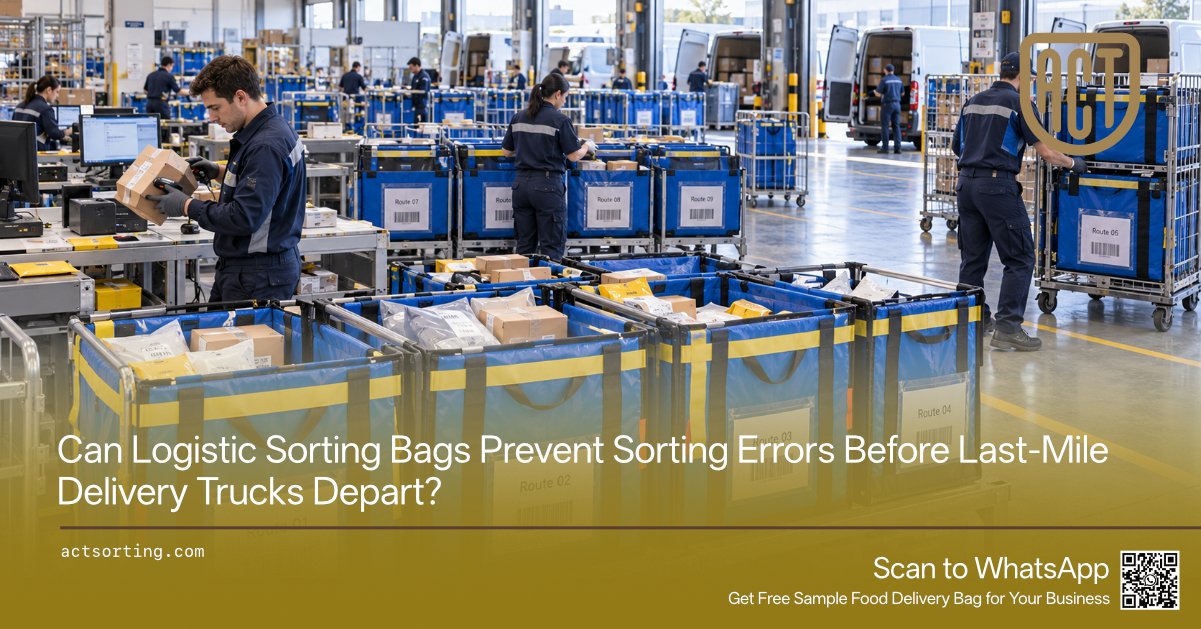
Logistic Sorting Bags help create a clearer physical structure during this final preparation stage. Once parcels are assigned to a delivery route or defined route section, they can be grouped inside reusable bags and moved to the corresponding dispatch lane. Instead of leaving several independent packages in temporary piles, the warehouse handles more clearly identified units.
This does not eliminate the need for scanning, shipment verification, or dispatch controls. It supports those processes by keeping the physical parcels organized according to the route assignments already established in the warehouse management system.
For high-volume delivery stations, the practical advantage is consistency. Employees know where route groups belong, drivers can identify prepared loads more easily, and supervisors can distinguish completed dispatch units from parcels that still require sorting.
Route-Based Parcel Sorting Bags Keep Dispatch Groups Together
One of the most important functions of Parcel Sorting Bags is maintaining the relationship between individual parcels and their assigned delivery routes.
Consider a last-mile warehouse preparing deliveries for several neighborhoods. Parcels arriving from an upstream distribution center are sorted into different route groups. Some routes contain mostly lightweight poly mailers, while others contain mixed cartons, envelopes, and irregular packages. If employees place these items into large, loosely organized piles, each subsequent handling stage creates another opportunity for parcels to become separated from their assigned groups.
A route-based bagging system provides a more controlled alternative. Employees place parcels into designated Parcel Sorting Bags during the sorting process, and each bag receives a visible route or zone identifier. Once the bag reaches its intended capacity, employees can verify the contents, close it where appropriate, and move it into the corresponding dispatch staging lane.
The system can also support subdivisions within a larger route. For example, one delivery route may require several numbered bags because its total parcel volume exceeds the practical capacity of a single container. The identification system can distinguish Route 12, Bag 1 of 3, from Route 12, Bag 2 of 3, allowing employees to recognize that the complete delivery group contains multiple physical units.
ACTSORTING can customize Logistic Sorting Bags in different dimensions according to average parcel volume, common package sizes, and expected load. Smaller bags may be suitable for lightweight residential routes, while larger Parcel Sorting Bags can support higher-volume delivery groups. The same identification pocket position, material construction, and color system can remain consistent across the product range.
This structure helps warehouses avoid a common problem: the digital system says the parcels belong together, but the physical parcels are scattered across the staging area. By preserving route groups inside identifiable containers, the sorting process produces a more manageable result for downstream dispatch and vehicle loading.
Clear Identification Makes Pre-Dispatch Verification More Reliable
A Parcel Sorting Bag should communicate its destination before anyone needs to open it. During busy dispatch periods, employees may handle dozens of visually similar bags, and relying on color alone is rarely sufficient for accurate route identification.
A large transparent identification pocket provides a fixed location for route information. Depending on the warehouse system, the pocket may contain a printed route number, sorting zone, barcode, QR code, dispatch batch, driver assignment, or another operational reference. Employees can recognize the bag’s intended destination and scan the relevant identifier where required.
Pocket placement is particularly important. In a sorting lane, workers may approach bags from the front, while completed bags may stand sideways inside roll cages or along loading areas. If the identification pocket becomes hidden after the bag is moved, employees may need to rotate or lift it simply to verify the route.
ACTSORTING can customize transparent pocket dimensions, orientation, position, and quantity according to the customer’s existing identification cards. A side-facing pocket may improve visibility during vehicle loading, while an additional front-facing pocket can support warehouse sorting and staging.
Permanent equipment identification should also remain separate from temporary route assignments. A reusable bag may carry a fixed asset number or depot code, while its route card changes each day. Keeping these two identifiers distinct helps operators track reusable equipment without confusing bag ownership with the parcels currently assigned to it.
For delivery warehouses handling repeated dispatch waves, consistency becomes especially valuable. When every Logistic Sorting Bag uses the same label position, employees know where to look regardless of which route or bag size they are handling.
Clear identification does not guarantee that every parcel inside the bag is correct. The final verification still depends on scanning and the operator’s procedures. However, it makes those checks easier to perform without repeatedly opening, moving, or searching through unrelated bags.
Structured Bag Openings Help Workers Sort Parcels Without Interruptions
The opening structure of a Parcel Sorting Bag can affect how efficiently employees work during high-volume sorting.
In many warehouses, workers repeatedly place cartons and poly mailers into designated containers as parcels arrive from conveyors or manual sorting stations. If the bag opening collapses after every item, employees must use one hand to hold the fabric open while placing the parcel inside with the other. The problem becomes more noticeable when handling rigid boxes or irregular packages that catch against the upper edge.
A more practical bag design can reduce these interruptions. Depending on the customer’s sorting equipment, a reinforced upper edge, wider rectangular opening, compatible hanging arrangement, or removable structural support may help keep the receiving area accessible.
The correct opening depends on where the bag is used. A Parcel Sorting Bag positioned inside a roll cage may receive enough support from the surrounding equipment, while a bag standing independently beside a sorting lane may benefit from a more structured base and upper opening.
ACTSORTING can customize the bag dimensions, opening width, upper-edge reinforcement, attachment points, and closure structure according to the warehouse layout. The objective is to ensure that the product supports the movement of parcels from the sorting station into the appropriate route container.
Material selection also matters. A very soft structure may collapse too easily, while an excessively rigid construction can increase storage requirements and make empty bags difficult to fold. A balanced design uses reinforcement where it improves handling without unnecessarily increasing the weight of the entire product.
For warehouse operators, these details affect more than convenience. When hundreds of sorting bags are used during one dispatch period, a container that is awkward to open introduces repeated interruptions across many employees.
The best Logistic Sorting Bags should allow workers to concentrate on sorting parcels correctly rather than constantly adjusting the container receiving them.
Standardized Bag Dimensions Improve Dispatch Lane Organization
A warehouse staging area has limited space, particularly during the period when several delivery routes are waiting to be loaded. Bags may be positioned inside roll cages, arranged along marked dispatch lanes, or grouped near vehicle loading doors. If their dimensions vary significantly, organizing these areas becomes more difficult.
An oversized Parcel Sorting Bag may occupy more staging space than its parcel volume requires. A bag that is too small may force employees to create additional containers for a route, increasing the number of physical units that must be counted and verified before departure. Completely flexible bags may also spread across the floor as parcels accumulate, reducing the available space between staging groups.
Standardized dimensions help make the physical layout more predictable. Warehouse managers can plan where completed route bags should stand, how many fit inside a roll cage, and how those containers will move toward the corresponding vehicle.
ACTSORTING can customize bag width, depth, height, and bottom reinforcement according to the customer’s staging equipment and average parcel profile. A rectangular bottom can help the container maintain a more consistent footprint, while reinforced side sections or adjustable side straps may support the intended shape where required.
Different capacities can be developed without abandoning standardization. A delivery network may use a smaller model for low-volume route sections and a larger model for high-volume groups, while maintaining common identification pockets, handles, colors, and closure methods.
This helps employees recognize and manage the equipment more easily. Sorting teams understand the available bag sizes, dispatch supervisors can estimate the physical space required for each route, and drivers receive containers that are compatible with the intended vehicle layout.
Choosing ACTSORTING allows logistics operators to develop these dimensions around actual warehouse infrastructure rather than selecting a generic sack and discovering afterward that it does not fit the staging cage.
Reinforced Handles and Bottoms Support Faster Vehicle Loading
After parcel sorting and verification, completed bags need to move from the warehouse staging area into delivery vehicles. This transfer may involve lifting bags out of roll cages, carrying them across loading zones, placing them onto trolleys, or arranging them inside van cargo compartments.
The process places repeated stress on handles, webbing, lower corners, and bag bottoms.
A Parcel Sorting Bag may contain several rigid cartons with considerable combined weight. If the webbing is attached only to a small area of fabric, repeated lifting can concentrate force around the stitching. Similarly, an insufficiently reinforced bottom may deform under heavy loads or experience premature wear when employees slide the bag across warehouse floors.
ACTSORTING can customize reinforced webbing handles, extended attachment structures, lower corner protection, laminated woven materials, and additional bottom layers according to the expected load and handling method.
Handle placement should match the loading process. Long handles may be useful when moving lighter bags over short distances, while side handles can provide better control when lifting larger containers from a roll cage into a vehicle. In some applications, a combination of carrying positions may be more practical than relying on one handle type.
The bottom structure should provide sufficient support without making the bag unnecessarily heavy. A reinforced rectangular base can improve load distribution and help the bag maintain its shape during staging and loading.
These features are particularly important for reusable logistics equipment because the same bag may pass through hundreds of handling movements during its service life. Strengthening the areas that experience repeated stress is generally more useful than adding extra material indiscriminately across the entire body.
For courier networks, the value of durable Logistic Sorting Bags is not limited to reducing replacement purchases. Reliable handles and bottoms also reduce interruptions during the time-sensitive movement from sorting lane to vehicle.
Sorting Bags Should Match the Driver’s Loading Sequence
Correct route sorting is only useful when the prepared parcels can be loaded and accessed efficiently.
A delivery vehicle may carry several Parcel Sorting Bags assigned to different sections of the same route. If those bags enter the vehicle in the wrong sequence, the driver may need to move unrelated containers during later stops.
This creates an avoidable problem after the warehouse has already completed its sorting work.
A better dispatch process considers vehicle loading order during the final staging stage. Bags can be labeled according to route section, stop range, or another sequence established by the delivery system. Employees can then position completed bags in the appropriate loading order before the vehicle arrives.
For example, a route divided into four geographic sections may use four clearly identified Parcel Sorting Bags. The dispatch team can stage the bags in the intended loading sequence so the driver understands which group should be accessed first.
The exact arrangement depends on the delivery vehicle and route-management process. Some operations use shelving or racks, while others place totes directly on the cargo floor. Bag size and handle orientation should therefore support the vehicle’s physical layout.
ACTSORTING can customize identification pockets, bag dimensions, webbing positions, and reinforcement according to these loading requirements. A consistent pocket location allows drivers to check route information without pulling each bag out of its position, while compatible dimensions reduce the need to rearrange containers simply to make them fit.
It is important to distinguish route-level organization from parcel-level delivery order. A bag assigned to a specific route section does not automatically arrange every parcel inside it in exact stop sequence. Where detailed sequence control is required, the operator may need additional scanning, internal separation, or loading procedures.
The role of the Parcel Sorting Bag is to preserve the organization established during warehouse preparation, making the transition from sorting to delivery more predictable.
Late Arrivals and Mis-Sorted Parcels Need a Separate Exception Process
One of the most difficult moments in a delivery warehouse occurs when new parcels arrive after most route bags have already been prepared.
A shipment may arrive shortly before the dispatch cutoff. Another parcel may be discovered in the wrong sorting lane. A barcode may require manual verification, or an oversized package may not fit inside the assigned container.
These situations are not unusual in high-volume logistics operations, but poor exception handling can disrupt the entire dispatch process.
If employees simply place late parcels on top of completed bags, the final contents may no longer match the verified shipment records. If mis-sorted parcels are moved between routes without the appropriate scanning procedure, the physical load and digital assignment can become inconsistent.
A clearer exception process uses designated locations or containers for parcels requiring further action.
For example, late arrivals can be placed into a separately identified sorting group until they are verified and assigned to a delivery route. Mis-sorted shipments can move into an exception container for correction rather than being added to an unrelated bag. Oversized parcels may require a separate handling method if they cannot fit safely inside the standard Logistic Sorting Bags.
ACTSORTING can manufacture coordinated exception bags using different body colors, webbing colors, identification pockets, or printed status markings. These bags can share the same construction and handling features as the standard Parcel Sorting Bags while remaining visually distinct.
Once the issue is resolved, employees can complete the required scan or reassignment and move the parcel into the appropriate dispatch unit according to the operator’s procedure.
The value is operational clarity. Instead of allowing unidentified parcels to accumulate beside the loading doors, the warehouse creates a visible separation between completed route bags and shipments that still require decisions.
A sorting bag cannot correct an incorrect shipment record. It can, however, keep the unresolved parcel from disappearing into a container that everyone else believes is already ready for dispatch.
Reusable Logistic Sorting Bags Must Be Ready for the Next Dispatch Wave
Reusable sorting bags provide value only when they can circulate efficiently between delivery vehicles and the warehouse.
After parcels are delivered, empty bags return to the depot or another designated collection point. They may need to be inspected, cleaned, folded, counted, and prepared for the next dispatch cycle.
If the equipment is difficult to fold or occupies excessive storage space, warehouses can experience unnecessary congestion between sorting waves. Bags that remain expanded after use may fill roll cages and storage areas even though they no longer contain parcels.
ACTSORTING can customize flexible woven structures, reinforced wear zones, removable supports, folding methods, and securing straps according to the customer’s empty-return process.
The bag should provide adequate structure while loaded but remain manageable when empty. For networks handling large numbers of reusable Courier Sorting Totes, this balance can influence both vehicle space and warehouse storage requirements.
Permanent equipment identification can also support return management. A printed depot number or reusable bag ID helps employees distinguish the ownership of the container from its temporary route assignment. This becomes useful when equipment circulates between several delivery stations or regional depots.
Material selection should account for repeated handling and routine cleaning where necessary. Laminated woven surfaces may offer practical advantages when bags accumulate warehouse dust or floor residue, while reinforced lower panels can protect areas exposed to regular abrasion.
For procurement teams, the full operating cycle matters: sorting, staging, loading, delivery, empty return, inspection, storage, and redeployment.
Choosing ACTSORTING allows these requirements to be considered during OEM & ODM development rather than treating the product as a one-way transport container.
The objective is to ensure that a bag finishing one route can return to the warehouse and become useful again during the next scheduled dispatch period.
Why Choose ACTSORTING for Customized Parcel Sorting Bags?
A logistics warehouse needs sorting bags that match its equipment, route structure, loading process, and purchasing requirements. Generic products may provide basic containment, but they do not necessarily fit the dimensions of existing roll cages, the identification system used by dispatch teams, or the way employees handle bags during vehicle loading.
ACTSORTING develops Logistic Sorting Bags and Parcel Sorting Bags around these practical operating conditions.
Founded in 2013, ACTSORTING operates a manufacturing facility covering more than 12,000 square meters in Yangchun, Guangdong, China, with over 400 employees. BSCI and ISO9001 certification provide additional support for responsible manufacturing and structured quality management.
For commercial logistics customers, ACTSORTING provides OEM & ODM customization covering woven material selection, lamination, bag dimensions, reinforced bottoms, webbing handles, closures, transparent route pockets, color coding, logo printing, barcode identification areas, and folding structures.
The company can work from existing samples, technical drawings, warehouse photographs, current bag specifications, or descriptions of operational problems. A customer may need stronger bottom construction because bags are frequently dragged across concrete. Another may require larger route identification pockets to match an existing scanning workflow. A multi-depot courier network may need several standardized sizes that remain compatible with the same vehicle loading system.
These requirements can be developed and evaluated during sampling before the project moves into larger production quantities.
Manufacturing consistency is equally important. Once a specification has been approved, customers need future batches to follow the same dimensions, handle positions, identification layout, material requirements, and branding. Unexpected variation can interfere with staging capacity, roll cage compatibility, driver handling, and employee training.
ACTSORTING’s manufacturing facility and workforce support customized commercial orders, multi-location procurement programs, seasonal requirements, and repeat production. The approved sample and confirmed technical requirements can provide a reference for subsequent manufacturing and inspection.
This is the practical reason to choose ACTSORTING: the company can support both the development of a warehouse-specific sorting bag and the continued production of that design as the customer’s logistics network grows.
For courier companies, postal operators, e-commerce fulfillment centers, delivery stations, and third-party logistics providers preparing a new sorting bag procurement project, the starting point should be the actual dispatch workflow.
Customers can provide common parcel dimensions, average load, sorting lane arrangement, roll cage measurements, route identification format, preferred closures, handle requirements, material preferences, colors, branding, and target order quantity to receive a customized manufacturing proposal.
A well-organized delivery route begins before the driver starts the engine. The purpose of Logistic Sorting Bags is to make sure that the organization created inside the warehouse survives the final journey from sorting lane to delivery vehicle.
FAQ
Q: What are Logistic Sorting Bags used for in delivery warehouses?
A: Logistic Sorting Bags are reusable containers used to group parcels according to delivery routes, sorting zones, dispatch batches, or other operational categories. They help warehouse employees organize packages before staging and vehicle loading.
Q: Can Parcel Sorting Bags be customized for different delivery routes?
A: Yes. ACTSORTING can customize dimensions, capacity, materials, colors, route identification pockets, handles, reinforcement, and closures according to the parcel volume and handling requirements of different delivery routes.
Q: Can ACTSORTING add barcode or route identification pockets to sorting bags?
A: Yes. Transparent identification pockets can be customized to accommodate route cards, barcodes, QR codes, driver assignments, dispatch batch information, and other operational documents.
Q: Are Parcel Sorting Bags compatible with warehouse roll cages and delivery vans?
A: Bag dimensions and construction can be developed according to the customer’s roll cage measurements, warehouse staging layout, loading equipment, and delivery vehicle dimensions. Compatibility should be confirmed during sampling and operational testing.
Q: Why choose ACTSORTING for bulk Logistic Sorting Bags?
A: ACTSORTING has specialized in commercial logistics bags since 2013, operates a manufacturing facility exceeding 12,000 square meters with more than 400 employees, holds BSCI and ISO9001 certification, and provides OEM & ODM development, customized bulk manufacturing, and repeat production support.