

Table of Contents
- Cross-Docking Operations Depend on Fast and Accurate Parcel Transfers
- Loose Parcels Create Unnecessary Handling Between Inbound and Outbound Docks
- Destination-Based Parcel Sorting Bags Keep Transfer Groups Organized
- Clear Identification Helps Prevent Wrong-Dock and Wrong-Vehicle Loading
- Bag Dimensions Should Match Cross-Dock Sorting Lanes and Transport Equipment
- Reinforced Handles and Bottoms Support Frequent Hub-to-Hub Transfers
- Secure Closures Help Keep Small Parcels Together During Linehaul Transportation
- Exception Parcels Need a Separate Verification and Transfer Process
- Reusable Logistic Sorting Bags Support Equipment Circulation Between Hubs
- Why Choose ACTSORTING for Customized Cross-Docking Sorting Bags?
Introduction
A linehaul truck arrives at a regional logistics hub carrying hundreds of parcels collected from several distribution facilities. Workers unload the shipments, identify their next destinations, and transfer them into outbound groups scheduled to leave within a relatively short period. Unlike traditional warehousing, these parcels are not intended to remain in storage for several days. Their purpose is to move through the facility and continue toward the next logistics destination as efficiently as possible.
This is the basic principle of cross-docking, but the physical handling process is not always straightforward.
Parcels arriving in loose cartons and poly mailers may need to be unloaded individually, moved across the receiving area, sorted into destination groups, and handled again before outbound loading. Small packages can become mixed with unrelated shipments, while staging lanes may accumulate temporary piles that require further organization before the next vehicle departs. When inbound and outbound schedules overlap, employees have limited time to identify and correct these problems.
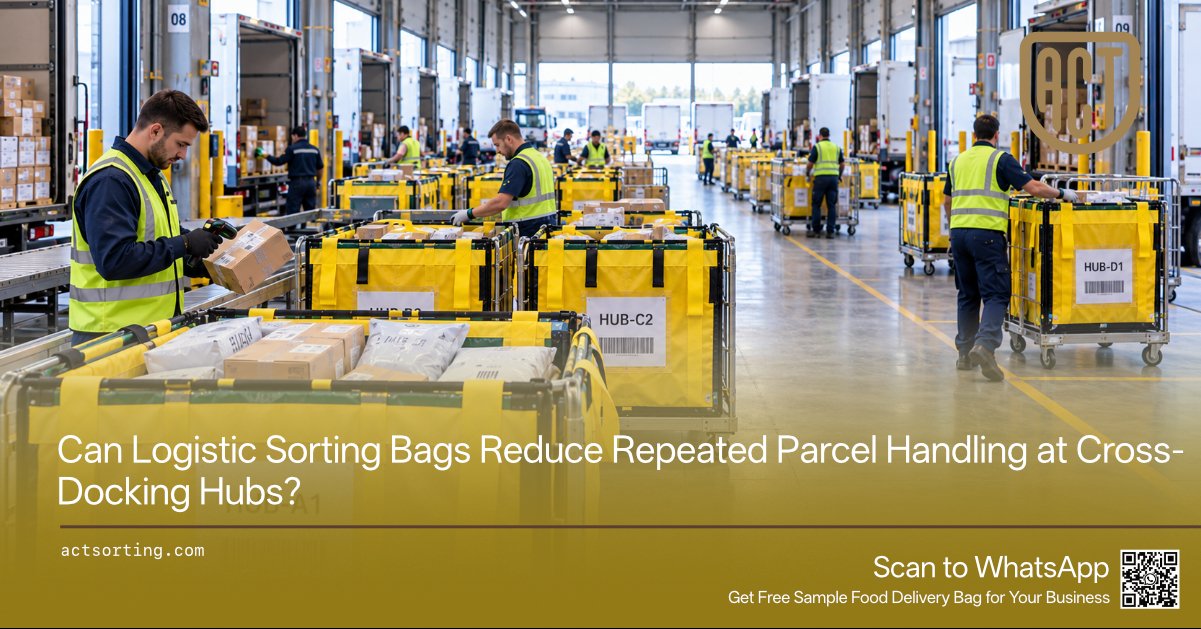
Logistic Sorting Bags and Parcel Sorting Bags provide a practical way to organize parcels into reusable transfer units. Packages assigned to the same outbound destination, regional hub, or transportation batch can be consolidated into clearly identified bags, allowing employees to preserve their sorting groups throughout staging and loading.
For courier networks, parcel distribution companies, postal operators, third-party logistics providers, e-commerce fulfillment networks, and regional transportation hubs, this creates an opportunity to reduce unnecessary parcel rehandling while maintaining clearer physical organization.
ACTSORTING has specialized in commercial logistics bags since 2013. The company operates a manufacturing facility covering more than 12,000 square meters in Yangchun, Guangdong, China, with over 400 employees. Supported by BSCI and ISO9001 certification, ACTSORTING provides OEM & ODM manufacturing for Logistic Sorting Bags, Parcel Sorting Bags, Courier Sorting Totes, and other reusable logistics equipment.
With customizable woven materials, reinforced bottoms, webbing handles, transparent identification pockets, closures, dimensions, colors, and printing, ACTSORTING helps logistics operators develop sorting bags around their existing cross-docking and transportation procedures.
The objective is to keep parcels organized as they move between inbound transportation, sorting lanes, and outbound vehicles, without requiring employees to rebuild the same groups unnecessarily.
Cross-Docking Operations Depend on Fast and Accurate Parcel Transfers
Cross-docking facilities are designed to move goods between transportation stages with limited intermediate storage. In parcel logistics, inbound vehicles deliver shipments to a regional hub, where packages are identified, sorted, and assigned to outbound routes or destination facilities. The process depends on coordinating vehicle arrivals, sorting capacity, staging space, and outbound departure schedules.
This creates a different operating environment from a traditional fulfillment warehouse. Employees cannot always postpone sorting until additional storage space becomes available. When several inbound vehicles arrive close together, the receiving area may need to process substantial parcel volumes before scheduled outbound trailers depart.
The efficiency of this operation depends partly on how parcels are physically grouped. If shipments for the same destination remain scattered across the sorting area, employees must repeatedly locate, gather, and verify them before loading. Even when scanning systems correctly identify outbound destinations, poor physical organization can slow the movement between processing stages.
Logistic Sorting Bags help establish clearly defined transfer groups. Once parcels have been assigned to the same destination or outbound batch, they can be placed inside an identified reusable bag. The completed bag can move into the appropriate staging lane, where employees can confirm its assignment before transferring it to the outbound vehicle.
ACTSORTING can customize sorting bag dimensions and structures according to the number of parcels normally assigned to each transfer group. Smaller bags may serve low-volume destination hubs, while larger rectangular models can support concentrated outbound flows.
The benefit is not that the sorting bag replaces the warehouse management system or automated sorting equipment. It supports the physical organization established by those systems, making the transition between inbound processing and outbound transportation more manageable.
Loose Parcels Create Unnecessary Handling Between Inbound and Outbound Docks
A cross-docking hub may unload mixed parcels from multiple inbound trucks within the same operating window. Packages can vary significantly in size and weight, from lightweight clothing mailers to rigid cartons containing consumer goods. When these shipments remain loose, employees need to handle many individual packages throughout the transfer process.
Consider parcels assigned to a regional destination hub. They may arrive in several inbound loads, pass through scanning stations, and accumulate in a temporary sorting lane. If workers place them into loose piles, the parcels may need to be reorganized before outbound loading. Small mailers can become hidden beneath cartons, while packages near the edge of the group may be moved into neighboring lanes.
The problem becomes more noticeable when additional inbound shipments arrive after the first group has already been prepared. Employees may need to combine packages from different arrivals while maintaining the correct outbound assignment.
Parcel Sorting Bags can reduce this repeated regrouping by establishing a physical destination container during sorting. As packages are verified, workers place them into the corresponding bag rather than building an uncontrolled pile. Once the bag reaches its intended capacity, it can be identified, secured where necessary, and moved into outbound staging.
ACTSORTING can customize wide openings that allow employees to load mixed cartons and poly mailers efficiently. Reinforced bottom structures can help maintain a stable footprint, while transparent pockets provide a designated location for destination codes and transfer information.
For facilities handling high parcel volumes, the advantage is continuity. Packages assigned to one outbound group remain physically organized while additional shipments enter the building, reducing the need to reconstruct completed sorting groups before every loading operation.
Destination-Based Parcel Sorting Bags Keep Transfer Groups Organized
Destination-based separation is central to parcel cross-docking. A regional hub may receive shipments from several cities and redistribute them toward multiple downstream facilities. Although all these parcels share the same building temporarily, they may need to leave through different loading doors and travel on different vehicles.
A reusable sorting bag system can represent these outbound destinations through identifiable physical units.
For example, one Parcel Sorting Bag may contain shipments assigned to Destination Hub A, while another carries packages for Destination Hub B. Where shipment volume exceeds the practical capacity of one bag, several containers can share the same destination reference with individual bag numbers.
This helps warehouse employees identify complete transfer groups without inspecting every parcel individually during each handling stage. The sorting process still requires shipment-level verification, but the completed bags can move through staging and vehicle loading as organized units.
ACTSORTING can customize different bag capacities while maintaining consistent identification layouts, handle construction, and material specifications. A low-volume destination may require smaller containers to avoid excessive unused space, while a high-volume outbound lane may benefit from larger bags that consolidate more packages into manageable transfer groups.
The bag structure should also match the type of parcels being handled. A destination receiving mostly lightweight mailers may use a different capacity from one carrying mixed cartons. Operators should define practical load limits rather than simply filling the largest available bag to its maximum volume.
The objective is not to eliminate individual parcel handling entirely. Parcels may still require sorting, scanning, inspection, or unloading at the next facility. The value of Parcel Sorting Bags is preserving the destination grouping between those processing stages, reducing unnecessary mixing during transportation and internal transfers.
Clear Identification Helps Prevent Wrong-Dock and Wrong-Vehicle Loading
Cross-docking hubs frequently operate multiple outbound loading doors at the same time. Parcels assigned to different destinations may move through adjacent staging lanes, and workers can encounter numerous sorting bags with similar dimensions and colors.
Without clear identification, a completed bag may be positioned in the wrong outbound area or loaded onto an incorrect vehicle. The error may remain unnoticed until the shipment reaches another facility, creating additional transportation and sorting work.
Large transparent identification pockets help employees recognize the correct destination before transferring a bag. Depending on the logistics operator’s existing system, the pocket can hold an outbound hub code, route number, loading door reference, transfer batch, barcode, QR code, or other operational information.
ACTSORTING can customize identification pocket dimensions, materials, positions, and opening directions according to the customer’s existing documents and scanning procedures. Side-facing pockets may remain visible inside roll cages, while front-facing identification can support sorting lane verification.
Permanent bag identification should remain separate from temporary transportation assignments. A reusable Logistic Sorting Bag may carry a fixed asset number or depot code, while its destination card changes between transfer cycles. This allows logistics operators to manage the equipment independently of the parcels currently inside it.
Color coding may provide an additional visual distinction between outbound regions or processing categories. However, colors should support rather than replace the operator’s scanning and verification procedures, especially when destinations change between dispatch waves.
For procurement teams, consistent identification is an important customization requirement. When every sorting bag uses the same label position and format, warehouse employees can recognize the relevant information more quickly, even when handling several bag sizes or different outbound transportation programs.
Bag Dimensions Should Match Cross-Dock Sorting Lanes and Transport Equipment
Cross-docking facilities often depend on roll cages, wheeled trolleys, palletized handling units, and designated staging lanes to move parcels between loading areas. Sorting bag dimensions should therefore be developed around the equipment already used inside the facility.
A bag that is too wide may prevent multiple units from fitting inside a roll cage. An excessively tall container can make it difficult to access parcels or remove the bag from a loading structure. A completely flexible bottom may expand unevenly when filled with mixed cartons, reducing the predictability of the storage footprint.
Standardized rectangular dimensions can help maintain more consistent equipment placement. ACTSORTING can customize bag width, depth, height, and opening dimensions according to roll cage measurements, available staging space, common parcel sizes, and expected working loads.
Several coordinated capacities may be appropriate for facilities serving different destination volumes. Smaller Parcel Sorting Bags can handle limited parcel groups, while larger models support major outbound hubs. Maintaining consistent handles, pocket locations, and colors across the product family helps employees use the equipment without learning different identification procedures.
The bottom structure should also reflect the handling environment. Reinforced woven bottoms may be suitable for normal warehouse transfers, while additional wear protection can be considered where bags repeatedly contact abrasive floors or metal equipment. More specialized bottom configurations should be evaluated when the operation involves frequent sliding on compatible surfaces.
ACTSORTING’s OEM & ODM capabilities allow these details to be incorporated during product development rather than treated as adjustments after the bags have already entered service.
For logistics operators, the practical objective is to create sorting bags that fit the movement of parcels through the facility. A suitable bag should work with the sorting lane, the staging equipment, and the outbound loading process, not just provide enough volume to hold packages.
Reinforced Handles and Bottoms Support Frequent Hub-to-Hub Transfers
A Parcel Sorting Bag used in cross-docking may experience repeated loading and unloading throughout its working life. It can move from a sorting station into a roll cage, from the cage to an outbound vehicle, and from that vehicle into another regional hub before being emptied and returned for reuse.
Each movement places stress on the carrying handles, webbing attachment points, seams, lower corners, and bottom material.
The type of stress depends on the handling process. A bag lifted repeatedly from a metal cage may experience concentrated force around the handles. A container that is regularly dragged across a warehouse floor may experience greater abrasion around the underside. Mixed rigid cartons can also create localized pressure against the bag walls and bottom.
ACTSORTING can customize reinforced webbing handles, extended attachment structures, laminated woven materials, additional bottom layers, and lower corner protection according to these requirements.
Handle placement should match the way employees move the equipment. Long handles may provide convenient carrying for manageable loads, while shorter side handles can improve control when lifting larger bags into transport cages. A combination of handle positions may be suitable where the same container moves between different handling environments.
The construction should also avoid unnecessary weight. Adding the thickest possible material to every panel may increase cost and folded volume without addressing the specific locations where the bag experiences wear. Targeted reinforcement can provide a more appropriate balance between durability and handling convenience.
For operators using reusable sorting bags across several hubs, these details affect more than product replacement. Reliable carrying points and bottom structures support consistent handling and reduce interruptions caused by damaged equipment during busy transfer windows.
ACTSORTING can work from existing samples, photographs of wear, expected load information, and handling procedures to develop the appropriate reinforcement specification before bulk manufacturing.
Secure Closures Help Keep Small Parcels Together During Linehaul Transportation
Linehaul transportation creates a different handling environment from stationary warehouse sorting. A vehicle may carry many reusable sorting bags containing mixed parcels, and those containers can experience movement during normal road transportation, loading, and unloading.
Small poly mailers and lightweight parcels are particularly vulnerable to becoming separated from their assigned groups when bags remain open. Packages placed near the top may shift as other containers are moved, while an open bag that tips during handling may release loose items.
A suitable closure can improve physical containment during transportation. Depending on the customer’s requirements, Parcel Sorting Bags may use zipper closures, hook-and-loop flaps, covered openings, or other fastening structures.
ACTSORTING can customize the closure according to parcel type and access frequency. A bag used primarily for hub-to-hub transfer may remain closed for a substantial portion of the journey, while one used for active manual sorting may need frequent access before dispatch. The design should balance convenient loading with secure containment during movement.
Opening dimensions remain important. Employees need sufficient space to insert cartons without repeatedly forcing packages through a narrow opening. A wide rectangular opening can support the sorting process, while the selected closure helps secure the contents after the transfer group is complete.
The bag should not be treated as a substitute for shipment-level verification or appropriate vehicle load securing. Operators still need to follow their established transportation and loading procedures. The sorting bag’s role is to maintain the physical parcel group and reduce the likelihood that loose packages become mixed with neighboring containers.
For cross-docking networks, this helps preserve the destination grouping created inside the originating hub until the parcels arrive at the next controlled processing point.
Exception Parcels Need a Separate Verification and Transfer Process
Not every parcel passing through a cross-docking hub can immediately follow the planned outbound route. A package may have an unreadable label, an incorrect destination code, missing documentation, or dimensions that require special handling. In some cases, a shipment may arrive after its scheduled outbound vehicle has already departed.
These parcels create exceptions that need to remain separate from completed transfer groups.
If employees place unresolved shipments into normal outbound Parcel Sorting Bags simply to clear the sorting area, the packages may travel to the wrong destination or become difficult to locate when further verification is required.
A clearer process uses designated exception containers or holding areas. Parcels requiring additional administrative checks can be placed into identified sorting bags according to the operator’s procedure. Once the destination or handling issue has been resolved, the parcel can be reassigned through the required scanning process.
ACTSORTING can customize exception bags using distinct body colors, webbing colors, printed markings, and transparent identification pockets. These containers can share the same basic material and handling structure as standard Logistic Sorting Bags while remaining visually recognizable.
Different exception categories may require different procedures. A package with an incomplete shipping label is not necessarily equivalent to an oversized shipment or a parcel requiring safety assessment. Damaged, leaking, or potentially hazardous packages should follow appropriate specialized handling procedures rather than being placed into ordinary reusable woven sorting bags.
For routine administrative exceptions, however, identifiable containers help maintain physical separation and make unresolved shipments easier for supervisors to locate.
The objective is to prevent exceptions from disrupting normal outbound groups while ensuring that parcels requiring additional attention remain visible until the appropriate next action has been completed.
Reusable Logistic Sorting Bags Support Equipment Circulation Between Hubs
Cross-docking networks often connect several regional facilities through regular transportation routes. A reusable sorting bag may leave one hub filled with parcels, arrive at another facility, be emptied during processing, and then require redistribution for another sorting cycle.
This makes empty-bag management an important part of the equipment system.
If empty Logistic Sorting Bags are difficult to fold, they can occupy unnecessary space inside return vehicles and warehouse storage areas. If reusable equipment lacks permanent identification, bags may accumulate at one location while another facility experiences shortages.
ACTSORTING can customize foldable woven structures, securing straps, reinforced wear zones, and permanent equipment identification according to the customer’s circulation requirements. The bag should remain sufficiently structured for loading while allowing practical storage after the contents have been removed.
Permanent asset IDs or depot markings can help logistics operators distinguish reusable equipment from temporary outbound assignments. A transparent pocket may display the current transfer destination, while a separate printed area identifies the bag itself.
Material selection should also consider repeated commercial handling. Laminated woven surfaces may support routine cleaning, while reinforced bottom sections help protect areas exposed to warehouse floors and transport equipment.
For multi-hub networks, standardized bag dimensions and folding methods can simplify empty equipment storage and redistribution. Different bag capacities may be necessary, but consistent construction and identification can help employees recognize the same equipment system across multiple facilities.
ACTSORTING can develop these requirements during OEM & ODM sampling, allowing customers to evaluate both loaded transportation and empty return before confirming the final specification.
The practical value of reusable Parcel Sorting Bags depends on their complete circulation cycle. A container that performs well during outbound transportation but creates excessive return-handling work may not provide the most suitable long-term solution.
Why Choose ACTSORTING for Customized Cross-Docking Sorting Bags?
Cross-docking operations require sorting equipment that supports rapid parcel transfers, clear destination identification, repeated handling, and compatibility with existing transport systems. A generic woven sack may hold packages, but it may not provide the dimensions, reinforcement, identification, or folding structure needed for a coordinated regional logistics network.
ACTSORTING develops Logistic Sorting Bags and Parcel Sorting Bags around these commercial requirements.
Founded in 2013, ACTSORTING operates a manufacturing facility covering more than 12,000 square meters in Yangchun, Guangdong, China, with over 400 employees. BSCI and ISO9001 certification provide additional support for structured manufacturing and responsible production practices.
The company’s OEM & ODM capabilities include woven polypropylene material selection, laminated surfaces, customized dimensions, reinforced bottoms, webbing handles, transparent destination pockets, closures, color coding, logo printing, and foldable structures.
For example, a regional parcel operator may require several standardized bag sizes for different destination hubs. Another facility may prioritize reinforced bottom panels because containers frequently move across metal roll cages. A multi-hub network may need permanent asset identification and large removable route cards to support repeated equipment circulation.
ACTSORTING can work from existing samples, technical drawings, warehouse photographs, roll cage measurements, transportation equipment specifications, and descriptions of current handling problems. These references can be used to develop samples for evaluation before the final design moves into bulk production.
Manufacturing consistency remains important when equipment is distributed across several facilities. Once a specification is approved, materials, finished dimensions, handles, reinforcement, pocket placement, colors, closures, and packaging can provide references for production and inspection.
ACTSORTING’s manufacturing facility and workforce support customized commercial orders, multi-location procurement programs, seasonal requirements, and repeat manufacturing.
For courier networks, postal operators, e-commerce distribution companies, third-party logistics providers, and regional cross-docking hubs, the next sorting bag project should begin with the actual parcel transfer process.
Procurement teams can provide typical parcel dimensions, expected load, outbound destination groups, sorting lane layout, roll cage measurements, transportation requirements, identification formats, preferred closures, handle specifications, colors, branding, and target quantity to develop a customized manufacturing proposal.
Cross-docking efficiency depends on keeping parcels moving without losing the organization established during sorting. Logistic Sorting Bags and Parcel Sorting Bags help preserve destination-based parcel groups between receiving, staging, linehaul transportation, and the next regional hub.
The goal is not simply to move packages faster. It is to avoid handling and sorting the same packages more times than the process actually requires.
FAQ
Q: Are Logistic Sorting Bags suitable for cross-docking operations?
A: Yes. Logistic Sorting Bags can help organize parcels according to outbound destinations, transfer batches, or regional hubs. They support physical grouping during sorting, staging, transportation, and subsequent receiving operations.
Q: Can ACTSORTING customize Parcel Sorting Bags for different destination hubs?
A: Yes. ACTSORTING can manufacture bags in different dimensions, colors, and capacities with customized identification pockets, reinforced handles, closures, and bottom structures according to the customer’s transfer requirements.
Q: Can sorting bags include outbound destination codes and barcode pockets?
A: Yes. Transparent identification pockets, barcode areas, QR code positions, printed destination markings, depot codes, and permanent asset numbers can be customized according to the customer’s existing logistics procedures.
Q: Can Logistic Sorting Bags be folded and returned between regional hubs?
A: Yes. Depending on the required structure, ACTSORTING can develop foldable woven bags with reinforced wear areas, securing straps, and permanent equipment identification to support repeated circulation between logistics facilities.
Q: Why choose ACTSORTING for bulk Parcel Sorting Bags?
A: ACTSORTING has specialized in commercial logistics bags since 2013, operates a manufacturing facility exceeding 12,000 square meters with more than 400 employees, holds BSCI and ISO9001 certification, and supports OEM & ODM development, customized bulk manufacturing, coordinated product ranges, and repeat orders.