

Table of Contents
- Daily Van Loading Exposes the Weakest Part of Ordinary Sorting Totes
- Plastic Runner Bases Protect Bags During Repeated Sliding and Dragging
- Reinforced Bottom Construction Must Work With Vehicle Shelving
- Route Identification Windows Keep Parcels Organized Before Dispatch
- Foldable Sorting Totes Make Better Use of Limited Fleet Storage
- Standard Models Can Be More Practical Than Customized Bags
- Green and Color-Coded Sorting Totes Support Warehouse Organization
- Dimensions, Materials, and Load Capacity Should Be Verified Before Ordering
- Small Fleet Orders Require Clear MOQ, Lead Time, and DDP Planning
- ACTSORTING Supports Commercial Delivery Fleets With Reliable Logistics Equipment
Introduction
A parcel sorting tote may survive hundreds of loading cycles without a problem, then suddenly develop holes along the bottom after being dragged across concrete or pulled repeatedly from a metal van shelf. For delivery companies, this is more than an inconvenient product defect. Every damaged tote means additional equipment purchases, unexpected interruptions, and workers spending time transferring parcels into replacement bags.
The problem becomes particularly noticeable in commercial delivery fleets where the same sorting bags circulate between distribution centers, loading docks, vehicles, and delivery stations every day. Workers rarely lift every loaded bag completely off the ground. They slide them across staging areas, pull them toward van doors, and drag them along shelves when preparing delivery routes. Conventional fabric bottoms often become the first point of failure.
A recent purchasing inquiry concerning ACTSORTING’s DSP Logistics Sorting Totes with Reinforced Plastic Runner Base highlighted another important consideration. The buyer was interested in a relatively small quantity of standard sorting totes for commercial fleet operations, preferably in green, and wanted to avoid customization to reduce costs and shorten delivery time. The purchasing team also needed confirmed dimensions, material specifications, load capacity, stock availability, minimum order quantity, production schedule, and shipping arrangements to Mexico.
This is a common situation for growing courier companies and regional logistics operators. They need professional equipment, but they do not necessarily want to fund a completely new product design. A standard model with the right structure may solve the operational problem without additional development work.
ACTSORTING has manufactured commercial delivery bags and logistics equipment since 2013. Its production facility in Yangchun, Guangdong, China, covers more than 12,000 square meters and employs over 400 experienced workers. Supported by BSCI and ISO9001 certification, ACTSORTING develops Parcel Delivery Bags, DSP Logistics Sorting Totes, Courier Sorting Totes, Parcel Sorting Sacks, Van Loading Totes, and other reusable logistics products for warehouse operators, e-commerce distribution centers, parcel delivery companies, and commercial fleets.
The reinforced plastic runner base is one example of a relatively simple structural improvement that addresses a specific warehouse problem. Rather than allowing the woven fabric to rub directly against abrasive surfaces, raised plastic runners create dedicated contact points beneath the bag.
For procurement teams, the decision should not simply be whether a tote looks durable. The more useful question is whether its bottom construction, dimensions, identification system, handles, and folding structure actually match the fleet’s daily handling process.
1. Daily Van Loading Exposes the Weakest Part of Ordinary Sorting Totes
Walk through a busy parcel delivery station during morning dispatch, and one detail becomes obvious: sorting totes rarely move in the controlled manner shown in product photographs. Workers lift some bags, slide others across the floor, and pull heavily loaded containers toward vehicle doors. Once inside the van, bags are pushed into position, rearranged between shelves, and removed as delivery routes progress. These movements are normal in high-volume logistics, but they place continuous mechanical stress on the bag.
The bottom panel usually receives the most abrasion because it carries the combined weight of the contents while contacting warehouse floors and vehicle surfaces. On a conventional Parcel Delivery Bag, the same woven fabric that forms the sidewalls also makes direct contact with concrete and metal. Repeated dragging gradually wears the fibers, particularly around the lower corners and seams. Small holes may appear before the rest of the bag shows any serious damage.
This creates an awkward purchasing problem. The handles may still be strong, the zipper may work perfectly, and the route label pocket may remain usable, but the entire tote becomes unreliable because the base has failed. Workers cannot safely continue using a bag that risks spilling parcels during loading or transportation. The purchasing department then receives another replacement request, sometimes only a few months after the original equipment arrived.
For a fleet operating 50 delivery vehicles, the consequences can become significant even without dramatic failure rates. If each vehicle uses several sorting totes and only a small percentage require replacement every month, the company must continuously purchase, store, distribute, and track replacement equipment. The cost includes not only the bags themselves but also the time required to remove damaged units and reorganize their contents.
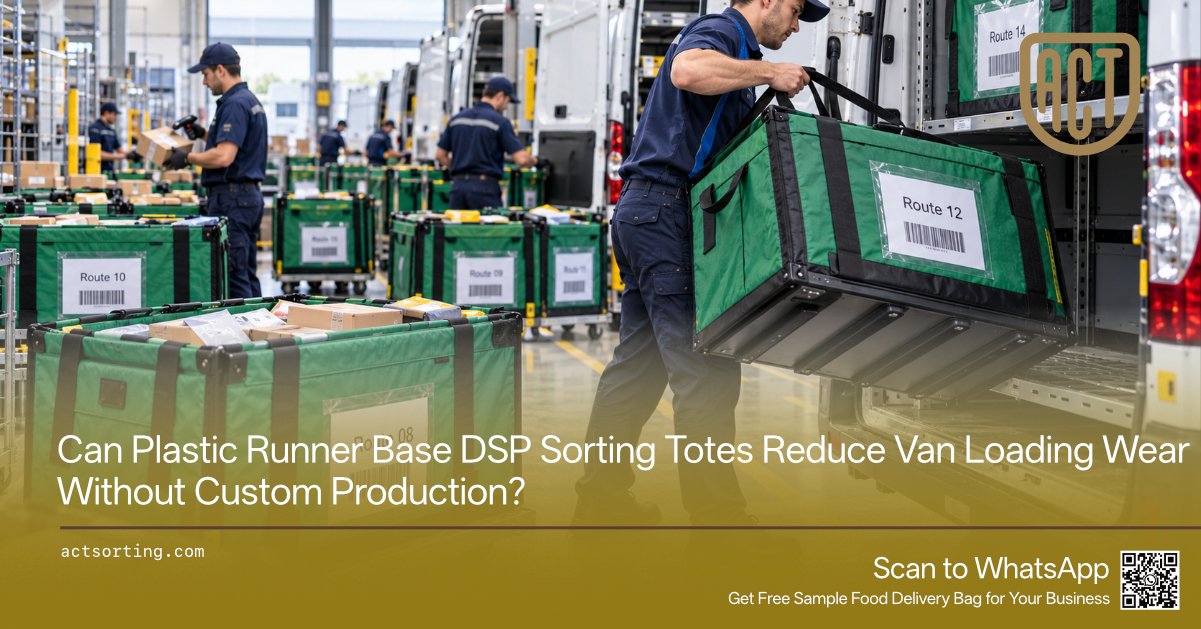
ACTSORTING’s DSP Logistics Sorting Totes with Reinforced Plastic Runner Base are designed around this wear pattern. Instead of depending entirely on the textile bottom to resist contact with rough surfaces, the bag uses raised plastic runners as dedicated contact points. These components help protect the fabric during repeated sliding and loading while preserving the practical advantages of a reusable textile tote.
For delivery companies, this construction is particularly relevant when totes move frequently between concrete dispatch floors and commercial van shelving. The product addresses a specific operational weakness rather than simply adding thicker fabric everywhere.
2. Plastic Runner Bases Protect Bags During Repeated Sliding and Dragging
The principle behind a plastic runner base is straightforward. When a loaded sorting tote rests on a flat surface, the raised runners contact the floor or shelf before the fabric bottom does. During sliding, the runners absorb much of the direct abrasion that would otherwise affect the woven material.
This changes how the bag experiences wear. Instead of allowing the entire underside to scrape across the surface, the construction concentrates contact on designated plastic components. The effectiveness depends on runner height, width, material, attachment method, spacing, and the condition of the surface beneath the bag.
Consider a courier depot where workers move completed Parcel Sorting Sacks from a staging lane toward waiting delivery vans. A standard fabric-bottom tote may be dragged several meters before being lifted or pushed into the vehicle. Repeating this movement throughout the day gradually damages the woven base. A tote with appropriately positioned plastic runners can reduce direct fabric contact during the same handling process.
The benefits extend to vehicle shelving. Commercial delivery vans often contain metal or other rigid shelving surfaces with edges, joints, and fastening points. Even relatively smooth shelves can produce wear when heavy bags are pulled forward repeatedly. A runner-equipped base creates a more suitable sliding interface, particularly when the runners are aligned with the direction of movement.
However, plastic runners should not be treated as a guarantee that the entire bag is immune to damage. Rough concrete, sharp shelf edges, protruding screws, and uneven loading surfaces can still affect the runners or exposed fabric. The attachment method also matters. A poorly secured runner may loosen long before the bag itself wears out.
ACTSORTING’s design uses reinforced plastic runners integrated with an industrial woven fabric structure. The objective is to protect high-contact areas without turning the entire tote into a rigid plastic box. This distinction matters because logistics operators still need manageable weight, practical handling, and compact empty storage.
For procurement managers comparing standard sorting bags, the useful evaluation is not simply whether a product includes plastic runners. It is whether those runners are positioned correctly, attached securely, and suitable for the surfaces used in the actual warehouse and delivery fleet.
A reinforced runner base should make everyday handling more reliable. It should not require workers to change their entire loading process just to protect the bag.
3. Reinforced Bottom Construction Must Work With Vehicle Shelving
A strong bottom is useful only when it fits the vehicle.
Commercial delivery fleets use different types of vans, shelving systems, staging carts, and storage arrangements. Some vehicles have adjustable metal shelves, while others use fixed racks or open floor-loading areas. The available shelf depth, width, height, and clearance can vary considerably, even within the same delivery company.
For DSP Logistics Sorting Totes, bottom construction therefore needs to be evaluated alongside the dimensions of the loading equipment. A bag with an oversized rigid base may be difficult to position inside a narrow shelf. Plastic runners that extend too far beyond the bottom could catch against shelf edges. A tote that is too tall may fit on the floor but become awkward when loaded into an upper rack.
A rectangular reinforced bottom generally provides a more predictable footprint than a completely unstructured fabric base. When properly designed, it helps the tote maintain its shape while loaded with mixed e-commerce parcels. This is particularly useful during van loading, when workers need to arrange several bags beside one another without continuously adjusting their position.
Runner orientation is another consideration. Longitudinal runners can support sliding in a particular direction, but buyers should confirm how the bag will be inserted and removed from their shelves. A tote that slides smoothly forward may behave differently when pulled sideways across a shelf joint. Testing with the actual rack provides more reliable information than a generic compatibility claim.
The bag should also remain easy to lift when necessary. Plastic runners do not replace proper handles, reinforced seams, or safe handling procedures. Workers may still need to lift the tote over a loading lip, move it between carts, or carry it through an area where sliding is impractical.
ACTSORTING offers standard reinforced-runner sorting totes and supports customized dimensions for projects requiring a particular vehicle layout. However, purchasing teams seeking faster procurement may find that an existing model already fits their shelves without modification.
A practical evaluation begins with the vehicle measurements. Buyers should confirm the usable shelf width, depth, height clearance, and expected loading orientation, then compare these measurements with the finished tote dimensions, including the runner base.
The objective is not to fit the largest possible bag into the vehicle. It is to use a size that workers can load, identify, remove, and return consistently throughout a full delivery shift.
4. Route Identification Windows Keep Parcels Organized Before Dispatch
Durability is only one part of an effective DSP sorting tote. The bag must also help workers identify the correct parcels and delivery routes quickly.
Inside a busy distribution center, dozens of visually similar totes may stand beside one another. Each may contain packages assigned to a different driver, postcode area, neighborhood, delivery sequence, or dispatch wave. If route identification is unclear, workers spend additional time checking labels and opening bags, increasing the risk of placing parcels into the wrong vehicle.
Transparent route label pockets help reduce this confusion. Instead of attaching loose paper labels to the outside of woven fabric, warehouse staff can insert route cards, barcode sheets, destination identifiers, or driver information into dedicated sleeves.
ACTSORTING’s reinforced plastic runner sorting tote includes transparent routing windows on multiple sides. This is particularly useful when bags are stored close together or positioned differently during loading. A worker may be able to identify the route from the front while another checks the side without turning the entire tote.
The importance of this feature becomes clearer during morning dispatch. Imagine a regional delivery station preparing 40 vehicles simultaneously. Workers scan parcels, consolidate them into route groups, move completed totes into staging lanes, and load vehicles according to departure schedules. At each stage, the bag’s identification must remain visible and associated with the correct contents.
A transparent pocket creates a reusable identification point. The outer bag can circulate through many shifts while the route card changes according to the next assignment. This avoids permanently printing temporary route information onto the bag and allows the same equipment to serve different drivers.
The label holder should also be evaluated for durability. Repeated contact with shelves, rough handling, and exposure to dust can damage thin transparent materials. A reinforced sleeve positioned away from the highest abrasion areas is more suitable for frequent commercial use.
For fleet managers, clear identification supports standardized workflows. Workers learn where to find the route card, supervisors can check staging areas more quickly, and drivers have a more reliable way to confirm that the correct tote is inside the vehicle.
A good sorting tote should be recognizable without opening it. If every worker needs to examine the contents to determine its destination, the bag is not doing much sorting work.
5. Foldable Sorting Totes Make Better Use of Limited Fleet Storage
A reinforced bottom and a foldable body may appear to serve opposite purposes. One adds structure, while the other reduces rigidity. In commercial logistics, however, the combination can be highly practical when the design is properly balanced.
During morning dispatch, a DSP sorting tote needs enough structure to stand open, support its contents, and remain manageable during loading. By the end of the route, many of those bags are empty. The operational priority changes from supporting parcels to recovering storage space.
Rigid plastic containers continue occupying nearly the same amount of space whether they are full or empty. Foldable textile totes can collapse into a more compact form, allowing drivers to stack empty equipment and create additional room for returns, failed deliveries, or other collected items.
This is particularly valuable for fleets operating multiple routes from a limited number of delivery stations. Empty bags may return to the warehouse every afternoon, where they need to be counted, checked, stored, and prepared for the next shift. A foldable design can reduce the amount of floor space occupied by inactive equipment.
ACTSORTING’s reinforced-runner tote combines a structured loading body with a collapsible textile design. The plastic runners protect the underside during active use, while the foldable construction supports more efficient storage after unloading.
Procurement teams should still verify the actual folded dimensions. Adding rigid components to a soft bag can affect how compactly it collapses. The runner arrangement, bottom reinforcement, and internal panels should be compatible with the folding method.
This becomes even more important when products are shipped internationally. Foldable bags generally offer packing advantages over rigid containers, but the final carton volume depends on the complete structure. Plastic runners, stiffeners, and other components may limit compression, so freight calculations should use confirmed packing dimensions.
For growing delivery operations, the ability to deploy more totes during busy periods and store them compactly afterward supports better equipment management. The fleet gains temporary sorting capacity without permanently occupying valuable storage areas.
A successful foldable sorting tote should remain stable when carrying parcels and become compact when empty. Getting both behaviors right is more useful than simply describing a bag as either rigid or flexible.
6. Standard Models Can Be More Practical Than Customized Bags
Customization is useful when a standard product cannot meet the operational requirement. It is not automatically necessary for every procurement project.
A logistics company may already have compatible vehicle shelves, a simple route identification system, and no strict corporate branding requirements. In this situation, a standard DSP Logistics Sorting Tote with reinforced plastic runners may provide the necessary durability and handling features without additional development.
This is particularly relevant for smaller fleet orders. A buyer purchasing 50 sorting totes may be testing a new delivery operation, replacing damaged equipment, or evaluating a new bag structure before expanding the purchase. The purchasing team may care more about product availability and delivery time than having a custom logo or an exclusive color.
Standard models can offer several advantages when inventory is available. There may be no need to prepare new cutting templates, develop a special fabric color, approve printing artwork, or produce additional samples. Existing specifications can simplify product confirmation, and the purchasing process may move more quickly.
However, standard does not necessarily mean ready for immediate shipment. Availability depends on the exact model, color, quantity, and current stock. A supplier should distinguish between finished inventory, materials available for standard production, and items that require a new production run.
Buyers should also check whether the standard model fits their equipment. A low-cost tote that does not fit the vehicle shelf, cannot carry the required load, or lacks usable route labeling may create more expense than a correctly designed alternative.
ACTSORTING supports both standard products and OEM & ODM manufacturing. For buyers seeking a straightforward initial order, the recommended approach is to confirm the existing model first. Dimensions, materials, bottom construction, color, load capacity, and folded size should be reviewed against the actual application.
If the standard model meets those requirements, further customization may add cost and complexity without creating meaningful operational value.
For larger fleet programs, customization becomes more attractive when businesses need consistent branding, specific route systems, special vehicle dimensions, or recurring bulk orders. The correct decision depends on the operational need, not the assumption that every commercial buyer requires a fully customized product.
7. Green and Color-Coded Sorting Totes Support Warehouse Organization
Color is often associated with branding, but in logistics operations it can also function as a practical identification tool.
Large sorting facilities may use different colors to distinguish delivery regions, service levels, parcel categories, vehicle groups, or processing stages. A warehouse could assign green totes to one route zone, blue totes to another, and red totes to priority or exception parcels. Workers recognize the broad category before checking the detailed route card.
This is particularly useful during busy dispatch periods. When many bags are standing in a staging area, clear visual differences can reduce the time required to locate the correct equipment. Color coding can also make procedures easier to explain to temporary workers who are unfamiliar with the warehouse layout.
For a smaller courier fleet, however, a complex color system may be unnecessary. The purchasing team may prefer one consistent color across all vehicles, especially if the operation already uses barcode labels or printed route cards for identification.
Green is a practical option for companies seeking a distinct appearance, but procurement teams should confirm whether the required shade is available as a standard product. A manufacturer’s ability to produce custom green fabric does not mean finished green inventory is currently available.
This distinction matters when delivery time is the priority. A standard color already in stock may be available sooner than a special shade requiring new material preparation. Custom color matching can also involve minimum production quantities that make the project less economical for a small order.
ACTSORTING supports color customization for larger commercial projects, alongside logo printing and other OEM services. For standard purchases, the available color range should be confirmed before the quotation is finalized.
The same applies to green runner-base sorting totes intended for commercial van shelving. Buyers should verify that the selected color belongs to the exact model with the required plastic runners, not merely to another product with a similar shape.
A useful procurement quotation should identify the chosen color, model, material, and bottom construction together. This prevents confusion between a standard fabric-bottom sorting bag and a reinforced-runner version that may appear similar in catalog photographs.
Color can improve warehouse organization, but it should never replace verification of the product’s actual specifications.
8. Dimensions, Materials, and Load Capacity Should Be Verified Before Ordering
Three technical details deserve particular attention when purchasing reinforced-runner DSP sorting totes: finished dimensions, material construction, and maximum working load.
Dimensions determine whether the tote fits the intended vehicle shelving and how many bags can be carried in one van. The specification should state the finished length, width, and height, ideally alongside folded dimensions. For runner-base products, buyers should also confirm whether measurements include the plastic components or refer only to the fabric body.
Material construction affects durability, weight, maintenance, and product life. ACTSORTING’s reinforced-runner DSP tote is described with industrial woven polyester fabric, reinforced stitching, transparent routing windows, and a plastic runner base. Buyers should request the specific fabric weight, coating or lamination where applicable, webbing specification, runner material, and construction details for the chosen version.
Load capacity requires even more care. A bag may physically hold a large volume of parcels while still having a lower recommended working load. The usable weight depends on fabric strength, handle construction, stitching, runner attachment, load distribution, and the lifting method.
A maximum load rating should not be inferred from the bag’s size or appearance. It should be confirmed through the manufacturer’s technical specification and supported by appropriate testing for the intended use.
For example, a courier company handling mainly lightweight fashion parcels may prioritize volume and easy access. Another operator handling mixed cartons may place much greater stress on the handles and base. The same bag dimensions do not necessarily provide the same suitability for both applications.
Runner construction should also be inspected. Buyers may want to know the number of runners, their orientation, approximate height, material, and attachment method. These details affect sliding behavior and compatibility with metal racks or uneven warehouse floors.
ACTSORTING can provide technical clarification according to the selected model and production specification. Where precise figures are not available in the public product description, they should be confirmed before the purchasing team approves the order.
For an initial fleet purchase, a small functional trial can be valuable. Testing the bag with normal parcel loads, vehicle shelves, and warehouse handling conditions provides better evidence than relying entirely on promotional descriptions.
The right product is not necessarily the one with the largest advertised capacity. It is the one that handles the expected load reliably while fitting the operation.
9. Small Fleet Orders Require Clear MOQ, Lead Time, and DDP Planning
A commercial buyer ordering 50 DSP Logistics Sorting Totes has different priorities from a national delivery network purchasing several thousand units. The smaller buyer may be evaluating the product before expanding, replacing a limited number of worn bags, or supplying a regional courier operation.
For this type of order, the most important commercial questions are whether the quantity meets the minimum order requirement, whether the standard version is available, how soon it can be shipped, and what the complete delivered cost will be.
MOQ should be confirmed for the exact product and configuration. A standard tote may have a different minimum quantity from a customized version requiring special fabric, printing, or reinforcement. Buyers should not assume that the MOQ published for one product applies to every model in the manufacturer’s catalog.
Stock availability is equally important. A product may be part of the standard range without being held in finished inventory at all times. The supplier should distinguish between immediately available stock and a standard production order. This allows the buyer to compare the benefits of waiting for the preferred model against choosing an available alternative.
For customers in Mexico, international freight becomes another important part of the decision. A shipment to Mexico City may be arranged through express delivery, air freight, sea freight, or other door-to-door services depending on the packed volume, weight, urgency, and commercial terms.
DDP, or Delivered Duty Paid, can be useful for buyers who want the seller to arrange transportation and applicable import formalities and costs under an agreed quotation. However, the feasibility and final price must be confirmed for the specific shipment. Product classification, declared value, customs requirements, destination details, and the agreed importer arrangements can all affect the service.
ACTSORTING lists DDP among its available commercial terms, but that does not automatically confirm a DDP quotation for every destination and order size. A reliable proposal should specify what is included, what documents are required, and whether delivery extends to the consignee’s actual address.
Shipping cost also depends on packing. Foldable sorting totes may be packed more efficiently than rigid boxes, but reinforced plastic runners increase the importance of accurate folded dimensions, carton measurements, and gross weight.
For a 50-piece inquiry, the purchasing team should request both product cost and transportation cost before comparing suppliers. A low unit price does not necessarily produce the lowest delivered cost if international freight is disproportionately expensive.
The most useful quotation combines a confirmed product specification, actual order eligibility, realistic production or stock status, shipping method, estimated delivery schedule, and transparent payment terms.
10. ACTSORTING Supports Commercial Delivery Fleets With Reliable Logistics Equipment
ACTSORTING manufactures commercial logistics bags for parcel sorting, van loading, regional distribution, warehouse handling, and last-mile delivery. Since 2013, the company has developed reusable delivery equipment for businesses requiring practical handling, durable construction, and stable production quality.
Its manufacturing facility in Yangchun, Guangdong, China, covers more than 12,000 square meters and employs over 400 experienced workers. BSCI and ISO9001 certification support responsible manufacturing practices and quality management.
The DSP Logistics Sorting Tote with Reinforced Plastic Runner Base is designed for a specific problem frequently encountered by commercial delivery operators: accelerated fabric wear caused by repeated contact with warehouse floors and vehicle shelving.
The product combines protective plastic runners, reinforced woven construction, transparent routing label windows, strong webbing handles, and a foldable structure. These features address several stages of the daily delivery workflow, from warehouse sorting and route preparation to van loading, parcel access, unloading, and empty equipment storage.
For businesses seeking a standard model, ACTSORTING can review the requested quantity, available colors, technical specifications, inventory status, production schedule, and shipping requirements. Buyers should confirm these details before treating the product as ready for immediate dispatch.
For larger logistics projects, OEM & ODM services allow customers to customize dimensions, fabric materials, colors, logo printing, label holders, handle placement, closure systems, and reinforcement structures. These options are particularly useful for delivery fleets using standardized vehicle shelving, branded equipment, or specialized route identification systems.
The company serves parcel delivery operators, e-commerce fulfillment centers, courier networks, regional distribution facilities, third-party logistics providers, and commercial fleet equipment buyers.
Procurement teams evaluating reinforced-runner sorting totes can begin with a few practical questions. Does the base protect the areas where the bag actually contacts the floor? Do the finished dimensions fit the vehicle shelves? Are route labels easy to read? Can workers lift and slide the tote safely? Does it fold efficiently when empty? Is the standard model available in the desired color and quantity?
These questions reveal more about long-term suitability than a product photograph or a low quotation alone.
For buyers seeking standard DSP sorting totes with reinforced plastic runners, ACTSORTING can evaluate requests based on product model, quantity, preferred color, destination, and required delivery schedule.
Commercial buyers can submit their expected load, vehicle shelf dimensions, delivery requirements, and order quantity to request a technical specification and quotation. For standard orders, this helps determine whether an existing model is suitable before additional customization is considered.
A stronger delivery tote does not solve every logistics problem. It does, however, remove one common source of unnecessary equipment replacement: the bag bottom wearing out before the rest of the product.
For fleets handling parcels every day, that is a practical place to start.
Frequently Asked Questions
Q: What is the advantage of a plastic runner base on DSP Logistics Sorting Totes?
A: Reinforced plastic runners create raised contact points beneath the tote, reducing direct friction between the fabric bottom and warehouse floors or vehicle shelves. This can help limit abrasion in high-contact areas during repeated sliding, loading, and unloading. Actual service life depends on the runner construction, working load, surface condition, and handling frequency.
Q: Can ACTSORTING supply green DSP Logistics Sorting Totes without customization?
A: ACTSORTING supports different color options, including custom color development. However, the availability of green as a finished standard-stock option must be confirmed for the exact reinforced-runner model. Buyers seeking faster delivery should request the current standard color list and stock status before placing an order.
Q: Can buyers order 50 reinforced-runner sorting totes?
A: ACTSORTING can evaluate a 50-piece commercial inquiry, but acceptance depends on the minimum order quantity for the selected model, available inventory, and production arrangements. Standard products and fully customized versions may have different minimum order requirements. The applicable MOQ should be confirmed in the quotation.
Q: What dimensions, materials, and load capacities are available?
A: ACTSORTING’s reinforced-runner DSP sorting tote uses industrial woven polyester construction, reinforced handles, transparent route label windows, and protective plastic runners. Exact dimensions, fabric specifications, runner construction, folded size, and maximum recommended working load should be confirmed through the technical specification for the selected model before purchasing.
Q: Can ACTSORTING arrange DDP shipping to Mexico?
A: DDP is among the commercial terms listed by ACTSORTING, and its availability can be evaluated for shipments to Mexico. The final quotation depends on quantity, packed dimensions, shipment weight, delivery location, customs classification, import requirements, and current freight conditions. Buyers should request written confirmation of the applicable shipping terms, estimated delivery time, and included charges.