

Table of Contents
- European Laundry Services Are Moving Beyond Traditional Drop-Off Shops
- Doorstep Laundry Collection Requires More Than an Ordinary Fabric Sack
- Courier Vehicles Need Organized Bags for Multi-Customer Pickup Routes
- Laundry Facilities Must Identify and Separate Every Customer Order
- Reusable Sorting Bags Support Movement Between Laundry Processing Stages
- Clean and Folded Laundry Needs a More Stable Delivery Structure
- QR Codes and Identification Pockets Connect Physical Bags With Order Tracking
- Hygiene, Cleaning, and Reuse Determine the Real Value of a Laundry Bag
- Bag Dimensions, Handles, and Reinforced Bottoms Should Match the Service Model
- ACTSORTING Develops Laundry Logistics Bags for European Pickup and Delivery Operations
Introduction
A customer in a European city schedules a laundry pickup through a mobile application. A courier arrives at the apartment building, collects a bag containing several days of clothing, scans the order, and places the laundry inside a delivery vehicle. The order travels to a commercial laundry facility, where it is checked, sorted, washed, dried, and folded. Later, another courier brings the cleaned garments back to the customer’s home.
From the customer’s perspective, the service is simple. Dirty clothes leave the apartment and clean clothes return. Behind that experience, however, the laundry company must coordinate customer identification, courier collection, vehicle loading, warehouse intake, washing operations, order consolidation, quality inspection, and final delivery.
The bags used throughout this process can become a significant operational detail. Traditional laundry sacks are designed primarily to hold clothing, but an end-to-end laundry delivery service requires something more versatile. The bag must be easy for a courier to carry, practical for repeated vehicle loading, compatible with order identification systems, and suitable for protecting folded garments during the return journey.
These requirements are particularly relevant to laundry pickup and delivery businesses operating in European cities. In France, Germany, the Netherlands, Spain, and other European markets, service providers may collect orders from apartment buildings, residential neighborhoods, office locations, student accommodation, and serviced apartments. Couriers often handle multiple customer orders during one trip, while central laundry facilities process those orders in scheduled batches.
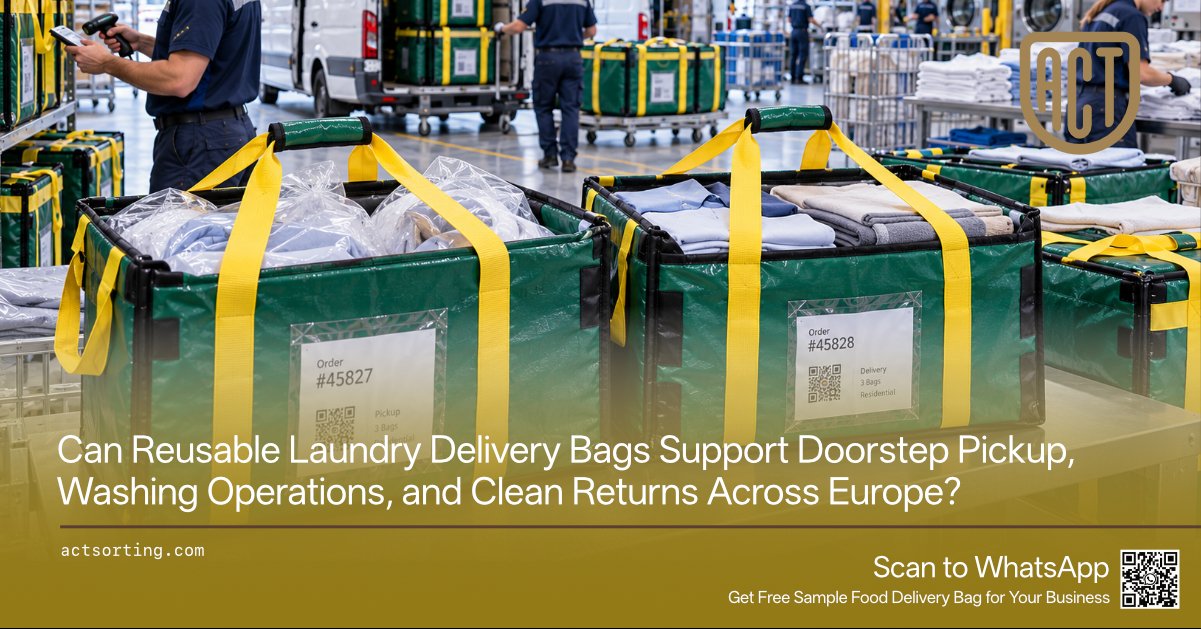
A reusable PP Woven Laundry Delivery Bag can help connect these stages when its structure is designed around the complete workflow. Reinforced handles support repeated collection, a stable bottom protects folded laundry, and transparent identification pockets allow staff to associate each bag with the correct customer order. Foldable construction also helps reduce storage requirements when bags are not in use.
ACTSORTING manufactures reusable logistics equipment for commercial operations, including PP Woven Logistic Sorting Bags, Parcel Sorting Bags, Courier Sorting Totes, Laundry Delivery Bags, and customized transport solutions. Established in 2013, the company operates a production facility covering more than 12,000 square meters in Yangchun, Guangdong, China, with over 400 experienced workers. With BSCI and ISO9001 certification, ACTSORTING supports OEM & ODM development for businesses requiring durable and repeatable logistics products.
For European laundry companies, the purchasing decision should not begin with the appearance of the bag. It should begin with an understanding of what happens to each customer order between the first doorstep collection and the final clean delivery.
1. European Laundry Services Are Moving Beyond Traditional Drop-Off Shops
Traditional laundry businesses usually expect customers to bring their clothes to a physical location and collect them after processing. This model allows the laundry facility to control most of the handling process within one building. Once pickup and delivery services are introduced, however, the operation becomes more complex because customer orders must move through several locations before the service is complete.
Consider an on-demand laundry operator serving residential customers in a large European city. During the morning, couriers collect orders from multiple households. Some customers provide a small collection of office clothing, while others hand over towels, bedding, sportswear, or several kilograms of mixed garments. The collection routes may cover apartment buildings, narrow residential streets, and commercial neighborhoods. Every order then needs to reach the correct processing facility without becoming mixed with another customer’s laundry.
The same operator may also provide services for serviced apartments, student accommodation, small hospitality businesses, or professional households requiring scheduled collections. These customers often expect predictable pickup windows and reliable returns, which means the delivery process must be organized rather than improvised.
Unlike a conventional laundry shop, the business now manages a two-way logistics network. Dirty laundry travels toward the processing center, while clean laundry travels outward to customers. Failed deliveries, customer rescheduling, and repeat subscriptions can create additional movements between vehicles, staging areas, and storage shelves.
Reusable Laundry Sorting Bags help provide a physical structure for this operation. Each bag can represent a customer order, collection group, delivery route, or processing batch depending on the service model. Instead of moving loose garments or repeatedly transferring clothing between temporary containers, employees can work with clearly identified handling units.
This does not mean every stage must use the same physical bag. A successful system may use one standardized outer tote design with interchangeable liners, or separate dirty-laundry and clean-laundry bag pools. The important point is that the equipment remains compatible across the service network.
For businesses planning to expand across several cities or processing centers, standardized logistics bags can simplify training, storage, procurement, and replacement. The physical equipment becomes part of a repeatable service system rather than an assortment of unrelated sacks purchased whenever the warehouse runs out.
2. Doorstep Laundry Collection Requires More Than an Ordinary Fabric Sack
The first contact between the courier and the laundry bag often takes place at a customer’s home. The courier may need to wait outside an apartment door, collect the order, confirm the customer information, and carry the laundry through a corridor, elevator, stairwell, or building entrance before returning to the delivery vehicle.
This environment creates different requirements from a warehouse. A large industrial sack may work well when it remains on a sorting cart, but it can become difficult to manage inside a residential building. Excessively short handles force couriers to use both hands, while an unstable bottom allows the contents to shift during carrying. A bag that drags against the floor can also create an unprofessional customer experience.
For this reason, handle construction deserves particular attention. A practical Laundry Pickup Bag may use long webbing handles attached to two opposite sides of the body. The handles should extend far enough above the opening for the courier to bring them together and carry the load comfortably with one hand. A hook-and-loop handle wrap can keep the straps joined and provide a more secure grip.
Handle length must be considered alongside bag height. A tall bag with very long straps may hang too close to the ground when carried by a shorter worker. A wide bag with short handles may tilt or force the courier to hold it awkwardly. Sample testing with a realistic laundry load helps identify the correct balance.
The opening also affects collection speed. Dirty laundry is rarely arranged neatly when it is collected. Customers may hand over clothing inside a temporary bag, reusable liner, or sealed collection sack. A wide opening allows the courier to place these items into the transport tote without excessive rearrangement.
ACTSORTING can develop PP Woven Laundry Delivery Bags with reinforced webbing handles, practical opening dimensions, suitable closures, and foldable structures. For operators using collection routes that involve apartments and pedestrian access, the bag should be evaluated according to the distance couriers actually carry it.
The benefit is not merely convenience for employees. A comfortable, organized pickup process supports quicker customer handovers and helps the service feel consistent across different couriers and neighborhoods.
3. Courier Vehicles Need Organized Bags for Multi-Customer Pickup Routes
A laundry courier may collect orders from several households before returning to the processing facility. During that time, the vehicle becomes a temporary storage and sorting area containing bags of different sizes, weights, and customer assignments.
Without a clear system, the bags can become mixed or difficult to identify. A driver may have several similar-looking laundry orders inside the vehicle, each collected from a different address. If identification cards fall out or labels become hidden beneath other bags, workers must spend additional time checking orders at the laundry facility.
Reusable Courier Sorting Totes can help prevent this problem. The operator may assign one tote to each customer or use larger collection totes containing separate, individually identified laundry sacks. Either approach requires a consistent identification method so garments remain associated with the correct order.
Vehicle dimensions also matter. European laundry services may use compact vans, small commercial vehicles, or cargo bikes for certain urban routes. A tall, wide bag suitable for a large van may be impractical in a smaller vehicle, while a very narrow sack may waste space or become unstable when partially filled.
A rectangular base generally offers better packing predictability than an irregular soft sack. Several bags can be placed beside one another, making it easier for the courier to organize the available vehicle space. Reinforced bottoms help maintain the footprint while allowing the textile body to flex around uneven laundry loads.
For services operating cargo bikes or compact vehicles, smaller modular bags may be more practical than one large collection sack. The operator can divide orders into manageable units that fit existing vehicle compartments. Handles and closures should remain accessible even when bags are loaded close together.
ACTSORTING can customize dimensions, fabric, reinforcement, handle positions, and identification pockets according to the vehicle configuration. Buyers can provide compartment measurements, typical order weight, average route capacity, and photographs of their current loading system.
A useful bag design reduces the need for couriers to rearrange orders during the route. It also helps the laundry facility unload and identify customer orders more quickly once the vehicle returns.
4. Laundry Facilities Must Identify and Separate Every Customer Order
When collected laundry arrives at the processing facility, the operational focus changes. Couriers no longer need to move quickly between residential addresses. Instead, receiving staff must confirm each order, identify the contents, and transfer the garments into the correct processing workflow.
An end-to-end laundry service may handle hundreds of individual customer orders during a busy working day. Some orders require ordinary washing and drying, while others include delicate garments, specific temperature requirements, ironing, or separate cleaning services. Each order must remain traceable even when the physical garments are removed from the transport bag.
Clear identification therefore becomes one of the most important bag features. A transparent document pocket can hold a printed customer-order card, barcode, QR code, collection route number, or processing reference. The pocket should be positioned where receiving staff can scan it without turning the bag upside down or searching beneath the handles.
A permanent serial number can identify the reusable tote itself, while a replaceable order card identifies the customer laundry currently associated with it. This distinction allows the same bag to circulate through many collection and delivery cycles without confusing the bag’s asset identity with the customer’s order.
Consider a receiving station where workers unload 30 collection bags from a van. If every bag has a visible order label, staff can scan the identifier, confirm receipt, and move the laundry into its designated intake area. If the labels are missing or difficult to read, workers may need to investigate each bag manually, slowing the process and increasing the opportunity for mistakes.
ACTSORTING can integrate transparent PVC identification pockets, protected QR-code areas, printed serial numbers, and custom color systems into reusable Laundry Sorting Bags. The bag does not operate the laundry management software, but it provides the physical identification point through which workers can connect the customer order with the facility’s digital records.
The value becomes particularly clear when a business operates multiple collection routes or centralized processing facilities. Consistent labeling reduces confusion during handovers and helps staff locate the correct order throughout the workflow.
5. Reusable Sorting Bags Support Movement Between Laundry Processing Stages
Once an order reaches the laundry facility, the garments may pass through several stages: intake inspection, sorting, washing, drying, folding, packaging, quality checking, and dispatch preparation. The equipment needed at each stage is not necessarily identical.
A reusable outer logistics bag can support movement between receiving areas and processing zones, but it should not automatically accompany garments into washing or drying machines. Industrial laundry machines require containers, textile bags, or processing systems specifically suitable for their operating conditions. PP woven transport bags are generally intended for handling and movement rather than exposure to machine washing cycles, high temperatures, or aggressive processing chemicals unless their suitability has been established.
This distinction matters because some buyers expect one bag to perform every possible function. A better approach is to define which stages need the outer transport tote and which stages require a separate washable inner bag, mesh processing sack, trolley, or other specialized equipment.
For example, the outer PP Woven Logistic Sorting Bag may arrive at the receiving station carrying a customer’s laundry inside a removable liner. The garments are then transferred into the laundry facility’s controlled processing system. After cleaning and folding, the finished order is placed into clean protective packaging or a designated clean liner before being returned to the transport system.
This arrangement allows the logistics bag to remain useful without requiring it to perform functions for which woven PP is not designed. It also helps the operator manage hygiene and product lifespan more effectively.
During internal handling, reusable sorting totes may carry sealed or bagged orders from inspection stations toward dispatch shelves. Different tote colors can identify processing stages, while transparent pockets hold the corresponding order references.
ACTSORTING’s material and structural customization can support these internal transport requirements. Buyers can select flexible woven construction, reinforced bottoms, wide openings, easy-clean liners, and appropriate dimensions according to the facility’s workflow.
The aim is to reduce unnecessary transfers while preserving clear separation between different garment conditions. A properly designed logistics tote should support the laundry process without creating additional hygiene or handling problems.
6. Clean and Folded Laundry Needs a More Stable Delivery Structure
The return journey presents a different challenge from collecting dirty laundry. After washing, drying, ironing, and folding, customers expect their garments to arrive neatly organized. A bag that works perfectly for loosely packed dirty clothing may not provide enough support for folded shirts, trousers, towels, or bedding.
A completely soft bottom allows the contents to sag when the courier lifts the bag. During vehicle movement, folded stacks may slide toward one side, creating wrinkles or causing garments to become mixed. The problem becomes more noticeable when the bag is relatively large but only partially filled.
A reinforced rectangular bottom helps create a stable platform for clean orders. One practical structure uses a removable HDPE or PP board placed inside a protective sleeve at the base. The board supports folded garments while allowing the outer bag to remain relatively lightweight and foldable.
The base should be selected according to bag dimensions and expected load. An oversized board adds unnecessary weight, while an undersized or overly flexible insert may bend under the contents. The objective is to provide enough stability for the type of clothing being delivered, not to create a rigid box.
Sidewall structure also matters. A rigid base cannot prevent all movement if the bag is extremely tall and the folded order occupies only the lower portion. For clean delivery, a wider and moderately low rectangular shape may work better than a narrow, deep sack. Optional internal dividers or removable side supports can provide additional stability when required.
Protective inner packaging should also be considered. Clean laundry may be placed inside sealed or otherwise suitable protective liners before entering the delivery tote. This helps prevent direct contact between finished garments and surfaces that may have been exposed during collection or warehouse handling.
ACTSORTING can develop Laundry Delivery Bags with reinforced bottoms, removable boards, suitable interior sleeves, and custom dimensions for folded garments. Samples should be tested inside the actual delivery vehicle rather than evaluated only when placed on a flat table.
A practical test involves packing a representative clean order, loading it into the vehicle, completing a normal delivery route, and inspecting the garments at the end. The objective is to confirm that the bag supports the presentation quality expected from a professional laundry service.
7. QR Codes and Identification Pockets Connect Physical Bags With Order Tracking
On-demand laundry services depend on reliable order identification. A customer may book collection through an application, receive confirmation when the courier arrives, track the order through processing, and receive a notification when the clean laundry is ready for delivery.
The software manages the information, but the physical order still needs an identification point as it moves between employees, vehicles, and facilities.
A reusable laundry tote can carry a visible QR code, barcode, or NFC tag linked to the operator’s tracking system. Each identifier serves a slightly different purpose. A permanent QR code or NFC tag may identify the physical bag as a reusable asset, while a temporary printed label identifies the customer order assigned to that bag during the current cycle.
For example, a courier could scan a customer-order label during doorstep collection. When the tote arrives at the laundry facility, receiving staff scan the same order reference to confirm arrival. After processing, another scan associates the completed garments with the outbound delivery route.
These interactions require compatible software and operational procedures, but the bag provides a reliable place to display or protect the necessary identifiers.
ACTSORTING can customize transparent label holders, printed QR-code areas, serial numbering, and protective compartments for identification tags. Placement should be considered carefully. A tag located near the bottom may be damaged by floor abrasion, while a label pocket hidden beneath the handles may become difficult to scan when the bag is full.
A large transparent upper-side pocket is often practical for replaceable order cards. Permanent identification can be positioned on another protected area so workers do not confuse the reusable bag ID with the current customer’s order number.
For operators managing hundreds or thousands of reusable bags, asset identification also helps track circulation. The business may be able to record which bags are assigned to couriers, which have returned to the facility, and which require inspection or replacement.
The bag does not replace the company’s laundry management platform. It makes that platform easier to connect with the physical movements taking place throughout the service.
8. Hygiene, Cleaning, and Reuse Determine the Real Value of a Laundry Bag
Using reusable logistics bags for dirty laundry pickup and clean garment delivery requires more than durable fabric. A hygiene process must be established before the same physical equipment is allowed to move between different handling stages.
A collection bag may encounter soiled clothing, damp towels, dust, vehicle floors, and other potentially contaminated surfaces. Even if the exterior remains visually clean, it should not automatically be considered suitable for direct contact with freshly washed garments.
One practical approach is to use separate bag pools. Collection bags are reserved for dirty laundry, while clean delivery bags are reserved for finished orders. Different colors or permanent markings can make the separation visible to couriers and laundry staff.
Another approach uses a shared outer tote design with removable liners and a validated cleaning procedure. The outer bag can be inspected and cleaned between uses, while designated clean liners protect finished garments during the return journey. Whether this system is appropriate depends on the operator’s hygiene controls, material compatibility, contamination risks, and the applicable local requirements.
Material choice therefore matters. Laminated PP woven fabrics can provide surfaces that are easier to wipe than untreated woven materials, but a wipe-clean surface is not the same as a material proven suitable for a particular disinfection process. Cleaning agents, temperatures, exposure time, seams, and reinforcement components all need to be considered.
Removable bottom boards can simplify inspection and maintenance. If moisture or dirt accumulates beneath a permanent rigid insert, the area may be difficult to clean. A board housed inside an accessible sleeve can be removed, inspected, cleaned according to its material compatibility, and replaced when necessary.
Reusable bags also require a retirement policy. Damaged seams, torn liners, cracked rigid inserts, and contaminated materials may make a bag unsuitable for continued use even if the main body remains intact.
ACTSORTING can help customers evaluate materials, removable components, liner arrangements, and bag structures around their intended maintenance procedures. The final hygiene protocol remains the responsibility of the laundry operator.
The commercial value of reuse comes from consistent service life and controlled circulation. A durable bag that can be maintained safely and used repeatedly may reduce frequent replacement purchases, but durability must always be balanced with cleanliness and garment protection.
9. Bag Dimensions, Handles, and Reinforced Bottoms Should Match the Service Model
There is no universal size for an end-to-end laundry delivery bag. The correct design depends on the operator’s customers, order volume, collection method, vehicle type, and handling process.
An urban service collecting laundry from single-person households may prefer a relatively compact tote. A family laundry service may need a larger rectangular bag, while a commercial linen operator collecting towels or bedding from serviced apartments may require higher capacity. These applications place different demands on the bag’s fabric, handles, reinforcement, and internal dimensions.
For operators seeking one standardized bag format, a rectangular PP woven body provides a useful starting point. The bag should be large enough for a typical customer order but not so large that couriers routinely carry unnecessary bulk. Overfilling should be avoided because it creates additional stress around the handles and may damage garment presentation during clean delivery.
Long opposing handles are particularly useful for door-to-door collection. The handles can meet above the bag, allowing the courier to carry it using one hand. A hook-and-loop wrap can join the straps and improve grip comfort. Reinforced webbing attachment zones help distribute the lifting force across the body instead of concentrating it near the upper seam.
For clean delivery, a removable rigid bottom helps maintain the bag’s footprint and supports folded garments. However, the bottom should not prevent the empty bag from being stored efficiently. A removable or fold-compatible base may offer a practical compromise between transport stability and return storage.
Material weight also requires careful selection. Very lightweight fabric may struggle with repeated dragging and loading, while unnecessarily thick material adds bulk and may make the bag less comfortable to carry. Laminated PP woven construction, reinforced corners, protected stitching, and stronger webbing can be evaluated according to expected working conditions.
ACTSORTING supports OEM & ODM customization for dimensions, woven fabric, color, logo printing, handles, closures, transparent identification pockets, removable boards, liners, internal dividers, and foldable structures.
Before approving bulk production, buyers should test the sample through a complete working cycle. The test should include doorstep collection, vehicle loading, facility intake, handling after processing, packing of folded garments, final delivery, and empty return storage.
This provides a much more realistic assessment than testing one feature in isolation. A bag may have excellent handles but be too tall for the vehicle. It may have a strong bottom but be difficult to clean. It may fold compactly but collapse while workers try to load it.
A successful design balances all these conditions instead of optimizing one feature at the expense of the others.
10. ACTSORTING Develops Laundry Logistics Bags for European Pickup and Delivery Operations
ACTSORTING manufactures reusable logistics bags for businesses that require repeated handling, organized transport, and reliable product specifications. Its product range includes PP Woven Logistic Sorting Bags, Parcel Sorting Bags, Courier Sorting Totes, Laundry Pickup Bags, Laundry Delivery Bags, and customized textile transport equipment.
Established in 2013, ACTSORTING operates a production facility covering more than 12,000 square meters in Yangchun, Guangdong, China, with over 400 experienced workers. The company holds BSCI and ISO9001 certification and supports OEM & ODM manufacturing for commercial-volume orders.
For European laundry pickup and delivery operators, ACTSORTING can develop reusable bags around the full service workflow rather than a single handling stage. A project may begin with a standard PP woven sorting tote and then introduce longer joined handles, a removable rigid bottom, protective liner compatibility, transparent order-identification pockets, and dimensions matched to the customer’s delivery vehicles.
The company can support customization of woven material, fabric weight, body color, logo, handle layout, hook-and-loop fastening, closures, bottom reinforcement, identification areas, and export packaging. These features can be combined according to whether the bag is primarily used for collection, internal transport, clean delivery, or a standardized system spanning several service stages.
Businesses in France, Germany, the Netherlands, Spain, and other European markets may have different vehicle layouts, pickup arrangements, and order volumes. The most useful purchasing information therefore includes the expected laundry weight, average number of customer orders per route, vehicle compartment dimensions, collection method, clean packaging process, hygiene requirements, preferred identification system, and target order quantity.
ACTSORTING can use these details to evaluate a standard design or develop a customized sample for functional testing. Sample approval should focus on the actual handling process: can the courier collect the order comfortably, can the laundry facility identify it quickly, can the clean garments remain protected, and can the bag return to service efficiently?
A reusable transport bag should not add complexity to an end-to-end laundry business. It should reduce unnecessary handling while supporting consistent order identification and professional delivery.
For commercial laundry operators planning a new pickup and delivery service or expanding an existing fleet, ACTSORTING can provide product development and bulk manufacturing support based on the required dimensions, materials, handles, reinforcement, labeling, and operating conditions.
The customer sees clean clothes arriving at the door. Behind that simple experience is a coordinated chain of collection, transport, processing, identification, and delivery.
The right logistics bag helps those stages work together.
Frequently Asked Questions
Q: Can the same reusable bag design be used for dirty laundry collection and clean laundry delivery?
A: Yes, the same bag design can support both applications, but the hygiene process must be considered. Operators may use separate dirty and clean bag pools or a controlled cleaning procedure with removable liners. Clean garments should remain appropriately protected during return delivery.
Q: Which handle structure is suitable for European doorstep laundry collection?
A: Long reinforced webbing handles attached to two opposite sides are a practical option. The handles can meet above the bag for one-hand carrying, while a hook-and-loop handle wrap helps keep the straps together. The correct dimensions should be tested with the expected laundry load.
Q: Is a reinforced bottom necessary for clean folded laundry?
A: A reinforced base is recommended when the bag carries neatly folded garments. A removable rigid PP or HDPE insert can help maintain a flat supporting surface and reduce movement during transportation. The final structure should be selected according to the bag size and garment load.
Q: Can ACTSORTING add QR codes, NFC tags, and customer-order labels?
A: Yes. ACTSORTING can develop transparent order-label holders, protected NFC tag areas, printed QR-code panels, and serial numbering as part of a custom bag. The laundry operator’s existing software determines how these identifiers are linked to customer orders.
Q: What information should a laundry service provide before requesting a customized bag quotation?
A: Useful information includes expected laundry weight, typical order volume, bag dimensions, vehicle type, preferred fabric, handle requirements, bottom reinforcement, closure design, clean and dirty handling procedures, identification needs, logo, color, and expected purchase quantity. These details help determine the appropriate sample and production specification.