

Table of Contents
- Destination Groups Break When Loose Parcels Ride in a Bare Roll Cage
- Sizing Bags from Cage Interior, Gate Opening, and Pack Count
- Bags That Sit on the Cage Floor versus Sacks That Hang from the Frame
- Tie-Down Straps and How They Meet Approved Anchor Points on the Cage
- Open-Top versus Zipper Closures for Fill at the Sort and Travel in the Cage
- Handle Placement for Lifting Bags Through a Half-Drop Gate or over a Cage Wall
- Identification Faces That Stay Readable Through Cage Mesh
- Keeping Filled Bags Stable While the Cage Rolls and Boards a Dock
- Empty Fold So Returned Cages Are Not Filled with Unused Bags
- What Buyers Should Send for a Roll-Cage Sorting-Bag Build
Destination Groups Break When Loose Parcels Ride in a Bare Roll Cage
At a parcel hub or delivery station, the work after the sort is not finished when a carton leaves the belt. Items for one destination, one route, or one van load-out still have to travel together from the sort face to a dock, a trailer, or a staging lane. Many sites already use steel roll cages for that short movement. When those same parcels ride loose in a bare cage, the group that the sort just built begins to come apart. Small packages slip through or press hard against the mesh, cartons rotate and nest into gaps, and a bump at a dock plate is enough to mix two neighboring destinations. The cage arrives looking full, but the count no longer matches the sort, and someone has to rebuild the group by hand before the trailer or the van can be loaded.
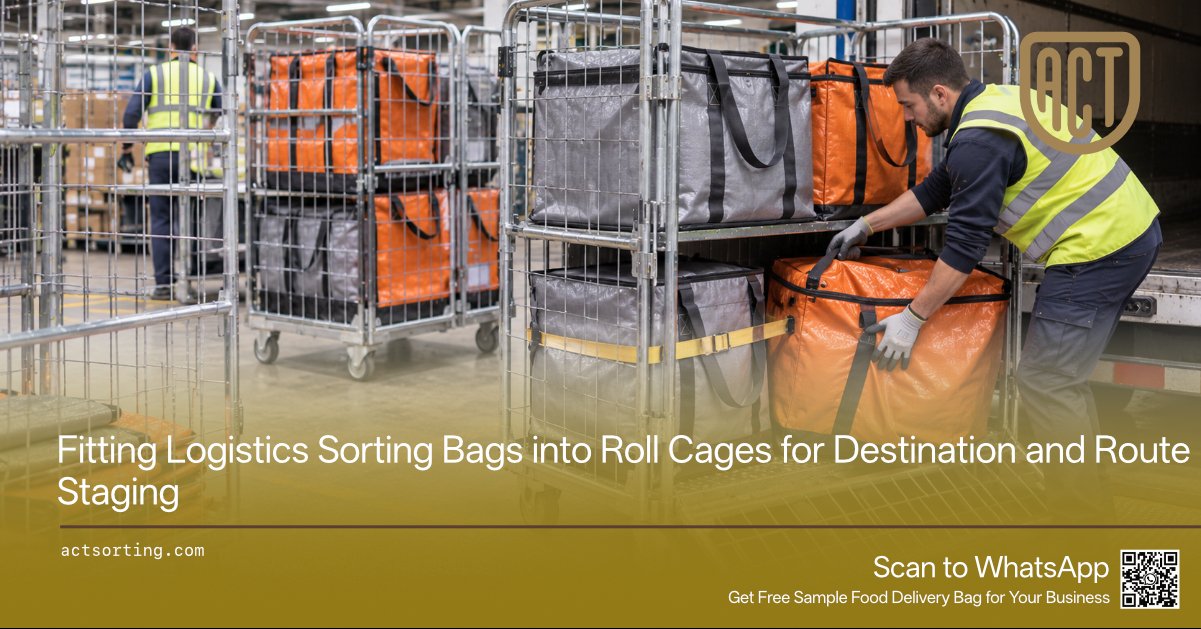
The useful arrangement is to treat the bag as the grouping unit and the cage as the rolling unit. Parcels for one destination or route are packed into a bag at the sort, and that filled bag then sits in the cage—or, when the buyer specifies a hanging construction, hangs from the frame—so the group stays together while the cage is rolled. The cage still does what a cage is built to do: it rolls, it contains volume, and its gate or door keeps the load from falling into the aisle. It does not, by itself, keep one route’s parcels from mixing with another, or keep small items from working through the mesh. Reusable logistics sorting bags take on that grouping work so the cage can be moved without turning the load back into a loose pile.
A filled bag in a cage is still subject to the same floor, the same dock plate, and the same lift the cage already uses. The bag keeps parcels in one group; it does not automatically keep that group from shifting, tipping, or leaning on the mesh if the cage is over-stacked or the load is left unsecured. Those limits belong in the same operating picture as size and pack count, and they are taken up later as seating versus hanging, straps, and travel stability. What matters first is the use cycle itself: sort into the bag by destination or route, place or hang the filled bag in the cage, close the gate, roll the cage to the dock or load-out, lift the bag out as a unit, and return empty bags in a fold that does not waste cage space on the way back.
A photograph of a cage packed with loose cartons will not show whether a bag of a given outer size can pass the half-drop gate, sit stably on the floor, or leave a readable face through the mesh. Parcel Sorting Bags for this staging path need sizing, closure, handles, identification, and any hang or strap details specified as one build around the cages the site already runs. ACTSORTING develops reusable sorting equipment from those measured interiors, gate openings, pack counts, and handling features so a foldable logistics sorting bag can be built to ride in the operator’s existing roll-cage fleet.
Sizing Bags from Cage Interior, Gate Opening, and Pack Count
Bag size for this work is not a catalog litre figure. It starts from the cage the operator already has. Interior width, depth, and usable height—taken to the underside of any shelf, strap, or top bar that actually limits the load—set the outer envelope of a filled bag. The gate opening is a second, often tighter, constraint. Many warehouse roll cages use a half-drop or split gate: the lower leaf stays in place as a lip while the upper leaf folds down or swings aside so a bag can be lifted through a shorter aperture than the full internal height. A bag that fits the interior once it is seated can still be too tall, too wide, or too bulky at the mouth to pass that opening without catching on the gate frame, the mesh, or the latch hardware.
Pack count is the third measurement, and it is an operations choice rather than a fabric property. One large bag per cage can be efficient when a single destination fills the cage, but it may be too heavy to lift through a half-drop gate, and it leaves no way to keep two routes apart inside the same rolling unit. Two or three bags side by side can match how the dock actually releases work, provided each filled bag still has a clear lift path. A second row above the first should not be treated as a normal packing pattern for flexible PP woven bags; it belongs in the brief only when the site already requires two-layer loading and the stability of that arrangement has been checked. The brief should state how many filled bags are meant to share one cage, whether they stand in a single layer, and whether any bag must be pulled from the back of the cage while others stay in place.
Filled outer size should be quoted in the state the bag will actually travel—mouth closed if a zipper is used, or filled to the working line if the bag is open-top—because a bulging mouth or an unfastened flap changes the dimension that has to clear the gate. Handle projection, any side straps, and label pockets also add to the clearance, not only the body panels. If the same bag program has to serve more than one cage pattern, size should be locked against the tightest recurring interior and the tightest recurring gate, not against the most generous cage in the fleet. A bag built only to the largest cage will jam or have to be forced through a smaller gate on another aisle.
Interior photos with a tape in frame, a note of shelf or divider positions, and a short description of how bags are loaded—through the half-drop, over a side wall, or with the full door open—are more useful than a requested capacity in litres. A filled outer size can be derived from those clearances and from the pack count the site wants to run, then confirmed on a sample against the actual cage. Until that check is done, a size is a design to try, not a guaranteed fit for every cage in the building.
Bags That Sit on the Cage Floor versus Sacks That Hang from the Frame
The usual starting point is a floor-standing sorting bag that sits on the cage floor. A floor-standing sorting bag takes the weight of the parcels on its base, leans against the mesh or against neighboring bags for lateral support, and is lifted in and out as a complete unit. The construction that serves that arrangement is a body with a defined base, handles placed for a lift through the gate, and a footprint that matches the interior so the bag does not wander into a corner or collapse into a puddle of fabric when it is only partly filled. A floor-standing sorting bag does not need hanging hardware to do its job. It does need a base and enough wall support—or enough fill—to stay upright while the next bag is placed beside it and while the cage starts to roll.
A hanging sack is a different construction. Hanging parcel sorting sacks use reinforced grommets or eyelets along the upper edge so the sack can be suspended from a compatible bar, hook, or frame point inside the cage or on a nearby rack. Once hung, the mouth stays open at a fixed height for drop-in sorting, and the body occupies vertical space rather than a wide patch of floor. That arrangement is useful when the buyer wants bags to remain parked at a sort position, or when several sacks must hang side by side along a cage wall. It is not a floor-standing sorting bag with extra holes. A hanging sack typically does not hold the same independent shape when it is taken off the frame; the load hangs from the grommet line, and the empty body is meant to fold flat rather than stand. Asking one pattern to sit stably on a cage floor and also hang from the same grommet line, without a prototype check, treats two different constructions as if they were one.
The choice is therefore not a cosmetic option on a single body. If the site sorts into bags on the floor and then rolls those bags in the cage, a floor-standing sorting bag is the usual starting point. If the site wants the bag to hang in the cage or on a frame during the sort and then be lifted off for travel, the grommet layout, spacing, and diameter must be matched to the hooks or bars the cage already has, and the filled weight must stay within what those points and the textile around them can reasonably carry in service. A removable rigid board, used in some standing depot bags so the textile can fold independently of a base insert, is a different construction again and is typically not the first choice for a bag that must sit among cage mesh and roll over dock plates.
Floor-standing and hanging bags should be treated as separate constructions in a roll-cage brief, with grommets or a standing base placed only where the buyer has specified that arrangement. Empty-fold method, folded size, and how many empties fit in a returning cage follow from that construction choice and are a packing question for the return trip, not a shared fold assumed for both bodies.
Tie-Down Straps and How They Meet Approved Anchor Points on the Cage
Tie-down straps are a manufacturer option unless the buyer specifies them. Their job is to limit how far a floor-standing sorting bag can shift, tip, or lean while the cage is rolled, turned, or moved across a dock plate. They do that by connecting webbing on the bag to attachment points the operator has accepted on that cage—typically a bar, a dedicated lashing point, or another fitting already used for restraint. Ordinary cage mesh is not assumed to be a reliable anchor. Wire or grid openings can cut webbing, deform, or pull out under a concentrated strap load, so a mesh panel should not be treated as a natural tie-down point. Straps do not replace the cage door or half-drop gate, and they do not raise the operator’s loading limit. A cage that is overfilled, loaded above a stable height, or rolled with the gate unlatched can still lose a load; straps on the bag will not correct that.
When straps are specified, the useful brief is about interface, not about a claimed restraint rating. Strap position—base, mid-wall, or upper third—should match where the bag tends to move and should line up with the approved points on the cage, not with whatever opening happens to be nearest. Length and adjustability should allow the strap to be tensioned in the cages the site already runs, including slightly different interior widths, without leaving a long free tail that can catch a wheel or a gate latch. Hardware should be chosen so it can be opened and closed with gloved hands in an aisle, and so it can be released quickly when the bag has to come out at the dock. Bags with tie-down straps for roll cages follow that logic: the strap is part of the bag, and it is meant to meet the cage the operator already has, provided the dimensions and the approved attachment points allow it. The fit between the strap, the hardware, and the cage structure should be checked on a sample against the actual cage before the layout is treated as settled.
What straps cannot do should be stated as clearly as what they can. They do not certify the cage-and-bag combination as a restrained transport system. Rolling, dock plates, and lifts can still shift an unsecured or overfilled load. A strap that is left loose, or that is tied to ordinary mesh because no approved point was identified, is not doing the work a product photograph might suggest. No restraint certification or test figure is claimed.
If the site does not want straps, a floor-standing sorting bag can still be used, with stability then depending on fit, pack count, how the bags lean on one another, and how the cage is gated and rolled. That is a valid arrangement, not a lesser one, as long as the operating brief does not quietly assume a strap that was never specified. Strap positions, lengths, and fittings can be added when they are requested, and left off when the cage and the loading method do not call for them.
Open-Top versus Zipper Closures for Fill at the Sort and Travel in the Cage
Closure is a choice with real tradeoffs, not a locked specification. An open-top bag is fast at the sort face. Parcels can be dropped or placed through a wide mouth without a zipper to open and close on every item, which suits a destination or route group that is being built continuously at a station. In the cage, that same open mouth is also the face that can spill if the bag tips, if a neighboring bag leans into it, or if the cage starts over a dock plate with the load sitting high. An open-top build can still travel if the bag sits low, the mouth stays below the gate lip, and the fill line is kept below the point at which parcels ride near the rim. Those conditions are operating habits, not features the fabric can guarantee.
A zipper mouth changes the sequence. The bag can be filled at the sort, closed for travel, and opened again at the dock or on the van load-out so the group stays covered while the cage moves. That is useful when the cage shares an aisle with other traffic, when the load includes smaller items that would otherwise work toward the mouth, or when the site wants a closed face behind the mesh. The cost is time and two-handed work at both ends of the move, and a zipper that has to clear the gate opening as part of the filled outer size. A zipper also adds a line of hardware that can catch on mesh or on a half-drop latch if the slider is left proud of the wall.
Neither closure is universally stronger or more secure in every hub. A zipper keeps the mouth together; it does not lock the cage, and it does not replace a gate. An open top is not automatically a spill risk if the bag is sized and filled for the way the cage is actually rolled. Some programs use an open top for bags that stay in a hanging position at the sort and a zipper for bags that sit in a cage and travel to a dock; those are two builds, not one bag asked to do both jobs with a single mouth. Drawcords and flaps exist as further options, but for this staging path the practical decision is usually between a mouth that stays open for speed and a mouth that can be closed for travel.
The brief should say where the bag is filled, whether it must travel closed, and whether it will be opened again inside the cage or only after it is lifted out. Either an open-top or a zipper mouth can be built around that sequence. The choice should be settled on a sample against the actual sort-and-roll path, rather than treated as a default that later has to be reversed in a running fleet.
Handle Placement for Lifting Bags Through a Half-Drop Gate or over a Cage Wall
Handles are not decoration around the mouth. They are the points at which a filled bag is lifted through a half-drop gate, passed over a cage wall, or pulled forward from the back of a cage so the next destination can be reached. Placement has to match that motion. Handles only at the short ends may be enough for a two-person lift through an open full door, and still leave no good grip when one person has to raise the bag over a lower gate leaf or slide it along the floor toward the opening. Side handles, or a combination of end and side grips, give a way to control the bag as it passes a tight frame, provided they are stitched into reinforced panels and do not sit where they will be crushed between the bag and the mesh once the bag is seated.
Height on the body matters as much as the side they are on. Handles set too close to the base are awkward once the bag is filled and the lift has to start from the cage floor. Handles set only at the very top can pull the mouth closed or, on an open-top bag, spill the upper layer as the bag is tilted to clear the gate. A mid-to-upper placement, clear of the zipper slider if a zipper is used, usually matches a lift through a half-drop opening, but the right height is the one that clears the actual gate lip and still lets the operator keep the bag close during the lift. Webbing that wraps under the base can help the textile carry the load in the handles rather than tearing at a short stitch line; that is a construction choice to specify, not a published load rating.
The lift itself is limited by the people, the aisle, and the cage, not by the presence of handles. A bag filled to a pack count that two people cannot raise through the gate will not become easier to handle because more grips were added. The brief should name the lift that is actually used—two-person gate lift, single-person pull over a side wall, trolley transfer after the bag is out—and whether gloves, a narrow aisle, or a high van floor change the motion. Handle count, width, and stitch into reinforced panels can then be set against that motion, and tried on a sample with a representative fill. A request for stronger handles alone leaves the gate height and the lift path unspecified.
Identification Faces That Stay Readable Through Cage Mesh
Once bags sit behind mesh, the mark that mattered on an open sort table can disappear behind a bar, a latch plate, or the shadow of a neighboring bag. Identification for this path is therefore a question of face and placement, not only of what is printed. A destination name, route code, or color panel has to land on a surface that remains visible through the mesh when the bag is seated in its usual orientation—typically an upper side wall, not a panel that folds under the base or hides against the cage back. If bags are loaded with a preferred face toward the gate, that face should carry the mark; if a cage may be approached from either side in the aisle, a second face may be needed so a mark is not lost against the far wall.
Color, logo, and a unique bag identity or barcode are confirmed only when the buyer asks for them. When color is specified, it can distinguish a destination group, a service class, or a return stream at a glance, including through mesh, so long as the color field is large enough and not broken up by a busy print. When a logo is specified, it marks ownership; it should not cover the destination face or sit where mesh wire will cut the mark into unreadable fragments. When the buyer requires a unique number or a barcode, that code identifies one physical bag for manifests and return checks. The operator owns the numbering scheme. The manufacturer can print or sew the agreed series and add a barcode only if asked. A barcode that will be scanned through mesh, or at an angle in a dim dock, needs a quiet zone and a placement that can actually be reached; that is a scanning habit to test on the cage, not a typography choice alone.
Marks also have to live with handles, straps, and zipper terminals. A label pocket sewn under a handle, or a code printed across a strap path, will be covered in use. The brief should show, even in a simple sketch, which wall faces the gate, which faces the aisle, and which marks must remain readable after the bag is seated. Color fields, logos, and identity marks can be placed on those faces when they are specified, and left off when they are not part of the request. Unspecified marking should stay listed as an open option, not as a feature already built into the bag.
Keeping Filled Bags Stable While the Cage Rolls and Boards a Dock
A cage does not travel only on a smooth warehouse floor. It is rolled through turns, across joints, onto dock plates, and sometimes onto a lift or into the mouth of a trailer. Each of those motions can tilt the floor of the cage and shift a filled bag toward the mesh, the gate, or a neighboring bag. Stability is therefore a loading and geometry problem as much as a hardware problem. A bag that fits the interior snugly, sits on its base, and is packed to a consistent fill line will lean less than a half-empty bag that can collapse to one side. A second bag placed beside the first can help both stay upright, provided the pair still clears the gate and does not wedge so tightly that the first bag cannot be lifted out at the dock.
A flexible PP woven bag is not, by default, a load-bearing platform for another fully loaded bag. Two-layer loading in the cage should be considered only when the operator already needs that packing method, and only after the site has checked that the arrangement stays stable and that the lower bag and the cage can actually carry the upper load under the movements the cage already makes. Handles, mouths, and tie-down straps are not default structures for bearing a second filled bag; they are for lifting, closing, and, when specified and attached to approved points, limiting shift of the bag they belong to. The cage door or half-drop gate still has to be latched. The operator’s loading limit still caps how high and how heavy the cage should be before it is rolled.
Dock boarding deserves its own note because the plate and the trailer sill introduce a short, sharp change of angle that an aisle does not. Bags should be seated before the cage is pushed onto the plate, not adjusted mid-crossing, and empty space at the top of the cage should not be treated as an invitation to perch a loose carton on top of a closed bag. Nothing in the bag’s construction certifies the cage for a particular ramp angle or lift. What the bag can offer is a grouping unit that keeps its contents together while the rolling unit is moved with the care the site already applies to a loaded cage. Fit, pack count, and optional straps can be discussed against that movement; the rolling, gating, and dock procedure remain the operator’s.
Empty Fold So Returned Cages Are Not Filled with Unused Bags
The return path is easy to ignore at the sort face and expensive in cage space if it is left unplanned. After bags are emptied at a dock, a trailer, or a van load-out, they often ride back to the hub in the same cages that brought the filled groups out. If those empties stay unfolded, a cage that should be carrying the next wave of destination bags—or simply returning as a compact empty unit—comes back looking full. The fold is therefore part of the same build as the filled size, not an afterthought for the warehouse to improvise with a loose body.
What matters for the return is a measured folded size, a target count of empties per returning cage, and a packing density the dock can actually repeat. Folded length, width, and thickness should be taken from the signed sample of the construction that will be ordered, then checked against the interior of the returning cage—including any bars, shelves, or gate lips that reduce the usable pack space. The brief should say how many empty bags are meant to ride back in one cage, and whether they travel as a single pile, as tied bundles, or as a loose pack. A sleeve, strap, or tie for keeping a bundle together can be included when that pack method is wanted, and left off when it is not.
A tighter fold that is hard to repeat on a busy dock will not survive the shift; a looser, repeatable fold that still leaves room in the cage is usually the more useful packing-density target. Color or identity marks, when they have been specified, should remain readable on the folded bundle so a mixed return can still be sorted without opening every pack. Floor-standing sorting bags and hanging sacks pack to different thicknesses because their bases, grommets, handles, and any side straps add different bulk; the packed size should be taken from the sample of the body that will actually be returned, not copied from another style.
What Buyers Should Send for a Roll-Cage Sorting-Bag Build
A workable brief separates what is already decided from what is still open, and it starts with the cage, not with a fabric name. The inquiry does not have to be complete before it is sent. Cage photographs, an existing bag already in use, or approximate interior and gate dimensions are already enough for ACTSORTING to review the application and discuss a custom build. Where more detail is available, photos of the roll cage with a tape in frame should show interior width, depth, and usable height, the gate or half-drop opening, latch hardware that might catch a bag, and any bars, hooks, or approved attachment points intended for straps or hanging. A note on how many filled bags share one cage, whether they stand in a single layer on the floor, and how a bag is lifted out—through the half-drop, over a wall, or with the full door open—lets filled outer size be derived instead of guessed from a litre figure. Two-layer loading should be mentioned only if the site already requires it.
The brief should then state whether bags sit on the cage floor or hang from the frame. A floor-standing sorting bag is the usual starting point. If sacks are to hang from the frame, grommet spacing, diameter, and a photo of the hook or bar are needed, and that request should be written as a hanging construction, not as holes added to a floor-standing sorting bag. Tie-down straps, when wanted, need the attachment points the operator has accepted on the existing cage and a preferred strap position on the bag. Closure should be named as open-top or zipper according to whether the bag must travel closed, not as a generic request for a secure mouth. Handle lift path, identification faces that must remain readable through mesh, and empty-fold pack counts for returning cages complete the handling picture.
Color, logo, unique identity numbers, and barcodes should be included only when the operator already requires them, together with artwork, numbering rules, and which wall faces the gate. Laminated PP woven is a common material option when a coated body is wanted; it should be named if it is required, and left open if the site is still comparing constructions. Expected load can be given as an operating requirement to discuss; it is not converted into a published rating. A physical sample of a hook, a strap fitting, or an existing bag, if one is already in use, is more useful than a verbal comparison.
If parts of that list are still open, they can be marked as choices to settle on a sample rather than as hidden defaults. Even a short set of cage photos, an existing sample, or a rough size range is enough to open the discussion. ACTSORTING develops reusable Logistics Sorting Bags and Parcel Sorting Bags around this kind of cage-specific brief, and can advise on floor-standing versus hanging constructions, strap interfaces, closures, and fold once the use path is clear. Photos, drawings, approximate dimensions, or an existing sample all support a sampleable OEM inquiry for a roll-cage destination or route staging bag.
FAQ
Q: How should bag size be chosen for destination or route groups that ride in a roll cage?
A: Measure the cage interior—width, depth, and usable height to any shelf or bar that limits the load—and measure the gate or half-drop opening, which is often tighter than the interior. Set filled outer size in the state the bag will travel, including handles and any side straps, and decide how many filled bags share one cage as an operations choice. If more than one cage pattern is in use, lock size against the tightest recurring interior and gate. Do not start from a generic catalog litre figure. Confirm the result on a sample in the actual cage.
Q: Should the bag sit on the cage floor or hang from the frame?
A: Sitting on the floor is the common default when destination or route groups are packed and then rolled to a dock as complete units. Hanging from the frame is a different construction, usually a sack with reinforced grommets matched to hooks or bars the cage already has, and it is used when the buyer specifies that path. The two should not be treated as one body with optional holes. Fold methods also differ and should be prototype-validated on the construction that will actually be ordered.
Q: Do tie-down straps keep a filled bag from moving in the cage?
A: Straps are a manufacturer option unless specified. When fitted, they can limit how far a floor-standing sorting bag shifts or leans by meeting attachment points the operator has accepted on the cage, after the strap and the cage structure have been checked together on a sample. Ordinary cage mesh is not assumed to be a reliable anchor for a concentrated strap load. They do not replace the cage door or half-drop gate, and they do not raise the operator’s loading limits. Rolling, dock plates, and lifts can still shift an unsecured or overfilled load. No restraint certification or test figure is claimed.
Q: Is an open-top or a zipper better for bags that are filled at the sort and then travel in a cage?
A: It depends on the sequence. An open top is faster at a continuous sort face but can spill if the bag tips or is filled too high for travel. A zipper lets the mouth be closed for the roll and opened again at the dock, at the cost of time and a zipper line that must still clear the gate. Neither closure locks the cage or replaces the gate. The brief should say whether the bag must travel closed; the choice is a tradeoff to settle on a sample, not a locked specification.
Q: What information helps ACTSORTING quote a roll-cage sorting-bag build?
A: A complete brief is helpful, but it is not required to start. Cage photographs, an existing bag sample, or approximate interior and gate dimensions are already enough for ACTSORTING to review the application and discuss a custom build. Where more is available, list confirmed requirements separately from open choices: pack count and lift path, whether bags sit or hang, and, if hanging or straps are required, hook or bar details and the attachment points the operator has accepted. Add closure preference, handle notes, empty-fold pack targets, and, where already specified, color, logo artwork, unique-ID rules, material preference, and expected load as a requirement to discuss. Photos, drawings, approximate dimensions, or an existing sample all support a sampleable OEM inquiry for logistics and parcel sorting bags.