

Table of Contents
- Mixed Parcel Loads in Passenger-Bus Luggage Holds and Roadside Stops
- Sizing Filled Bags from Luggage-Bay, Door, and Pack-Count Measurements
- Laminated Woven Bodies: Water Shedding, Tear Resistance, and Real Limits
- Wide Zipper Openings for Mid-Route Load and Unload
- Zipper Locks, Tamper-Evident Seals, and Mid-Route Resealing
- Reinforced Handles and Bottoms for Bay-Floor Lifts and Slides
- High-Visibility Color and Operator Logo as Fleet Marking
- Unique Bag Identification Numbers the Operator Controls
- Empty Fold So Unused Bags Do Not Fill the Return Bay
- What Buyers Should Send for a Bus Luggage-Hold Bag Build
Mixed Parcel Loads in Passenger-Bus Luggage Holds and Roadside Stops
When an intercity or regional coach also carries courier work, the underfloor luggage hold becomes a mixed compartment: passenger suitcases, strollers, and a stream of small parcels that must be added or pulled at terminals and at roadside stops. Loose cartons slide under other luggage, hide behind wheel-arch walls, and have to be counted one by one every time the hatch opens. Crews working under time pressure at a brief stop cannot rebuild a pile of loose packages and still close the bay before the coach leaves.
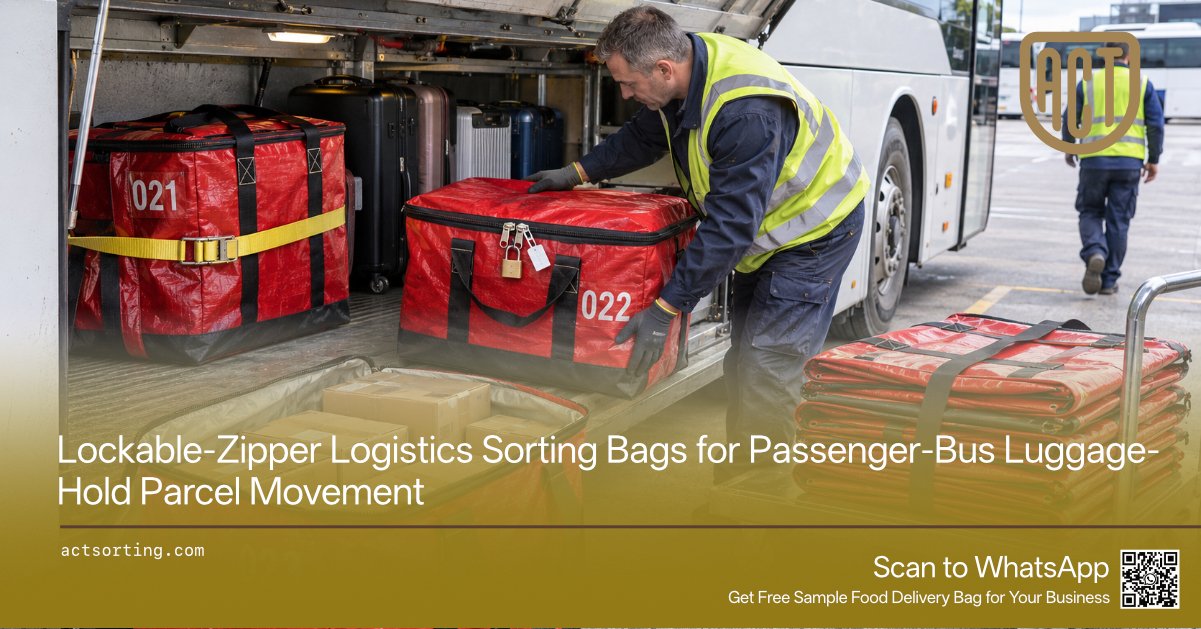
The useful unit is a large-volume bag that holds many small parcels together, can be opened wide at a stop, closed again, and lifted or slid in and out of a tight bay without spilling the load into passenger luggage. Logistics Sorting Bags built for that path follow one use cycle: depot sort into the bag → close the wide zipper and apply the lock or seal the route actually uses → load the filled unit into the luggage hold among mixed baggage → open and reclose at intermediate stops when the route requires it → unload at the destination apron → fold the empty bag so it does not occupy passenger luggage space on the return or at layover.
A filled bag also moves with the coach. Hard braking, tight turns, and rough road surfaces can make an unsecured unit slide, tip, or drift into passenger luggage and block the path to the hatch at the next stop. Keeping parcels inside a bag does not, by itself, keep that bag in place. How the unit is stowed against partitions, other luggage, or the straps, nets, and tie-down points already fitted in the coach—and how many filled bags the hold can carry without leaving a free mass—belongs in the same brief as outer size. Those loading limits are the operator’s vehicle and stowage rules, not a bag certification. No crash, braking, or restraint test figure is claimed here.
A warehouse tote photo will not show whether the same unit can be opened at a roadside hatch, marked for the operator, stowed with the fittings the coach already has, and folded out of the way on the return. Parcel Sorting Bags for this mixed-hold work need the zipper and seal interface, handle and bottom reinforcement, fleet marking, unique asset numbers, empty fold, and any strap-loop positions the buyer wants for existing tie-downs specified as one build. ACTSORTING develops reusable sorting equipment from those dimensions, materials, handling features, and identification details so a foldable lockable-zipper bag can be built for a passenger-bus hold.
Sizing Filled Bags from Luggage-Bay, Door, and Pack-Count Measurements
OEM size for this family is not a catalog litre figure and should not be copied from another fleet’s drawing. The starting measurements are the luggage bay itself: clear height under the floor or any intermediate shelf, width between bay walls or wheel-arch intrusions, depth from the hatch to the back wall, and the door or hatch opening in both height and width. Those four figures, taken with the bag oriented the way crews will actually insert it—long side first, short side first, or laid on a face—decide the maximum filled outer size that can enter and leave without jamming on the sill or the door header.
How many filled bags share one bay is an operations decision, not a manufacturer standard. The count depends on how much of the hold must remain free for passenger luggage, whether bags stand or lie, whether a later stop still needs a clear path to reach a bag at the back, and whether the remaining units can be stowed so they are less free to travel under braking or on a rough road. A relatively large body is useful because many small parcels can ride as one handling unit, but a bag that fills the hatch and leaves no residual space will block mixed luggage and slow every stop. Filled outer dimensions should be quoted in the closed-zipper state the bag will have in the bay, including handle protrusion and any bottom-reinforcement thickness. Interior usable volume is a second figure: zipper tape, internal webbing, and corner gussets all take space from the nominal outer box.
Stowage should be planned with the fittings already on the vehicle. If the hold has cargo straps, nets, or floor or wall tie-down points, the bag can include webbing loops or handle positions those fittings can actually reach; that match should be checked on the coach, because a loop that looks useful on a drawing may sit out of reach of a short strap. Bags can also be packed against a bulkhead or against other luggage so they have less room to slide. None of these measures should be treated as a certified cargo-restraint system unless the operator already has its own tested procedure. If a buyer has not asked for strap loops, they remain an option to discuss, not a default part of the build.
Photos of the open luggage bay and the hatch, with a measuring tape in frame, plus a note on bag orientation and how many filled units must share the compartment with passenger bags, give production a usable brief. ACTSORTING can develop Parcel Sorting Bags to those coach clearances. A size that enters a long-distance coach bay may still fail a smaller regional hatch, so a mixed fleet should approve one primary dimension set against the tightest door and bay that will actually carry the bag, then sample that size before rolling it across vehicle types. Folded pack size should be measured in the same exercise, because an empty return still has to fit the leftover bay niche or a depot trolley once passenger luggage reclaims the hold.
Laminated Woven Bodies: Water Shedding, Tear Resistance, and Real Limits
When a buyer asks for a waterproof, tear-resistant body, a laminated PP woven construction is a common industrial option to sample; it is not a locked material specification unless the inquiry already names it. The woven grid supplies tear resistance when the bag is pressed against suitcase corners, bay ribs, and hatch sills. The laminate or coating sheds rain and road spray on intact body panels, which matters on open aprons and in holds that take water through the hatch. If the buyer has already named a fabric, coating, or color, that requirement leads the sample; if not, material grade and face color remain choices to confirm in the brief.
The material has limits that belong in the brief. Coating scuffs under slide and rub; a worn face is not automatically a failed weave, but it does reduce water shedding on that panel and should be judged as a maintenance condition rather than assumed to last a stated number of seasons. The zipper remains a water path even when the body is laminated: teeth, zipper tape, and the stitch line that joins the zipper to the mouth can admit spray or standing moisture from a wet bay floor. Handle stitch holes and uncoated cut edges are additional paths. A laminated body therefore sheds water on the panels; it does not make the finished bag a sealed dry box.
Fabric weight, laminate thickness, and weave density change stiffness, fold bulk, and unit cost. A thicker coated face can resist scuffs longer on abrasive bay metal and will pack thicker when empty and feel stiffer in cold weather. A lighter body packs denser for return and will show floor scuffs sooner. For laminated woven Logistics Sorting Bags used in a luggage hold, useful inputs to ACTSORTING are apron weather exposure, whether bags sit in wet bays, and whether crews slide or lift the unit across the sill. Those conditions shape the material choice; they do not stand in for a service-life figure or a waterproof rating the buyer has not tested.
Wide Zipper Openings for Mid-Route Load and Unload
The wide opening is mouth geometry: a long top zipper, or a zipper that runs far enough along the mouth that crews can load and unload many small parcels quickly at a stop without digging through a narrow neck. That matters at a roadside hatch, where time is short and parcels must come out or go in without emptying the whole bag onto the apron. Dual sliders can help the mouth open from the center; a single long slider can also work if the run is clear and the stop end is easy to find with gloves. Those slider choices are about opening and closing the bag in the time a stop allows. Lockable pulls, padlocks, and seals are a separate interface and are taken up in the next section.
This opening style differs from a drawcord gather used on some sealed custody bags. A drawcord is efficient when the mouth is closed once for a short handoff and does not need to be opened and reclosed many times along a route. A zipper is the more practical mid-route interface when the same bag may be opened at several terminals or roadside stops and then closed again before the coach moves. That contrast is a handling habit, not a claim that one closure is universally stronger. When a buyer has specified a wide, lockable zipper, the wide opening and the lock provision are confirmed requirements; zipper length, tooth type, and single versus dual sliders still need to be fixed on the sample unless the inquiry already names them.
Zipper quality shows up in tape width, tooth type, the reinforced mouth panel the zipper is sewn to, and whether the stop ends are bartacked so the slider cannot tear off the tape. Limits are equally concrete. The zipper is a mechanical line: teeth can separate under a packed mouth, sliders wear, and dust or grit from bay floors can foul the track. A stuffed bag can also pull the mouth out of a straight line and make the slider harder to start. Sample evaluation should include packing the bag to a representative fill, closing the zipper under that fill, and cycling the slider with gloves on a dusty or slightly wet tape—the conditions of an apron hatch, not a clean table.
Zipper Locks, Tamper-Evident Seals, and Mid-Route Resealing
Lockable zipper hardware and a tamper-evident seal do different jobs. Lockable hardware is the slider arrangement that can accept a padlock or a lockable pull—typically two sliders whose pull holes can be brought together, or a single slider that can be locked at the closed end. A padlock slows casual opening for people who do not have the key or combination. A tamper-evident seal—typically a plastic or cable-style tie the operator already buys—is separate hardware. When it is correctly applied, the seal leaves a visible sign that the mouth was opened after it was sealed. That visible mark is not, by itself, a complete custody or handover record. Manifests, asset IDs, and the operator’s own stop procedure still have to be kept if the route needs a record of who opened the bag and when. Fitting a lockable zipper does not, by itself, create proven tamper evidence.
When a buyer specifies a security seal, that requirement should be written into the brief. The exact seal path is then a construction to validate on a sample, not a pre-set factory standard. A common arrangement, after the zipper is closed and the sliders meet, is for the seal strap—and, if a padlock is also used, the lock shackle—to pass through both pull holes, and sometimes through a sewn webbing loop or a small flap eyelet at the zipper terminal, so the sliders cannot be separated far enough to open the mouth without cutting the seal or opening the lock. A seal that only circles one loose pull, or a loop that sits too far from the closed sliders, can look tidy while still allowing the zipper to be run open.
Padlock and seal must also share the same closed-slider geometry when the route uses both at once. Pull-hole diameter, shackle thickness, seal-head size, and loop position have to leave a path for both fittings. A hole that takes the shackle with no remaining room for the seal strap, or a seal head that blocks the shackle, will force crews to skip one of the two devices at a hurried stop. Operators should send physical seal and lock samples—or precise shackle, head, and strap dimensions—with the bag RFQ so those holes and loops can be sized against the hardware already in use. Until that hardware is fitted and opened under glove conditions on a prototype mouth, the arrangement remains a design to validate, not a proven tamper-resistant system.
Mid-route stops add a further practical point. If a bag must be opened to add or remove parcels, the existing seal is broken and a new seal has to be applied before the coach leaves. The bag can provide the holes and loop; applying the new seal, and keeping any written or system note of that stop, is the operator’s procedure. ACTSORTING can match opening and closure details to the way the route is actually opened and closed. A useful luggage-hold brief for lockable Logistics Sorting Bags states whether a lock, a seal, or both are required, the geometry already in use, and whether bags must be reopened and resealed at intermediate stops.
Reinforced Handles and Bottoms for Bay-Floor Lifts and Slides
Luggage-hold bags are lifted from a platform or apron into a low hatch, slid across ribbed metal or worn plywood bay floors, pulled out at the next stop, and sometimes carried a short distance by two people. Handles therefore have to map to those moves, not to a single front-face lift. End or side handles help when the bag is inserted long-side first through a narrow door. Upper loops help a second person steady the top at the sill. Lower or mid-height grips help when the bag is started from the ground or from a trolley deck. Too few grips force one-sided lifts that twist the zipper mouth. Too many soft loops can snag on hatch hardware or on other luggage in a packed bay.
The bottom does different work from the handles. The wear face is the panel that slides on the bay floor, catches the hatch sill, and rubs against suitcase wheels. A reinforced or coated bottom, with extra stitch or a denser panel at the corners, is there to take that abrasion and to keep the load from punching through the base during a slide. That is a fixed wear surface, not a removable rigid board. A removable board—used in some standing depot bags so the textile can fold independently—is a different construction. In a moving luggage hold a loose board can shift under braking and become a second part to chase at a roadside stop; this build typically keeps a sewn or laminated reinforced bottom unless the buyer has a standing-depot reason to specify a board as a separate option.
Webbing width, stitch into reinforced panels, and bottom-panel thickness all add weight and fold bulk. A heavier base survives abrasive sills better and makes the empty pack thicker; a lighter base packs flatter and will show floor wear sooner. ACTSORTING lists handle layout and base reinforcement among the handling options for sorting-bag programs. For bus-bay fleets the brief should name the lifts and slides crews already use—hatch insertion, two-person apron carry, trolley transfer—and whether the bay floor is ribbed metal, wood, or wet painted steel. A request for stronger handles alone leaves those contact points unspecified.
High-Visibility Color and Operator Logo as Fleet Marking
Color, logo print, and unique bag numbers do different jobs and should not be collapsed into one branding line. When a buyer specifies a body color and an official operator logo, those are confirmed program requirements for that order. If color or artwork is not named in the inquiry, they remain choices to settle in the brief—not default specifications of this bag type. A high-visibility body color helps crews find the courier units quickly among dark passenger suitcases in a dim hold, and it can also mark a service class or priority family from the apron. Red is one common fleet or priority choice when a buyer asks for it; it is not a fixed ACTSORTING catalog color, and other operators may assign different hues to routes, service types, or return bags. Color, once specified, belongs in the same brief as webbing contrast, because a handle color that disappears against the body slows a gloved grab in mixed light.
When specified, the operator’s official logo, printed or applied as OEM marking, states ownership. At a shared terminal, that mark reduces casual mix-up with another company’s equipment and supports a passenger-facing courier service without covering the zipper, handles, or identification number with artwork. Artwork placement should remain readable when the bag lies on its side in the bay—the position it often takes—and should stay clear of the zipper path, handle anchors, and the unique-number zone. Print on a high-rub face (the bottom, or the side that slides along the bay wall) will wear faster; those faces are poor locations for a logo that must stay legible.
ACTSORTING includes custom branding and logo marking among identification options for Parcel Sorting Bags. Buyers who already have a color and logo should send the artwork, preferred placement on the filled and the lying bag, and the body color crews must recognize in the hold. Buyers who have not yet fixed those items can leave them open for advice on the sample. Color and logo do not replace unique asset numbers; those are a separate layer, and only when the buyer requires them. A color that is vivid on a sunny apron can flatten under a yellow bay lamp, and a logo that looks correct on a flat drawing can wrap into an unreadable curve once the bag is stuffed. Those checks belong on the handling sample, under the lighting the depot and the hold actually use.
Unique Bag Identification Numbers the Operator Controls
When a buyer requires a unique identification number on each bag, that number is a confirmed requirement, not an optional graphic. The number names one physical bag. Color, when specified, says which family or service the unit belongs to; the logo, when specified, says who owns it; the number says which asset left the depot, which asset was loaded into a particular hold, and which asset should come back. Without that third layer, bags that are swapped at a shared terminal, left at an intermediate stop, or mixed into another coach cannot be reconciled against a parcel manifest or against whatever seal and stop notes the operator keeps.
The manufacturer can print or sew the numbers as sequential codes or asset tags. A barcode or other scannable mark next to the human-readable ID is an optional addition only if the buyer asks for it; it should not be written into the build as if it were already specified. ACTSORTING can apply custom logo marking, unique numbers, and, when requested, individual barcodes. The numbering scheme itself belongs to the operator: prefix, digit length, whether codes are pure serials or also encode a depot or route, and how numbers are reserved for replacements. The factory’s job is to apply the agreed series accurately and to place the mark where it can be read in use.
Placement should work in more than one state. A number that sits only on the face against the bay wall is invisible when the bag is loaded; a number that disappears into a fold is useless on empty return. Marks on both a long side and a short end, or a mark that remains visible on the folded pack, make apron checks faster. The ID zone should not collide with the logo, the zipper terminal, or a handle stitch column. Buyers should send the numbering rules, the typography or tag format they already use, and photos of how bags sit in the hold so the mark lands on a visible face. A unique number does not, by itself, create a custody record; it becomes useful when manifests, depot checks, and any seal or stop notes the operator keeps all refer to the same asset ID.
Empty Fold So Unused Bags Do Not Fill the Return Bay
After unload, unused bags should not occupy the luggage hold as if they were still full. On a return trip or at layover, that bay is needed for passenger luggage, and a row of half-open mouths wastes the space the large-volume design just used on the outbound run. The empty state is a measured folded pack, often strapped or banded so it does not unfold under vibration, stacked at one end of the bay or returned on a depot trolley.
Fold action for a wide-zipper bag is a textile sequence, and the sample should prove it. A typical path is: unzip and confirm the bag is empty; flatten the long walls; fold or roll to a pack size the bay or shelf can hold; close or cover the zipper so the teeth are not crushed in the stack; apply a pack strap if the route needs it. Large bodies will not flatten as thin as a small sack; that is a direct tradeoff of choosing a volume that carries many parcels in one unit. The purchase file should state folded outer dimensions after the approved method, how many empty packs share a bay niche or a trolley, and whether empties travel on the same coach or back to the depot by another vehicle.
Permanent logo and unique ID should remain readable on the folded pack so return crews do not have to open every unit to see who owns it and which asset it is. ACTSORTING’s parcel sorting bag category includes foldable and reinforced constructions that can serve as a starting point when empty packs must share a luggage bay with returning passenger bags. For luggage-hold Logistics Sorting Bags, what matters commercially is the pack size after the signed fold, measured against remaining bay space and depot storage. A pack that only looks flat on a table but springs open on a bouncing bay floor has not passed the route. Validation should be photographed: empty open, mid-fold, and strapped pack, then a trial stack in the actual hatch or on the trolley the depot already uses.
What Buyers Should Send for a Bus Luggage-Hold Bag Build
Before asking ACTSORTING for a quote or sample on this luggage-hold build, it helps to separate what the inquiry has already confirmed from what is still open. If the buyer has already specified a wide lockable zipper, reinforced handles and bottom, a security seal, a body color and official logo, a unique number on each bag, and a foldable empty state, those items should be listed as confirmed requirements. Luggage-bay and hatch photographs with a measuring tape in frame, plus filled outer size or a note that size should be derived from those clearances, still have to accompany that list so the bag can be built to the coach. Photos of any straps, nets, or tie-down points in the hold, and a note on how many filled bags may share the bay with passenger luggage, allow stowage against existing fittings to be discussed without inventing a restraint rating.
Open choices should be marked as such. Material grade—for example laminated PP woven as a common option where water shedding and tear resistance are required—exact zipper length, single versus dual sliders, barcode next to the ID, and extra strap loops for the coach’s existing tie-downs should not be written as if they were already fixed. Physical seal and lock samples, or exact head, strap, and shackle dimensions, are needed when a lock, a seal, or both are required, including whether both must fit the same pull holes at once. Handle layout—or photos of hatch insertion, apron carries, and trolley moves—and bottom wear notes (bay floor material, slide versus lift) complete the handling brief. Expected load stated as a buyer requirement to discuss on the sample, and folded pack size or a remaining-bay packing target, complete the empty-return plan.
If some of those items are still open, ACTSORTING can advise on typical options for Logistics Sorting Bags and Parcel Sorting Bags—material and mouth styles, seal-loop and lock-hole placement, webbing maps, color and marking layouts, and fold methods—once the bay photos and use path are clear. Reference photos of the open hold and hatch, a size drawing, or an existing bag sample all shorten the path from RFQ to a handling sample. Environmental notes help too: wet aprons, dusty or ribbed bay floors, and the lighting under which color, logo, and ID must be read.
A practical next step is to send that package—or as much of it as is ready—to ACTSORTING and request a sample that is packed, zipped, fitted with the buyer’s specified lock and seal, lifted and slid through the real hatch, checked against the hold’s existing fittings, unloaded, and folded to the target pack size, then locked as the master for replenishment. When confirmed requirements and open options are listed separately, the sample can be judged against the real hatch, the real stowage method, and the real return pack.
FAQ
Q: Why use a lockable zipper rather than a drawcord for bags that ride in a bus luggage hold?
A: A wide zipper lets crews open and close the mouth at multiple terminals or roadside stops without fighting a gathered neck. A drawcord is often sufficient when a bag is closed once for a short custody move. For mid-route add-and-remove work, the zipper is the more practical opening; lockable sliders then give a place for the route’s padlock or seal. The choice is a handling habit, not a universal strength ranking.
Q: Does a lockable zipper already provide tamper evidence?
A: No. A lockable zipper lets sliders be joined with a padlock or lockable pull. A tamper-evident seal is separate hardware that, when applied, leaves a visible sign that the mouth was opened after sealing. That visible mark is not automatically a complete handover record. If a padlock and a seal are used together, pull holes and any sewn loop must leave room for both. The path must be fitted and tested with the buyer’s physical seal and lock on a prototype. Until that check is done, the interface is a design to validate, not a proven tamper-resistant system.
Q: How should bag size be chosen for a passenger-bus luggage compartment?
A: Measure bay height, width, depth, and hatch opening, then set filled outer size in the closed-zipper state so the bag can enter, leave, and still leave room for passenger luggage. Decide how many filled bags share one bay as an operations choice. Do not start from a generic catalog litre figure. Multi-fleet operators should lock size against the tightest recurring hatch and bay. Folded pack size should be measured on the signed sample.
Q: What is the difference between body color, operator logo, and a unique bag ID?
A: When specified, color helps crews find a service family among mixed luggage and can mark priority or route class, and the logo states ownership. When the buyer requires a unique number, that number identifies one physical asset for manifests, return checks, and any seal or stop notes the operator keeps. The operator owns the numbering scheme; the manufacturer can print or sew the agreed series and add a barcode only if asked. These marks should not cover one another or the zipper terminal, and unspecified items should stay listed as open options, not as already fixed specifications.
Q: What information helps ACTSORTING quote this bus luggage-hold bag configuration?
A: List confirmed requirements separately from open choices. Send bay and hatch photos with a tape in frame, notes on existing straps or tie-downs and pack count, filled size or a request to derive it, zipper and lock type, seal samples or dimensions (including whether lock and seal must share the same holes), handle and bottom-wear notes, and, where already specified, body color, logo artwork, unique-ID rules, foldable empty-state needs, expected load as a requirement to discuss, and folded packing targets. If parts of that list are still open, ACTSORTING can advise once the use path is clear. Photos, drawings, or an existing sample all support a sampleable OEM brief for logistics and parcel sorting bags.