

Table of Contents
- Route and Transfer Groups Have to Leave the Warehouse Floor as One Unit
- Open-Top Loading and a Structure That Folds When Empty
- How Buyers Specify Length, Width, Height, Filled Mouth, and Empty Fold
- Carry Straps and Side or Lower Lift Points for Real Handling
- Side Label and Barcode Pockets That Identify the Group
- Unlined Woven Totes and a Thermal Inner Lining as a Specification Choice
- A Plain Exterior or a One-Color Custom Logo
- Polypropylene Woven Bodies, Reinforced Bases, and Buyer-Specified Coatings
- Samples, Production Timing, and a Freight Estimate to Europe
- What Buyers Should Send for a Foldable Open-Top Tote Specification
Route and Transfer Groups Have to Leave the Warehouse Floor as One Unit
A warehouse or courier hub rarely finishes its work when the last item is scanned. After the sort, a route, a store delivery, or a transfer group has to stay together, move from the floor to the dock, go onto a vehicle, and arrive at the receiving point as the same group. When that group breaks apart on the floor, on a cart, or inside the van, staff spend the next stretch restacking a decision the sort already made.
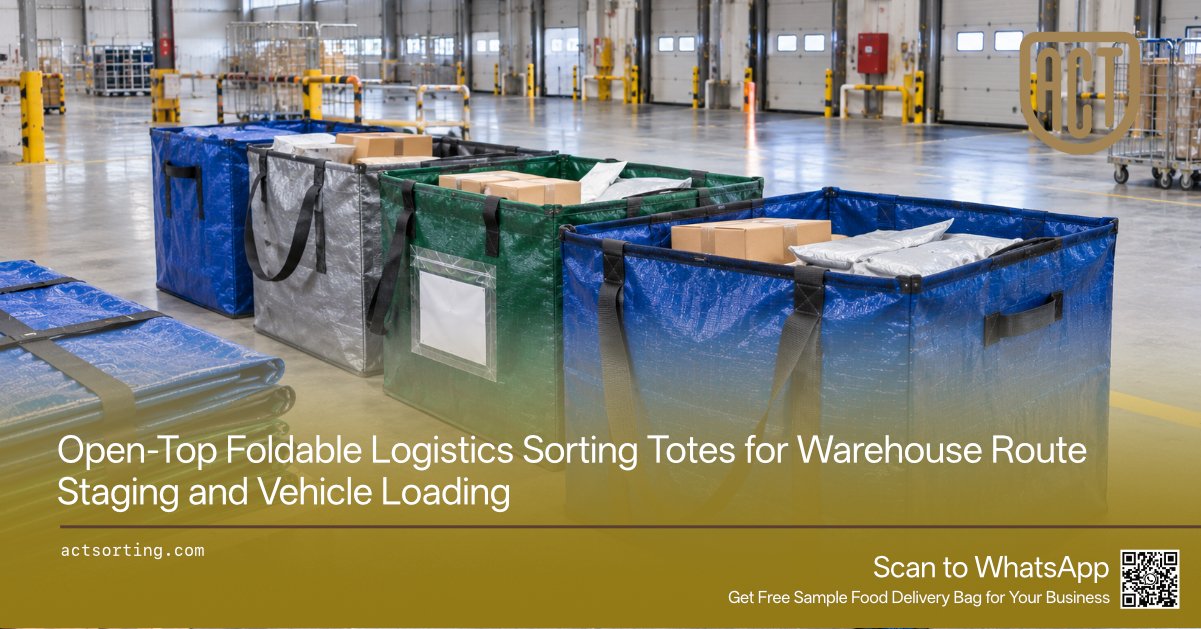
A foldable open-top logistics sorting tote is a reusable handling unit for that movement. It stands on the staging floor while cartons, poly mailers, and mixed pieces are placed into it, then it is carried or lifted toward the vehicle, and it is emptied or handed on at the other end. The tote is not a conveyor, a roll cage, or a rigid plastic bin. It is a textile container that can be loaded quickly, identified from the outside, and folded down once it is empty so the return trip does not haul the same volume of unused space.
Foldable logistics sorting bags of this kind are used in warehouses, courier hubs, and fulfillment operations, including as warehouse transfer totes for route staging and vehicle loading. The decisions that actually change the unit are practical ones: how the tote is carried, how the group is marked, whether the body stays unlined or is specified with a thermal inner lining, and whether the exterior stays plain or carries a one-color logo. Those choices belong to the same path, from the warehouse floor onto the vehicle and on to the receiving point.
Open-Top Loading and a Structure That Folds When Empty
Open-top sorting totes keep the mouth clear so staff can keep placing items into the bag without working a zipper, flap, or lid between pieces. Beside a scanning station or in a staging lane, that uninterrupted access is the point of the shape. Whether the same tote is suitable for a vehicle ride depends on more than the open mouth. The expected full-load weight, the actual loading height, and whether the goods stay at or below the mouth all have to be considered before the unit leaves the floor. Pieces that stand above the rim can shift or fall in a tight van; they have to be loaded so they remain inside the opening. The open mouth also leaves the load more visible and more exposed to the air around it. If the operation needs a secured close during travel, an open-top tote is the wrong starting structure.
Once the tote is emptied, the same construction should fold into a flatter form for backhaul, a return stack, or seasonal storage. How compact that fold is depends on the body, the base, and any internal support. It is not a general property of every open-top bag. A body that holds a usable rectangular opening is helpful at the sort. A firmer base panel or a heavier lower section can make that stance easier, and can also make the empty fold thicker. The operation has to live with both ends of that compromise: a tote that collapses inward during loading is hard to fill, and a tote that will not flatten after the drop wastes space on the way back.
Loaded totes have no fork openings of their own. Where a group has to move as a floor unit, the totes can be placed on a pallet and moved with the warehouse’s usual handling equipment. That is a placement choice, not a claim that the bag itself is a palletized container. On the vehicle, how the filled tote is stood, stacked, or set against a wall, and how it is held there, is a loading decision that uses the vehicle’s own space and restraint methods—shelves, cages, walls, or vehicle straps. The textile bag does not itself restrain the cargo and does not replace those methods. The fold still matters after that ride, because the empty units have to come back in a smaller stack than they occupied when they were full.
How Buyers Specify Length, Width, Height, Filled Mouth, and Empty Fold
Buyers usually start with three outside dimensions: length, width, and height. Those figures only mean something when they are tied to where the tote will stand and what it will hold. A tote that is too long for a van wall or a staging slot will be turned or stacked in ways the handles were not planned for. A tote that is too short leaves mixed pieces hanging over the mouth or forces a second container for the same group. Height should be read against the tallest regular item, the intended loading height, and the space above the floor, the shelf, or the vehicle floor, not as a capacity slogan. The expected full-load weight belongs in the same brief, because a dimension that fits an empty outline can still be impractical once the tote is filled to the weight the route actually carries.
Two further measurements are easy to leave out and then costly to discover in use. The filled mouth is the opening as it behaves when the tote is loaded—whether the top stays usable, whether the walls fall inward, and whether staff can still add or remove the last pieces without fighting the fabric. If goods would sit above the mouth at the planned fill, that is a loading-height problem to resolve in the specification, not something the open top will correct in the vehicle. The empty fold is the packed size after the tote is emptied: the height of a stack of empties, or the space they take on a return pallet. A sample, or a photograph of a current bag in both states, tells more than a single unused outline.
Approximate dimensions are enough to open a discussion, together with a note on the vehicle, the rack, or the floor position the tote has to fit, and how the filled unit will be placed and held on the vehicle. Listed open-top totes from ACTSORTING are described with customizable size; the right figures still come from the operation, not from copying a catalog rectangle onto a different van or a different sort lane. What should be written down is the working envelope—length, width, height, the mouth when filled, the intended loading height, the expected full-load weight, and the fold when empty—so the first sample is already close to the slot and the ride it has to occupy.
Carry Straps and Side or Lower Lift Points for Real Handling
A tote in this role is lifted, pulled, turned, and sometimes carried for a short walk. The handling layout has to match those motions. Extended carry straps on an open-top foldable parcel sorting tote give staff a longer grip for a two-handed carry or a controlled lift when the aisle is clear. Side handles, or lower lift points, are more useful when the tote is sitting on the floor, standing against a van wall, or packed tightly beside other units, because the upper straps may not be where a hand can reach.
The arrangement is a handling specification the buyer can send, not a single catalog pattern that already covers every combination of top straps and lower grips. Some operations want long straps and a pair of side handles. Others mainly pull the tote a short distance and care more about side or lower points. What matters is that the webbing is attached where the load actually travels through the body, and that staff are not forced to pinch a raw top edge because the only handles disappear once the tote is full and sitting down.
Long straps have a limit. In a narrow vehicle or a crowded staging lane they can hang, catch, or get trapped under the next tote. Short side pulls avoid that, but they are a poor substitute for a carry across a yard or down a dock. Lower lift points help a second person share the load, or help someone start a tote off the floor; they do not replace a carry path if the tote is routinely walked to the vehicle. A short note on how the tote is actually moved—carried, pulled, lifted by two people, or placed on a pallet—gives the strap and handle layout something definite to be built around. The handles should then be tried on a sample under a representative load, using the expected full-load weight or a controlled test load of that order, not only on an empty tote. That trial shows whether the webbing, the attachments, and the grip still work when the tote is full. It is a handling check, not a published load rating, and it does not mean the bag will restrain the goods once the tote is on the vehicle.
Side Label and Barcode Pockets That Identify the Group
Once several similar totes stand in a lane, the group inside each one is invisible. A side label pocket, or a clear window for a route card or a barcode label, is how staff read the destination, the store, the wave, or the return category without opening the tote. A blue structured parcel sorting tote with transparent route label pockets already uses this kind of identification area. The pocket is a visible holder for a card or a label. It is not a warehouse management system, and a printed barcode is only useful if the operation already reads that kind of mark.
Placement is as important as the pocket itself. A window on the face that staff see when the tote is in the lane will be used. A pocket on a panel that sits against a van wall, or under a strap, will be ignored, and people will start writing on the fabric. The card has to stay in during a lift and a vehicle ride. If the pocket is too shallow, or opens in the direction of travel, the identifier is often the first thing that goes missing.
Body color can also separate routes or zones at a distance, and a logo, if one is specified, can mark ownership. Those marks work together with the pocket; they do not replace a changeable route card when the same tote will serve a different group the next day. The buyer can send a preferred pocket size and position, and say whether the identifier is a paper insert, a barcode label, or both, so the window is built for the mark that will actually be used in the lane.
Unlined Woven Totes and a Thermal Inner Lining as a Specification Choice
An unlined polypropylene woven tote is a handling and transport unit. It keeps a route or transfer group together, takes the wear of the floor and the vehicle, and folds when it is empty. It is not a temperature-control device. For ordinary parcels, packed goods, and transfers that do not depend on a held product temperature, that is the appropriate construction.
A thermal inner lining, including an aluminum or foil lining, can be raised as a specification option when the buyer wants the tote itself to offer some resistance to heat transfer while the load sits in warmer air—for example, during a short wait on a dock or a ride in an unrefrigerated compartment. An aluminum foil lining is not, by itself, a complete insulated structure. On an open-top tote the mouth stays open, so the load continues to exchange heat with the air around it. Adding a foil lining to an ordinary open-top sorting bag does not make that bag a complete insulated transport bag. A light-colored interior fabric, where one is used on a tote, is an inner face of the bag. It is not a thermal foil lining and should not be read as one.
If the operation does have a temperature-control requirement, the discussion has to go further than lining alone: whether the top needs a cover or another form of closure, what insulation materials would be combined in the body, and how temperature performance will be checked. A lined open-top tote still does not replace a cold room, a refrigerated vehicle, or an insulated pallet or roll cage cover. Those covers are a different product, built to jacket a pallet or a cage. Constructions used on covers should not be copied across and treated as bag linings. A lining, if specified, may also change how the tote folds, how it is cleaned, and how much it weighs.
Fit check and temperature check. Two checks should be kept apart. A size and handling check confirms that the tote fits the slot, that the mouth works when filled, that the handles lift as planned under a representative load, and that the empty tote folds in an acceptable way. That check does not answer how product temperature behaves. A temperature-performance check, used when temperature control is being considered, should be judged against the buyer’s specified product temperature requirement, the agreed measurement method, and the actual transport conditions—the interval, the ambient path, and the dock or vehicle the tote will use. Recording only that a lined tote and an unlined tote changed temperature by different amounts is not enough. Where a comparison is needed, both sides should use a controlled test load so the starting condition is the same. The trial still records the initial product temperature, the ambient temperature, the exposure duration, and the product temperature change, and those results are read against the stated requirement. They come from the operator’s own trial. They are not a catalog hold time, and they should not be replaced by a generic figure.
A Plain Exterior or a One-Color Custom Logo
Many logistics programs run unmarked totes and identify the group only with a pocket card or a body color. A plain exterior is simpler to move between routes, contract accounts, or shared pools, because the bag itself is not tied to one brand face. It also avoids a print decision before the operation has settled on a mark, a position, or a color.
A one-color custom logo is a common next step when the buyer wants the tote to show who owns it, to encourage return, or to be recognizable on a third-party dock. Logo printing is a real customization option on ACTSORTING open-top totes and is described on the product pages as available, together with color and size. The useful brief is modest: one color, a clear artwork file, and a preferred position that does not sit under a strap or inside a label window. Print-process lists and palette ranges do not need to be settled in the first message. The artwork and the position matter more than a catalog of methods.
A logo is also a commitment. Once it is on the bag, that tote is less anonymous in a shared fleet, which is often the point, and less flexible if the same stock is later used for another account. Placement should be chosen so the mark remains readable after ordinary warehouse handling, but a logo does not strengthen the body and does not replace a label pocket. If the program is still deciding between a plain pool and custom logo logistics totes, a sample of each face—or a plain sample plus the artwork—gives a clearer discussion than a long print specification written in advance.
Polypropylene Woven Bodies, Reinforced Bases, and Buyer-Specified Coatings
The listed open-top sorting totes in the ACTSORTING range are made from polypropylene woven fabric. That is the real product line for this job: a woven body that can take repeated loading, hold a more usable rectangular form than a loose sack, and accept changes in color, size, handle layout, and identification areas. A tall open-top logistics sorting bag with a reinforced base shows how a darker or heavier lower section is used on the area that meets the floor, the van, and the dock. The reinforcement is there because that zone takes the abrasion. It is not a published load rating, and it does not turn the tote into a rigid crate.
Buyers sometimes send a further material request: a coated exterior, or a high-visibility color, for wet docks, dim yards, or easier spotting in a crowded lane. A coating, if specified, should be discussed for the conditions it is meant to meet. It can add weight, change how the fabric folds, and alter how scuffs show. It should not be assumed as a waterproof guarantee or as a substitute for ordinary care on a wet dock.
The lower reinforcement and the woven body pull in slightly different directions when the tote is emptied. A stronger base protects the floor-contact area and can help the loaded tote sit more firmly. The same structure can make the empty fold a little bulkier than a light, unstructured sack. The buyer can say whether the tote will live mostly on clean staging floors, on rougher yards, or inside vehicles, so the base and the fabric can be balanced against that wear—and against the need to send empties back in a compact stack.
Samples, Production Timing, and a Freight Estimate to Europe
A sample is the practical way to test the decisions already described. It is used to check the outside dimensions against the slot or the vehicle, to see how the mouth behaves at the intended loading height, to try the straps and the side or lower lift points under a representative load, to confirm that a label pocket sits where staff will actually look, and, if a logo is planned, to review the print position on a real panel. If a thermal inner lining or a broader temperature-control construction has been specified, the sample is also the unit on which a temperature-performance check can be run, judged against the buyer’s temperature requirement, the agreed measurement method, and the actual transport conditions, with a controlled test load when a comparison is needed.
Those two uses of a sample should not be collapsed into one. A sample that only proves it can be folded and carried is not a temperature result. A temperature trial is not a substitute for a handling trial. If only one of those questions is open, the sample plan can follow that question. If both are open, both checks still need to be done.
Sample freight and production freight need different information. A sample shipment is usually a small parcel or a few units sent for trial, so the brief is the packed size and weight of that sample, the destination, and the scope of the quote for the sample only. A freight estimate for a production quantity is a separate request. It needs the packed volume after the empty totes are folded, the packed weight, how many units are packed in a carton or in a shipment, the purchase quantity, the destination, and the range the quote is meant to cover. A thermal inner lining or a reinforced base can make the empty fold thicker and change how many units pack in the same space; those construction choices belong in the freight brief because they affect packed volume. They do not produce a fixed loading count or a fixed saving. A reference freight estimate to Europe can be discussed once those packed details and a destination are known. Production timing likewise follows the confirmed specification, including any lining, print, handle layout, and the production quantity. Those items belong in the inquiry; they are not catalog constants. Photographs of the current container, or a physical sample the buyer already uses, still shorten the gap between a written dimension and the way the tote will be handled on the floor.
What Buyers Should Send for a Foldable Open-Top Tote Specification
A useful specification starts with the movement, not with a part number. The buyer can send photographs of the current bag or container, or a sample if one exists, and a short note on where the tote will be filled, how it travels, and where it is emptied. Approximate length, width, and height are enough to begin, together with the intended loading height, the expected full-load weight, any constraint from a vehicle, a rack, or a floor position, how the filled tote will be placed and held on the vehicle, and a word on how compact the empty fold needs to be.
The brief should also state whether the tote is to remain unlined, or whether a thermal inner lining is being requested, and if so, what goods it will carry and how long the tote is expected to sit in warmer air. If the operation has a temperature-control requirement, that should be said plainly, including the product temperature requirement, the preferred measurement method, and whether a top cover or a combination of insulation materials is being considered. That information opens a construction discussion and, if a sample goes ahead, a temperature check against those conditions. It does not require a claimed hold time. Handle layout and the position of a label or barcode pocket should be described as they will be used in the lane and in the vehicle. The exterior can be left plain or specified with a one-color logo, with artwork attached when a mark is required.
If a sample is needed first, that should be said at the outset, including whether sample freight should be quoted separately. Production timing and a freight estimate to Europe can be taken up once packed volume after folding, packed weight, packing quantity, purchase quantity, and destination are known. These details can be sent through the ACTSORTING contact page, with the product type and the operating conditions attached, so the conversation starts from the actual route or transfer group rather than from a generic bag outline.
FAQ
Q: Does a thermal inner lining turn an open-top tote into a complete insulated transport bag?
A: No. An aluminum foil lining is not, by itself, a complete insulated structure, and an open mouth continues to exchange heat with the air around the load. Adding a foil lining to an ordinary open-top sorting bag does not make that bag a complete insulated transport bag. If the operation has a temperature-control requirement, the discussion should also cover a top cover or closure, the insulation materials to be combined, and a temperature-performance check judged against the buyer’s specified product temperature requirement, the agreed measurement method, and the actual transport conditions. Where a comparison is needed, it should use a controlled test load. A lining, if specified, still does not replace a cold room, a refrigerated vehicle, or an insulated pallet or roll cage cover.
Q: Should a logistics sorting tote be ordered plain or with a one-color logo?
A: Either is a workable choice, and the difference is operational rather than structural. A plain exterior is easier to move across routes or shared pools because the bag is not tied to one brand face. A one-color custom logo can show ownership, support return, and make the tote recognizable on a third-party dock. The logo does not replace a changeable route card in a label pocket, and it does not need a long print-process list in the first brief—artwork, one color, and a clear position are enough to start.
Q: Which dimensions matter besides length, width, and height?
A: The filled mouth, the intended loading height, the expected full-load weight, and the empty fold. Length, width, and height describe the unused outline and should be read against the vehicle, the rack, or the floor slot. The filled mouth describes whether the opening stays usable once the tote is loaded. The intended loading height and the filled weight describe whether the goods will stay inside the mouth and whether the tote is practical to move. The empty fold describes how much space the tote occupies on the return trip. Approximate figures, plus a photograph or a current sample in both states, are more useful than a single unused measurement.
Q: How should carry straps and side or lower lift points be chosen?
A: From the way the tote is actually moved. Extended carry straps help when staff need a longer grip for a carry or a controlled lift in an open aisle. Side handles or lower lift points help when the tote is on the floor, against a van wall, or packed beside other units. Long straps can catch in a tight vehicle; short side pulls are a poor substitute for a longer carry. A note on whether the tote is carried, pulled, lifted by two people, or placed on a pallet is enough to shape the layout. The handles should then be tried on a sample under a representative load, not only on an empty tote. That trial is a handling check, not a published load rating, and it does not mean the bag will restrain the goods in the vehicle.
Q: When can a sample, production timing, and a freight estimate to Europe be discussed?
A: A sample can be discussed as soon as the main construction choices are on the table—dimensions, unlined or lined body, handle and pocket layout, and plain or one-color exterior—because the sample is how those choices are checked in the hand. Sample freight and a production freight estimate need different information. The sample quote depends on the packed size and weight of the trial units, the destination, and the scope of that sample shipment. A reference freight estimate to Europe for a production quantity needs the packed volume after folding, the packed weight, packing quantity, purchase quantity, the destination, and the range the quote should cover. A lining or a reinforced base can change fold thickness and packed quantity, so those choices belong in the brief. Production timing can be discussed once the specification and quantity are known. No single catalog figure can stand in for those details.