

Table of Contents
- Why Do Parcel Warehouses Struggle During Peak Season?
- How Can Parcel Delivery Bags Create Flexible Sorting Capacity?
- Why Are Parcel Sorting Sacks Useful During Sudden Volume Spikes?
- How Do Last-Mile Delivery Totes Help Drivers Leave Faster?
- Why Does Color Coding Matter During Black Friday and Holiday Peaks?
- How Can Foldable Courier Sorting Totes Save Space After Peak Season?
- Why Do Van Loading Totes Matter When Delivery Fleets Are Under Pressure?
- How Does OEM & ODM Customization Support Seasonal Logistics Programs?
- What Should Procurement Teams Check Before Placing a Large Peak-Season Order?
- How Can ACTSORTING Support High-Volume Logistics Projects?
Introduction
Peak season always looks manageable on a spreadsheet.
Then the parcels arrive.
A warehouse that normally handles 20,000 shipments a day suddenly needs to process 35,000, 50,000, or even more. Temporary workers join the shift. Extra delivery vans appear outside the loading dock. Sorting lanes overflow. Route staging areas become crowded. Empty floor space somehow disappears before 8 a.m.
This is what Black Friday, Prime Day, Christmas shopping, major promotional events, and regional e-commerce campaigns can do to a logistics operation.
The problem is not simply that there are more parcels. The real problem is that every weak point in the warehouse becomes more visible when volume rises. Poor route identification creates more sorting errors. Weak bags fail faster. Loading zones become congested. Drivers spend longer finding their parcels. Temporary workers need more guidance. Equipment shortages suddenly become operational emergencies.
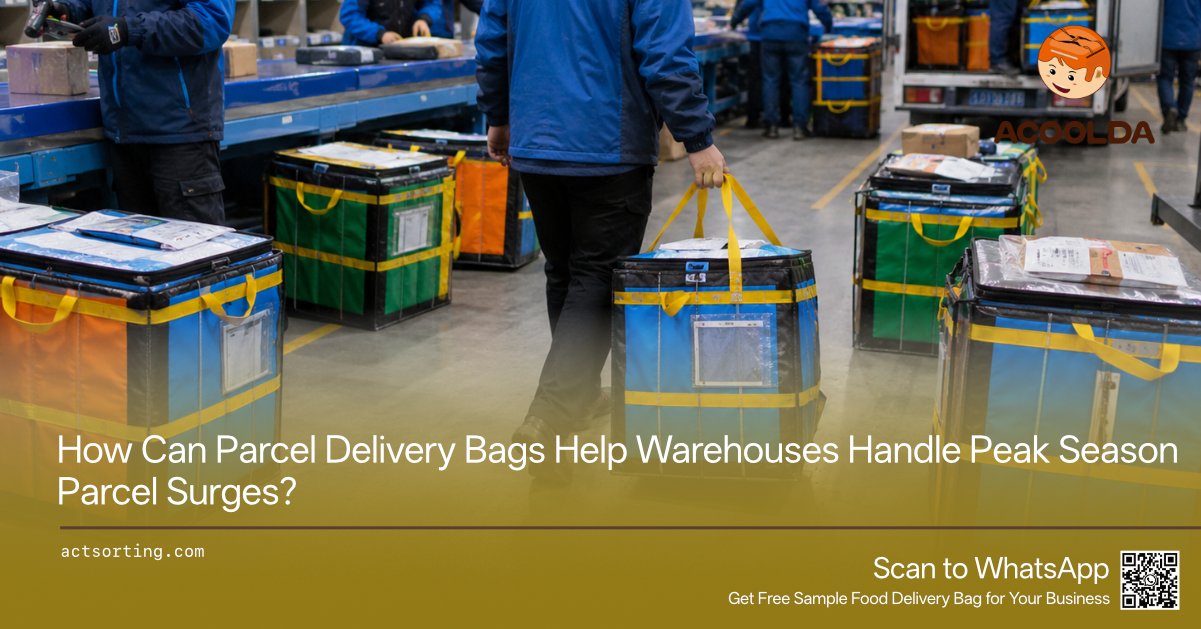
A well-designed Parcel Delivery Bag helps create flexible sorting capacity without requiring permanent changes to the warehouse. Parcel Sorting Sacks can divide packages by route, region, driver, dispatch wave, or service level. Last-Mile Delivery Totes help prepare parcels before van loading. Courier Sorting Totes simplify temporary staging areas. Van Loading Totes keep delivery vehicles more organized when route volume is unusually high.
ACTSORTING has manufactured industrial logistics bags since 2013. From a 12,000+ square meter factory in Yangchun, Guangdong, China, supported by more than 400 skilled workers, the company supplies Parcel Delivery Bags, Parcel Sorting Sacks, Last-Mile Delivery Totes, Courier Sorting Totes, Van Loading Totes, and DSP Delivery Supplies to parcel delivery companies, e-commerce fulfillment centers, warehouse operators, courier fleets, and large distribution networks across Europe and North America.
With BSCI and ISO9001 certification, ACTSORTING supports complete OEM & ODM customization, including fabric materials, dimensions, colors, logo printing, transparent label holders, closure systems, handle positions, reinforced bottoms, webbing layouts, and bulk production planning.
During peak season, the goal is not to make the warehouse look perfect.
The goal is to keep parcels moving.
1. Why Do Parcel Warehouses Struggle During Peak Season?
Most warehouses are designed around normal operating volume.
That makes sense. Building permanent capacity for the busiest seven days of the year would be expensive, inefficient, and slightly ridiculous. The problem comes when daily parcel volume rises suddenly and every existing process is forced to handle more than usual.
The first pressure point is usually sorting space.
Parcels arrive faster than workers can move them. Existing cages, bins, shelves, and staging areas fill up. Packages begin waiting on carts or floors. Temporary sorting zones appear in places that were never originally designed for sorting.
Then identification becomes harder.
More routes mean more labels. More temporary workers mean less familiarity with warehouse systems. More delivery vans mean more chances to place the wrong parcels in the wrong loading lane.
A single Parcel Delivery Bag may not sound important in this situation, but hundreds or thousands of properly designed bags can create temporary sorting capacity very quickly.
Instead of leaving loose parcels scattered across staging areas, workers can place them into labeled Parcel Sorting Sacks according to route, delivery zone, driver, vehicle, dispatch wave, or parcel category. Each bag becomes a portable sorting unit.
This matters during peak season because flexibility becomes more valuable than permanent infrastructure.
A warehouse can deploy additional Courier Sorting Totes within minutes. New sorting zones can be created without installing new shelving. Extra route groups can be separated physically. Bags can move between sorting areas, loading bays, vans, and return zones as needed.
ACTSORTING designs Parcel Delivery Bags for repeated commercial use. Heavy-duty woven materials help resist tearing. Reinforced handles support dragging and lifting. Transparent label pockets improve route identification. Foldable construction allows bags to be stored efficiently after demand falls.
Peak season creates chaos because everything moves faster.
The right equipment does not eliminate that pressure, but it gives workers a clearer structure to work with.
And during a volume surge, structure is often what prevents a busy warehouse from turning into a parcel-themed archaeological site.
2. How Can Parcel Delivery Bags Create Flexible Sorting Capacity?
Permanent sorting infrastructure is expensive.
Conveyor systems, fixed shelving, automated equipment, and warehouse expansion all require significant investment. They are useful when parcel volume remains consistently high, but seasonal peaks create a different problem.
The warehouse may need more capacity for four weeks, two weeks, or even several days.
This is where Parcel Delivery Bags become extremely practical.
A large Parcel Delivery Bag can be placed almost anywhere inside a warehouse. It can create a temporary sorting point beside a conveyor line, near a van loading lane, inside a staging zone, or next to a return processing area.
Workers can assign each bag to a specific route or parcel category. Once full, the entire unit can be moved without individually handling every parcel again.
For example, imagine a regional delivery station that normally operates 60 routes but temporarily increases to 85 routes during Christmas season.
Without additional sorting equipment, parcels for those extra routes may become difficult to organize.
By deploying extra Parcel Sorting Sacks with visible route cards, the warehouse can create 25 new route groups immediately. No new shelving installation. No construction. No complicated equipment deployment.
This is one reason Parcel Sorting Sacks are widely used by parcel delivery companies, courier networks, Amazon DSP-style operations, and e-commerce fulfillment centers.
ACTSORTING can customize transparent label holders so workers can insert route numbers, driver IDs, barcode sheets, delivery zone cards, or dispatch instructions. Colors can also be customized so different service levels or delivery waves are easier to recognize.
For example, blue Courier Sorting Totes might represent standard delivery. Red bags might indicate priority routes. Yellow Last-Mile Delivery Totes could identify same-day delivery. Green bags could be reserved for returns.
Simple visual systems become especially valuable when temporary workers join during peak season. They may not know the full warehouse layout, but they can quickly understand clear colors and labels.
A Parcel Delivery Bag is simple equipment.
That simplicity is exactly why it works so well during temporary volume spikes.
3. Why Are Parcel Sorting Sacks Useful During Sudden Volume Spikes?
Sudden volume spikes are different from predictable seasonal growth.
Sometimes a retailer launches a promotion that performs better than expected. Sometimes a major marketplace campaign creates a surge. Sometimes bad weather delays parcels for one or two days, and then everything arrives at once.
The warehouse has little time to prepare.
Parcel Sorting Sacks provide immediate flexibility.
They can be brought into active areas quickly, filled directly from conveyor lines, moved to temporary staging zones, and loaded into vehicles without requiring complex setup.
The most important advantage is physical separation.
When parcel volume rises suddenly, mixed packages become dangerous. Wrong-route parcels are harder to detect. Workers rush. Scanning queues grow. Staging lanes overflow.
A dedicated Parcel Sorting Sack gives each route or category its own physical boundary.
This sounds basic, but basic systems often survive operational stress better than complicated ones.
ACTSORTING manufactures Parcel Sorting Sacks using durable woven materials suitable for frequent warehouse use. Customers can select different fabric specifications depending on expected weight, friction level, and handling frequency.
Reinforced bottoms are available for operations where bags are dragged across concrete floors. Strong webbing handles support lifting and pulling. Optional zipper, hook-and-loop, flap, or open-top closures allow customers to choose between speed and security.
Transparent label pockets can be customized according to actual documentation size. Some warehouses need small route cards. Others use larger barcode sheets or A4-style documents.
Size customization is also important.
A warehouse handling small fashion parcels may prefer taller, lighter bags. A courier depot dealing with mixed boxes may need wider Parcel Delivery Bags with stronger bottom reinforcement. A last-mile station may need totes sized specifically for delivery van shelves.
ACTSORTING supports all of these requirements through OEM & ODM manufacturing.
The result is not simply a larger bag.
It is a temporary piece of warehouse infrastructure made from fabric.
4. How Do Last-Mile Delivery Totes Help Drivers Leave Faster?
Peak season does not stop at the warehouse door.
Drivers feel the pressure too.
More parcels mean fuller vans, longer routes, tighter schedules, and more opportunities for loading mistakes.
A driver may normally complete 80 stops but suddenly face 110 or 130. Under these conditions, poor parcel organization becomes expensive very quickly.
If the driver has to search through loose boxes at every stop, seconds disappear constantly.
Last-Mile Delivery Totes help group parcels into smaller delivery units before the van leaves.
Each tote can represent a neighborhood, route segment, building cluster, delivery sequence, postcode area, or stop range.
Instead of loading hundreds of loose parcels into one vehicle, workers load organized groups.
This makes it easier for drivers to understand the van layout.
The first-route Last-Mile Delivery Totes can be placed near the door. Later-route bags can be positioned deeper inside the vehicle. Return parcels can have their own dedicated tote. Priority shipments can be separated clearly.
ACTSORTING can customize bag dimensions according to van layout and shelf height.
This is important because delivery vehicles vary widely. A small urban van in Paris does not have the same internal space as a larger suburban delivery vehicle in Texas. A tote designed for one fleet may waste space in another.
Handle placement can also be customized. Some drivers need side handles for pulling bags from shelves. Others prefer top webbing for lifting. Certain operations need additional lower straps so heavily loaded totes can be moved by two workers.
The closure system matters as well.
Open-top totes support very fast access. Hook-and-loop closures allow repeated opening. Zippers offer more containment during transportation.
ACTSORTING can adjust these details based on real route conditions.
During peak season, drivers already have enough problems.
They do not need to spend their morning fighting a badly organized van too.
5. Why Does Color Coding Matter During Black Friday and Holiday Peaks?
Color coding is one of the simplest warehouse systems available.
That may be exactly why it works.
During normal operations, experienced warehouse staff may remember route numbers, loading lanes, service categories, and dispatch waves without much difficulty.
Peak season changes the workforce.
Temporary workers arrive. Extra drivers join. Supervisors manage larger teams. New staging areas appear. People are moved between shifts.
Suddenly, not everyone knows the system.
Color-coded Parcel Delivery Bags make information visible immediately.
For example, a warehouse might use:
Blue Parcel Sorting Sacks for standard delivery routes.
Red Courier Sorting Totes for urgent or priority shipments.
Yellow Van Loading Totes for same-day dispatch.
Green Last-Mile Delivery Totes for returns.
Gray bags for failed delivery parcels.
This reduces dependence on memory.
Workers do not need to read every small label before understanding the general category.
ACTSORTING supports color customization for large-volume orders. Customers can select colors based on warehouse systems, route structures, service levels, brand identity, or regional operations.
Logo printing can also be added.
For large courier companies and e-commerce delivery networks, branded Parcel Delivery Bags create a more consistent appearance across multiple stations.
Transparent label holders work together with color coding.
The color gives workers the broad category. The label provides specific information such as route number, driver ID, van number, barcode, date, or dispatch wave.
This combination is particularly useful during Black Friday and holiday sales, when warehouses process unusually high parcel volumes and mistakes become more expensive.
The goal is not to make the warehouse colorful for entertainment.
It is to reduce the number of decisions workers need to make every minute.
Human brains are already doing enough during peak season. There is no reason to make them decode forty nearly identical black bags before breakfast.
6. How Can Foldable Courier Sorting Totes Save Space After Peak Season?
Peak season eventually ends.
The parcels slow down. Temporary workers leave. Extra vans disappear. The warehouse finally stops looking like someone emptied the entire internet onto the floor.
Then another problem appears.
What happens to all the extra equipment?
Rigid plastic bins and containers continue occupying the same amount of space whether full or empty.
Hundreds of unused containers can consume valuable warehouse capacity for months.
Foldable Courier Sorting Totes solve this problem.
When empty, they collapse into a compact shape. Large quantities can be stacked, bundled, or stored on pallets until the next volume surge.
This is one of the biggest advantages of a fabric-based Parcel Delivery Bag system.
Capacity can expand during peak season and contract afterward.
A warehouse may deploy 3,000 extra Parcel Sorting Sacks during November and December, then fold and store most of them in January.
They do not require the same permanent storage footprint as rigid containers.
Foldability also makes equipment redistribution easier.
A national courier company may experience different peaks across regions. Bags can be moved between warehouses more efficiently because empty folded totes consume less truck space.
ACTSORTING can customize folded dimensions, bundling straps, packaging methods, and carton quantities according to customer warehouse requirements.
The bag still needs to be durable, however.
A foldable structure is not useful if it tears after several cycles.
ACTSORTING uses woven materials, reinforced seams, strong webbing, and optional bottom reinforcement to balance flexibility with commercial durability.
Customers can also choose different material weights depending on expected lifespan and handling intensity.
Good seasonal equipment should solve a temporary problem without creating a permanent storage problem.
Foldable Courier Sorting Totes do exactly that.
7. Why Do Van Loading Totes Matter When Delivery Fleets Are Under Pressure?
During peak season, delivery fleets operate closer to their limits.
Vans are fuller. Drivers handle more stops. Extra vehicles may be rented temporarily. Loading areas become busier.
Under this pressure, vehicle organization becomes critical.
Poor van organization creates delays at every stop.
A driver opens the rear door, looks at 150 packages, and begins searching.
Ten seconds here. Twenty seconds there.
Repeated across an entire route, this becomes a serious productivity loss.
Van Loading Totes help divide parcels into controlled groups before the vehicle leaves the warehouse.
One tote might contain deliveries for stops 1 to 20. Another for stops 21 to 40. Another for a specific apartment complex or business district.
The exact system depends on the delivery network.
ACTSORTING can customize Van Loading Totes according to vehicle dimensions, shelf layouts, parcel size, route density, and expected loading methods.
Rectangular bags may fit better against shelving. Taller bags may work for bulky parcels. Reinforced bottoms may be needed when totes are regularly dragged.
Transparent label holders make route identification easier inside dark or crowded vehicles. Custom colors can distinguish delivery zones. Printed numbering can support sequential loading.
Handle placement is especially important.
A tote that fits perfectly into a shelf but cannot be pulled out easily is not a good design. Side handles, top straps, lower lifting loops, and reinforced webbing can all be adjusted.
This is where ACTSORTING’s OEM & ODM capability becomes practical.
The company does not simply print a logo on a standard bag and call it customization.
Material, dimensions, structure, closure, handles, labels, reinforcement, and printing can all be developed around the customer’s operation.
During peak season, every unnecessary movement becomes more expensive.
A better Van Loading Tote removes some of those movements.
8. How Does OEM & ODM Customization Support Seasonal Logistics Programs?
Large logistics networks rarely use one identical system everywhere.
One warehouse may handle small parcels. Another manages bulky e-commerce orders. One delivery fleet operates compact urban vans. Another uses large vehicles for suburban routes.
Seasonal logistics programs add even more variation.
Some customers need temporary sorting capacity for Black Friday. Others prepare for Christmas. Some serve marketplace campaigns. Others handle regional festival peaks or promotional events.
OEM & ODM customization allows Parcel Delivery Bags to match these different environments.
ACTSORTING supports custom fabric selection based on abrasion, load, flexibility, coating, weather exposure, and lifespan requirements.
Dimensions can be adapted to warehouse shelves, sorting lanes, van interiors, pallet systems, or staging areas.
Colors can represent routes, service levels, delivery waves, parcel categories, or company branding.
Transparent pockets can be customized for barcode cards, route labels, driver information, shipping documents, or dispatch instructions.
Closure systems can include zipper, hook-and-loop, open-top, flap, strap closure, or other customized structures.
Handle positions can be adjusted for lifting, dragging, side carrying, or van loading.
Reinforced bottoms and corners can be added for high-friction warehouse environments.
Logo printing, warning labels, route numbers, handling instructions, and other graphics can be applied according to customer requirements.
For ODM projects, customers may start with an operational problem rather than a finished drawing.
For example:
“Our workers cannot identify route bags quickly during the holiday peak.”
ACTSORTING may recommend a system combining different colors, large transparent label holders, printed route numbers, and customized dimensions.
Another customer may say:
“Our bags wear out too fast because workers drag them across concrete.”
The solution may involve stronger woven fabric, reinforced bottoms, and redesigned webbing.
This is what useful customization looks like.
Not decoration.
Problem solving.
9. What Should Procurement Teams Check Before Placing a Large Peak-Season Order?
Peak-season procurement has one unpleasant characteristic.
Mistakes become visible when it is already too late.
If a supplier delivers late in January, nobody cares that the bags were supposed to support Black Friday in November.
Procurement teams should therefore evaluate more than unit price.
Production capacity is one of the first things to check.
Can the factory actually handle a large order?
ACTSORTING operates a 12,000+ square meter manufacturing facility in Yangchun, Guangdong, with more than 400 workers supporting industrial logistics bag production.
The company has operated since 2013 and holds BSCI and ISO9001 certification.
Material consistency also matters.
A sample may look excellent, but large production batches must maintain the same fabric, dimensions, printing, stitching, and reinforcement quality.
Buyers should ask about material inspection, production monitoring, final inspection, packaging control, and sample approval.
Customization capability is another key point.
Some suppliers say they support OEM but only offer logo printing.
Serious logistics projects may require custom size, fabric, colors, label holders, closure systems, webbing, reinforcement, and packing methods.
ACTSORTING supports these requirements as part of its OEM & ODM manufacturing process.
Timing should also be planned early.
Peak-season orders should not be treated like emergency shopping.
Large orders involving custom colors, printing, special materials, or new designs need time for sampling, approval, production, inspection, packing, and shipping.
The earlier procurement teams finalize specifications, the easier it is to reserve production capacity and reduce supply risk.
Apparently even logistics cannot escape the ancient human discovery that doing something before the deadline is useful.
10. How Can ACTSORTING Support High-Volume Logistics Projects?
ACTSORTING specializes in industrial logistics textile products for parcel sorting, warehouse handling, van loading, last-mile delivery, and courier operations.
Since 2013, the company has manufactured Parcel Delivery Bags, Parcel Sorting Sacks, Last-Mile Delivery Totes, Courier Sorting Totes, Van Loading Totes, and DSP Delivery Supplies for business customers.
Its factory in Yangchun, Guangdong covers more than 12,000 square meters and employs over 400 workers.
BSCI and ISO9001 certification support responsible production management and stable quality control.
For peak-season projects, ACTSORTING can support custom product development, sample preparation, material selection, color matching, logo printing, structural customization, bulk production, inspection, and export packaging.
Customers can customize:
Fabric material and weight.
Bag dimensions.
Color systems.
Transparent label holders.
Logo printing.
Route numbers.
Closure methods.
Handle placement.
Bottom reinforcement.
Webbing structure.
Reflective elements.
Internal dividers.
Packaging and carton requirements.
ACTSORTING works with parcel delivery companies, e-commerce fulfillment centers, courier networks, logistics providers, warehouse operators, large retail distribution systems, Amazon DSP-style delivery operations, and other organizations that require reliable logistics bags in large quantities.
The main value of the Parcel Delivery Bag is simple.
It creates flexible capacity.
When parcel volume rises, additional bags can create new route groups, temporary staging areas, extra sorting zones, and better van organization.
When volume falls, foldable bags can be stored compactly until needed again.
For companies preparing for Black Friday, Christmas, Prime Day, major marketplace promotions, or seasonal parcel growth, ACTSORTING can provide customized logistics bags designed around actual warehouse and delivery workflows.
Send the required size, material preference, expected load, color system, logo artwork, usage scenario, and target quantity to receive a customized manufacturing proposal.
The busiest weeks of the year are not the right time to discover that your bags are too weak, your labels are too small, and half your routes are stored in identical sacks.
That lesson is expensive.
FAQ
Q: Are Parcel Delivery Bags suitable for Black Friday and holiday peak seasons?
A: Yes. Parcel Delivery Bags provide flexible sorting capacity during temporary parcel volume spikes. They can be used to separate routes, dispatch waves, delivery zones, vehicles, service levels, and parcel categories without installing permanent warehouse infrastructure.
Q: Can ACTSORTING customize colors for different routes or delivery zones?
A: Yes. ACTSORTING supports custom colors for Parcel Sorting Sacks, Courier Sorting Totes, Last-Mile Delivery Totes, and Van Loading Totes. Different colors can represent routes, regions, service levels, returns, priority parcels, or dispatch waves.
Q: Can Parcel Delivery Bags be folded and stored after peak season?
A: Yes. Foldable Parcel Delivery Bags can be collapsed and stored compactly when not in use. This makes them useful for seasonal logistics programs because warehouses can expand sorting capacity temporarily without creating a permanent storage problem afterward.
Q: Can ACTSORTING support large-volume customized orders?
A: Yes. ACTSORTING operates a 12,000+ square meter factory with more than 400 workers and supports OEM & ODM manufacturing for large-volume logistics projects. Customers can customize material, dimensions, colors, logo printing, label holders, closures, handles, reinforcement, and packaging.
Q: Why should logistics companies order peak-season bags early?
A: Customized bulk orders may require sampling, material preparation, color matching, printing, production, quality inspection, packing, and international shipping. Ordering early helps customers reserve production capacity and reduce the risk of equipment shortages during Black Friday, Christmas, Prime Day, or other high-volume periods.