

Table of Contents
- Why Does Van Loading Become Slow Before Drivers Even Start?
- How Does a Parcel Delivery Bag Work as a Route Sorting Tool?
- Why Do Label Holders and Color Systems Reduce Sorting Errors?
- How Can Last-Mile Delivery Totes Improve Driver Readiness?
- Why Are Parcel Sorting Sacks Useful in High-Volume Staging Areas?
- What Makes Courier Sorting Totes Easier for Workers to Handle?
- How Do Van Loading Totes Improve Vehicle Space and Route Order?
- Why Does OEM & ODM Customization Matter for Delivery Networks?
- What Should Procurement Teams Check Before Choosing a Supplier?
- How Can ACTSORTING Support Your Next Bulk Order?
Introduction
In many parcel warehouses, van loading is where the day starts to go wrong.
The packages are there. The drivers are there. The vans are parked outside. The scanners are working. Still, the loading area somehow turns into a small battlefield before 9 a.m. Parcels are placed in the wrong zone. Drivers walk back and forth looking for route bags. Warehouse staff shout across lanes. A few bags are already overloaded, some labels are missing, and one driver is quietly repacking everything because the delivery sequence makes no sense.
This is not only a labor issue. It is often an equipment issue.
A well-designed Parcel Delivery Bag can do much more than carry packages. In a busy warehouse, it becomes a route sorting unit, a staging tool, a van loading helper, and a last-mile delivery organizer. When the bag is durable, foldable, clearly labeled, easy to drag, and customized for real operations, the entire dispatch process becomes faster and less painful.
ACTSORTING has been manufacturing industrial logistics bags since 2013. From a 12,000+ square meter factory in Yangchun, Guangdong, China, supported by over 400 skilled workers, the company produces Parcel Delivery Bags, Last-Mile Delivery Totes, Parcel Sorting Sacks, Courier Sorting Totes, Van Loading Totes, and DSP Delivery Supplies for parcel delivery companies, e-commerce fulfillment centers, courier networks, and large delivery stations across Europe and North America.
With BSCI and ISO9001 certification, ACTSORTING supports full OEM & ODM services, including fabric material customization, size adjustment, color matching, logo printing, transparent label pockets, closure systems, strap placement, reinforcement design, and large-volume production. The goal is simple: help logistics teams sort faster, load smarter, and replace fewer bags.
1. Why Does Van Loading Become Slow Before Drivers Even Start?
Van loading delays usually begin much earlier than people think. The problem is not always the driver. It is not always traffic. Quite often, it starts inside the warehouse when parcels are not grouped clearly enough before they reach the loading bay.
Imagine a delivery station handling thousands of parcels in one morning wave. Workers are moving quickly. Drivers are checking route lists. Parcels arrive from different sorting lanes. If the bags are not easy to identify, or if they cannot hold route groups properly, the whole loading process becomes slower. A driver may spend only 20 extra seconds checking one bag, but if this happens 80 times in one route and across 50 vans, the wasted time becomes serious. Lovely, another operational leak hiding in plain sight, because apparently logistics enjoys playing hide-and-seek with profit.
A strong Parcel Delivery Bag helps solve this by turning loose parcels into organized route units. Instead of pushing individual packages around the staging area, workers can group parcels by route, zone, delivery order, or driver assignment. The bag becomes a controlled container that moves from sorting lane to staging area and then into the van with less confusion.
ACTSORTING designs its Parcel Delivery Bag for this exact kind of work. Reinforced woven fabric resists tearing when the bag is full. Strong handles support repeated lifting and dragging. Foldable construction saves space after deliveries are completed. Transparent label holders allow route numbers or barcode cards to stay visible during sorting and loading.
For courier companies, Amazon DSP operations, e-commerce warehouses, and regional delivery networks, this means fewer wrong-route bags, faster staging, and less time wasted before vehicles leave the dock.
2. How Does a Parcel Delivery Bag Work as a Route Sorting Tool?
A Parcel Delivery Bag is not just a soft container. In a professional delivery operation, it acts like a movable sorting cell. Parcels can be grouped according to route sequence, delivery zone, driver assignment, building type, customer category, or dispatch wave. This makes the bag part of the workflow rather than just an accessory thrown into the back of a van.
When route sorting is done poorly, drivers often have to reorganize parcels inside the vehicle. That is one of the worst moments in the day. The van is narrow, the clock is already running, and the driver is trying to rebuild the warehouse sorting logic while standing beside shelves and stacked packages. It is inefficient, tiring, and very easy to get wrong.
A properly designed Parcel Delivery Bag reduces this problem. Each bag can be marked with a clear route card, zone number, or barcode label. Workers can move the correct group of parcels directly to the loading area. Drivers can identify which Last-Mile Delivery Totes belong to their route without opening every bag like they are solving a warehouse-themed escape room.
ACTSORTING can customize Parcel Delivery Bags with large transparent label pockets, color-coded fabric panels, printed route identifiers, different closure methods, and reinforced handles based on how each customer organizes its dispatch flow. Some customers prefer open-top bags for fast loading. Others use hook-and-loop closures for repeated access. Some need zipper closures when parcels must remain more secure during hub-to-hub transfer.
This flexibility matters because logistics systems are never identical. A dense urban route in London is different from a suburban delivery route in Texas. A large e-commerce warehouse in Germany may use staging lanes, while a regional courier depot in Canada may load directly from sorting carts. A useful Parcel Delivery Bag must fit the process, not force the process to bend around the bag.
3. Why Do Label Holders and Color Systems Reduce Sorting Errors?
Sorting errors are rarely dramatic. They are usually boring, small, and expensive. One wrong bag goes into one wrong van. One route label falls off. One driver grabs the wrong Courier Sorting Tote because two bags look almost the same. Then someone has to fix it later, usually when everyone is already tired and pretending the system is fine.
Transparent label holders are one of the simplest ways to reduce these mistakes. A clear card slot allows warehouse staff to insert route cards, delivery zone tags, barcode sheets, driver IDs, or dispatch notes. The label stays visible while the bag moves through sorting, staging, loading, and delivery. Workers do not need to unzip or open the bag just to confirm where it belongs.
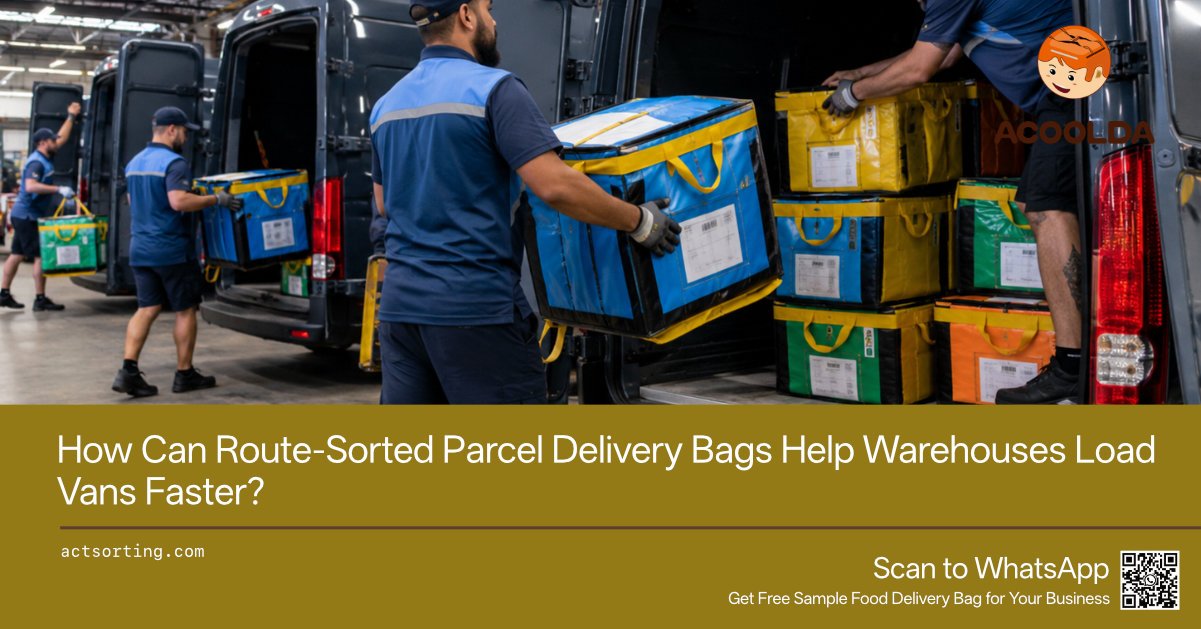
Color systems are equally practical. For example, a delivery center might use blue Parcel Sorting Sacks for morning routes, green Last-Mile Delivery Totes for returns, yellow Van Loading Totes for priority delivery, and red Courier Sorting Totes for exception handling. Even temporary workers can understand the visual logic quickly. This is especially useful during peak periods, when extra labor joins the operation and nobody has time for a poetic lecture on warehouse organization.
ACTSORTING supports both label holder customization and color customization. The size, position, material, and stitching of transparent pockets can be adjusted. Colors can be matched according to customer branding, route systems, warehouse zones, or service types. Logo printing can also be added to help delivery teams maintain a professional look across vans, hubs, and customer-facing operations.
These details sound small, but they create real value. Faster identification reduces wrong sorting. Better color recognition reduces training pressure. Visible route labels help drivers load correctly. When thousands of parcels move through the same space every day, small visual improvements can save a surprising amount of time.
4. How Can Last-Mile Delivery Totes Improve Driver Readiness?
Driver readiness is not only about whether the driver arrives on time. It is about whether the parcels are already organized in a way that allows the driver to start the route without rebuilding the loading plan.
A poorly packed van creates stress from the first stop. The driver opens the door and sees a pile of mixed parcels, bags without labels, or totes that do not match the route order. Then every delivery becomes a small search mission. It may only cost seconds at each stop, but after dozens or hundreds of stops, that delay becomes a real operating cost.
Last-Mile Delivery Totes help by creating smaller, manageable groups of parcels. Instead of loading everything loosely, warehouses can prepare route-based totes that correspond to neighborhoods, apartment blocks, business areas, delivery time windows, or stop sequences. The driver can then work through the van more logically, using each tote as a ready-made delivery unit.
ACTSORTING manufactures Last-Mile Delivery Totes with lightweight but durable woven structures, reinforced seams, optional closure systems, transparent label pockets, and custom handle positions. The tote can be designed to fit delivery vans, warehouse shelves, staging racks, or driver workflows. Some customers request taller bags for bulky parcels. Others prefer wide, low-profile bags that fit better under van shelving. This is where customization stops being decoration and starts becoming operational engineering, which is a fancy way of saying the bag finally does what workers actually need.
For Amazon DSP contractors, courier fleets, postal delivery teams, and e-commerce distribution centers, better driver readiness means fewer loading corrections, less route confusion, and faster departure from the warehouse. It also improves the driver experience. Nobody enjoys starting a route by digging through a messy van before the first delivery has even happened.
5. Why Are Parcel Sorting Sacks Useful in High-Volume Staging Areas?
Staging areas are the pressure points of parcel logistics. This is where sorted goods wait before they are loaded into vehicles. When staging is organized, the operation feels smooth. When staging is chaotic, the loading bay becomes a crowded mess of carts, bags, parcels, scanners, and workers trying very hard not to lose patience.
Parcel Sorting Sacks help create order in this space. They allow workers to group parcels into visible, movable units instead of leaving loose packages spread across floors or carts. This improves route preparation and makes the loading area easier to manage during dispatch waves.
High-volume e-commerce warehouses benefit especially from this structure. During busy periods, staging lanes may handle thousands of parcels within a short window. If each route or zone has clearly labeled Parcel Sorting Sacks, workers can move packages more confidently and reduce the chance of mixing parcels between different vans.
ACTSORTING designs Parcel Sorting Sacks for repeated use in this kind of environment. Heavy-duty woven fabric helps resist abrasion from concrete floors. Reinforced bottoms and corners protect the areas most likely to suffer damage. Strong webbing handles make it easier to drag or lift loaded sacks. Foldable construction allows empty sacks to be stored efficiently after the dispatch wave is complete.
Customers can also customize sack size according to route volume. Smaller Courier Sorting Totes may work better for dense urban delivery routes with compact parcels, while larger Parcel Delivery Bags may be preferred for suburban or mixed-volume routes. For warehouses dealing with oversized packages, ACTSORTING can adjust dimensions, material weight, and reinforcement design to support heavier use.
A staging area does not need more clutter. It needs better tools. Parcel Sorting Sacks give teams a simple way to turn fast-moving chaos into visible order.
6. What Makes Courier Sorting Totes Easier for Workers to Handle?
A logistics product can look strong in photos and still be annoying to use. That is the tragedy of many warehouse supplies. Someone designs them for a catalog, not for the person dragging them across a floor at 6:45 a.m.
Courier Sorting Totes need to be durable, but they also need to be easy to handle. If a bag is too heavy when empty, workers will avoid it. If handles are placed badly, lifting becomes awkward. If the opening is too narrow, loading becomes slower. If the bag collapses too much while being filled, workers waste time holding it open. These small irritations repeat hundreds of times a day.
ACTSORTING builds Courier Sorting Totes with practical handling in mind. Handle placement can be customized for lifting, dragging, side carrying, or van loading. Webbing strength can be adjusted according to expected load weight. Openings can be designed wider for faster parcel insertion. Closure systems can be selected based on whether workers need speed, security, or both.
The material structure also matters. A good Parcel Delivery Bag should be light enough for frequent handling but strong enough to survive commercial use. ACTSORTING uses woven materials that provide good tear resistance without making the bag unnecessarily bulky. Reinforced stress points help prevent early handle failure, while foldable bodies make the totes easier to store and move when empty.
For parcel delivery companies and large e-commerce warehouses, worker-friendly design directly affects productivity. When employees can load, drag, identify, fold, and stack bags more easily, the whole process becomes faster. This is not a glamorous improvement. Nobody is going to make a movie about proper handle placement. But in a warehouse, it matters every single shift.
7. How Do Van Loading Totes Improve Vehicle Space and Route Order?
A delivery van is not just a vehicle. During a route, it becomes a moving warehouse. Every shelf, floor space, and side compartment matters. If the layout is poor, the driver spends the day fighting the van instead of delivering parcels.
Van Loading Totes help organize vehicle space by grouping parcels into planned units before loading begins. Instead of loose packages sliding around, each tote can represent a route section, delivery zone, building cluster, or time window. This helps drivers move through the route in a more predictable order.
ACTSORTING can customize Van Loading Totes according to van dimensions, shelf height, route size, and parcel mix. Some customers want rectangular bags that fit neatly along van aisles. Others prefer taller bags for bulkier packages. Some require reinforced bottoms because the totes are dragged in and out repeatedly. Others need printed numbers or colored panels so drivers can locate each tote quickly during the route.
The practical result is better use of space. When Van Loading Totes fit the vehicle properly, loading becomes cleaner and faster. Drivers can place early-route bags near the door and later-route bags deeper inside the van. Return parcels can be separated from outgoing deliveries. Exception parcels can be grouped clearly. This reduces confusion and helps the van remain organized throughout the day.
A strong Parcel Delivery Bag also protects the operation from daily rough handling. Vans are not gentle places. Bags are pushed, stacked, pulled, and sometimes squeezed into awkward spaces because route volume does not politely ask for permission. ACTSORTING uses reinforced woven materials and durable stitching to help the tote keep performing under these conditions.
Better van organization does not solve every last-mile problem. Traffic still exists, sadly. But it does remove one avoidable source of delay: the driver not knowing where the next parcel is.
8. Why Does OEM & ODM Customization Matter for Delivery Networks?
Standard bags can work for standard problems. But large delivery networks rarely have standard problems.
A courier company operating in city centers may need compact Courier Sorting Totes for apartment routes. A warehouse serving suburban areas may need larger Parcel Delivery Bags for mixed package sizes. An Amazon DSP station may require color-coded Last-Mile Delivery Totes with route cards and reinforced drag zones. A cross-border logistics center may need Parcel Sorting Sacks with multilingual labels and heavy-duty closures.
This is why OEM & ODM customization matters. It allows the bag to be designed around the actual operation.
ACTSORTING supports custom material selection, including PP woven fabric, laminated woven fabric, polyester blends, coated fabrics, and reinforced abrasion-resistant options. Customers can adjust dimensions, colors, logo printing, transparent label pocket size, closure style, handle position, webbing layout, bottom reinforcement, internal dividers, folding structure, packaging method, and shipping carton requirements.
For ODM projects, customers may come with a workflow challenge rather than a finished design. ACTSORTING can help turn that need into a practical product sample. For example, if a customer says its drivers lose time identifying route bags inside vans, the solution may involve larger label windows, color zones, printed numbers, and specific bag dimensions that match van shelves. If the problem is floor abrasion, the solution may involve stronger bottom material and reinforced corners.
This type of customization is possible because ACTSORTING controls production inside its own factory. With more than 400 workers and a 12,000+ square meter production area, the company can handle sample development, material testing, bulk sewing, printing, inspection, and packing within a stable production system.
Customization is not about making a bag look special. It is about making logistics less annoying, less wasteful, and less expensive.
9. What Should Procurement Teams Check Before Choosing a Supplier?
Choosing a Parcel Delivery Bag supplier should not begin and end with price. Price matters, obviously. Nobody is buying bags with fairy dust. But if the cheapest supplier delivers unstable quality, weak stitching, delayed production, and inconsistent materials, the final cost becomes much higher than the quotation suggested.
Procurement teams should first check whether the supplier understands logistics use cases. A general bag factory may know how to sew fabric, but that does not mean it understands parcel sorting, staging lanes, van loading, route identification, drag resistance, or high-frequency warehouse handling. This difference becomes obvious when buyers ask technical questions about reinforcement, handle strength, label holder placement, or foldable structure.
Factory capacity is another serious factor. Delivery networks often need recurring supply, seasonal stock preparation, and fast repeat orders. ACTSORTING’s manufacturing base covers more than 12,000 square meters and is operated by over 400 experienced employees, allowing the company to support bulk orders and long-term procurement programs.
Certifications also matter for global buyers. ACTSORTING holds BSCI and ISO9001 certification, supporting responsible production management and consistent quality control. Each order can be managed through material inspection, production monitoring, stitching checks, printing review, final inspection, and packaging verification.
Customization capability should also be reviewed carefully. Some suppliers say they support customization but only mean logo printing. ACTSORTING offers deeper OEM & ODM options across fabric, size, color, closure, label pocket, strap layout, reinforcement, and packaging. For serious logistics operations, that difference is not small. It determines whether the final product actually supports the workflow.
A good supplier should not just ask, “How many pieces do you need?” It should also ask, “How will your workers use these bags every day?”
That second question is where better products begin.
10. How Can ACTSORTING Support Your Next Bulk Order?
ACTSORTING is built for companies that need durable, customized logistics bags at scale. Since 2013, the company has focused on Parcel Delivery Bags, Last-Mile Delivery Totes, Parcel Sorting Sacks, Courier Sorting Totes, Van Loading Totes, and DSP Delivery Supplies for commercial delivery and warehouse operations.
From its 12,000+ square meter factory in Yangchun, Guangdong, ACTSORTING supports customers across Europe and North America with a full manufacturing process covering design support, sampling, material selection, cutting, sewing, printing, inspection, packing, and export coordination. With over 400 workers and production systems supported by BSCI and ISO9001 certification, the factory is prepared for both customized projects and recurring large-volume orders.
Customers can request custom bag dimensions for van layouts, warehouse shelves, staging lanes, or route systems. Fabric materials can be selected according to durability needs, including tear resistance, abrasion resistance, flexibility, and weight control. Colors can be customized for branding or warehouse classification. Logos, route markings, warning labels, and identification graphics can be printed according to project requirements.
Transparent label holders can be added for route cards, barcode sheets, delivery zones, or driver assignment tags. Closure methods can include hook-and-loop, zipper, open-top, flap cover, strap closure, or special customer-developed structures. Handle positions and webbing strength can be adjusted for lifting, dragging, side carrying, or van loading.
For parcel delivery companies, courier networks, e-commerce fulfillment centers, Amazon DSP contractors, warehouse operators, postal services, and large retail distribution hubs, ACTSORTING provides a practical route from product idea to bulk production.
If your current bags are slowing down sorting, wasting van space, creating route confusion, or failing too quickly under daily use, ACTSORTING can help develop a better Parcel Delivery Bag system for your operation. Contact the team with your drawings, target size, expected load, preferred material, logo design, order quantity, and usage scenario to receive a tailored manufacturing proposal.
FAQ
Q: Can ACTSORTING make Parcel Delivery Bags for specific van sizes?
A: Yes. ACTSORTING can customize Parcel Delivery Bags and Van Loading Totes according to vehicle dimensions, shelf height, aisle width, route capacity, and loading method. This helps customers improve vehicle space usage and keep parcels organized during delivery.
Q: What customization options are available for route sorting?
A: Customers can customize colors, transparent label holders, printed route numbers, barcode card pockets, logo printing, closure systems, handle positions, bag dimensions, and reinforcement areas. These options help warehouses sort parcels faster and reduce wrong-route loading.
Q: Are these bags suitable for Amazon DSP-style delivery operations?
A: Yes. ACTSORTING supplies Parcel Delivery Bags, Last-Mile Delivery Totes, Parcel Sorting Sacks, Courier Sorting Totes, Van Loading Totes, and DSP Delivery Supplies suitable for Amazon DSP-style operations, courier networks, and e-commerce delivery stations.
Q: Can ACTSORTING support large bulk orders?
A: Yes. ACTSORTING operates a 12,000+ square meter factory with over 400 workers and supports large-volume production for international customers. The company is experienced in recurring procurement programs, seasonal demand planning, and customized logistics bag projects.
Q: Why choose route-sorted Parcel Delivery Bags instead of generic transport bags?
A: Route-sorted Parcel Delivery Bags help workers group parcels clearly, reduce loading errors, improve driver readiness, keep vans organized, and support faster last-mile delivery. Generic bags may carry parcels, but they rarely improve the workflow.