

Table of Contents
- Outbound Work Breaks When Sort, Transfer, and Trailer Loading Are Treated as Separate Jobs
- After the Shipping Label: Destination Sort at the Outbound Face
- Logistics Sorting Bags as the Hold for a Destination or Departure Group
- Moving Filled Groups from the Sort Face to the Assigned Dock Door
- Loading the Trailer: Carton Walls, Bag Groups, Cages, and Palletized Units
- Kept Destination Groups at the Next Site, and the Sorting That May Still Follow
- Marks and Door Codes That Keep Destination Groups Identifiable at the Dock
- Empty Return After the Outbound Wave: Folded Bags, Racks, and Parked Travel Units
- Where Sorting Bags Belong in Outbound Work, and Where They Do Not
- What Buyers Should Send for an Outbound Sort and Trailer-Loading Equipment Setup
Outbound Work Breaks When Sort, Transfer, and Trailer Loading Are Treated as Separate Jobs
A parcel that has already been packed and labeled is still not on the right vehicle. In a logistics park, the remaining work is destination sort, movement to the correct dock door, and loading. Those three steps form one outbound path when they are planned together. They become three bottlenecks when they are not. A correct sort left as a loose pile on the floor cannot reach a departing door in time. A group that arrives at the dock without a readable destination is loaded onto the wrong vehicle. A vehicle packed as an unidentified mix arrives at the next site as a heap that has to be opened and sorted again.
That work takes place in more than one geography, and the two should not be treated as the same flow. In a park that consolidates or exports parcels destined for the United States, the job at that origin is to sort, stage, and load the vehicle or container that leaves that site. The later path those parcels may take inside the United States is a different stage, at a different location, and should not be copied onto the origin dock. In a park or fulfillment site inside the United States, the job is domestic outbound: parcels already in that country are sorted to a departure and loaded for a domestic trailer or truck. Equipment should be specified from the actual shipping location and the stage being loaded, not from a single national template.
Amazon fulfillment centers in the United States publish one documented version of domestic outbound work. In a photo tour of an Amazon fulfillment center, packed parcels move to a shipping sorter that assigns each package to a chute by destination; the chute leads toward a shipping trailer, and associates often pack the trailer from the floor toward the ceiling. A related warehouse tour published by Amazon describes the shipping sorter as the step that reads the label and sends packages down slides into the trailer that matches shipping method, speed, and location. That account is a useful industry reference for shipping sorters, chutes, and floor-to-ceiling carton loading. It is not a standard process for every logistics center in the United States, and it is not a description of cross-border export from a park outside the country.
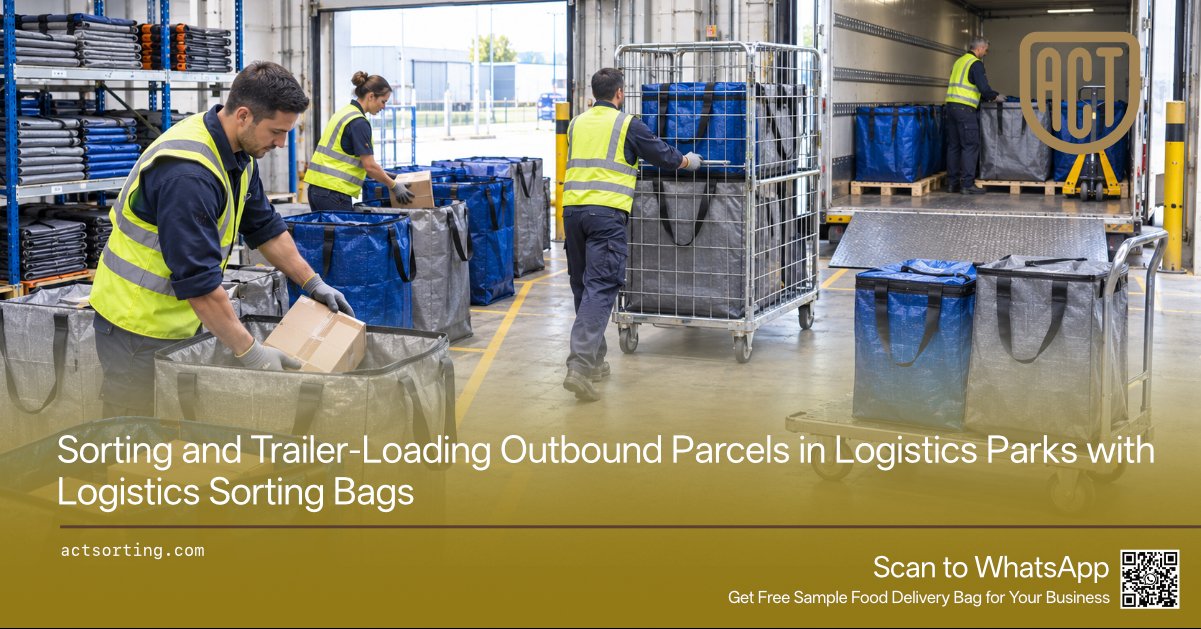
The work this article follows begins after a group has been sorted. The group is staged, it leaves the sort line for the loading door, the departure door may change before the vehicle leaves, the group may travel in a bag, a cage, a trolley, or on a pallet, and empty units have to come back. Logistics sorting bags, roll cages, warehouse trolleys, rolling logistics bags, and bag storage racks are specified for that stretch. They hold a destination, route, or departure-batch group and move it to the door. They do not replace the labeling step or the sorter, and they do not stand in for a later site’s own sort.
After the Shipping Label: Destination Sort at the Outbound Face
Once a shipping label is on the parcel, the unit of work at the outbound face is the destination, route, or departure that belongs to that label. In the Amazon reference above, a shipping sorter and chute give that assignment a physical path into a trailer. Many logistics parks form the same kind of group without a sorter that ends inside the vehicle. Operators or a smaller divert system build lanes at a sort face, and each lane belongs to a door, a region, a wave, or a receiving site. The lane has to stay distinct from the one beside it. When two destinations share an unmarked table, the sort is only as good as the next person’s memory.
The decision that matters for equipment is what happens when the sort ends short of the vehicle. If a chute already delivers cartons into an open trailer, the door may be loaded as parcels arrive, and no intermediate hold is required for that door. If the lane ends on the floor, the group has to be staged in a bag or another unit, then moved off the sort line to the assigned door. The hold has to remain identifiable while it waits, and it has to be ready to move when the door is called or when the door assignment changes. A sort that is correct on a screen still fails if the physical group cannot leave the sort face in time.
Logistics Sorting Bags as the Hold for a Destination or Departure Group
A logistics sorting bag earns its place when a destination, route, or departure-batch group has to be staged after the sort, identified, and moved as a unit from the sort line to the loading door. A reusable logistics sorting bag is specified here because it can be opened for fill, closed for the transfer, and marked on a face the dock team can read, rather than leaving the group as a loose stack on the floor. The bag carries packed, labeled parcels. It is not an inbound inventory tote used to move merchandise before packing.
Opening form follows how the bag is filled and how soon it must travel. An open top is practical when parcels are being added continuously at a sort face and the bag will stay in the lane until the group is complete. A zipper or other wide closure is the better choice when the bag must stay shut while it is lifted onto a trolley, placed in a cage, or held at the dock after a door change. The opening should be wide enough for the parcel mix actually being sorted. Those are selection conditions to be checked against the sort face and the travel method, not a single default build.
The label window or card pocket belongs on a wall that remains visible after the bag is standing in a staging lane, sitting in a cage, riding on a trolley, or placed in a vehicle row. A window set only under a closure flap, or on a face that will turn against a cage wall, will be hidden when the loader needs it. Handle layout should match the lift that actually occurs: onto a trolley deck, through a cage gate, or onto a pallet. Handles that are easy to reach when the bag stands in a lane may be awkward once the bag is already inside a cage. That is a reason to look at handle height and side versus top grips on a sample, not a reason to assume one handle pattern fits every move.
Bag-body stability is the difference between a bag that can wait in a staging lane and a bag that slumps as soon as it is set down. A group that must stand after the sort, then sit in a cage or rest on a pallet, needs a body and base that stay upright in those positions. A bag that will only lie in a cage can be specified differently. Color and a large identification face tell the dock team which door the group is for. They are not a complete tracking system, and they do not replace the shipping label on each parcel.
Moving Filled Groups from the Sort Face to the Assigned Dock Door
The stretch from the sort line to the assigned dock door is where a staged group is often lost. A bag that can be filled correctly still has to leave the sort face, cross the park, and arrive before the vehicle is scheduled to leave. The travel unit should be chosen from the distance, the number of bags in the departure group, and the door the group must pass, not from a habit of using one catalog item for every move.
Logistics roll cages fit when several bags belong to the same door and should roll as one. The bag footprint, pack height, and handle positions have to pass through the gate and sit stably on the cage floor; the cage itself has to clear the aisle and the dock door. Whether the cage only travels to the vehicle threshold, or is loaded into the vehicle, is a measurement of cage size, vehicle opening, dock plate, and the site’s method. It is not a default for every cage.
Warehouse trolleys fit a shorter move or a smaller group: a few bags from a nearby sort lane to a door, or a shift along the dock when a cage would be too large for the aisle. Rolling logistics bags fit when a single group should roll on its own wheeled form. In each case, the bag still has to stand or sit stably on that unit, and the label window has to remain readable during the move. A strap, if used, belongs on an anchor the travel unit actually provides. Ordinary cage mesh is not a reliable concentrated anchor.
When the move is a pallet move, filled bags can stand on the site’s existing pallet and travel with the jack or forklift and the load-stabilization method already in use. Handle reach and base stability should be checked for a standing bag on a pallet, just as they are for a bag in a cage. That is a travel method, not a reason to introduce a pallet box for every outbound group. A pallet box or sleeve pack belongs only when the load needs a stable container boundary and sidewalls, which is a different decision from whether the dock is served by a pallet jack.
Loading the Trailer: Carton Walls, Bag Groups, Cages, and Palletized Units
Trailer loading is the last chance to keep the current group identifiable. In the Amazon fulfillment-center photo tour cited above, associates often pack cartons into the trailer from the floor toward the ceiling so the cargo fills the volume and is less free to shift. In industry language, that method is often called fluid loading: it fits a door that receives a continuous stream of cartons from a chute or slide, and it treats the trailer itself as the container. It is a documented method in that fulfillment setting, not a rule that every dock must load the same way.
A logistics park that has already grouped parcels in bags, cages, or palletized units is loading a different object. The loader is placing identifiable groups, not building a carton wall from loose parcels. The groups should enter the vehicle in an order the receiving site can use. A group that must come off first at the next split should not be buried at the nose of the trailer behind later doors. The mark on the bag or cage has to be readable from the dock without opening the group. A loader who has to unzip a bag to see the destination has already slowed the departure and risked a mix.
How the group sits in the vehicle follows the travel unit. Bags may be loaded as a row, stood on a pallet that is already in the trailer, or remain inside a roll cage if that cage has been checked for the opening and the site’s method. Palletized bag groups move with a jack or a forklift the way any palletized unit does, and they still need the wrap, straps, or other stabilization the site uses for pallet loads. In every case, the bag is a hold for the parcel group. It is not a cargo-restraint device. Load bars, straps, and locking methods that secure freight in the vehicle remain a separate requirement. A closed bag that slides as a loose pile against the door is a loading problem, not a sign that the bag should have been asked to restrain the load.
Some parcels should never enter the bag at this point. Oversize or irregular pieces that will not pass the bag opening, or that would distort the group so it cannot be lifted or rolled, stay as floor or pallet freight and are accounted for in the same door’s loading plan. Forcing them into a bag to keep the method uniform usually creates a group that cannot be moved safely or stacked stably in the vehicle.
Kept Destination Groups at the Next Site, and the Sorting That May Still Follow
A bag that arrives with its closure held and its mark still readable has done one job: it has kept the current destination, route, or departure-batch group together. The receiving team can unload that group as a unit—roll a cage to a sort face, lift bags to a lane, or stage a palletized group. That is the value of the hold.
It is not the same as avoiding a further sort. A downstream site often has a finer assignment than the origin group was built for. In the Amazon network described in the official photo tour, many trailers that leave a fulfillment center continue to a sortation center and then to a delivery station, and each of those sites still sorts to the next, narrower destination. A cross-border receiving site, a regional hub, or another door in the same park may likewise open a kept group and subdivide it by region, route, or departure. The bag can preserve the group it was given. It cannot promise that the next building will skip its own sort.
A trailer that was fluid-loaded with loose cartons arrives as a carton wall and is unloaded or inducted piece by piece. That method does not describe a bagged load, and a bag should not be asked to make a carton wall easier to unload. The opposite failure is also plain: if bags were loaded as an unidentified mix, or if several destinations were combined in one bag to fill leftover space, the second site has to open the bag just to recover the origin grouping. The hold has then failed at its own job. That failure is separate from the further sort that may still be required after a correctly kept group arrives.
Empty units that went forward with the vehicle have to come back, or the origin sort face will run out of holds. The return plan belongs in the same conversation as the outbound load.
Marks and Door Codes That Keep Destination Groups Identifiable at the Dock
A group that cannot be identified from the dock aisle will be treated as mixed freight, even if every parcel inside it is labeled correctly. The shipping label on the parcel tells the next automated sorter, and the later delivery network, where that one piece should go. The mark on the bag or cage tells the people at the door which departure the group belongs to. Those are different faces for different readers.
The group mark is usually a destination region, a sort code, a door number, or a departure wave, not a street address. A large color field that corresponds to a lane or a door can be read at a distance. A card or a printed code belongs on a wall that still faces the aisle or the dock after the bag is placed in a cage, on a trolley, or in a vehicle row. A small label on a face that turns against a cage wall, or a card tucked only under a closure flap, disappears at the moment the loader needs it. The label window discussed earlier is the structural place for that mark; the dock needs to be able to read it without opening the bag.
The same rule applies when several bags share one cage or one pallet. Each bag still needs its own readable face if the bags may be split at the door or at the next site. A single card on the cage frame is enough only when the entire cage is one destination and will not be broken down before that destination is reached. If the cage is only a travel unit that will be emptied at the vehicle, the bags—not only the cage—must carry the door or sort code. Marks are identification. They are not a warehouse management system, and they do not replace a scan of the parcel label when the next sorter or the next site requires it.
When a door assignment changes mid-wave—a trailer is swapped, a departure is held, or a region is split across two doors—the mark on the bag has to follow the new departure, not a floor color that no longer matches the door. A lane painted once at the start of the shift is not enough if bags will wait and the door plan will change. The dock team should be able to read the current departure on the bag itself.
Empty Return After the Outbound Wave: Folded Bags, Racks, and Parked Travel Units
When the wave leaves, the sort face needs empty holds back before the next group starts to form. Filled bags that have gone to the vehicle, and empty bags left standing in the aisle, both remove capacity from the sort. The empty path is therefore part of outbound work, not a housekeeping task that can wait until the dock is quiet.
A logistics sorting bag that folds flat can be stacked or placed on a bag storage rack off the dock and returned to the sort face in a compact count. The useful checks are practical: whether the empty fold is stable enough to stack or rack the way the site actually stores empties, whether the rack sits where a trolley or a walking operator can reach it without blocking a door, and whether the number of bags in circulation covers the wave plus the bags that are still on a vehicle or at the next site. Those quantities come from the buyer’s own wave and return cycle. They are not a catalog ratio. A return cycle that stays inside the same park is usually shorter than one in which empties have left on a longer domestic or cross-border vehicle; the origin face still needs a working buffer for the waves that leave before that return arrives.
Roll cages and trolleys have their own empty behavior. Cages that nest or fold can be parked in a smaller footprint; trolleys need a defined park so they do not collect at the dock and starve the sort face. If empties travel back on the same vehicle, they should be staged as a known empty return, not mixed with filled groups in a way that makes either set hard to recognize. A rack that sits a long walk from the sort face will not be used during a short wave; empties will be dropped in the aisle instead. The rack or empty stack belongs where the next fill will actually start. The aim is simple: the next outbound wave should start with bags, cages, and trolleys already at the sort face, not with a search down the dock.
Where Sorting Bags Belong in Outbound Work, and Where They Do Not
Logistics sorting bags are a hold for a destination, route, or departure-batch group. They are not a shipping sorter, and they are not a substitute for the scan, label, and manifest step that puts a valid shipping label on the parcel. A park that has not yet decided how parcels are assigned to a door will not fix that assignment by buying bags. The bag only keeps together a group the sort has already defined, and a later site may still subdivide that group.
Bags are also the wrong default for every outbound door. When a chute already delivers a continuous stream of cartons into a trailer, and the receiving site is set up to unload or induct loose cartons, fluid loading the carton wall is often the direct method. Introducing bags at the chute end would add a fill-and-empty step that door does not need. Bags become useful when the sort ends short of the vehicle, when a group must be staged for a later departure, when the group must leave the sort line as a unit, or when the dock must be able to redirect a marked group after a door change. Those conditions can exist in the same park on different doors. One door may fluid-load; another may stage bagged regional or departure-batch groups. The equipment mix should follow that difference.
Inbound work is a separate container problem. Inventory totes, storage cages, and sleeve packs used to hold merchandise before it is packed should not be asked to double as outbound parcel holds unless the site has actually designed that reuse and checked the opening, cleanliness, and identification for both jobs.
A bag does not secure a vehicle load, does not prove a destination by itself, and does not change the departure time. Its limits are the opening, the closure, the label-window position, the handle layout, the way the body sits on a trolley, in a cage, or on a pallet, and the face that carries the mark. Within those limits it can carry a kept group from the sort face to the vehicle. Outside those limits, the park needs a different method for that door, not a heavier bag.
What Buyers Should Send for an Outbound Sort and Trailer-Loading Equipment Setup
A useful inquiry for this kind of outbound setup starts from the path the group will actually travel, not from a request for a generic warehouse bag. The first facts to state are the shipping location and the transport stage: whether the park is exporting parcels destined for the United States, or running domestic outbound inside the United States, and what vehicle or container is being loaded at that dock. Photographs of the sort face or chute end, the aisle to the dock, the door opening, and the vehicle being loaded tell a manufacturer how the bag will be filled, staged, moved, and placed. Approximate dimensions—bag footprint and height against cage interiors, trolley decks, pallet size, and door opening—matter more than a name for the bag style. If bags will ride in roll cages or on warehouse trolleys, those units should be measured or photographed with the same inquiry.
The same materials should support a discussion of opening form, label-window position, handle layout, and bag-body stability, checked against the lift and the travel unit rather than assumed from a catalog page. Operational figures the buyer already has help size the mix and the empty return: daily or wave parcel volume, the number of destination or departure groups, how long a filled group waits before the door is called, how often bags, cages, and trolleys turn, and how empties come back from the vehicle or the next site. Those figures belong in the inquiry when they exist. They should not be guessed by the manufacturer, and they do not have to be complete before a first sample conversation.
ACTSORTING supplies logistics sorting bags, roll cages, warehouse trolleys, rolling logistics bags, and bag storage racks for this kind of outbound work in logistics parks and fulfillment operations. A first message can include the shipping location and stage, the photos, the approximate dimensions, the travel method between sort face and door, and the return cycle for empties. From those conditions, the bag opening, closure, identification face, handles, and the matching travel and storage units can be discussed as one setup rather than as unrelated catalog items.
FAQ
1. Do Amazon fulfillment centers load outbound parcels in logistics sorting bags?
Amazon’s official fulfillment-center photo tour and warehouse tour describe packed, labeled parcels moving through a shipping sorter and down chutes or slides into shipping trailers, and they describe associates packing those trailers from the floor toward the ceiling. Those published accounts verify that the facilities in the tours use a shipping sorter, chutes or slides, and floor-to-ceiling carton packing. They do not show or state that outbound parcels are held or loaded in logistics sorting bags. From these official public sources, it cannot be confirmed that Amazon fulfillment centers use logistics sorting bags as an outbound hold, and it also cannot be treated as a complete inventory of every container used at every Amazon site. The question is therefore unanswered by the public record cited here, not answered by describing how other logistics parks specify bags.
2. When should a logistics park fluid-load cartons instead of filling sorting bags?
When a chute or a continuous stream already delivers cartons to an open trailer, and the receiving site is set up to unload or induct loose cartons, fluid loading is the direct method. Bags are the better hold when the sort ends short of the vehicle, the group must be staged or moved as a unit, or the dock must keep a marked group together through a door change.
3. Can a logistics sorting bag replace a shipping sorter or the labeling step?
No. The bag holds a group after the parcel already has a shipping label and after the operation has assigned that parcel to a destination, route, or door. Without that assignment, the bag is only a bulk container. A kept group may still be subdivided at the next site.
4. How should roll cages and warehouse trolleys be chosen for the move from the sort lane to the dock door?
From the distance, the number of bags in a departure group, and the clearances of the aisle and the door. A cage is for a larger group that should roll as one, and only goes into the vehicle if size, opening, and method have been checked. A trolley is for a shorter move or a smaller group. The bag still has to sit stably on the unit that is chosen, with handles and a label window that still work in that position.
5. What should a buyer send when specifying equipment for outbound sort and trailer loading?
The shipping location and transport stage; photos of the sort face, the path to the dock, the door, and the vehicle; approximate dimensions against cages, trolleys, or pallets; the travel method; and, when already known, wave volume, number of destination groups, dwell time, turnover, and the empty-return cycle. ACTSORTING can discuss the bag—including opening form, label-window position, and handles—and the matching travel and storage units from those conditions.